
Community is the growth engine most solo entrepreneurs overlook until they’re exhausted from chasing cold leads. The role of community in business growth is straightforward: it turns your customers and peers into active advocates who bring in new clients, reduce your acquisition costs, and keep existing clients coming back. For a one-person business, that compounding effect is the difference between spinning your wheels and building something that grows while you sleep.
Here’s what community-driven growth actually does for you:
- Drives acquisition through peer recommendations that carry up to 10x the influence of paid ads
- Deepens retention by creating a sense of belonging that keeps clients engaged long after the first purchase
- Reduces costs by generating earned distribution you never paid for
- Feeds your product development with real feedback from people who care about your work
- Builds resilience through authentic relationships that outlast any single campaign
Trust and active participation are the two non-negotiables. A passive following is not a community. The moment members start talking to each other, not just to you, growth accelerates.
What are the real benefits of building a community as a solo founder?
The community impact on business goes well beyond warm feelings. Harvard Business Review advises prioritizing depth of member connection over community size for revenue and engagement. A tight group of highly engaged community members generates more revenue than a much larger passive following.
- Peer advocacy outperforms ads. People trust other people, not brands. Word-of-mouth recommendations carry far more weight than any sponsored post.
- Customer lifetime value rises. When someone feels like they belong to something, they churn less, buy more, and refer others actively.
- Acquisition costs drop over time. Every referral, shared post, or forum mention is earned distribution you didn’t pay for.
- Feedback loops sharpen your offers. Community conversations are the best market research you’ll ever do. Questions and complaints tell you exactly what to build next.
- Investor and partner appeal grows. Forbes identifies embedding in community as a competitive advantage that increases loyalty and investor appeal for small and medium businesses.
The compounding math is real. Community marketing reduces acquisition cost over time and creates a self-sustaining growth engine through earned distribution. The longer you build, the cheaper and faster growth becomes.
What risks come with community-driven growth, and how do you manage them?
Community-based growth has a fragility most guides skip over. 2024 INSEAD research warns that business models relying on strong social ties are vulnerable to sudden downturns when collective trust breaks. A scandal, a misstep, or even a macroeconomic shock can trigger collective disengagement across an entire customer base at once.
- Collective disengagement is the biggest risk. When one member has a bad experience and shares it publicly, social influence can cascade quickly through the group.
- Engagement fatigue is real. Constant asks, promotions, or low-value content will drain your community faster than silence.
- Balancing value and business needs takes discipline. Push too hard on sales and members leave. Go too quiet on your offers and you leave money on the table.
- Transparency is not optional. Members who sense a hidden agenda disengage. Being upfront about how your business works builds more trust than any polished pitch.
Pro Tip: Maintain a high ratio of delivered value to sales requests to build trust and prevent community fatigue. This single discipline, highlighted by Forbes on community building, is what separates thriving communities from pitch factories.
How do you build and nurture a community that actually fuels growth?
Quality beats quantity every time. Harvard Business Review’s guidance on small, engaged communities holds especially true for solo founders who can’t afford to manage a sprawling, low-signal group.

MIT Sloan senior lecturer Kate Isaacs puts it plainly: “Engagement is a conversation between you and the world. When you really listen to what people want and need, that sparks your own creativity, and the solution is better in the end.” That curiosity-first mindset is what separates communities that compound from ones that stall.
Implementation checklist for sustainable community building:
- Invite your highest-value, most engaged clients as founding members first. Give them a title and a role before you open the doors publicly.
- Set a weekly rhythm: a discussion prompt, a wins thread, or a short live session. Consistency matters more than format.
- Aim for a balance where the majority of content is member-generated, supported by facilitated discussions and original content.
- Recognize your most active members publicly. Feature their wins, make introductions, give them visible roles.
- Apply the 10:1 value-to-sales ratio religiously. Forbes highlights the importance of maintaining a 10:1 ratio of delivered value to sales requests, emphasizing that this practice builds trust and prevents community fatigue.
- Collect feedback quarterly and visibly act on it. When members see their input shape your offers, they recruit.
| Practice | Why it works |
|---|---|
| Seed with high-LTV founding members | Sets culture and ownership from day one |
| Weekly engagement prompts | Creates a recurring reason to show up |
| 10:1 value-to-sales ratio | Prevents community from feeling like a sales funnel |
| Public member recognition | Rewards the behavior you want more of |
| Feedback-to-product loop | Turns members into invested co-creators |
How can AI tools help you scale community-driven growth without burning out?
This is where solo founders get a real edge. AI tools can automate community management tasks, analyze engagement data, and personalize outreach, letting you maintain consistent presence without hiring a team.
- Automate routine engagement. Use AI assistants to draft weekly prompts, respond to common questions, and schedule content across platforms.
- Analyze community health. AI-powered analytics tools can flag drops in engagement, surface trending topics, and identify your most active members before you lose them.
- Personalize outreach at scale. AI writing tools help you send personalized welcome messages, follow-ups, and check-ins that feel human without eating your whole morning.
- Summarize feedback loops. Feed community discussions into an AI summarizer to extract product insights, common pain points, and feature requests in minutes.
| AI task | Tool type | Time saved |
|---|---|---|
| Weekly prompt drafting | AI writing assistant | 30 min/week |
| Engagement analytics | AI analytics platform | 2–3 hrs/week |
| Personalized member outreach | AI email assistant | 1–2 hrs/week |
| Feedback summarization | AI summarizer | 1 hr/session |
The Yoursolobusiness AI toolkit covers the specific workflows solo founders use to handle community management without adding headcount. If you want to see how to wire these tools together, the AI workflow automation guide walks through the full setup.
Real-world examples of community-driven business growth
The pattern shows up across industries. Atlassian built a massive software business without a large sales team by cultivating a self-sustaining community of users, partners, and developers who became the brand’s most powerful advocates. HubSpot turned its annual INBOUND event into a community institution that now drives pipeline independent of any ad spend.
For solo operators, the mechanics are the same at a smaller scale. One community builder documented that his paid community generates roughly 8x more revenue per member than his email list and 25x more than his LinkedIn following. The structural reason is simple: trust compounds inside a community in a way that broadcast channels can’t replicate. By the time a member is ready to buy, the trust barrier is already gone.
The business growth through community flywheel works because members sell for you. When a new person asks “Has anyone worked with this person?” and three members share positive experiences, that peer validation outperforms any testimonial you could write yourself.
How do you measure the impact of community on your business?
Retention is the leading indicator. Advocacy is the lagging one. If members keep showing up and engaging month after month, advocacy and pipeline influence will follow.
Track these four metrics consistently:
- Monthly Active Members (MAM): What percentage of members posted, commented, or reacted in the past 30 days? Healthy communities sit at 30–50% MAM.
- Member-generated content ratio: If you’re producing more than 40% of the content yourself, the community is too dependent on you.
- Net Promoter Score: Survey members quarterly. Scores above 50 indicate a healthy community.
- Revenue attribution: Ask every new client where they heard about you. Track how many sales conversations mention the community as a touchpoint.
These numbers tell you whether your community is a growth engine or a cost center. If MAM is below 20%, something needs to change before you invest more time.
Which types of communities work best for different solo business models?
The right community structure depends on what you sell and who you serve.
Practice-based communities work well for consultants and coaches. Members gather around a shared skill or challenge, and your expertise naturally positions you as the trusted guide. Customer communities suit product-based solopreneurs: members help each other get more value from what they bought, reducing churn and generating referrals. Niche interest communities fit content creators and educators who want to own the conversation in a specific topic area. Local business communities give service providers a geographic anchor, building loyalty and word-of-mouth in a defined area.
The key rule across all models: build the community around the problem your clients have, not around your product. If you sell copywriting services, build a community for founders who want to improve their messaging. Be the host, not the vendor.
Online vs. offline communities: which one grows your business faster?
Online communities scale faster and cost less to run, which makes them the default choice for solo founders. Platforms like Circle, Slack, and Discord let you host conversations, share resources, and run events without a physical space. The trade-off is that online communities require more deliberate structure to build depth, since members can disappear with a single click.
Offline communities, whether local meetups, mastermind groups, or in-person events, build trust faster because face-to-face interaction creates stronger emotional bonds. The importance of community support is amplified in person: a single well-run local event can generate more referrals than months of online posting.
The practical answer for most solopreneurs is a hybrid approach. Start online for reach and consistency, then layer in occasional in-person touchpoints for the members who matter most.
How do you build trust and loyalty inside your community?
Trust is built through consistency, not intensity. Showing up every week with something useful does more than a single impressive launch event.
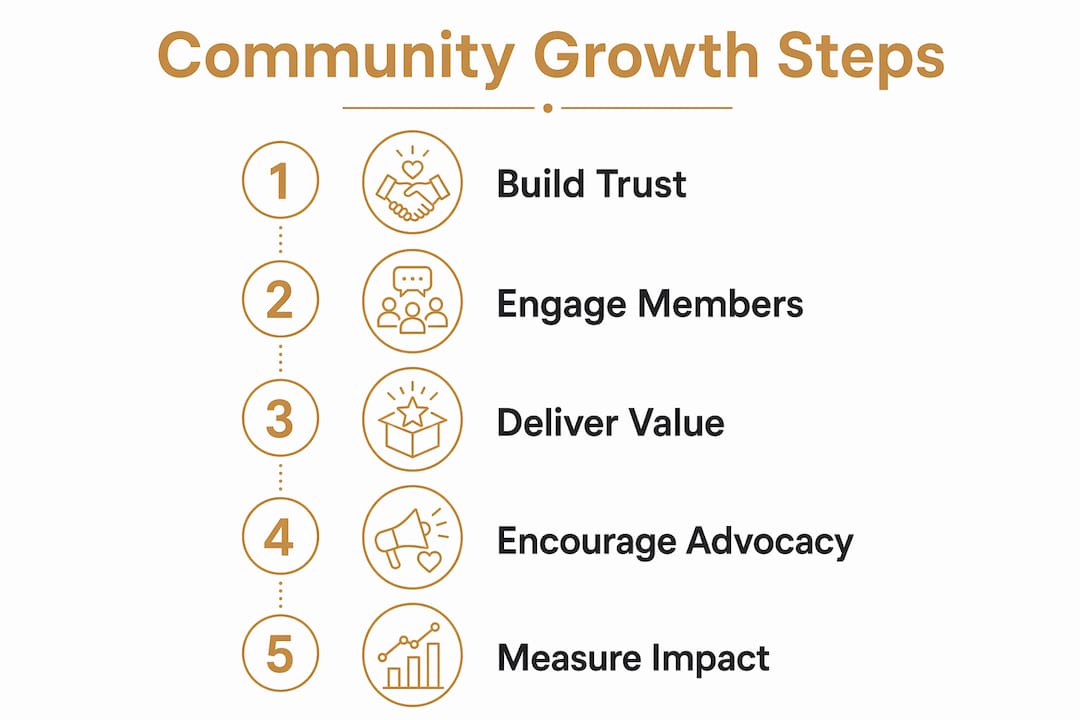
Five steps that actually work:
- Listen before you lead. As MIT Sloan’s Kate Isaacs notes, approaching your community with curiosity and a willingness to hear grievances is how you lay the foundation for real dialogue. If people are willing to talk, even if they’re venting, that’s a good sign.
- Be transparent about your business model. Members respect honesty. Tell them how the community connects to your revenue. Hidden agendas kill trust faster than anything else.
- Celebrate member wins publicly. Recognition creates emotional investment. Members who feel seen stay and recruit.
- Act on feedback visibly. When you change an offer or create something new based on community input, say so. That closes the loop and deepens loyalty.
- Introduce members to each other. Direct introductions between members who share challenges are one of the highest-value things you can do. It shifts the community from a hub-and-spoke model to a web of connections that doesn’t depend entirely on you.
Loyalty follows trust, and trust follows consistent, genuine investment in your members’ success.
Key Takeaways
Community-driven growth compounds over time because peer trust and advocacy are assets that paid advertising can never replicate.
| Point | Details |
|---|---|
| Peer advocacy outperforms ads | Word-of-mouth recommendations carry up to 10x the influence of paid advertising, as noted by MarketingProfs. |
| Depth beats size | A small, engaged community generates more revenue and referrals than a large passive following. |
| 10:1 value-to-sales ratio | Maintain a 10:1 ratio of delivered value to sales requests, as recommended by Forbes, to build trust and prevent community fatigue. |
| Retention leads, advocacy follows | Track monthly active members first; advocacy and pipeline impact compound from there. |
| AI scales your presence | AI tools handle routine engagement, analytics, and outreach so you maintain consistency without burnout. |
Ready to put AI to work for your community growth? The Yoursolobusiness AI toolkit gives you the exact workflows solo founders use to automate engagement, analyze member activity, and personalize outreach at scale. No team required.






[…] The Role of Community in Business Growth for Solopreneurs […]