
Self-management is the single most reliable predictor of consistent professional output. It converts good intentions into finished work by regulating your attention, energy, and behavior without waiting for someone else to hold you accountable. Research on structured self-management interventions confirms that shifting from reactive to proactive behavior produces measurable improvements in both work quality and personal well-being.
Here’s what strong self-management actually delivers:
- Fewer missed deadlines because you build systems instead of relying on memory
- Lower stress levels through proactive planning rather than last-minute scrambling
- Faster progress toward goals by keeping daily actions aligned with longer-term priorities
- Reduced need for external oversight, which matters enormously for remote workers and solopreneurs
- More consistent output, even on low-motivation days, because habits carry the load when willpower doesn’t
What is self-management, and how does it differ from related concepts?
Self-management is the set of practices and systems a person uses to regulate their attention, energy, behaviors, and follow-through without external oversight. It’s broader than time management, which is just one component, and it’s different from self-awareness, which is about knowing yourself rather than acting on that knowledge.
Think of it this way: self-awareness tells you that you procrastinate on difficult tasks in the afternoon. Self-management is the system you build to schedule those tasks for 9 AM instead.
The core components break down like this:
- Attention control: Choosing where your focus goes and protecting it from interruptions
- Energy regulation: Matching task difficulty to your natural energy peaks and valleys
- Habit systems: Automating recurring behaviors so they don’t drain decision-making capacity
- Accountability: Tracking commitments and following through without needing a manager to check in
- Goal alignment: Keeping daily actions connected to what actually matters long-term
Time management sits inside this framework as a scheduling tool. Self-awareness feeds it with data. But self-management is the operating system that runs everything.
Why does self-management matter for work performance and goals?
Self-management converts intention into predictable results that teams and managers can rely on. That’s the core value proposition, and it shows up in every professional context.
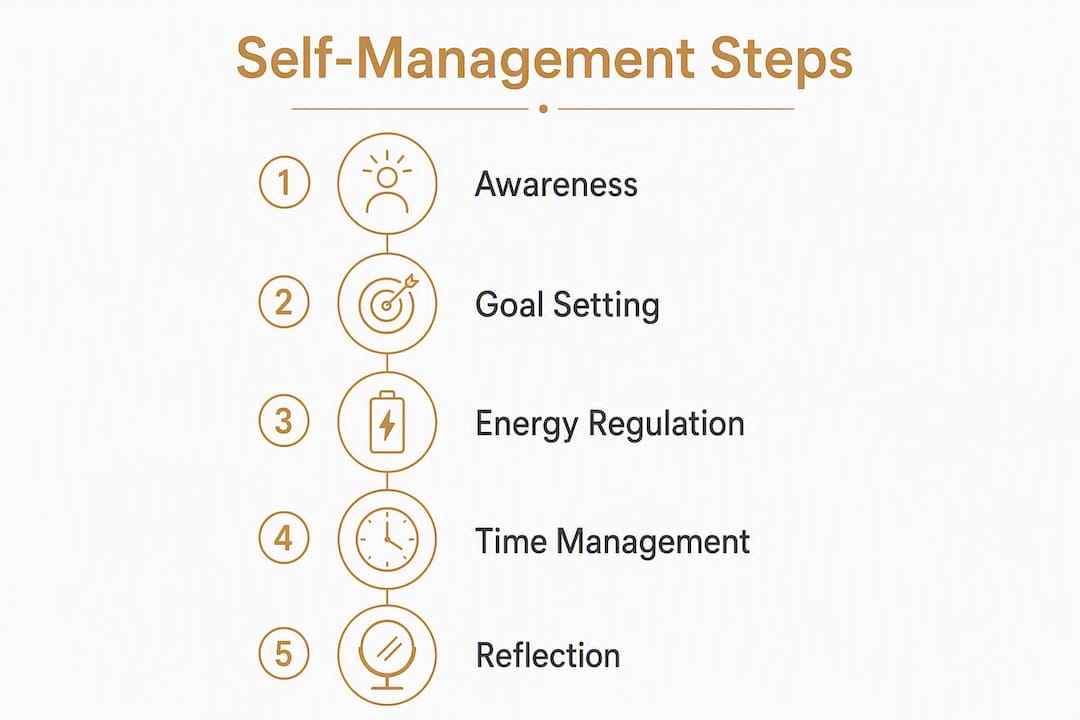
When you manage yourself well, you reduce the oversight burden on everyone around you. A manager doesn’t need to follow up twice. A client doesn’t need to chase a deliverable. A team member doesn’t need to compensate for your missed piece of a project. That reliability compounds over time into a reputation for dependability, which is one of the fastest career accelerators there is.
The WHO’s self-care framework frames agency and autonomy as foundational to long-term sustainability, and that maps directly onto burnout prevention. People who manage their own energy and workload proactively are far less likely to hit the wall than those who push through on willpower until something breaks.
Three concrete use cases show the difference clearly:
Remote worker: Without a physical office structure, self-management provides the scaffolding. A remote worker with strong self-management habits sets clear start and stop times, batches communication into defined windows, and tracks deliverables in a single system. One without those habits spends the day reacting to messages and ends it unsure what actually got done.
Project contributor: On a cross-functional team, the person who self-manages well shows up to meetings prepared, flags blockers early, and doesn’t need reminders. That behavior reduces friction for everyone and tends to get noticed at review time.

Solopreneur: When you’re running a one-person business, there’s no manager, no HR, and no colleague to catch your blind spots. Self-management isn’t a soft skill here. It’s the operational backbone.
What are the core self-management skills you need to develop?
The seven canonical self-management skills are: time management, self-motivation, stress management, adaptability, decision-making, goal alignment, and personal development. Each one shows up differently at work, and most people are stronger in some areas than others.
- Time management: — Blocking your calendar for deep work before reactive tasks fill it. A project manager who schedules two uninterrupted hours each morning before opening email consistently ships more than one who starts the day in their inbox.
Pro Tip: Energy regulation is the most underused lever in this list. Per Forbes’ practitioner reporting, most people over-focus on time management and ignore energy. Try logging your energy level (1–5) at the same time each day for one week. You’ll spot your peak window fast, and scheduling your hardest task there beats any productivity app.
How can you actually improve your self-management with daily practices?
Pick two or three high-impact practices and run them consistently. Improvement follows measurable behavior change, not motivation spikes.
A daily routine template that works
Start each workday with a three-minute planning check: identify your one non-negotiable task, set a time block for it, and note any potential friction points. End each day with a two-minute close: mark what got done, move anything unfinished to tomorrow’s list, and log one thing that slowed you down. That five-minute daily investment builds the feedback loop that most people skip.
A weekly self-audit flow
Every Friday (or Sunday evening), run through four questions:
- Did my daily actions connect to my top three priorities this week?
- Where did I lose the most time or energy to reactive work?
- What one system tweak would reduce that friction next week?
- Did I protect at least one deep-work block each day?
This isn’t a performance review. It’s a systems check. The Atlassian self-management framework emphasizes environment design over willpower, and this audit is where you identify the environment changes that actually stick.
Three targeted exercises
Focus blocks for attention control: Schedule 90-minute blocks with notifications off and a single task defined before you start. Use a site blocker like Freedom or Cold Turkey during those windows. Start with one block per day and scale to two once the habit is solid.

Pre-mortem for decision-making: Before committing to a new project or major task, spend five minutes imagining it failed. What went wrong? That exercise surfaces the real risks before you’re invested, and it sharpens your go/no-go criteria.
Energy log for stress and motivation: Track your energy at 9 AM, 1 PM, and 4 PM for two weeks. Most people discover a clear pattern. Once you see it, you can build systems around it rather than fighting it.
Pro Tip: A minimalist tool stack reduces the cognitive overhead of managing your own management system. One primary task capture tool handling the bulk of your workflow beats five apps that each hold a piece of the picture.
How does self-management change outcomes in real work scenarios?
Self-management changes outcomes in three distinct scenarios: as a team member, as a manager, and as a solopreneur. The before/after contrast in each case is sharper than most people expect.
-
Team member (before): Waits for a manager to clarify priorities, misses a deadline because a dependency wasn’t flagged early, spends Friday catching up on work that should have been done Tuesday.
-
Team member (after): Maintains a personal task board synced to team goals, flags blockers 48 hours before they become problems, and finishes the week with a clean handoff. Career research consistently identifies this kind of proactive behavior as a top employability signal.
-
Manager (before): Spends most of their time in reactive mode, firefighting team issues that could have been prevented, and struggling to carve out time for strategic work.
-
Manager (after): Uses a weekly planning block to set priorities, delegates with clear criteria, and protects two hours each week for non-urgent but high-value thinking. The team notices the difference because the manager stops being a bottleneck.
-
Solopreneur (before): Juggles client work, marketing, and admin in a reactive loop, constantly context-switching, and finishing the week unsure whether the business actually moved forward.
-
Solopreneur (after): Runs on a weekly theme schedule (client delivery days, content days, admin days), uses a single task management tool, and reviews goal alignment every Friday. The result is consistent client delivery and a content calendar that doesn’t fall apart when one week gets busy.
For solopreneurs specifically, the connection between self-management and systems is direct. Knowing why solopreneurs fail almost always points back to the same root cause: no reliable system for managing attention and priorities when no one else is watching.
How do you measure self-management progress, and what does research show?
Track a small set of objective indicators and expect meaningful change on the fastest metric within 3–8 weeks of consistent practice. The key is measuring behaviors, not feelings.
Self-audit checklist
Run this weekly:
- Did you hit at least 80% of your planned deadlines this week?
- Did you complete at least one deep-work block per day?
- Did you log your energy or stress level at least three times this week?
- Did you run your Friday review?
- Did you identify and act on one system improvement?
A “yes” on four of five is a strong week. Two or fewer is a signal to look at what broke, not to blame yourself.
Realistic improvement timeline
| Metric | Practice | Expected change |
|---|---|---|
| Deadline hit-rate | Weekly planning + daily close | Noticeable within 3–4 weeks |
| Deep-work minutes per day | Focus blocks + site blocker | Measurable within 2–3 weeks |
| Perceived stress level | Energy log + pre-mortem habit | Gradual reduction over several weeks |
| Goal alignment score | Weekly self-audit | Clearer within a month |
These timelines assume daily practice, not occasional effort. The PMC meta-analysis on self-management interventions confirms that structured, consistent practice shifts behavior from reactive to proactive, with measurable improvements in both output quality and well-being. The WHO’s framing of self-care as a foundation for long-term sustainability reinforces why the stress and burnout metrics matter as much as the productivity ones.
Key Takeaways
Self-management is the operating system beneath every other professional skill: without it, time management tools, goal-setting frameworks, and productivity apps all underperform.
| Point | Details |
|---|---|
| Self-management beats willpower | Build systems and environment cues instead of relying on motivation to carry you through. |
| Energy regulation is the hidden lever | Log your energy daily for one week to find your peak window, then protect it for your hardest work. |
| Measure behaviors, not feelings | Track deadline hit-rate, deep-work minutes, and weekly audit completion for objective progress signals. |
| Expect change in 3–8 weeks | Consistent daily practice produces measurable shifts in focus and stress within a few weeks, not months. |
| Yoursolobusiness resources accelerate implementation | The productivity toolkit and daily habits guide give you templates and tools to put this into practice immediately. |
What I’ve learned about self-management as a solo operator
The conventional wisdom on self-management gets one thing consistently wrong: it treats the problem as a motivation problem. Most advice boils down to “want it more” or “set better goals.” But in practice, the people who manage themselves well aren’t more motivated than everyone else. They’ve just built better defaults.
The most effective shift I’ve seen, both in my own work and in the patterns that show up across solo business operators, is moving from willpower-based management to environment-based management. When your desk is clear, your phone is in another room, and your task list has exactly one item at the top, you don’t need to summon discipline. The environment does the work.
There’s also a timing problem that nobody talks about enough. Most self-management systems are designed for the morning, when energy is high and the day feels manageable. But the real test is 2 PM on a Thursday when you’re behind, a client just emailed something urgent, and your original plan is already off the rails. The systems that survive that moment are the ones worth keeping. Everything else is just morning optimism.
For solopreneurs, the stakes are higher because there’s no safety net. No manager catches the ball you dropped. No team absorbs the slack. That’s not a reason to panic. It’s a reason to build the systems now, before you need them, and to treat a weekly self-audit as non-negotiable rather than optional.
The goal isn’t perfection. It’s a feedback loop tight enough that you catch problems in days, not months.
Yoursolobusiness helps you put self-management into practice
Running a one-person business at full output means your self-management system has to carry real weight, and the right resources cut the setup time dramatically.

Yoursolobusiness has built a set of practical tools specifically for solopreneurs who want to stop spinning their wheels and start running on systems. The AI for Solopreneurs guide shows you exactly how to pair self-management habits with AI-assisted automation so that routine tasks stop eating your best hours. For the daily execution layer, the productivity toolkit gives you seven proven strategies and ten tools you can plug in today, including templates for the weekly self-audit and focus-block scheduling covered in this article.
If you want one concrete next step: start with the daily habits guide and run the five-minute daily routine for two weeks. That single habit builds the feedback loop everything else depends on.
Useful sources for further reading
- PMC: Structured self-management interventions and professional outcomes — Meta-analytic evidence that structured practice shifts behavior from reactive to proactive with measurable outcome improvements.
- WHO self-care framework — The foundational framework connecting agency, autonomy, and long-term sustainability to burnout prevention.
- Cambridge Students: Self-management skills — Practical university guidance on goal monitoring, self-control, and iterative self-evaluation.
- Asana: Self-management at work — Workplace-focused breakdown of the canonical skill set and why self-management underpins autonomous performance.
- Atlassian: Self-management and environment design — Explains why environment tweaks outperform willpower and how shared systems reduce cognitive load.
- Forbes: Self-management skills at work and home — Practitioner perspective on energy regulation as a first-order lever and common pitfalls of over-focusing on time management.
- SEEK: Self-management skills and how to improve them — Career-advice framing of self-management as a core employability signal, with practical improvement steps.