

Setting out alone with only your skills and ideas can feel both thrilling and overwhelming for creatives and freelancers. Solopreneurship stands apart from other business paths, offering complete independence but also unique pressures that go far beyond simple freelancing. By understanding the core traits and mindset behind successful solo businesses, you can avoid common pitfalls and shape a professional life defined by purpose, flexibility, and genuine growth.
Key Takeaways
| Point | Details |
|---|---|
| Understanding Solopreneurship | Solopreneurship is a unique form of entrepreneurship characterized by individual independence and the direct application of personal expertise. Unlike freelancers, solopreneurs build structured businesses around their skills. |
| Essential Traits for Success | Key traits for solopreneurs include self-motivation, adaptability, and strategic thinking, which enable them to navigate the complexities of independent business effectively. |
| Risk Management Strategies | Successful solopreneurs proactively manage financial, legal, and emotional risks through comprehensive planning and support networks, ensuring sustainability in their ventures. |
| Common Pitfalls to Avoid | Strategic, operational, and financial mistakes, such as avoiding networking and mixing personal finances, can hinder solopreneur success; learning from these pitfalls is essential for growth. |
Solopreneurship Defined and Common Misconceptions
Solopreneurship represents a unique form of entrepreneurship centered on individual independence and personal expertise. Unlike traditional business models, solopreneurship involves running an entire business as a single person, leveraging personal skills and knowledge as primary assets. Research indicates that solopreneurs are typically highly educated professionals who deliberately choose to maintain small, personally meaningful enterprises.
The key characteristics of solopreneurship distinguish it from other entrepreneurial paths:
- Complete autonomy in business decision-making
- Direct utilization of personal expertise and skills
- Flexibility in business structure and operations
- Personal brand closely tied to business identity
- High degree of professional independence
Common misconceptions about solopreneurship often stem from misunderstandings about its fundamental nature. Many people incorrectly assume solopreneurs are simply freelancers or small business owners, when in reality, they represent a distinct category of entrepreneurship driven by individual vision and expertise. Mental resilience becomes crucial, as solopreneurs must manage not just business operations, but also psychological challenges like social isolation and decision-making pressures.
Psychological Dimensions: Evidence from behavioral economics research reveals that solopreneurs experience unique mental challenges, including potential cognitive distortions and decision paralysis. Understanding these psychological aspects is critical for developing sustainable solo business strategies.
Pro tip: Develop a robust support network of fellow solopreneurs to combat potential isolation and enhance your mental resilience.
Popular Solopreneur Business Types Today
Solopreneur business models offer incredible flexibility and potential for professionals seeking independence. These business types leverage individual expertise across diverse industries, allowing entrepreneurs to create personalized professional paths that align with their unique skills and passions.
The most popular solopreneur business types include:
- Freelance Writing: Creating content for businesses, websites, and publications
- Virtual Assistance: Providing administrative and technical support remotely
- Online Coaching: Offering specialized training and mentorship in specific domains
- Digital Marketing Consulting: Helping businesses develop strategic online presence
- Creative Content Production: Developing multimedia content like videos, podcasts, and graphics
- Technical Writing: Producing specialized documentation and instructional materials
- Web Design and Development: Creating websites and digital experiences for clients
Successful solopreneurs understand that matching personal traits with the right business type is crucial. Introverted professionals might gravitate toward roles requiring deep concentration like technical writing or web development, while more extroverted individuals might excel in coaching or consulting roles. The key is identifying a niche that not only matches professional skills but also personal temperament and lifestyle preferences.

Professional Diversity: Beyond traditional service-based models, solopreneurs are increasingly exploring digital product creation, online course development, and specialized consulting that allows for scalable income streams without linear time-for-money exchanges. This evolution reflects a broader trend of leveraging personal expertise into more flexible and innovative business models.
Pro tip: Conduct a comprehensive skills audit to identify your most marketable talents and potential solopreneur business opportunities that align with your unique strengths.
Essential Traits and How Solo Work Operates
Research on solopreneur personality traits reveals critical psychological characteristics that distinguish successful independent professionals. Solopreneurs operate differently from traditional entrepreneurs, with a unique blend of personal attributes that enable them to navigate complex business landscapes independently.
The most essential traits for solopreneurs include:
- Self-Motivation: Ability to drive personal productivity without external supervision
- Adaptability: Quick pivoting and learning in dynamic business environments
- Risk Management: Calculated approach to business opportunities and challenges
- Emotional Intelligence: Managing personal stress and client relationships effectively
- Strategic Thinking: Long-term planning and continuous skill development
- Financial Discipline: Maintaining consistent income streams and managing personal finances
Psychological Foundations: Empirical studies utilizing personality assessment consistently highlight that solopreneurs demonstrate high levels of conscientiousness, openness, and self-awareness. These traits enable them to make sound decisions, continuously innovate, and maintain professional resilience across various industry sectors.
Successful solo work fundamentally requires a robust personal operating system. This means developing disciplined routines, creating structured workflows, and maintaining clear boundaries between professional responsibilities and personal life. Unlike traditional employment, solopreneurs must simultaneously function as strategist, executor, marketer, and administrator of their professional ecosystem.
Pro tip: Develop a comprehensive personal development plan that regularly assesses your professional skills, market trends, and personal growth objectives.
Solopreneurship vs. Freelancing and Entrepreneurship
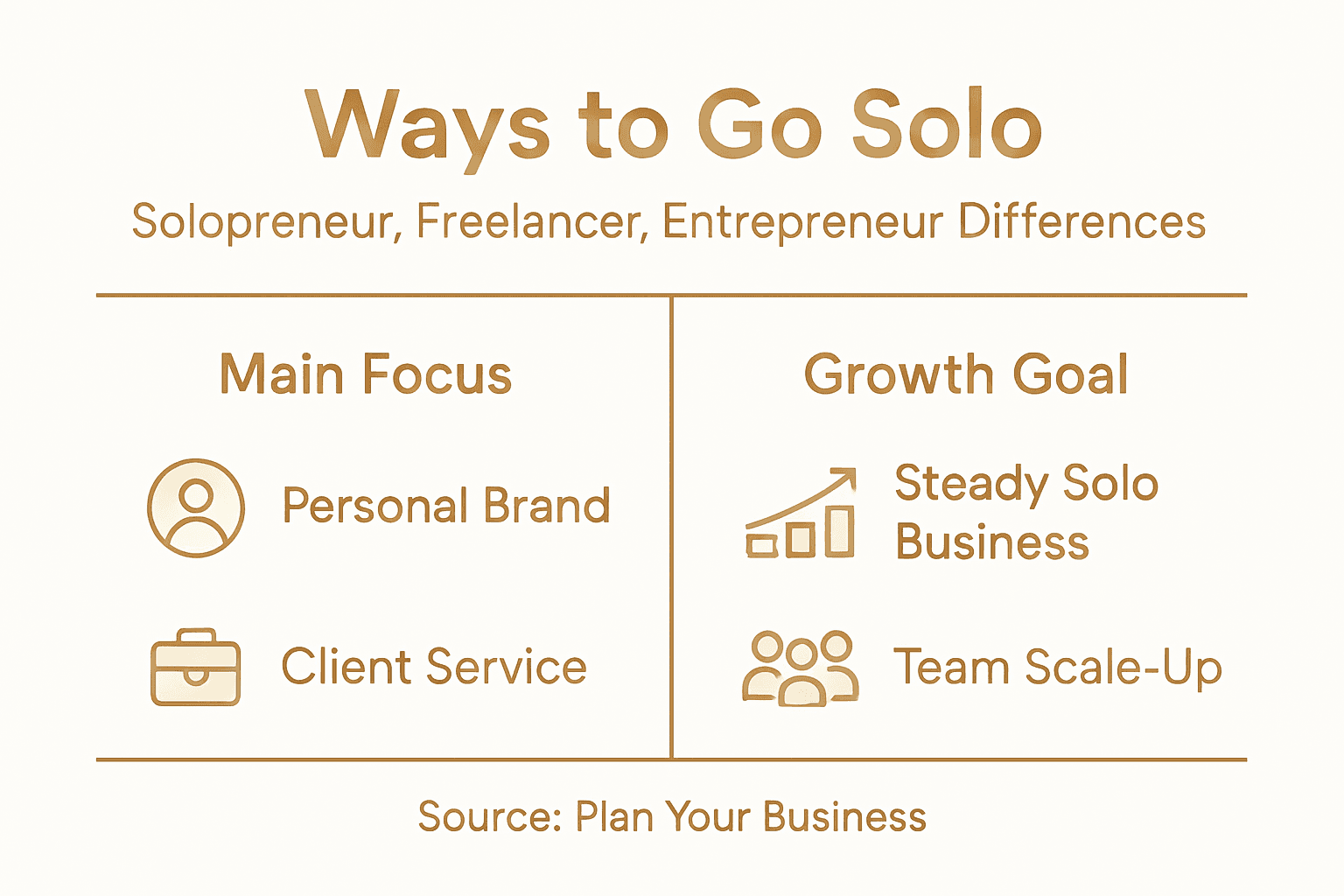
Business models in self-employment reveal distinct characteristics that differentiate solopreneurship, freelancing, and entrepreneurship. While these paths share commonalities of independent work, each represents a unique approach to professional independence and business development.
Key differences between these professional models include:
-
Freelancing:
- Project-based work
- Short-term client relationships
- Limited income potential
- No significant business infrastructure
-
Solopreneurship:
- Structured business model
- Multiple income streams
- Personal brand development
- Long-term strategic planning
-
Entrepreneurship:
- Team and employee expansion
- Scalable business model
- Investment and growth focus
- Complex organizational structures
Strategic Distinctions: Solopreneurs occupy a unique middle ground between freelancers and traditional entrepreneurs. They create structured businesses around their personal expertise while maintaining complete operational independence. Unlike freelancers who trade time for money, solopreneurs develop systems that can generate passive or recurring revenue.
The primary differentiator lies in intentionality and long-term vision. Freelancers typically focus on immediate project completion, entrepreneurs aim to build expansive organizations, while solopreneurs craft personalized professional ecosystems that reflect their individual skills and lifestyle preferences.
Here’s how solopreneurship, freelancing, and entrepreneurship differ in long-term potential and operations:
| Aspect | Freelancing | Solopreneurship | Entrepreneurship |
|---|---|---|---|
| Growth Potential | Limited to personal hours | Can build scalable systems | Team expansion, large-scale growth |
| Brand Focus | Minimal personal branding | Personal brand is central | Company brand prioritized |
| Work Structure | Task and project driven | Strategic with recurring systems | Departmental and hierarchical roles |
| Revenue Streams | Mostly one-off payments | Multiple and recurring options | Diverse, including investments |
Pro tip: Conduct a thorough self-assessment of your professional goals, risk tolerance, and personal strengths to determine which business model aligns best with your aspirations.
Financial, Legal, and Emotional Risks to Know
Financial success strategies reveal that solopreneurship involves navigating complex risk landscapes requiring sophisticated personal management. Unlike traditional employment, solo professionals must simultaneously manage financial stability, legal compliance, and psychological resilience.
Key risk categories for solopreneurs include:
-
Financial Risks:
- Unpredictable income streams
- Self-funded health insurance
- Personal liability for business debts
- No guaranteed paycheck
- Complex tax responsibilities
-
Legal Risks:
- Business entity registration
- Contract management
- Intellectual property protection
- Regulatory compliance
- Potential litigation exposure
-
Emotional Risks:
- Professional isolation
- Decision-making pressure
- Burnout potential
- Imposter syndrome
- Work-life balance challenges
Psychological Dimensions: Entrepreneurial stress management demonstrates that successful solopreneurs develop robust mental frameworks to counteract inherent professional uncertainties. Proactive risk mitigation involves creating comprehensive backup plans, maintaining emergency funds, and cultivating strong professional support networks.
Navigating these multifaceted risks requires continuous learning, adaptable strategies, and a commitment to personal and professional development. Solopreneurs must view challenges as opportunities for growth, transforming potential obstacles into strategic advantages through disciplined planning and emotional intelligence.
This table summarizes main risk factors and effective mitigation strategies for solopreneurs:
| Risk Category | Main Challenge | Recommended Mitigation |
|---|---|---|
| Financial | Irregular income, cash flow gaps | Build savings, diversify income |
| Legal | Compliance and contract disputes | Use legal counsel, formal agreements |
| Emotional | Burnout and isolation | Set boundaries, seek peer support |
Pro tip: Develop a quarterly personal risk assessment protocol that systematically evaluates your financial, legal, and emotional business vulnerabilities.
The Most Frequent Pitfalls and Mistakes
Common solopreneur failure patterns reveal critical mistakes that can derail independent business success. Understanding these pitfalls allows aspiring solopreneurs to develop proactive strategies that mitigate potential risks and enhance long-term sustainability.
The most significant solopreneur mistakes include:
-
Strategic Mistakes:
- Pursuing perfection over progress
- Lacking comprehensive business planning
- Underestimating market complexity
- Avoiding professional networking
- Neglecting continuous skill development
-
Operational Mistakes:
- Trying to manage everything independently
- Poor time management
- Inconsistent client communication
- Inadequate financial tracking
- Failing to establish professional boundaries
-
Financial Mistakes:
- Inconsistent pricing strategies
- Insufficient emergency funds
- Neglecting tax planning
- Mixing personal and business finances
- Undervaluing professional services
Psychological Foundations: Successful solopreneurs recognize that mistakes are learning opportunities, not permanent setbacks. They develop resilience by treating each challenge as a chance to refine their approach, adapt their strategies, and build more robust professional systems.
Transforming mistakes into growth requires a structured approach of continuous learning, seeking mentorship, maintaining financial discipline, and remaining flexible. The most effective solopreneurs view their journey as an ongoing process of strategic refinement and personal development.
Pro tip: Implement a monthly professional review process that critically analyzes your business performance, identifying potential mistakes before they become significant problems.
Discover True Independence with Your Solo Business
Solopreneurship demands more than just skill it requires strategic planning and strong personal resilience to overcome challenges like isolation and fluctuating income. If you want to build a thriving solo venture that leverages your unique expertise and avoids common pitfalls explore actionable strategies and inspiring ideas in our Solo Business Ideas – Your Solo Business section.

Unlock your potential by accessing valuable resources at Plan Your Business – Your Solo Business while connecting with a community that understands the emotional and financial complexities of solopreneurship. Act now to transform your vision into a sustainable business model. Visit Your Solo Business today and start shaping your success story.
Frequently Asked Questions
What is solopreneurship?
Solopreneurship is a form of entrepreneurship where an individual runs an entire business independently, leveraging their own skills and expertise to create a personally meaningful enterprise.
How does solopreneurship differ from freelancing?
Solopreneurship involves creating a structured business model with multiple income streams and a strong personal brand, whereas freelancing is typically project-based work with short-term client relationships and limited income potential.
What are the key traits of successful solopreneurs?
Successful solopreneurs often possess traits such as self-motivation, adaptability, emotional intelligence, and strategic thinking, which enable them to navigate the complexities of running their own businesses.
What are common pitfalls that solopreneurs should avoid?
Common pitfalls include pursuing perfection over progress, underestimating market complexity, poor time management, and mixing personal and business finances. Recognizing and addressing these mistakes can enhance long-term success.
Recommended
- Freelancer vs. Solopreneur vs. Entrepreneur: Which Path Fits You Best? – Your Solo Business
- 10 Reasons You Should Consider Quitting Your Job and Starting Your Solo Business – Your Solo Business
- How to Become a Successful Solopreneur in 2026 – Your Solo Business
- The 5 Phases of Solopreneurship: From Hustle to Thriving – Your Solo Business
- Financial Clarity: Unlocking Small Business Success