
TL;DR:
- Email marketing is a permission-based channel that you own, allowing direct communication with your audience. It offers high ROI, builds relationships, and remains effective through automation and segmentation.
Email marketing is a permission-based, owned-media channel where you send targeted messages directly to people who asked to hear from you. No algorithm decides who sees your content. No platform can pull the rug out from under your audience overnight. You own the list, you control the conversation, and the ROI speaks for itself.
Here’s what you’ll learn in this guide:
- What email marketing is and how it differs from spam
- How it works (subscriber lists, ESPs, automation, segmentation)
- The main types of marketing emails and when to use each
- A step-by-step checklist to launch your first campaign
- Key metrics to track and beginner benchmarks
- U.S. legal basics (CAN-SPAM compliance)
Why email marketing is worth your attention as a solopreneur
Social media followers are borrowed. Your Instagram audience belongs to Instagram. Your LinkedIn connections exist inside LinkedIn’s walls. Email is different. As WordStream explains, email is owned media: a direct line of communication you control, independent of any platform’s algorithm or policy change.
That ownership translates into real money.
Industry sources cite a high return on investment for email marketing, often reported as significantly outperforming most other digital channels — a figure that consistently outpaces most other digital channels
For a solopreneur, that ratio matters enormously. You’re not running a team of marketers. Every dollar and every hour counts. Email lets you build a relationship with your audience once, then automate the follow-up so the channel keeps working while you’re doing everything else on your never-ending to-do list.
Beyond ROI, email drives retention. A well-timed sequence can turn a one-time buyer into a repeat customer. A weekly newsletter keeps your name in front of people who might not be ready to buy today but will remember you when they are. And because you own the list, you can use it across any platform shift, product launch, or business pivot without starting from zero.
How email marketing actually works
Think of email marketing as a simple machine with four moving parts: your list, your platform, your messages, and your triggers. Once you understand each piece, the whole system clicks into place.
-
Subscriber list. This is your database of contacts who opted in to hear from you. Quality beats quantity here. A list of 500 engaged subscribers who open every email will outperform a list of 5,000 people who never click anything.
-
Email service provider (ESP). An ESP is the software that sends your emails, manages your list, tracks performance, and handles compliance. Tools like Mailchimp, ConvertKit, ActiveCampaign, and Flodesk are popular choices. Using a personal Gmail or Outlook account is a mistake — ESPs handle compliance, tracking, and scale in ways a personal inbox simply cannot.
-
Templates and content. Your ESP gives you drag-and-drop templates so you don’t need to code. The content itself ranges from short promotional blasts to long-form newsletters to automated sequences.
-
Automation and segmentation. Automation lets you send the right message at the right moment without being at your keyboard. Segmentation means grouping subscribers by behavior, interest, or source so each group gets content that actually fits them. Salesforce research confirms that segmentation and personalization materially improve relevance and long-term subscriber value.
The high-level flow looks like this:
- A visitor finds your website or social profile and signs up via a form or landing page.
- Your ESP triggers a welcome series automatically.
- You send regular campaigns (newsletters, promotions) on a set schedule.
- Automated triggers fire based on behavior: a purchase, a click, an abandoned cart, or 90 days of silence.
That loop, once built, runs largely on its own.

What are the main types of email campaigns?
Knowing the six core email types helps you pick the right tool for each job. They are not interchangeable.
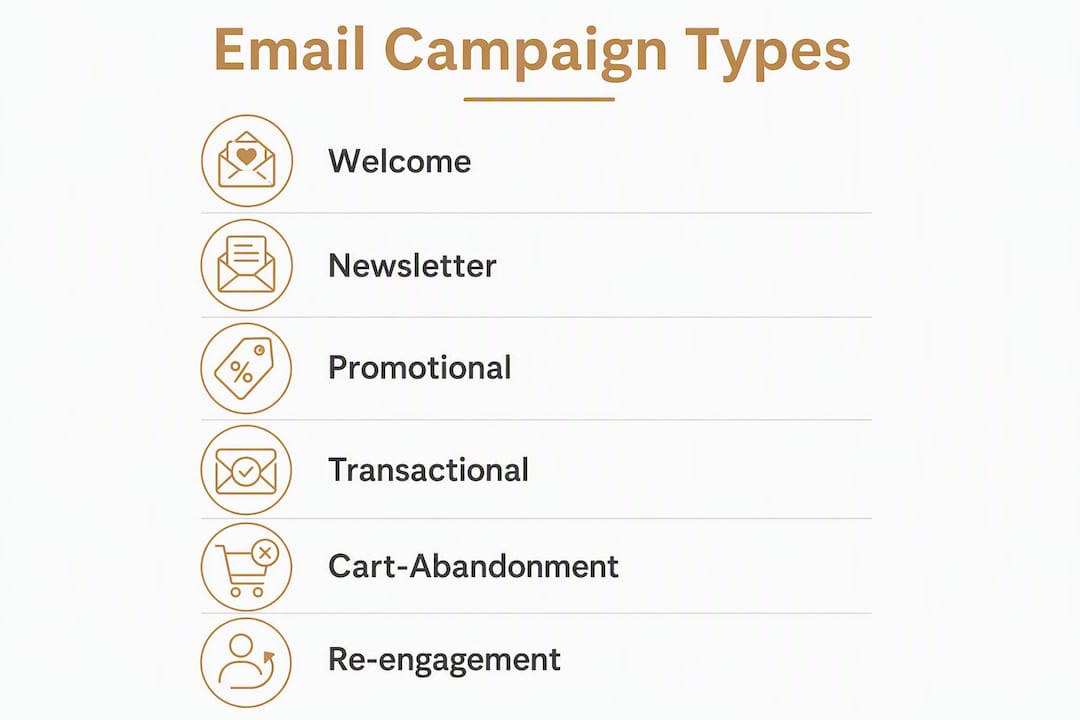
Welcome emails go out the moment someone subscribes. This is your highest-open-rate email, so use it to set expectations, deliver any promised lead magnet, and introduce yourself. Think of it as a first impression you get to script in advance.
Newsletters are regular, scheduled sends that mix value (tips, insights, curated links) with light promotion. They build the relationship over time rather than pushing for an immediate sale.
Promotional campaigns are direct offers: a discount, a product launch, a limited-time deal. These are fine in moderation, but a list that only receives promos will disengage fast.
Transactional emails confirm an action the subscriber already took: order confirmations, receipts, password resets. These are triggered by the user’s behavior and carry some of the highest open rates of any email type. They also live under different deliverability and legal rules than marketing messages, so most ESPs handle them through a separate sending stream.
Cart-abandonment emails fire when someone adds a product to their cart and leaves without buying. For e-commerce solopreneurs, this single automation often recovers meaningful revenue with almost no ongoing effort.
Drip and lifecycle sequences are multi-email series tied to where someone is in their relationship with you: new subscriber, new customer, lapsed buyer. They move people through a journey at their own pace.
Re-engagement emails target subscribers who have gone quiet. A simple “Are you still interested?” sequence with a clear opt-out option cleans your list and reactivates the people who are still worth reaching.
How to start your first email marketing program, step by step
Getting started does not require a big budget or a big list. Here’s the sequence that works.
-
Choose an ESP and set up your sending domain. Pick a platform with a free tier (Mailchimp, MailerLite, and ConvertKit all offer one). Then configure domain authentication: SPF, DKIM, and DMARC records in your DNS. This is non-negotiable in 2026 — mailbox providers increasingly block unauthenticated senders.
-
Create at least one lead capture point. Add a signup form to your website’s homepage and any high-traffic blog posts. A simple lead magnet (a checklist, a short guide, a free template) dramatically increases conversion rates on that form.
-
Build a 3-email welcome series. Email 1 delivers the lead magnet and introduces you. Email 2 (sent 2–3 days later) shares your best piece of content or a key insight. Email 3 (sent 4–5 days after that) makes a soft ask or invites a reply. Welcome and onboarding sequences consistently outperform single broadcast emails in both opens and clicks.
-
Set a regular sending cadence. Weekly or biweekly works well for most solopreneurs. Consistency matters more than frequency. Pick a day and stick to it.
-
Segment from day one. Tag subscribers by source (blog vs. social vs. referral) and by any interest signals your signup form captures. Even simple segmentation pays off quickly.
-
Set baseline goals. Before you send your first campaign, decide what success looks like: a target open rate, a click-through rate, or a specific conversion action. You can’t improve what you don’t measure.
-
Follow a 30–90 day ramp. Days 1–14: set up your ESP, domain auth, and welcome series. Days 15–30: publish your first lead magnet and start collecting subscribers. Days 31–60: send your first 4–6 regular campaigns and review open and click data. Days 61–90: refine subject lines, prune non-openers, and add one automation (cart abandonment or re-engagement).
For a deeper look at building your subscriber base from scratch, Yoursolobusiness has a full practical guide on email list building for solopreneurs.
Email marketing best practices that actually move the needle
Most beginner advice on best practices is too vague to be useful. Here’s what actually matters.
Subject lines and preview text. Keep subject lines under 50 characters so they display fully on mobile. Test curiosity-driven lines against benefit-driven lines. The preview text (the snippet after the subject line) is free real estate — use it to extend the subject, not repeat it.

Personalization. First-name personalization in the subject line or opening sentence still lifts open rates. Beyond the name, behavioral personalization (sending content based on what someone clicked last time) is where the real gains are. Grouping subscribers by behavior or interest is what separates lists that generate revenue from lists that stagnate.
Mobile-first design. More than half of all emails are opened on a phone. Use a single-column layout, a minimum 16px font size, and buttons at least 44px tall. Long paragraphs that look fine on desktop become walls of text on a 6-inch screen.
Deliverability hygiene. Prune inactive subscribers at least twice a year — inactive addresses drag down your sender reputation and reduce inbox placement for everyone else on your list. Set a re-engagement sequence first, then remove anyone who doesn’t respond.
Pro Tip: Set up a simple A/B test on your very first campaign: send two subject line variants to 20% of your list each, let the winner run to the remaining 60%, and you’ll have real data on your audience’s preferences before you’ve sent your second email.
Which metrics should you track first?
You don’t need to obsess over every number. Start with these six, and you’ll have a clear picture of your program’s health.
| Metric | Definition | Beginner benchmark |
|---|---|---|
| Open rate | % of delivered emails that were opened | 20–30% |
| Click-through rate (CTR) | % of delivered emails where a link was clicked | 2–5% |
| Conversion rate | % of recipients who completed the desired action | 1–3% |
| Unsubscribe rate | % who opted out per send | Under 0.5% |
| Deliverability rate | % of emails that reached the inbox (not bounced) | 95%+ |
| List growth rate | Net new subscribers as a % of total list per month | Positive month-over-month |
Open rate tells you whether your subject lines and sender name are working. CTR tells you whether your content and offers are compelling. Conversion rate ties everything back to revenue. An unsubscribe rate above 0.5% is a signal to revisit your content or sending frequency. Deliverability below 95% usually points to a list hygiene or authentication problem. And list growth rate is the long-term health indicator: if you’re losing subscribers faster than you’re gaining them, the top of your funnel needs attention.
U.S. legal basics: what CAN-SPAM requires from you
The CAN-SPAM Act, enforced by the Federal Trade Commission, sets the rules for commercial email in the United States. The core requirements are straightforward:
- Identify yourself honestly. Your “From” name, email address, and reply-to address must accurately represent who you are.
- No deceptive subject lines. The subject line must reflect the actual content of the email.
- Include your physical address. A valid postal address (a P.O. box works) must appear in every commercial email.
- Provide a clear unsubscribe mechanism. Every email needs a working opt-out link, and you must honor opt-out requests within 10 business days.
- No third-party list selling. You cannot sell or transfer an address to another sender after someone opts out.
The key distinction between marketing email and spam is consent and a clear opt-out. Buying a list and blasting strangers is spam. Sending to people who signed up for your content, with a working unsubscribe link, is marketing.
Practical compliance tips: keep your unsubscribe action to a single click (no login required, no “reason for leaving” survey), keep records of when and how each subscriber opted in, and use your ESP’s built-in compliance tools to manage opt-outs automatically.
This is general information, not legal advice. Confirm current requirements with the FTC’s CAN-SPAM guidance or a qualified attorney.
What does email marketing cost, and when will you see results?
The good news: you can start for free. Most major ESPs offer a free tier that covers lists up to 500–1,000 subscribers and a limited number of monthly sends. As your list grows, you’ll move to a paid plan, which typically runs $15–$50 per month for lists under 5,000 subscribers. Larger lists or advanced automation features push costs higher, but for a solopreneur just starting out, the free tier is genuinely sufficient for months.
Setup costs are mostly time. Configuring your ESP, writing your welcome series, and building your first lead magnet might take 8–12 hours total. If you hire a copywriter or designer for templates, budget a one-time cost, but it’s not required to get started.
On timeline: expect your first open and click data within days of your first send. Meaningful patterns (what subject lines work, which segments engage most) emerge after 4–6 campaigns. Revenue attribution, where you can clearly connect email sends to sales, typically takes 2–3 months of consistent sending. The channel rewards patience and consistency more than any single brilliant campaign.
Common beginner mistakes and how to fix them fast
- Confusing list size with list quality. A list of 10,000 cold contacts will underperform a list of 1,000 people who genuinely opted in. Prioritize engaged, permissioned subscribers from day one, and your sender reputation will thank you.
- Sending from a personal email address. Gmail and Outlook accounts are not built for bulk sending. Using an ESP protects your primary email, gives you compliance tools, and provides the analytics you need to iterate.
- Skipping the welcome series. Your first email to a new subscriber is your highest-leverage moment. Sending a single “thanks for signing up” and then going quiet for two weeks is a missed opportunity. Build the 3-email sequence before you launch your first lead magnet.
- Ignoring authentication. SPF, DKIM, and DMARC are not optional extras. Failing to configure these means your emails are likely to land in spam or get blocked outright, regardless of how good your content is.
Practical tips for solopreneurs: getting the most from a small list
The three automations that deliver the highest ROI for a one-person business are the welcome series, a cart-abandonment sequence (if you sell anything online), and a re-engagement series for subscribers who’ve gone quiet. Set those three up before you worry about anything else.
Your minimum tech stack: one ESP with automation capabilities, a landing page tool (many ESPs include one), and a simple analytics dashboard. That’s it. You don’t need a CRM, a dedicated email designer, or a marketing agency.
For your weekly measurement routine, check five numbers every Monday: open rate, CTR, new subscribers, unsubscribes, and deliverability rate. The whole review takes 10 minutes. If any number moves significantly, you have a signal worth investigating before the next send.
Jay covers the full solopreneur marketing strategy picture at Yoursolobusiness, including how email fits into a broader one-person business system.
Key Takeaways
Email marketing is a permission-based, owned-media channel that delivers high ROI, builds lasting audience relationships, and runs largely on automation once your welcome series and segmentation are in place.
| Point | Details |
|---|---|
| Owned media advantage | Email lists belong to you, not a platform — no algorithm can cut off your audience. |
| ROI benchmark | Industry sources cite a high return on investment for email marketing, often reported as significantly outperforming most other digital channels. |
| Start with authentication | Configure SPF, DKIM, and DMARC before your first send to protect deliverability. |
| First metrics to watch | Track open rate (aim for 20–30%) and CTR (aim for 2–5%) before anything else. |
| Yoursolobusiness resources | The email list building guide and audience-building resources at Yoursolobusiness give solopreneurs a practical roadmap to implement everything above. |
Why email is the foundation every solopreneur needs
Most solopreneurs I talk to treat email as an afterthought — something they’ll “get to eventually” after they’ve figured out social media, content, and paid ads. That ordering is backwards. Email is the one channel where you hold all the cards. You own the list. You set the schedule. You decide the message.
What I find most compelling about email for one-person businesses is the compounding effect. Every subscriber you add, every automation you build, every subject line test you run makes the next campaign a little smarter. Social content disappears in 24 hours. A well-built email sequence keeps working for years.
The solopreneurs who build sustainable revenue without burning out are almost always the ones who treated email as a relationship channel from the start, not a broadcast tool. That shift in thinking — from “sending emails” to “building a list of people who trust me” — is what separates lists that generate consistent income from lists that collect digital dust.
Yoursolobusiness can help you build your email audience faster
If you’ve read this far and you’re ready to stop spinning your wheels and actually build an email list that works, Yoursolobusiness has a resource built exactly for this moment.
The audience-building guide for solopreneurs walks you through the full process of growing a list from zero, converting that audience into buyers, and setting up the automations that keep the engine running without constant attention. No agency required, no bloated tech stack, and no guessing about what to do next. It’s the practical next step after everything you just read.
Head over to Yoursolobusiness and grab the guide to put your first email program on solid ground.
Useful sources and further reading
- CAN-SPAM Act: A Compliance Guide for Business — FTC
- What Is Email Marketing? — American Marketing Association
- Ultimate Guide to Email Marketing — WordStream
- Email Marketing — Wikipedia
- What Is Email Marketing? — Coursera
- Email list building for solopreneurs — Yoursolobusiness
- How to build an audience solo — Yoursolobusiness