

Running a solo business is more than just choosing independence – it’s shouldering every responsibility alone. For many aspiring solopreneurs, confusion about what truly defines their role and the challenges they face leads to wrong decisions and burnout. This article tackles the major misconceptions about solopreneurship, clarifies the difference between freelancing and solo entrepreneurship, and provides strategies to build your business with confidence and avoid common mistakes.
Key Takeaways
| Point | Details |
|---|---|
| Understanding Solopreneurship | Solopreneurship involves building a business with complete autonomy, focusing on both service and passive income streams without relying on client-based fees alone. |
| Overcoming Common Misconceptions | Misconceptions like the need for zero startup capital and confusion with freelancing hinder success; recognizing the true nature of solopreneurship is crucial. |
| Top Challenges to Address | Financial instability, isolation, and lack of skills are major barriers for solopreneurs, making it essential to build support systems and track progress effectively. |
| Mindset Matters | Adopting a growth mindset can transform how solopreneurs perceive failure and setbacks, turning challenges into opportunities for learning and growth. |
Defining Solopreneurship and Common Misconceptions
Solopreneurship isn’t just freelancing with a fancier title. It’s running an entire business yourself, handling everything from strategy to customer service to finances. Solopreneurs operate entirely alone, managing all aspects of their enterprise without employees or traditional corporate structures.
The key distinction matters. A freelancer takes projects and gets paid hourly or per assignment. A solopreneur builds a scalable business model that doesn’t depend solely on trading hours for money. You might use digital tools, automation, or productized services to create income beyond direct client work.
Here’s how solopreneurship differs from freelancing and traditional entrepreneurship:
| Aspect | Solopreneurship | Freelancing | Traditional Entrepreneurship |
|---|---|---|---|
| Decision-making | Full personal control | Client-driven decisions | Shared with partners or a team |
| Revenue Model | Productized/services & passive | Hourly or per-project fees | Scalable with staff involvement |
| Team Structure | No employees or co-founders | Solo, may subcontract | Employees and formal structure |
| Business Focus | Building a business asset | Primarily selling skills | Growth and scaling operations |
| Exit Possibilities | Sellable asset possible | Tied to individual | Can sell or transfer business |
What Actually Defines a Solopreneur
Here’s what separates you from other business owners:
- Complete autonomy – You make every decision, from pricing to target market to business pivots
- Solo operation – No employees, no partners, no co-founders sharing responsibility
- Multiple revenue streams – Often combining client work with digital products, courses, or affiliate income
- Ownership of everything – You own the business entirely and keep all profits
True solopreneurship means building a business that reflects your vision entirely, with no one else involved in decision-making or operations.
Common Misconceptions About Solopreneurship
Misunderstanding what solopreneurship actually is leads many to failure before they start. Let’s clear these up.
Misconception 1: Solopreneurship means isolation. Wrong. Many successful solopreneurs collaborate with contractors, outsource tasks, and build communities. The difference is you’re not paying employees – you hire specialists when needed.
Misconception 2: You must work alone forever. Not true. Some solopreneurs scale into team-based businesses. Others outsource 80% of operations while remaining the sole owner and decision-maker.
Misconception 3: It’s the same as freelancing. Freelancing is a job. Solopreneurship is building an asset. The distinction between freelancer and solopreneur matters when planning your business model and growth strategy.
Misconception 4: You need zero startup capital. Some solopreneurs start with nearly nothing, but smart ones invest in tools, training, and systems. Solopreneurs face challenges like limited access to capital that traditional businesses don’t face, requiring creative funding solutions.
Misconception 5: Success means passive income only. Many sustainable solo businesses involve ongoing client work combined with passive revenue. There’s nothing wrong with that model if it aligns with your goals.
Why This Clarity Matters for Your Success
Understanding what you’re actually building determines your entire strategy. If you think you’re building passive income but you’re really freelancing, you’ll get frustrated when income stops the moment you stop working.
Defining your model upfront helps you:
- Choose the right business structure for taxes and liability
- Build systems that match your actual business type
- Set realistic income goals and timelines
- Decide whether outsourcing makes sense for your model
- Plan for burnout and unsustainable work hours
Most solopreneurs fail because they’re unclear on what they’re building. Are you selling your time? Building a scalable product? Creating a lifestyle business? Once you know, you can make decisions aligned with that goal.
Pro tip: Write down your specific solopreneurship model in one paragraph – how you make money, whether you want passive income, and how much you’re willing to work. This clarity prevents wasted effort on strategies that don’t fit your actual business.
Top Reasons Solopreneurs Struggle to Succeed
You’re running your business solo, which means you’re also your accountant, marketer, operations manager, and customer service rep. No wonder so many solopreneurs hit a wall. The struggles are real, systemic, and often invisible until they derail your momentum.
Understanding why solopreneurs fail helps you avoid the same traps. Most failures aren’t about lack of effort – they’re about hitting obstacles that traditional employees never face.
The Core Struggles That Derail Solo Businesses
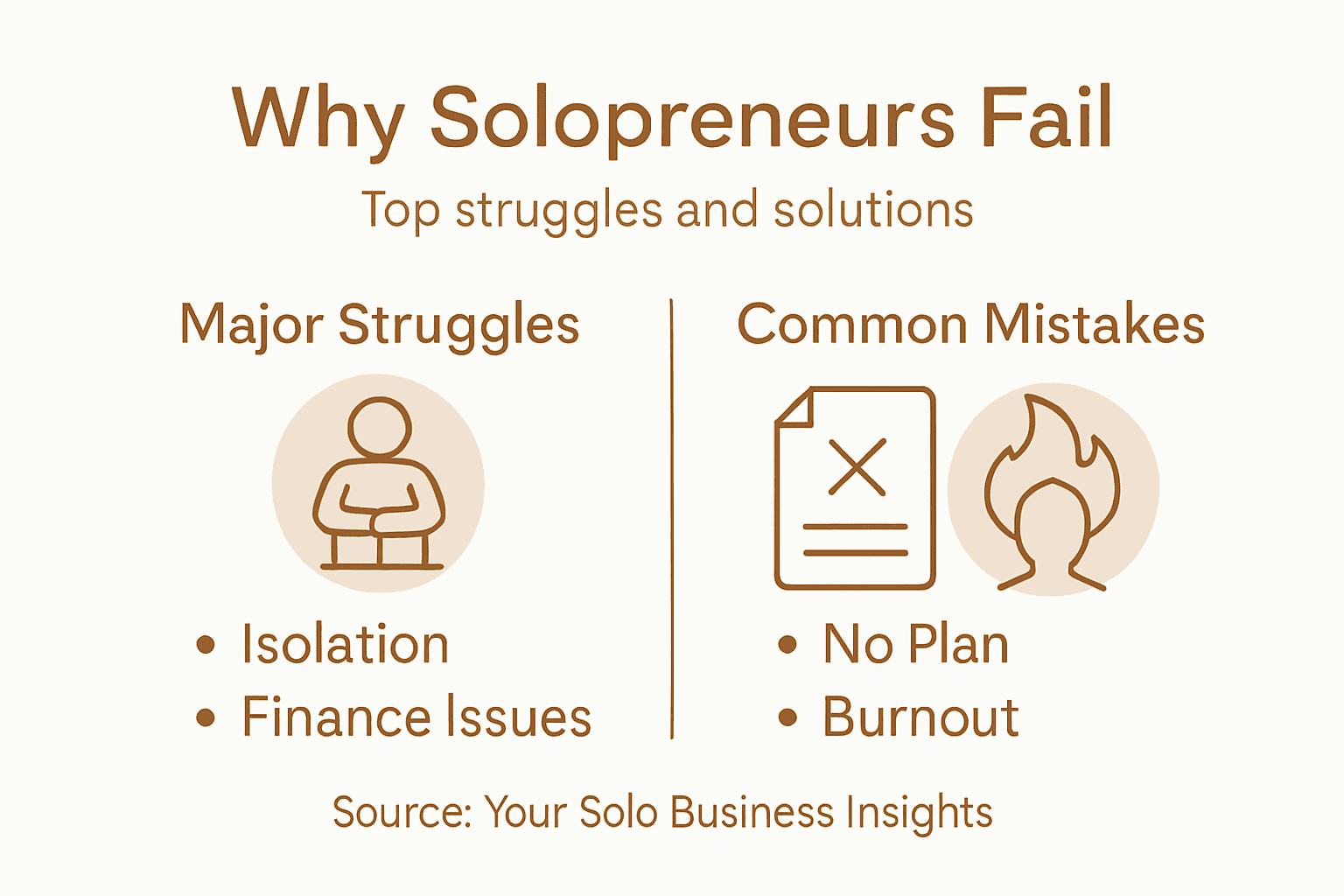
Financial instability tops the list. Solopreneurs struggle with healthcare access, complex tax codes, and difficulty securing capital without employer support. You’re paying for everything from your own pocket – health insurance, equipment, training, taxes – before you see consistent revenue.

Isolation and decision fatigue drain your energy faster than long work hours. You make every decision alone. No one to bounce ideas off. No team to share the mental load. This creates decision paralysis and, paradoxically, poor decisions from exhaustion.
Lack of business management skills catches most solopreneurs off guard. You might be talented at your craft but have no experience with sales, pricing, customer retention, or financial planning. These gaps become expensive mistakes.
Limited access to capital and networks stalls growth. Traditional loans favor established businesses with collateral. Solopreneurs often rely on personal savings, severely limiting what they can invest. Without professional networks, you miss partnership and referral opportunities.
Why These Struggles Compound
The real problem isn’t one single obstacle – it’s that they stack on top of each other:
- Money stress makes you work more hours chasing quick income
- Long hours kill your ability to learn systems that would help you scale
- Isolation prevents you from discovering solutions others have found
- Lack of skills means you reinvent the wheel repeatedly
- All of this creates burnout faster than traditional employment ever could
Many solopreneurs fail not from lack of talent, but from trying to do everything alone while lacking systems, support, and strategic guidance.
How Smart Solopreneurs Overcome These Barriers
The difference between those who succeed and those who fail isn’t luck – it’s how they address these structural challenges:
- Build accountability through communities, coaches, or mastermind groups
- Invest in learning specific business skills before they become crises
- Create systems early so you’re not personally bottlenecking growth
- Secure stable income before attempting ambitious growth plans
- Track finances obsessively from day one
- Set boundaries on work hours to prevent burnout
You can also address these gaps by learning practical strategies to achieve financial goals as a solopreneur, which directly tackles the money stress that derails so many solo businesses.
Below is a summary of the main challenges solopreneurs encounter and effective ways to address them:
| Challenge | Why It Occurs | Effective Solution |
|---|---|---|
| Financial Instability | Irregular income, high costs | Track cash flow, diversify streams |
| Isolation | Lack of peer interaction | Join networks or communities |
| Decision Fatigue | Constant solo decisions | Automate routine tasks |
| Skill Gaps | Limited business experience | Invest in training and mentors |
| Burnout | Sustained overload | Set strict work boundaries |
Pro tip: Identify which single struggle affects you most right now – money, isolation, skills, or network – and tackle that one first before trying to fix everything simultaneously.
Mindset Challenges and Motivation Pitfalls
Your mindset determines how you respond to failure, criticism, and uncertainty. Most solopreneurs fail not because they lack talent, but because their internal beliefs sabotage their efforts before external obstacles even matter.
The mental game separates those who persist through tough months from those who quit when revenue dips. Your thoughts become your actions, and your actions become your results.
The Mindset Trap: Fixed vs. Growth Thinking
Many solopreneurs operate with a fixed mindset. They believe their skills, intelligence, and earning potential are set. When they fail, they see it as proof they’re not cut out for entrepreneurship.
A growth mindset views failure differently. Every setback teaches something. Every rejection is data, not judgment. The entrepreneurial mindset requires developing resilience, adaptability, and the acceptance that failure is part of the journey.
Here’s the difference in action:
- Fixed mindset: “I failed because I’m not a natural entrepreneur” → Stop trying
- Growth mindset: “I failed because I haven’t figured out this strategy yet” → Iterate and learn
Your response to failure determines whether you build momentum or momentum kills your momentum.
Common Motivation Pitfalls That Derail Solo Businesses
Perfectionism paralyzes you. You wait for the perfect product, perfect timing, perfect website. Meanwhile, competitors launch rough versions and learn from customers. Your solo business never leaves the starting line.
Comparing your beginning to someone else’s middle destroys motivation. You see successful solopreneurs and think they started where they are now. You don’t see the 2 years of struggle that preceded their visibility.
Isolation breeds self-doubt. Without external perspective, your inner critic becomes your only voice. You amplify small problems into existential crises. A network would tell you this is normal and temporary.
Feast-or-famine cycles destroy consistency. When money is tight, you panic and chase every opportunity. When money is good, you relax. This emotional rollercoaster exhausts your motivation long before actual burnout sets in.
Lack of clear milestones makes progress invisible. You work hard but can’t see progress, so motivation evaporates. You need measurable wins, even small ones.
The Underdog Advantage Most Solopreneurs Miss
Here’s something counterintuitive: entrepreneurs who are told their ventures will likely fail often demonstrate heightened commitment, persistence, and motivation to prove doubters wrong. The underdog position becomes fuel.
Your deep emotional investment in your business is actually your superpower. Use it:
- Let doubt motivate you instead of discouraging you
- Channel criticism into proving skeptics wrong
- Transform fear into evidence of importance
- View slow progress as proof you’re building something real
The solopreneurs who succeed turn their mindset challenges into competitive advantages.
Pro tip: When motivation dips, identify one small win you’ve achieved – a client retained, a skill learned, revenue increased by even 5% – and write it down. Motivation follows evidence of progress, not the other way around.
Business Planning and Execution Mistakes
Having a solid business plan is worthless if you can’t execute it. Most solopreneurs write a plan, feel accomplished, then watch it collect dust while reality unfolds differently. The gap between what you plan and what you actually do kills more businesses than lack of planning ever could.
Execution is where strategy becomes reality. Without it, your best ideas remain ideas.
The Planning Trap: Over-Analysis Without Action
Many solopreneurs get stuck in endless planning mode. You refine your business model. You research competitors. You build the perfect website. You wait for conditions to be perfect before launching.
Meanwhile, months pass and you’ve generated zero revenue. The execution gap occurs when organizations become stuck in over-analysis, fear of failure, unclear accountability, and insufficient resources to bridge the space between strategy and action.
Your plan will never be perfect. Launch with 70% ready and adjust as you go.
Common Execution Failures
Vague goals kill momentum. You plan to “grow your business” or “get more clients.” These aren’t actionable. You need specific targets: “Get 3 new clients by March 31” or “Increase monthly revenue from $2,000 to $3,500.”
No clear ownership of tasks. As a solopreneur, everything is technically your responsibility. But unclear priorities mean everything feels urgent and nothing gets done. You need to decide what matters most each week.
Resource misallocation destroys progress. You spend time on tasks that feel productive but don’t move your business forward. Hours on social media. Days perfecting a landing page. Weeks on a feature no customer asked for.
Ignoring feedback from reality. Your plan predicted one thing. The market is showing you another. Successful solopreneurs adjust quickly. Failed ones defend their original plan.
Poor communication with yourself. You have goals scattered across your head, your notebook, and your email. You lose track. Deadlines slip. Accountability disappears.
How to Bridge Planning and Execution
The solopreneurs who succeed treat execution like a structured process:
- Break goals into weekly milestones – “Get 3 clients by March 31” becomes “Contact 5 prospects this week”
- Track progress visibly – Use a simple spreadsheet or tool you check daily
- Define one priority per day – Everything else supports that single focus
- Review weekly – What worked? What didn’t? Adjust immediately
- Eliminate distractions – Say no to opportunities that don’t serve your current goal
Execution isn’t about perfection. It’s about consistent, small progress sustained over months until breakthrough happens.
Creating a solopreneur business roadmap helps you translate your goals into actionable steps that actually move your business forward instead of spinning your wheels on busywork.
Pro tip: This week, pick one metric that proves you’re making progress toward your goal – new leads generated, revenue earned, or hours spent on revenue-producing work – and measure it daily to keep execution aligned with intention.
Building Support Systems and Avoiding Burnout
You’re working alone, which means you’re also working without a safety net. No colleague to vent to. No manager to catch you before you crash. No team to share the mental and emotional load. Burnout isn’t a distant threat – it’s a real risk that catches most solopreneurs off guard.
The difference between sustainable success and burnout often comes down to one thing: support systems. Without them, you burn out. With them, you thrive.
Why Isolation Destroys Solopreneurs
Loneliness amplifies every problem. When you hit a setback alone, your brain spirals. A small customer complaint becomes proof your business is failing. A slow month becomes evidence you should quit. With others around, you’d hear “that’s normal” and move on.
Solopreneurs face loneliness and lack of traditional support networks, which directly impacts mental health and business sustainability. Isolation isn’t just uncomfortable – it’s dangerous to your business.
Decision fatigue multiplies. You make 100 decisions daily with no one to delegate to or consult. By evening, your brain is fried. You make worse decisions. You become reactive instead of strategic.
You normalize unhealthy patterns. No one sees you working 60-hour weeks until you crash. No one notices you haven’t taken a day off in three months. You rationalize it as “necessary” because everyone around you is doing the same – nothing.
Building Your Support System
You don’t need employees. You need people. Here’s what works:
- Mastermind groups – 3-5 solopreneurs meeting monthly to solve problems together
- Mentors – One person further along who’s been where you are
- Accountability partners – Someone who checks your progress weekly
- Online communities – Solopreneur forums, Slack groups, or paid memberships
- Coaches or consultants – Professional guidance when you’re stuck
- Subcontractors and freelancers – Help with tasks outside your expertise
A support system doesn’t mean you’re weak. It means you’re smart enough to know that sustainable success requires connection.
Preventing Burnout Before It Happens
Set non-negotiable boundaries. Your business will expand infinitely if you let it. You must decide: “I stop working at 6 PM” or “I don’t work weekends” or “I take two weeks off each year.” Without boundaries, burnout is inevitable.
Track your workload honestly. If you’re consistently working more than 45 hours weekly, something is wrong. Either you’re undercharging, overcommitting, or lack systems. Managing workloads wisely and seeking external help are critical strategies to prevent burnout while sustaining your business.
Align work with purpose. You chose solopreneurship for freedom. If you’re miserable, you’ve lost that. Regularly ask: “Does this work still matter to me? Am I moving toward what I actually want?”
Invest in mental health. Therapy, coaching, or counseling isn’t a luxury – it’s maintenance. You wouldn’t skip oil changes on your car. Don’t skip your mental health.
Delegate ruthlessly. You don’t have to do everything. Solopreneurs who leverage flexible digital tools and subcontractors build sustainable businesses while preventing burnout and maintaining purpose-driven work.
Pro tip: This month, join one community, find one accountability partner, or hire one subcontractor to handle a task you hate. One action breaks the isolation cycle and reminds you that you don’t have to do this alone.
Overcome Solopreneur Challenges with Strategic Support and Clear Planning
Many solopreneurs find themselves overwhelmed by isolation, decision fatigue, and the struggle to execute plans effectively. If you are facing financial instability, burnout, or unclear business goals, you are not alone. This article highlighted the critical importance of defining your solopreneurship model clearly and building practical systems to avoid common pitfalls that lead to failure.
Take control of your solo business journey now by exploring targeted strategies in Plan Your Business – Your Solo Business.

Discover actionable tips in our Solopreneur Tips – Your Solo Business category to strengthen your mindset, improve execution, and build effective support systems. The sooner you develop a clear roadmap and tap into supportive communities, the faster you will avoid burnout and create the sustainable lifestyle you desire.
Visit Your Solo Business today to access expert insights and connect with coaching options that empower you to overcome the unique struggles of running a business alone.
Frequently Asked Questions
What are the main reasons solopreneurs fail?
Most solopreneurs fail due to financial instability, isolation, decision fatigue, lack of business management skills, and limited access to capital and networks. Understanding these challenges can help in developing strategies to overcome them.
How can solopreneurs prevent burnout?
Solopreneurs can prevent burnout by setting non-negotiable work boundaries, tracking their workload honestly, aligning their work with their purpose, investing in mental health, and delegating tasks to others when possible.
Why is mindset important for solopreneurs?
Mindset plays a crucial role in a solopreneur’s success. A growth mindset allows solopreneurs to view failures as learning opportunities, while a fixed mindset can lead to discouragement and quitting. Adopting a positive mindset can help in overcoming challenges.
What strategies can solopreneurs use to build a support system?
Solopreneurs can build a support system by joining mastermind groups, finding mentors, partnering with accountability partners, engaging in online communities, and hiring contractors or coaches to assist with tasks outside their expertise.