
Growing a solo business can feel isolating, but recent research shows mentorship significantly increases profitability for independent entrepreneurs. Many solopreneurs underestimate how guidance from experienced mentors accelerates business growth, sharpens strategy, and prevents common pitfalls. This guide reveals how mentorship transforms your productivity, personal brand, and long-term success with evidence-backed strategies you can implement immediately.
If you want personalized guidance on your next steps, you can book a free discovery call to explore what support would look like for your business.
Key takeaways
| Point | Details |
|---|---|
| Mentorship drives profitability | Solopreneurs with mentors show significantly higher long-term financial success rates. |
| Balance boosts engagement | Work-life harmony mediates the relationship between flexibility and productive engagement. |
| Strategic branding matters | Mentors accelerate personal brand development and strategic planning efficiency. |
| Multiple mentorship types exist | Peer, expert, and group mentoring each offer unique advantages for different growth stages. |
Why mentorship matters for solopreneur success
Running a solo business without guidance is like navigating unfamiliar territory without a map. Research demonstrates that mentorship significantly increases profitability for solopreneurs over the long term. The study reveals that personality traits like Openness and Conscientiousness, which correlate strongly with entrepreneurial success, can be enhanced through mentorship relationships.
Younger solopreneurs and those with lower risk tolerance particularly benefit from mentor guidance. Experienced advisors help you avoid costly mistakes, identify market opportunities faster, and build sustainable systems. Understanding why solopreneurs fail helps mentors tailor their advice to your specific vulnerabilities.
Mentorship delivers concrete benefits:
- Faster problem-solving through access to proven frameworks
- Accountability structures that maintain momentum during slow periods
- Network expansion through mentor connections
- Confidence building for strategic decisions
- Emotional support during entrepreneurial challenges
Sometimes the fastest way to gain clarity is to talk through your current business challenges with someone who can help you spot the next best move.
“The difference between successful and struggling solopreneurs often comes down to having someone who’s been there before to guide critical decisions.”
Your mindset drives success as a solopreneur, and mentors actively shape how you approach challenges. They provide perspective when you’re too close to problems, challenge assumptions that limit growth, and celebrate wins that fuel continued effort. This psychological support proves just as valuable as tactical business advice.
Balancing work flexibility, life, and engagement with mentor support
Flexibility attracts many people to solopreneurship, but managing that freedom effectively determines whether you thrive or burn out. Studies show work-life balance mediates flexibility and engagement for online solopreneurs. Without proper balance, the flexibility that initially appealed becomes a source of stress.

Family demands particularly challenge solopreneurs working from home. Mentors who’ve navigated similar situations offer practical strategies for boundary setting, schedule optimization, and energy management. They help you recognize warning signs of imbalance before productivity crashes.
| Balance Factor | Without Mentor | With Mentor Support |
|---|---|---|
| Boundary clarity | Blurred work/life lines | Clear time blocks and rules |
| Family conflict | Frequent interruptions | Proactive communication plans |
| Engagement levels | Inconsistent motivation | Sustained high performance |
| Flexibility use | Reactive scheduling | Strategic time allocation |
If you’re ready for more structure, accountability, and outside perspective, you can schedule a free consultation here.
Implementing mentor guidance on balance:
- Create dedicated workspace even in small homes
- Establish non-negotiable work hours family respects
- Schedule breaks to prevent burnout and maintain focus
- Use flexibility strategically for high-priority personal needs
- Track energy patterns to optimize work timing
Pro Tip: Ask your mentor to review your typical week schedule and identify where flexibility creates problems versus opportunities. Their outside perspective spots patterns you miss.
Mentors emphasize that solopreneur productivity requires intentional systems, not just willpower. They share tools and routines that maintain engagement without requiring constant discipline. Learning to leverage your natural productivity workflow through mentor coaching can accelerate output by 30 percent or more.
Enhancing personal branding and business strategy through mentorship
Your personal brand differentiates you in crowded markets, but developing authentic positioning takes outside perspective. Mentors provide honest feedback on how your brand lands with target audiences and identify gaps between your self-perception and market reality. This calibration accelerates brand development that might otherwise take years of trial and error.
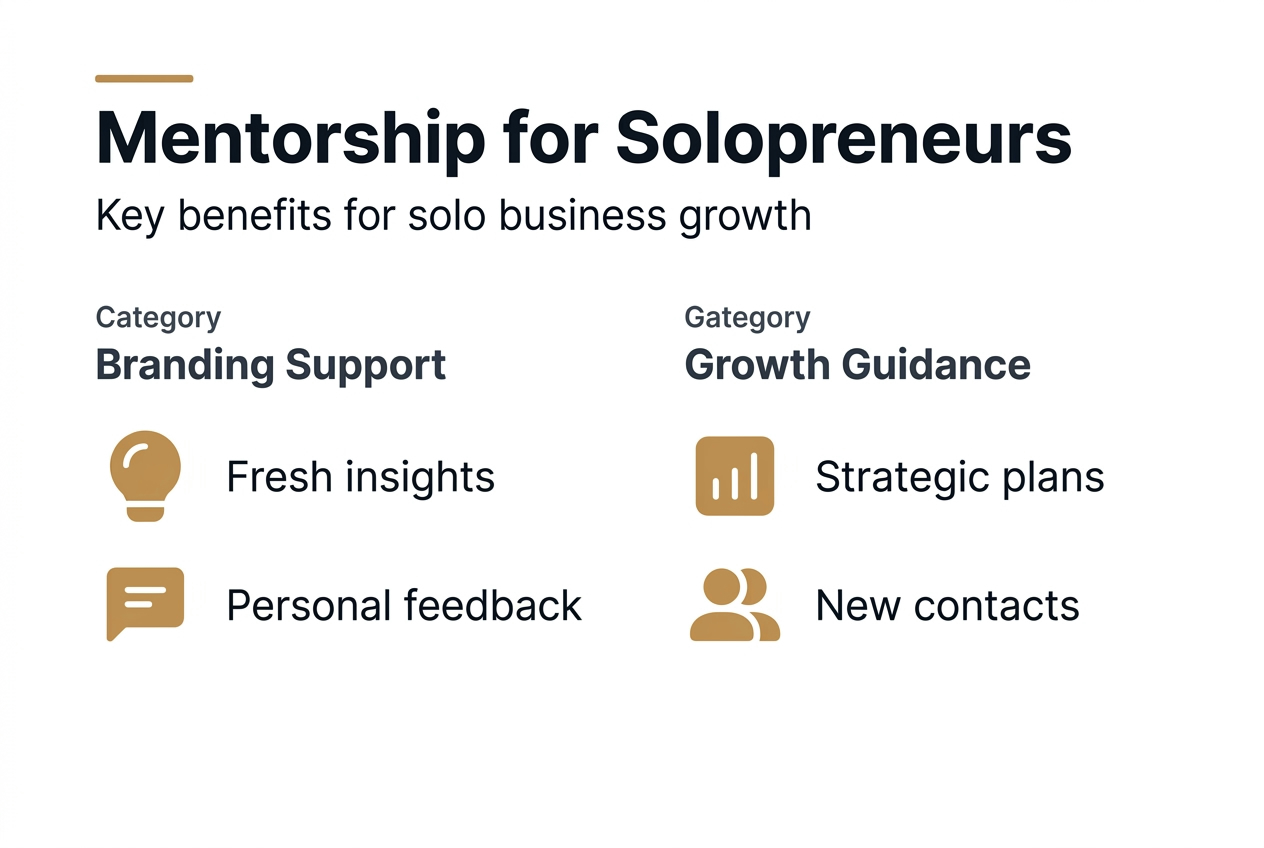
Strategic planning represents another area where mentors save solopreneurs significant time and resources. They’ve seen which strategies work across different market conditions and can steer you away from attractive-sounding approaches that rarely deliver results. Their pattern recognition helps you prioritize high-impact activities over busywork.
Working with mentors to craft powerful branding:
- Document your unique value proposition with mentor feedback
- Test messaging with mentor’s network before broad launch
- Refine visual identity based on mentor market knowledge
- Align content strategy with proven engagement patterns
- Iterate positioning as you receive real market response
Mentors help you build your personal brand on platforms like LinkedIn by sharing what actually works versus common myths. They review your profile, content, and engagement strategy with an expert eye, suggesting specific improvements that increase visibility and credibility.
Pro Tip: Leverage your mentor’s network by asking for introductions to 2-3 strategic connections quarterly. Their endorsement carries weight that cold outreach never achieves.
Strategic business planning becomes more focused with mentor input. They ask tough questions about your business strategy that force clarity on priorities, resource allocation, and growth paths. This accountability prevents the scattered approach many solopreneurs fall into when working without external structure. Mentors push you to define success metrics, set realistic timelines, and track progress systematically.
If you want to get expert feedback on your brand and strategy, booking a short discovery call can help you identify your biggest growth opportunities.
Choosing and working effectively with a mentor
Finding the right mentor requires clarity on what you need and intentional search. Look for advisors who’ve achieved what you’re building toward, demonstrate teaching ability, and show genuine interest in your success. Chemistry matters as much as credentials because you need honest communication for mentorship to work.
Different mentorship types serve different needs:
- Peer mentoring: Exchange with solopreneurs at similar stages for mutual support and accountability
- Expert mentoring: Learn from accomplished entrepreneurs ahead of your current level
- Group mentoring: Benefit from diverse perspectives in structured cohort programs
- Reverse mentoring: Learn new skills from younger professionals with fresh expertise
| Mentorship Style | Best For | Potential Drawback |
|---|---|---|
| One-on-one expert | Personalized strategic guidance | Limited availability, higher cost |
| Peer groups | Ongoing support and accountability | May lack deep expertise |
| Online coaching | Flexible access and lower cost | Less personal connection |
| Formal programs | Structured learning path | Rigid schedules and timelines |
Best practices for productive mentorship relationships:
- Come to meetings with specific questions and challenges
- Implement advice between sessions and report results
- Respect mentor time with preparation and punctuality
- Share wins and progress to keep mentors invested
- Ask for introductions only after establishing value exchange
- Express gratitude and offer help where you can contribute
Understanding business coaching benefits helps you evaluate whether structured coaching programs might complement informal mentorship. Professional coaches bring frameworks and accountability that differ from traditional mentoring, and many successful solopreneurs use both approaches simultaneously for different aspects of growth.
Effective mentorship evolves as your business grows. Early-stage guidance focuses on fundamentals and avoiding critical mistakes. As you mature, mentorship shifts toward scaling challenges, strategic positioning, and industry-specific expertise. Don’t hesitate to add new mentors while maintaining relationships with early advisors who know your journey.
Explore expert resources to elevate your solo business in 2026
Your Solo Business provides comprehensive guides and coaching to accelerate your solopreneur journey alongside mentorship. Our resources on personal branding help you stand out in competitive markets, while our business planning guide ensures strategic clarity.

Whether you’re seeking structured coaching or self-guided learning, our platform connects you with proven strategies tailored specifically for solo entrepreneurs. Combine these expert resources with mentorship to maximize your growth potential and build the profitable, sustainable business you envision.
Alongside these resources, you can also book your free 30-minute consultation for tailored support and strategic clarity.
FAQ
What is the role of a mentor for solopreneurs?
Mentors provide guidance, accountability, and experience-based advice that helps solopreneurs navigate challenges faster than learning through trial and error alone. They offer perspective on strategic decisions, introduce valuable connections, and provide emotional support during difficult periods. The relationship accelerates growth by helping you avoid common mistakes while building confidence.
How can I find the right mentor as a solopreneur?
Look for mentors with relevant industry experience, complementary skills, and communication styles that match your learning preferences. Consider peer mentoring groups for ongoing support and expert mentors for strategic guidance on specific challenges. Chemistry matters, so seek advisors who genuinely invest in your success and demonstrate teaching ability.
Can mentorship improve my work-life balance as a solopreneur?
Mentors coach you on managing the flexibility of solo work while maintaining boundaries that protect both productivity and personal life. Research confirms work-life balance mediates engagement for solopreneurs, and mentors share proven strategies for handling family demands and schedule optimization. Their experience helps you recognize imbalance warning signs before burnout occurs.
What are common mentorship pitfalls to avoid?
Avoid entering mentorship without clear goals, which wastes both parties’ time and creates frustration. Lack of regular communication breaks momentum, while ignoring mentor feedback signals disrespect for their expertise. Come prepared to sessions, implement advice between meetings, and maintain accountability to get maximum value from the relationship.
Recommended
- How mindset drives solopreneur success in 2026
- Solopreneur productivity workflow: 30% faster in 2026
- 2026 Trends in Solopreneurship: AI, Branding, and Burnout
- If you’d like support turning these mentorship insights into a practical plan, you can book a call here.
- What is solopreneur coaching? A guide to growth in 2026