

Entrepreneurs with a growth mindset are 34% more likely to hit business goals. Mindset is a crucial, often overlooked factor for solopreneur success. This guide offers proven strategies to develop the right mindset for resilience, productivity, and growth as you realize mindset’s powerful role in your solo business journey.
Key takeaways
| Point | Details |
|---|---|
| Entrepreneurial mindset involves growth orientation, resilience, and pragmatic optimism | This mental framework shapes how you approach challenges and opportunities in your solo venture |
| Mindset shapes decision-making, stress management, and persistence | Your beliefs and attitudes directly influence business outcomes and personal wellbeing |
| Common myths underestimate the role of mindset versus luck or innate talent | Research shows mindset and learned skills outweigh natural ability in determining success |
| Frameworks like the Entrepreneurial Mindset Canvas help self-assess and improve mindset | Structured models provide actionable pathways for cultivating productive mental habits |
| Practical strategies include mindfulness, positive reframing, and realistic goal setting | Consistent practice of these techniques builds resilience and enhances performance |
Understanding entrepreneurial mindset: foundations and definitions
Entrepreneurial mindset combines beliefs, attitudes, and mental habits that influence business actions. For solopreneurs, this mental framework determines how you respond to challenges, learn from setbacks, and seize opportunities.
Core traits include growth orientation, resilience, and pragmatic optimism. Growth orientation means believing your abilities can expand through effort and learning. Resilience allows you to bounce back from failures and maintain motivation during difficult periods. Pragmatic optimism balances positive expectations with realistic planning and risk awareness.
Mindset matters more than skills alone because it affects learning and adaptation over time. You can acquire technical skills quickly, but without the right mental approach, you’ll struggle to apply them effectively. Your mindset determines whether you view obstacles as roadblocks or stepping stones.
The fixed versus growth mindset concept explains why embracing challenges fuels progress. Fixed mindset assumes abilities are static, leading to avoidance of difficulty and fear of failure. Growth mindset sees challenges as opportunities to develop new capabilities.
Solopreneurs face unique mental demands requiring an intentionally cultivated mindset:
- Managing all business functions alone creates decision fatigue
- Lack of team support increases isolation and stress
- Income volatility demands emotional resilience
- Constant learning across multiple domains requires intellectual humility
- Balancing work and personal life needs strong boundaries
Now that you understand what entrepreneurial mindset is, we’ll uncover the psychological ways it influences your business outcomes.
How mindset shapes entrepreneurial success: psychological mechanisms
Growth mindset improves learning and adaptability to changing challenges. When you believe abilities can develop, you invest more effort in skill acquisition and persist longer through difficulties. This creates a compounding advantage as you accumulate knowledge and experience faster than those with fixed beliefs.

Mindset influences how you perceive and respond to risks and setbacks. Entrepreneurs viewing failure as feedback rather than personal inadequacy recover quickly and extract valuable lessons. They make more experimental decisions, test new approaches, and iterate based on results.
Positive reframing and mindfulness reduce cognitive errors and stress. Mindfulness practices and positive reframing improve decision-making speed by 25% and reduce stress-induced errors by 30%. These mental tools help you maintain clarity during high-pressure situations and avoid reactive choices driven by anxiety or frustration.
Better mindset enhances persistence, problem-solving, and productivity. When you approach problems with curiosity rather than defeat, you generate more creative solutions. This mental flexibility allows you to pivot strategies, explore unconventional approaches, and find opportunities others miss.
Resulting faster decisions and fewer errors improve business performance:
- Reduced analysis paralysis accelerates execution
- Lower stress improves focus and energy management
- Greater resilience sustains productivity workflows through challenges
- Enhanced learning speed shortens skill gaps
- Better emotional regulation prevents burnout
Pro Tip: Track your emotional responses to setbacks for one week. Notice patterns in your self-talk and identify opportunities to reframe negative narratives into growth-oriented perspectives.
Understanding these mechanisms helps debunk some common myths about what mindset can and cannot do.
Common misconceptions about entrepreneurial mindset
Myth 1: Success depends mainly on innate talent or luck. Studies show mindset and learned skills have a larger effect size on outcomes than natural ability or fortunate circumstances. While talent and timing matter, how you respond to opportunities and obstacles determines long-term results.
Myth 2: Optimism alone guarantees success. Many confuse being hopeful with neglecting risk management or strategy. Effective entrepreneurial mindset requires pragmatic optimism that balances positive expectations with realistic assessment of challenges and contingency planning.
Myth 3: Mindset work replaces skill development. Mental frameworks enhance how you learn and apply skills, but they don’t substitute for technical competence. You need both the right mindset and relevant capabilities to build a sustainable solo business.
Ignoring mental health can lead to burnout, harming business sustainability. Many solopreneurs push through exhaustion, believing willpower alone suffices. This approach depletes cognitive resources and increases failure risk.
Effective mindset requires combining positivity with skill development:
- Assess your current mental patterns honestly
- Identify specific skills gaps in your business
- Create learning plans that address both mindset and competencies
- Practice stress management techniques regularly
- Build support systems to maintain perspective
- Set realistic milestones that acknowledge current constraints
Pro Tip: Schedule monthly mindset check-ins where you review your self-talk patterns, stress levels, and learning progress. Adjust your strategies based on what’s working and what needs refinement.
With misconceptions cleared, let’s compare proven mindset frameworks that solopreneurs can use to improve themselves systematically.
Comparing mindset frameworks and models for entrepreneurs
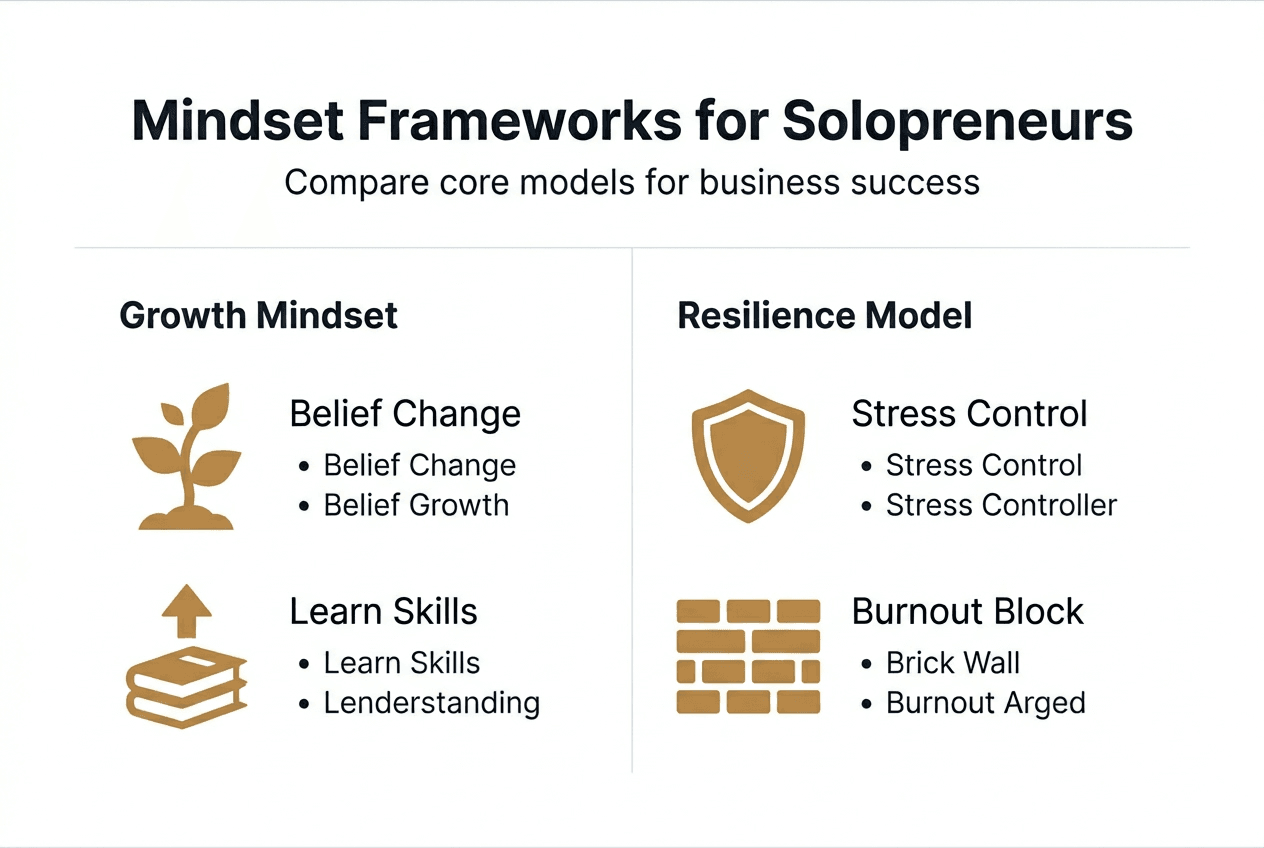
Growth versus fixed mindset highlights belief in ability to develop through effort. This foundational framework helps you recognize when you’re avoiding challenges due to fear of inadequacy. It provides a simple lens for evaluating your responses to difficulty.
Entrepreneurial Mindset Canvas offers holistic self-assessment across mindset dimensions. This tool examines multiple facets including risk tolerance, learning orientation, resilience, creativity, and strategic thinking. It provides a comprehensive profile revealing specific areas for development.
Resilience and self-compassion models focus on mental health and burnout prevention. These frameworks emphasize emotional regulation, stress recovery, and maintaining sustainable work practices. They’re particularly valuable for solopreneurs facing isolation and high workload demands.
| Framework | Primary Focus | Best For | Key Practice |
|---|---|---|---|
| Growth Mindset | Ability development | Learning orientation | Embrace challenges |
| Mindset Canvas | Comprehensive assessment | Strategic planning | Regular self-evaluation |
| Resilience Model | Stress management | Burnout prevention | Build recovery habits |
| Self-Compassion | Emotional wellbeing | Mental health | Practice self-kindness |
Each framework serves distinct needs: learning, emotional regulation, or planning. Growth mindset excels at fostering continuous improvement and skill acquisition. Resilience models protect against the unique stresses of solo entrepreneurship. Self-compassion frameworks prevent the harsh self-criticism that undermines confidence and motivation.
Choosing the right model depends on current challenges faced as a solopreneur:
- Struggling with new skills? Focus on growth mindset practices
- Feeling overwhelmed? Prioritize resilience building
- Experiencing self-doubt? Apply self-compassion techniques
- Planning next quarter? Use the Mindset Canvas for assessment
You can integrate multiple frameworks by addressing different needs sequentially. Start with whichever area causes the most immediate friction in your business planning and strategy development.
Armed with framework knowledge, you’re ready to apply mindset strategies practically to fuel your solo business growth.
Applying mindset strategies: practical steps for solopreneurs
Step 1: Assess your current mindset using tools like the Entrepreneurial Mindset Canvas. Complete a structured self-evaluation examining your beliefs about ability, approach to risk, response to failure, and learning habits. Identify 2-3 specific areas where limiting beliefs constrain your business decisions.
Step 2: Build resilience with mindfulness, self-compassion, and stress management. Start a daily 10-minute mindfulness practice focusing on breath awareness and present moment attention. When setbacks occur, practice self-compassion by acknowledging difficulty without harsh judgment. Develop stress management routines including regular breaks, physical activity, and clear work boundaries.
Step 3: Cultivate growth by embracing feedback, experimenting, and reframing failure. Actively seek input from clients, mentors, and peers. View critical feedback as valuable data rather than personal attack. Run small experiments to test new approaches, treating failures as learning opportunities that refine your strategy.
Step 4: Practice pragmatic optimism through goal-setting and contingency planning. Set ambitious yet achievable goals with clear milestones. For each goal, identify potential obstacles and develop backup plans. This combination of positive vision and realistic preparation builds confidence without creating blind spots.
Entrepreneurs who practice mindfulness and positive reframing significantly improve their performance metrics. Consistent practice leads to improved decision-making, adaptability, and wellbeing:
- Morning mindfulness routine sets positive tone
- Weekly reflection on lessons learned from challenges
- Monthly goal review with contingency adjustments
- Quarterly mindset canvas reassessment
- Regular connection with supportive community
Pro Tip: Create a “failure log” documenting setbacks and extracting specific lessons. Review quarterly to identify patterns and track how your response to difficulty evolves over time.
These practices integrate naturally with your solopreneur journey and business planning processes. Start with one technique, establish consistency, then layer additional practices as habits solidify.
To see these strategies in action, let’s consider real-world case studies showing measurable business improvements.
Case studies and real-world examples
A digital marketer improved client acquisition by adopting growth mindset methods. After plateauing at 3 clients monthly, she reframed rejection as feedback and systematically tested new outreach approaches. Within six months, her client acquisition doubled while closing rates improved 40%.
Resilience training helped solopreneurs reduce burnout and sustain consistent productivity. One consultant struggling with 60-hour weeks implemented mindfulness and boundary-setting practices. His work hours decreased to 45 weekly while revenue remained stable, and client satisfaction scores increased due to improved focus.
Entrepreneurship coaching focusing on mindset led to faster, more confident decision-making. A software developer paralyzed by analysis used reframing techniques to view decisions as experiments rather than permanent commitments. Her product launch timeline shortened by three months.
Common themes include persistent learning, stress regulation, and realistic optimism:
- Viewing setbacks as data rather than defeat
- Maintaining regular self-assessment practices
- Building supportive accountability structures
- Balancing ambition with self-compassion
- Integrating mental health practices into daily routines
These examples prove mindset cultivation is a practical tool, not just theory. Each solopreneur faced specific challenges requiring targeted mental shifts. Success came from consistent application of frameworks matched to their situations, not overnight transformation.
The digital marketer used growth mindset to overcome fear of rejection. The consultant applied resilience practices to prevent burnout. The developer employed pragmatic optimism to reduce decision paralysis. Your optimal approach depends on your current obstacles and goals.
Finally, let’s connect mindset development to long-term business growth and personal wellbeing for sustained solo success.
Bridging mindset to business growth and personal wellbeing
Mindset practices increase productivity while preventing burnout through resilience. Building resilience reduces burnout risk significantly and sustains motivation in solo entrepreneurs. When you maintain healthy mental habits, you work more effectively without depleting your energy reserves.
Sustained motivation comes from balanced optimism and adaptability. Setting realistic goals with contingency plans maintains momentum through inevitable obstacles. Celebrating small wins reinforces positive patterns while honest assessment of challenges prevents denial.
Mental habits enhance integration of mindset with business strategy and personal branding. Your mindset shapes how you present yourself, respond to market feedback, and pivot strategies. Resilient entrepreneurs adapt their brands and offerings based on learning rather than clinging to failing approaches.
A healthy entrepreneurial mindset supports both personal wellbeing and business growth:
- Regular self-assessment prevents drift from values and goals
- Stress management preserves cognitive capacity for strategic thinking
- Growth orientation accelerates skill development as markets evolve
- Self-compassion maintains confidence through setbacks
- Pragmatic optimism balances ambition with realistic planning
To further support your journey, explore related solopreneur resources and expert guidance below.
Explore solopreneur business planning and growth resources
Developing the right mindset creates a foundation for business success, but you need practical tools to translate mental shifts into tangible results. Our comprehensive business planning guide helps you structure your vision into actionable steps that align with your growth-oriented mindset.

Your personal brand amplifies your solo business by communicating your unique value. Learn proven personal branding strategies to differentiate yourself and attract ideal clients who resonate with your approach.
Sometimes the fastest path to mindset transformation comes through expert guidance. Discover how business coaching can accelerate your mental shifts and provide accountability for implementing the strategies that drive sustainable growth.
Frequently asked questions
What is the entrepreneurial mindset and why is it important?
Entrepreneurial mindset is a set of attitudes and mental habits enabling effective solo business success. It encompasses growth orientation, resilience, pragmatic optimism, and adaptive thinking. This mental framework impacts resilience, decision-making, and adaptability, which are crucial for navigating solo challenges like isolation, income volatility, and constant learning demands.
How can I develop a growth mindset as a solopreneur?
Begin with self-assessment using frameworks like the Entrepreneurial Mindset Canvas to identify limiting beliefs. Embrace learning from failure by treating setbacks as feedback rather than personal inadequacy. Seek regular feedback from clients and mentors, then practice positive reframing to extract lessons. Applying consistent habits like daily mindfulness and weekly reflection enhances growth mindset over time, particularly when integrated with your solopreneur journey planning.
What are the best strategies to overcome fear of failure?
Use mindfulness to manage anxiety by practicing present moment awareness and recognizing that fear is a natural response to uncertainty. Break intimidating tasks into manageable steps to reduce overwhelm and build momentum through small wins. Reframe mistakes as learning opportunities by maintaining a failure log that documents lessons extracted from setbacks. Building resilience and self-compassion reduces fear’s impact on decision-making by replacing harsh self-criticism with constructive self-evaluation, especially important for avoiding common reasons solopreneurs fail.
How does mindset affect long-term business growth and wellbeing?
A resilient mindset prevents burnout and promotes sustained motivation by helping you maintain healthy boundaries and stress management practices. Building resilience reduces burnout risk significantly and sustains motivation in solo entrepreneurs. Positive mindset integration with business strategy fosters steady growth and wellbeing by enabling you to adapt to market changes, learn from feedback, and maintain perspective during difficult periods. This balance protects both your business sustainability and personal health, making mindset work essential for avoiding burnout.