
Every solopreneur knows the feeling of trying to grow a business while juggling every responsibility alone. Pinpointing exactly what your market needs and where your strengths truly shine is the first real game plan for progress. By combining market research and direct self-assessment, you can find your competitive edge, reduce unnecessary risk, and start making choices with clarity instead of guesswork. This approach lays a practical foundation for smarter business growth and stronger personal branding.
Quick Summary
| Key Insight | Explanation |
|---|---|
| 1. Understand market needs | Research demographics, pain points, and competition to identify customer needs and gaps in the market. |
| 2. Set SMART business objectives | Define specific, measurable, achievable, relevant, and time-bound goals to guide your strategy effectively. |
| 3. Develop clear action plans | Break objectives into concrete initiatives with assigned responsibilities, timelines, and success metrics for clarity. |
| 4. Monitor performance consistently | Regularly track key metrics and evaluate actions to determine what works and what needs adjustment. |
| 5. Adapt based on results | Use performance data to refine strategies and capitalize on effective tactics while eliminating ineffective ones. |
Step 1: Assess your market and personal strengths
Before you build a business strategy, you need to understand two things: what your market actually wants and what you’re genuinely great at. This step is about getting clarity on both so you can position yourself strategically.
Start by researching your market. You’re looking for real data about who your potential customers are, what problems they face, and how crowded your space is. Use market research and competitive analysis to understand market size, customer demographics, and demand for your services. You don’t need expensive tools or consultants for this—begin with what’s publicly available.
Here’s what to gather:
- Demographics of your ideal customers (age, income, location, industry)
- Market size and growth trends in your niche
- What your competitors are offering and how they’re positioning themselves
- Customer pain points and unmet needs in your market
- Pricing ranges and service delivery models others use
Next, dig into direct customer research. Reach out to people in your target market through informal conversations, surveys, or small focus groups. Ask them what keeps them up at night, what solutions they’ve already tried, and why those didn’t work. This raw feedback is gold.
Now for the personal side. You need an honest assessment of your own strengths, weaknesses, opportunities, and threats. A personal SWOT analysis works beautifully for this—it forces you to examine your unique skills, areas where you need to grow, external opportunities you could capitalize on, and potential risks you face. The key word here is honest. This isn’t about ego; it’s about knowing exactly where you stand.
Your competitive advantage comes from the intersection of what the market needs and what only you can deliver.
Write down your core strengths. What skills do you have that clients actually value? What experience sets you apart? Don’t be modest here—be specific. Instead of “good at marketing,” write “skilled at creating email campaigns that convert leads at 22% above industry average.”
Then acknowledge your weaknesses. Every solopreneur has gaps. Maybe you’re uncomfortable with sales conversations, or you struggle with administrative tasks, or technical skills aren’t your strong suit. Naming these directly helps you plan around them.

Pro tip: Create a one-page comparison chart with your strengths in one column and your competitors’ strengths in another—this instantly shows you where you have a genuine edge.
Step 2: Define clear business objectives
Vague goals like “grow my business” or “make more money” won’t cut it. You need specific, measurable targets that guide every decision you make. This step turns your vision into actionable objectives.
Start by using the SMART framework to shape your goals. Your objectives should be specific (exactly what do you want?), measurable (how will you know you succeeded?), achievable (is this realistic for you?), relevant (does it align with your market and strengths?), and time-bound (when will you accomplish it?). This framework keeps you from spinning your wheels on vague aspirations.
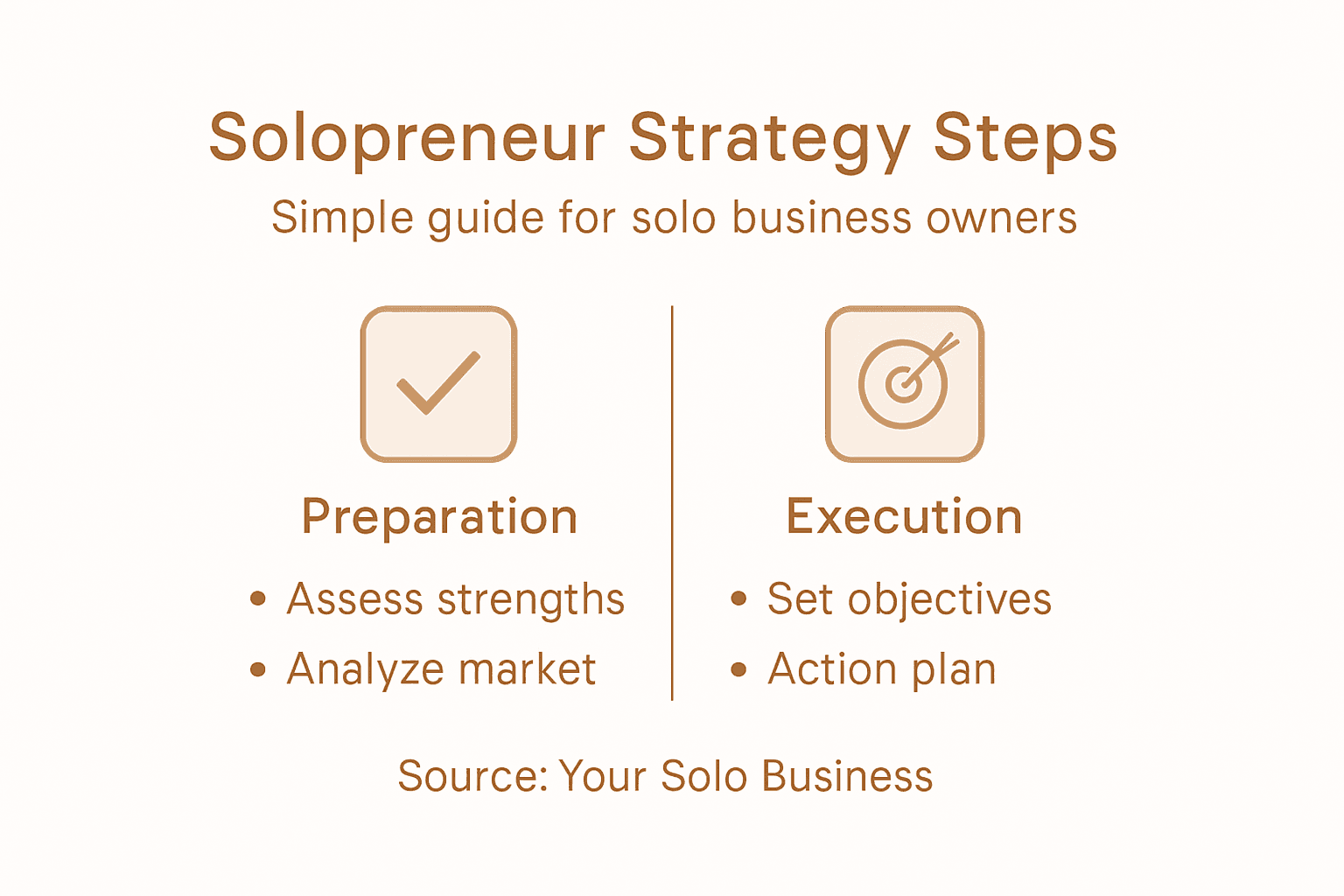
Instead of “increase clients,” write “secure 5 new service contracts worth $50,000 total revenue by end of Q2.” Instead of “improve my online presence,” write “publish 2 blog posts monthly and grow email list to 500 subscribers by December.” See the difference? You know exactly what success looks like.
Consider using SMART business objectives to align your goals with your overall vision. When objectives are clear, every action you take either moves you toward them or it doesn’t. That clarity is powerful.
Break your objectives into categories:
Here is a summary comparing the types of objectives you might set as a solopreneur:
| Objective Category | Example Target | Business Impact |
|---|---|---|
| Revenue | $50,000 quarterly service contracts | Enables growth and profitability |
| Client Acquisition | 5 new clients by Q2 | Expands client base |
| Service Quality | Launch new service option | Boosts differentiation |
| Skills Development | Attend two online courses | Strengthens core capabilities |
| Personal Sustainability | 30-hour work weeks, 3 weeks off yearly | Supports long-term motivation |
- Revenue and profitability targets
- Client acquisition and retention goals
- Service quality or scope expansion
- Skills or knowledge you need to develop
- Personal sustainability (income, work hours, lifestyle)
Now, think about what resources and capabilities you’ll need to hit these targets. Do you need to learn new skills? Invest in tools? Hire contractors for certain tasks? Identifying gaps early helps you plan your strategy.
Review and update your objectives regularly. Your market changes, your capacity grows, and opportunities emerge. Objectives that made sense six months ago might need adjustment based on what you’ve learned.
Clear objectives turn your business vision into a roadmap with actual milestones.
Pro tip: Write your three most important objectives on a sticky note and place it where you work daily—this keeps your strategy visible and prevents you from drifting toward busywork that doesn’t matter.
Step 3: Develop actionable strategy plans
Having clarity on your market and objectives is great, but without a concrete plan, you’re just hoping things work out. This step turns your strategy into specific, executable actions that move you toward your goals.
Start by identifying your go-to-market strategy. This means choosing how you’ll actually reach and convert your target customers. Will you focus on direct outreach, content marketing, referrals, or partnerships? Your approach should match your strengths, resources, and what your target market responds to. Don’t try to do everything at once.
Using strategic decision-making frameworks helps you evaluate which paths make sense for your specific situation. Consider what aligns with your values and capabilities, not just what sounds trendy or what worked for someone else.
Next, conduct thorough research on your niche and competitors. Understand who you’re up against and how you’ll differentiate. What can you offer that they can’t or won’t? This isn’t about being better at everything—it’s about finding your unique angle.
Break your strategy into concrete quarterly or monthly initiatives:
- Define the specific action (example: launch email newsletter)
- Identify who’s responsible (that’s you, or someone you delegate to)
- Set the timeline (by end of month, starting next week)
- Determine success metrics (500 subscribers by month three)
- Allocate resources needed (time, tools, budget)
When you develop actionable strategy plans, each tactic should ladder up to one of your core objectives. If your goal is to land five new clients by Q2, your plan might include starting a referral program, publishing case studies, and attending two industry networking events. Every action has a purpose.
Write everything down. A strategy that lives only in your head gets forgotten when unexpected problems pop up. A written plan keeps you anchored.
Your strategy is only as good as your execution. Pick initiatives you’ll actually complete.
Pro tip: Focus on three to five major initiatives per quarter rather than a massive list—this prevents overwhelm and lets you actually complete what you start.
Step 4: Implement and monitor your strategy
Plans mean nothing if they sit in a document gathering dust. This step is about taking action and then watching what happens so you can adjust course as needed.
Start by assigning yourself clear ownership of each initiative. As a solopreneur, that’s usually you, but be explicit about what you’re accountable for and by when. This prevents things from falling through the cracks when life gets busy.
Then actually execute. Start with your highest-priority initiatives and work through them systematically. Some actions will feel uncomfortable at first, and that’s normal. Pushing through the discomfort is where real progress happens.
Now comes the critical part: strategy implementation requires continuous monitoring. You need to track whether your actions are producing the results you expected. This isn’t about obsessing over metrics daily. It’s about checking in regularly.
Set up simple performance tracking:
- Revenue and profit (are you hitting financial targets?)
- Client acquisition (are you landing new customers?)
- Activity completion (are you executing your planned initiatives?)
- Market feedback (what are customers telling you?)
- Competitor movements (are they changing their approach?)
Review your performance monthly or quarterly. Look at what’s working and what isn’t. Maybe your email strategy is converting at 8 percent but your webinar approach is only reaching five people. That’s useful data. Double down on what works and adjust what doesn’t.
Being willing to adapt your strategy based on performance keeps you from wasting time on ineffective tactics. Markets shift, customers change their preferences, and your own capacity evolves. Your strategy should flex with these realities.
If something isn’t working after a genuine effort, pivot. Don’t abandon it after two weeks, but don’t cling to it for a year either. Six to eight weeks is usually enough time to see if a tactic is worth continuing.
The best strategy is one you actually implement and adjust based on real results.
Pro tip: Create a simple one-page monthly review template tracking your three key metrics, noting what worked, what didn’t, and one adjustment you’ll make next month.
Step 5: Refine your approach based on results
Your strategy isn’t set in stone. The best business leaders treat their plans like living documents that evolve as they learn what actually works. This step is about using your performance data to get smarter.
Start by comparing your actual results against your objectives. Did you land those five new clients? Did your email list grow to 500 subscribers? Where did you hit your targets and where did you fall short? This honest assessment is where refinement begins.
Analyze the gaps. If you missed a goal, dig into why. Was the tactic itself flawed, or did you not execute it fully? Did market conditions change? Did you underestimate the time needed? The reason matters because it determines your next move.
When you evaluate results against objectives and KPIs, you gain clarity on what’s truly working. Maybe your referral strategy brought in three clients while your paid ads brought in zero. That’s your signal to invest more in referrals and reconsider your ad approach.
Look for patterns across your data:
- Which marketing channels deliver the best return on your effort?
- Which client types are easiest to work with and most profitable?
- What time of year sees higher demand for your services?
- Which initiatives took less effort than expected?
- Where did you encounter unexpected obstacles?
Use these insights to redefine your strategy. Scale what’s working, reduce or eliminate what’s draining resources, and test new approaches based on what you’ve learned. This isn’t about chasing every shiny opportunity. It’s about doubling down on your competitive advantages.
Responding to new opportunities and correcting inefficiencies keeps your strategy fresh and relevant. Markets evolve, customer preferences shift, and you grow as a business owner. Your approach should adapt to these changes.
To help you refine your business approach, here’s a table summarizing how to evaluate performance and adapt:
| Metric Assessed | Common Challenge | Suggested Adjustment |
|---|---|---|
| Client Growth | Low conversion rates | Revamp outreach strategy |
| Revenue Targets | Sluggish sales | Try alternate pricing models |
| Marketing Results | Poor engagement | Shift to higher ROI channels |
| Initiative Completion | Missed deadlines | Simplify project scope |
| Customer Feedback | Unmet needs reported | Enhance service offerings |
Schedule quarterly strategy refinement sessions. Block two hours on your calendar, review your performance data, and decide what stays, what changes, and what gets added.
The solopreneurs who win aren’t the ones with perfect first strategies. They’re the ones who learn fastest and adjust accordingly.
Pro tip: Document one key insight from each quarter and one specific change you’re making because of it—this creates a record of your strategic evolution and shows patterns over time.
Take Control of Your Solopreneur Strategy with Proven Guidance
Crafting a clear and actionable business strategy can feel overwhelming when you are managing everything on your own. This article highlights key challenges like identifying your unique strengths, setting specific goals, and turning plans into reality without burning out. If you find yourself struggling to define measurable objectives or unsure how to translate your market research into practical steps, you are not alone.
At Your Solo Business, we specialize in helping solopreneurs like you overcome these exact hurdles. Explore our extensive resources on Plan Your Business for actionable insights that simplify strategy development. Learn smart ways to Grow Your Online Presence and connect with a supportive community focused on sustainable success.

Don’t wait until confusion stalls your progress. Visit Your Solo Business now to access expert guidance and start turning your vision into results today.
Frequently Asked Questions
How can I assess my market for creating a business strategy as a solopreneur?
Begin by conducting market research to gather data on potential customers, their demographics, and existing solutions. Identify customer pain points and analyze your competitors to understand the landscape within 30 days.
What should I include in my personal SWOT analysis as a solopreneur?
Your personal SWOT analysis should include your strengths, weaknesses, opportunities, and threats. Focus on defining specific skills and experiences that set you apart and identify areas where you need to improve or seek help.
How do I set measurable business objectives?
Use the SMART framework to create specific, measurable, achievable, relevant, and time-bound objectives. For example, aim to secure 5 new clients by the end of Q2, providing a clear target for your business growth efforts.
What steps should I take to implement my business strategy?
Assign clear responsibility for each initiative and start executing your highest-priority actions. Keep track of your progress and adjust based on performance, aiming for regular reviews (monthly or quarterly) to ensure you’re on track.
How can I refine my strategy based on results?
Evaluate your performance by comparing actual results with your established objectives. Identify gaps and adjust your plan accordingly, setting time for quarterly sessions to assess what’s working and what needs change.
What tools can help me monitor the execution of my strategy?
Utilize simple performance tracking methods like spreadsheets or project management tools to monitor key metrics. For effective tracking, consider focusing on three to five major metrics monthly that link directly to your objectives.