

Many solopreneurs struggle to start growing their business due to lack of clear plan. Businesses with structured growth plans are 30% more likely to report year-over-year revenue growth. This guide offers an actionable roadmap customized for solo businesses. You will learn practical steps to grow sustainably and boost productivity, addressing the specific challenges independent entrepreneurs face when scaling.
Key takeaways
| Point | Details |
|---|---|
| Clear roadmaps improve success | Structured plans boost solopreneur growth likelihood by providing focused direction and measurable milestones. |
| Prerequisites matter | Market clarity, financial health checks, and essential tools must be in place before executing growth strategies. |
| Stepwise execution works | Goal setting, marketing consistency, productivity optimization, and networking drive sustainable expansion. |
| Avoid common mistakes | Unclear goals, inconsistent marketing, poor time management, and ignoring finances derail growth efforts. |
| Measure what matters | Track revenue growth, client acquisition rates, and productivity metrics to validate progress and adjust plans. |
Understanding the business growth roadmap
A business growth roadmap is a structured, stepwise plan tailored for solo businesses to guide growth activities. It provides clarity, focus, and measurable progress tracking while addressing typical solo business challenges like limited resources and solo workload. Structured growth plans significantly increase business success rates among solo entrepreneurs.
The roadmap boosts likelihood of sustainable growth and reduces burnout risks by breaking ambitious goals into manageable actions. It facilitates balancing ambition with practical execution, ensuring you maintain momentum without overwhelming yourself.
Key benefits include:
- Transforms vague aspirations into concrete, actionable steps you can execute weekly
- Creates accountability through measurable milestones and progress indicators
- Reduces decision fatigue by providing a clear framework for prioritizing activities
- Prevents resource waste by focusing efforts on high-impact growth strategies
- Supports long-term sustainability by incorporating rest and capacity planning
Unlike corporate growth plans requiring extensive teams and budgets, solopreneur roadmaps emphasize lean, efficient strategies. You focus on what is business growth means for your specific situation, not generic expansion formulas. The top business growth strategies for solopreneurs center on maximizing your unique strengths while managing workload realistically.
Pro Tip: Start your roadmap by identifying your single most valuable client type, then build all growth activities around attracting more of them.
Prerequisites before starting your growth journey
Self-assessment of skills, motivation, and business readiness is vital before implementing any growth plan. Clear market and niche definition ensures targeted growth efforts that resonate with your ideal clients. Baseline financial health check including cash flow management is needed to support expansion without creating cash crunches.

Set up essential tools before you begin. CRM systems help track client relationships and opportunities. Project management apps organize tasks and deadlines. Time tracking tools reveal where your hours actually go, exposing inefficiencies.
Willingness to learn and adopt productivity methods like time-blocking is crucial for solo success. Without dedicated focus periods, growth activities get crowded out by daily operations.
Key preparations include:
- Honest evaluation of your current capacity and available hours for growth work
- Clear definition of your target market’s pain points and how you solve them uniquely
- Three months of operating expenses saved to buffer against revenue fluctuations
- Basic technology stack including email marketing, scheduling, and invoicing tools
- Commitment to consistent weekly review sessions to monitor progress and adjust tactics
The business planning checklist solopreneurs provides a comprehensive framework for assessing readiness. Use the solopreneur business planning guide 2026 boost success to validate you have foundational elements in place before scaling efforts.
Pro Tip: If you lack clarity on your niche, pause growth planning and spend two weeks interviewing your best existing clients about why they chose you.
Step-by-step implementation of the growth roadmap
Step 1: Conduct honest self-assessment and define your market niche. Identify what you do exceptionally well and which client segments value that most. Document your unique value proposition in one clear sentence.
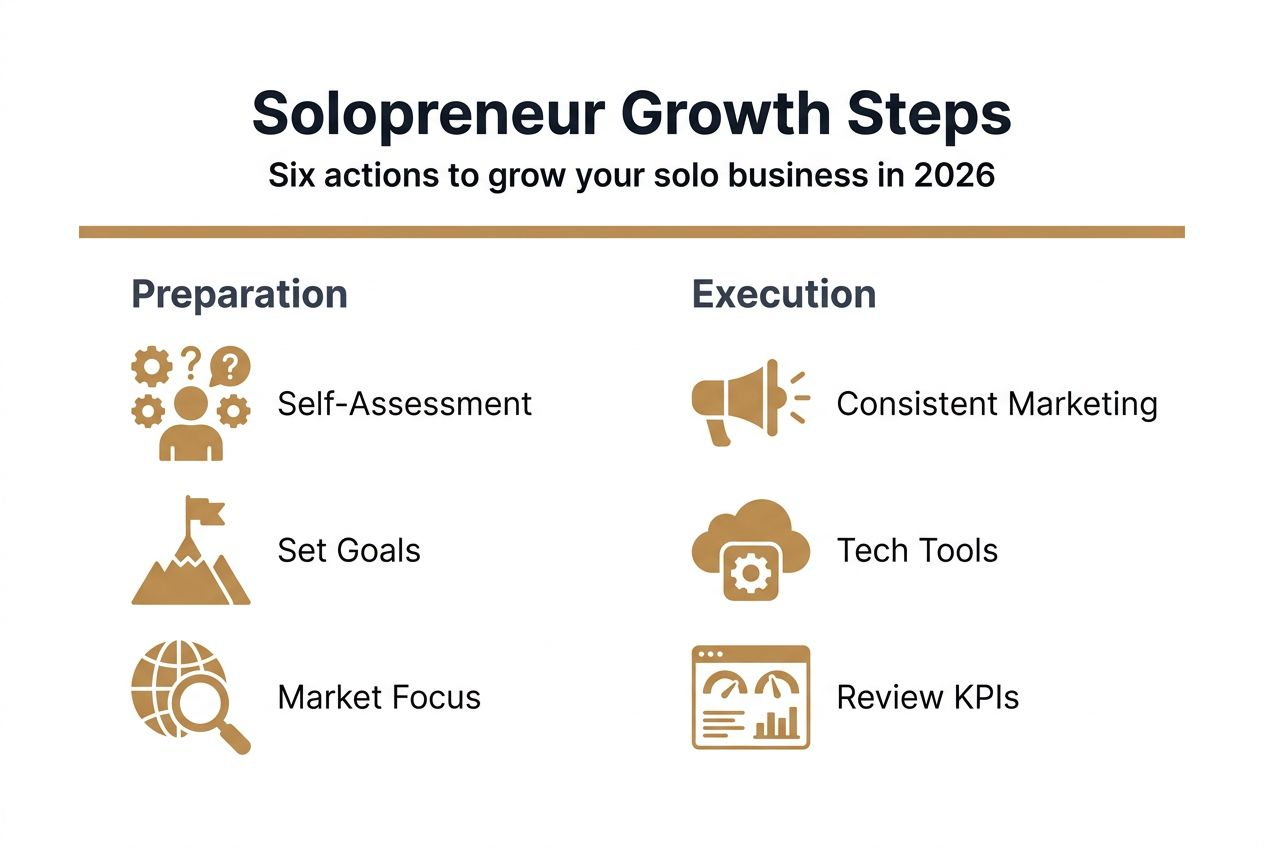
Step 2: Set SMART goals tied to measurable outcomes like revenue and clients. Instead of “grow my business,” specify “acquire 5 new clients at $2,000 average project value by June 2026.” Set business goals boost solopreneur success by creating accountability and direction.
Step 3: Prioritize focused marketing and consistent client acquisition tactics. Choose two marketing channels where your ideal clients actively seek solutions. The role social media solopreneurs play varies by industry, so select platforms strategically rather than spreading yourself thin.
Step 4: Adopt productivity techniques such as time-blocking to optimize workflow. Solopreneur productivity workflow 30 percent faster 2026 methods protect growth time from operational distractions. Dedicate specific hours weekly to business development activities.
Step 5: Leverage technology tools and build supportive networks. Automate repetitive tasks like invoicing and appointment scheduling. Connect with fellow solopreneurs for accountability and idea exchange.
Step 6: Regularly review financials and key performance indicators to track growth. Structured KPI tracking correlates strongly with sustained business expansion. Monthly reviews let you spot trends early and adjust strategies before problems compound.
Monitor these essential KPIs:
| KPI | Target | Measurement Frequency |
|---|---|---|
| Monthly revenue growth | 5-10% increase | Monthly |
| Client acquisition rate | 2-3 new clients monthly | Monthly |
| Productivity score | 80% billable hours | Weekly |
| Burnout indicators | Under 50 hours/week | Weekly |
| Marketing conversion | 10-15% inquiry to client | Monthly |
Pro Tip: Schedule your KPI review sessions on your calendar like client meetings so they never get skipped during busy periods.
Common mistakes and how to avoid them
Unclear or unrealistic business goals impede progress because you cannot measure success or allocate resources effectively. Fix this by setting SMART goals aligned to your actual capacity and market conditions. Vague aspirations like “make more money” provide no actionable direction.
Inconsistent marketing and client engagement cause stalled growth when prospects forget about you between sporadic outreach attempts. Fix by scheduling and tracking marketing activities weekly. Treat marketing like a client commitment you cannot cancel.
Poor time management leads to burnout and missed opportunities as urgent tasks constantly override important growth work. Fix using time-blocking and ruthless prioritization. Protect growth hours the same way you protect client delivery time.
Ignoring financial health risks cash flow problems that force you to accept wrong-fit clients or make desperate pricing decisions. Fix by scheduling regular financial reviews, even when things seem fine. Early detection prevents crises.
Burnout prevention is essential for sustainable growth. Balance workload and set realistic expectations about what one person can accomplish. The solopreneur business planning guide 2026 boost success emphasizes building sustainable rhythms over heroic sprints.
Avoid these critical errors:
- Copying competitor strategies without adapting them to your unique strengths and market position
- Neglecting existing client relationships while chasing new prospects, creating revenue instability
- Saying yes to every opportunity instead of filtering for ideal-fit work that supports your goals
- Skipping recovery time between intensive project periods, accumulating exhaustion debt
- Making major strategy changes based on one bad week instead of identifying actual trends
Growth without sustainability is just a fast track to burnout. Your roadmap must protect your energy as fiercely as it pursues revenue.
Pro Tip: Create a “stop doing” list alongside your growth plan, eliminating low-value activities that drain time without supporting your goals.
Expected timelines and measuring success
Typical timeline to see measurable growth is 6 to 12 months when executing your roadmap consistently. Quick wins may appear within weeks, but sustainable momentum requires patience and disciplined execution. Different growth strategies produce results at different speeds.
Key metrics to track include monthly revenue growth rates, client acquisition increase, productivity gains, and burnout signs. Tracking 3-5 KPIs improves growth sustainability by 40% among solo entrepreneurs. Focus on metrics you can actually influence through your actions.
Regular monitoring allows timely adjustments and prevents wasted effort on ineffective tactics. Setting intermediate benchmarks maintains motivation and focus when the ultimate goal feels distant.
Track progress with these milestone targets:
| Timeline | Revenue Target | Client Target | Productivity Target |
|---|---|---|---|
| Month 3 | 10% increase | 3 new clients | 70% billable hours |
| Month 6 | 25% increase | 8 new clients | 75% billable hours |
| Month 9 | 40% increase | 12 new clients | 80% billable hours |
| Month 12 | 50% increase | 15 new clients | 80% billable hours |
These targets assume consistent effort and market conditions. Your actual results depend on your industry, starting point, and execution quality. Adjust benchmarks based on your specific situation rather than forcing unrealistic expectations.
Measure these indicators monthly:
- Revenue growth percentage compared to same period last year
- Number of qualified leads generated through marketing activities
- Conversion rate from initial inquiry to signed client
- Average project value and how it trends over time
- Client retention rate and repeat business percentage
- Hours worked weekly and stress level self-assessment
The solopreneur productivity workflow 30 percent faster 2026 guide helps optimize your measurement systems for maximum insight with minimum tracking burden.
Alternative approaches and tradeoffs
Rapid scaling strategy focuses on aggressive client acquisition and revenue growth within 12 to 18 months. This approach offers faster revenue gains and market presence but risks burnout and requires more resources upfront. You invest heavily in marketing, potentially hire contractors, and prioritize volume.
Niche specialization approach builds deep expertise in a specific market segment, commanding premium pricing through authority. This leads to slower growth but lowers burnout risk and supports long-term sustainability. You focus on becoming the go-to expert rather than serving everyone.
Tradeoffs include balancing revenue speed against personal well-being and lifestyle preferences. Selecting approach depends on your individual capacity, market dynamics, and business goals.
| Approach | Pros | Cons | Best For |
|---|---|---|---|
| Rapid Scaling | Fast revenue growth, quick market presence | High burnout risk, requires capital | Those with resources and high risk tolerance |
| Niche Specialization | Premium pricing, lower competition, sustainable pace | Slower revenue growth, smaller market | Those prioritizing lifestyle and long-term value |
| Hybrid Model | Balanced growth, flexibility to adjust | Requires careful management, potential confusion | Experienced solopreneurs with clear boundaries |
Consider these factors when choosing:
- Your current financial runway and ability to invest in growth before seeing returns
- Personal energy levels and whether you thrive under pressure or need steady pacing
- Market saturation in your space and whether differentiation or volume matters more
- Long-term vision for your business and whether you plan to eventually sell or scale with team
Neither approach is inherently better. The solopreneur business planning guide 2026 boost success helps evaluate which strategy aligns with your situation and values.
Summary and next steps
Growth readiness requires preparation, clear goals, and consistent execution. The roadmap transforms overwhelming ambitions into manageable weekly actions that compound over time. Avoid common pitfalls by monitoring goals, marketing consistency, time management, and financial health religiously.
Regularly measure KPIs to validate progress and adjust plans when data reveals better opportunities or emerging problems. Be prepared to refine and adapt your roadmap as you learn what works in your specific market and situation.
Key principles for success:
- Start with honest assessment of capacity and market position before setting ambitious targets
- Choose growth strategies that align with your energy, resources, and long-term vision
- Protect time for both growth activities and recovery to prevent burnout cycles
- Track meaningful metrics monthly and adjust tactics based on actual data, not assumptions
- Build support networks with fellow solopreneurs who understand the unique challenges you face
Next steps include using the business planning checklist solopreneurs to validate your readiness. Apply how to create business strategy solopreneurs frameworks to document your specific roadmap. Schedule your first monthly review session now, before diving into execution.
Pro Tip: Write your roadmap in a shared document you review weekly, updating it as you learn rather than treating it as a static plan you created once.
Take your growth to the next level with expert support
Ready to accelerate your solo business growth with proven frameworks and expert guidance? The solopreneur business planning guide 2026 boost success provides comprehensive planning resources tailored for independent entrepreneurs.

Strategic personal branding attracts ideal clients and builds authority in your niche. Explore personal branding tips solo business to differentiate yourself in crowded markets. Learn how to build your personal brand on LinkedIn to leverage the platform’s professional network for sustainable client acquisition. Your Solo Business offers actionable strategies and community support designed specifically for solopreneurs navigating growth challenges in 2026.
FAQ
What is a business growth roadmap for solopreneurs?
A business growth roadmap for solopreneurs is a tailored plan outlining steps to grow a solo business sustainably, focusing on clear goals, productivity optimization, and resource management. It differs from corporate plans by emphasizing lean, actionable strategies suited for one-person operations without extensive teams or budgets.
How long does it take to see growth results using a roadmap?
Visible growth typically occurs within 6 to 12 months when applying the roadmap consistently with disciplined execution. Track metrics like monthly revenue growth percentage, client acquisition rate, and productivity improvements to gauge success. Quick wins may appear sooner, but sustainable momentum requires patience.
What are common pitfalls solopreneurs face when growing?
Common pitfalls include unclear goals that provide no measurable direction, inconsistent marketing that lets prospects forget you, poor time management causing burnout, and neglecting financial reviews that hide cash flow problems. Avoid these by setting SMART goals, maintaining regular marketing schedules, using time-blocking techniques, and scheduling monthly financial check-ins.
Should I focus on rapid scaling or niche specialization?
Rapid scaling can increase revenue quickly but raises burnout risks and demands significant upfront resources for marketing and operations. Niche specialization produces slower growth but supports sustainability, commands premium pricing, and reduces burnout through focused expertise. Your choice depends on your capacity, available resources, market conditions, and long-term business vision.
What productivity methods best support solo business growth?
Time-blocking is highly effective for managing limited solo hours by protecting growth activities from operational interruptions. Prioritizing high-impact tasks ensures consistent progress on revenue-generating goals rather than busy work. Leveraging technology tools to automate routine tasks like invoicing, scheduling, and email sequences saves hours weekly for strategic work.