

Many solopreneurs struggle with vague or overwhelming business goals that stall progress. Without clear direction, you waste time on tasks that don’t move the needle. This guide teaches you actionable strategies to set focused, measurable goals using the SMART framework. You’ll learn to align your objectives with personal values, avoid common pitfalls, and track progress effectively to achieve sustainable growth.
Key takeaways
| Point | Details |
|---|---|
| Clear goals drive results | Specific, actionable objectives increase productivity and create measurable growth paths for your business. |
| Align with values | Matching business goals to personal priorities sustains long-term motivation and prevents burnout. |
| SMART framework works | Using specific, measurable, achievable, relevant, and time-bound criteria sharpens focus and boosts success rates. |
| Review regularly | Monthly or quarterly check-ins keep goals relevant as your business evolves and priorities shift. |
| Avoid overcommitment | Limiting active goals to 3-5 priorities prevents diluted effort and maintains forward momentum. |
Prerequisites for effective goal-setting
Before diving into specific goals, you need solid groundwork. Rushing into goal-setting without preparation leads to unrealistic targets and wasted effort.
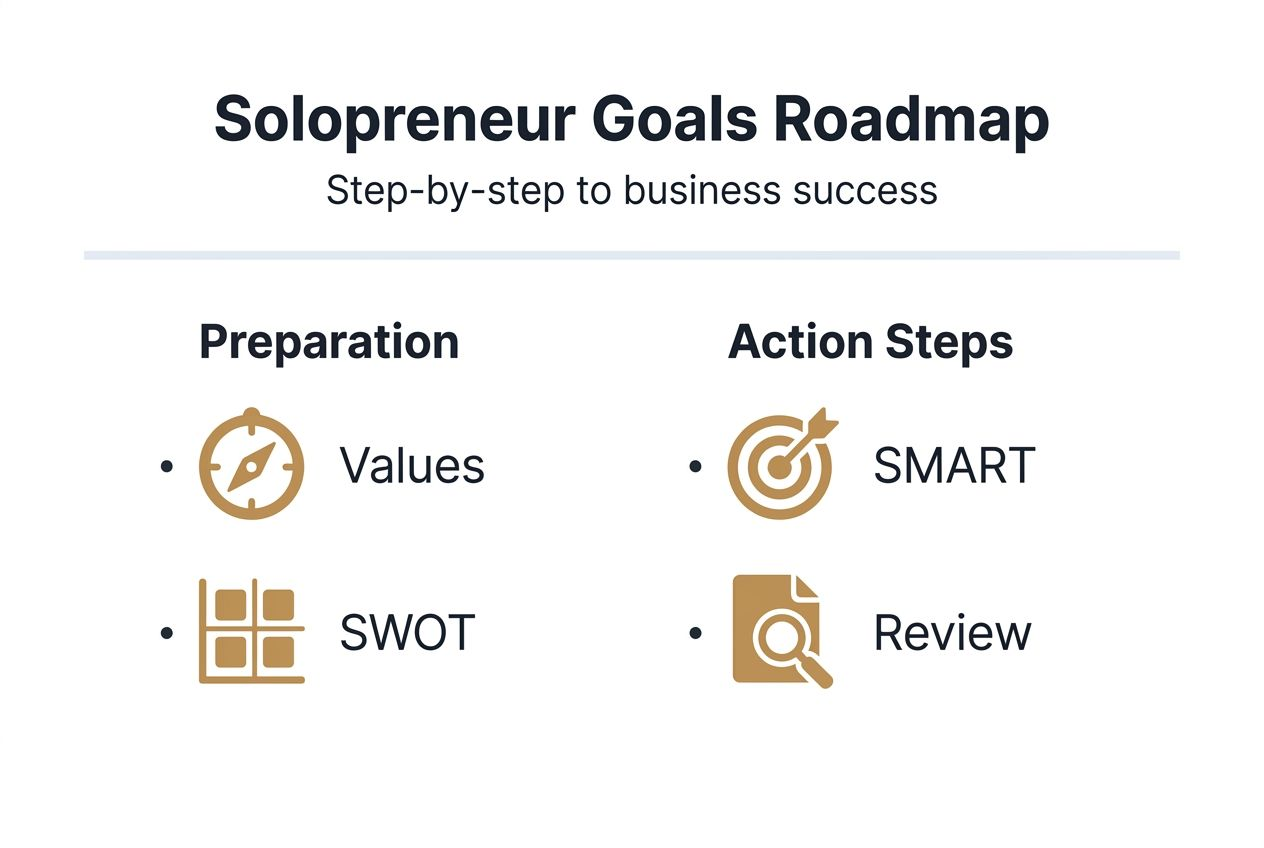
Start by aligning business goals with your personal values. If you value flexibility but set goals requiring 80-hour weeks, you’ll burn out fast. Your business should support your lifestyle, not consume it. Understanding a comprehensive business strategy for solopreneurs helps you connect daily actions to larger values.
Next, conduct a SWOT analysis. List your strengths, weaknesses, opportunities, and threats honestly. This reality check prevents setting goals your current resources can’t support. If your weakness is marketing but you set an aggressive customer acquisition goal without addressing this gap, failure becomes likely.
Clarify your long-term vision before setting specific goals. Where do you want your business in three years? What does success look like personally and professionally? Your vision acts as a north star, ensuring short-term goals move you in the right direction rather than sideways.
Finally, assess your current capacity realistically. Review how many hours you can dedicate weekly, what financial resources you have available, and which skills you bring to the table. This honest inventory prevents overcommitting, which is the fastest route to frustration and abandoning goals altogether.

Step-by-step goal-setting process for solopreneurs
Now you’re ready to set goals that actually work. Follow this proven process to create objectives that drive real results.
Step 1: Define SMART goals
Using SMART goals improves goal clarity significantly. Each goal needs five elements. Specific means clearly defining what you’ll accomplish, not vague wishes like “grow my business.” Measurable requires numbers you can track. Achievable ensures you have realistic resources and capabilities. Relevant connects to your broader vision. Time-bound sets a deadline for completion.
Step 2: Balance timeframes
Set both short-term and long-term targets. Short-term goals deliver quick wins that build momentum. Examples include landing three new clients this quarter or launching one product this month. Long-term goals, like reaching $100,000 in annual revenue, require breaking down into smaller milestones. Your financial goals for solopreneurs should span both timeframes for balanced growth.
Step 3: Document everything
Write goals down in a format you’ll reference regularly. A detailed solopreneur business planning guide 2026 provides templates and frameworks. Include the goal statement, success metrics, deadline, and action steps required.
Step 4: Schedule regular reviews
Set monthly or quarterly reviews on your calendar. During reviews, assess what’s working, what needs adjustment, and whether priorities have shifted. Business conditions change, and rigid adherence to outdated goals wastes energy.
Step 5: Adjust based on data
Use performance metrics to refine your approach. If a goal isn’t progressing, analyze why. Do you lack skills, time, or resources? Make data-driven adjustments rather than emotional ones.
| SMART Criteria | Definition | Example |
|---|---|---|
| Specific | Clear, detailed objective | Increase email subscribers by 500 |
| Measurable | Quantifiable metrics | Track subscriber count weekly |
| Achievable | Realistic with current resources | Based on 50 new subscribers monthly |
| Relevant | Aligns with business vision | Supports content marketing strategy |
| Time-bound | Has a deadline | Complete within 10 months |
Pro Tip: Use a SMART goal setting guide and digital tools that send automatic reminders for your scheduled review dates. This simple habit prevents goals from becoming forgotten to-do list items. Applying top business growth strategies within your SMART framework accelerates results.
Common pitfalls and how to avoid them
Even with a solid process, solopreneurs frequently stumble over predictable obstacles. Recognizing these patterns helps you sidestep wasted effort.
Vague goals kill progress. “Improve marketing” tells you nothing about success or how to start. Instead, define measurable outcomes like “publish 8 blog posts monthly” or “gain 200 Instagram followers quarterly.” Specificity creates actionable steps.
Overcommitment spreads you too thin. Juggling 15 active goals guarantees mediocre results across all of them. Limit yourself to 3-5 priority goals at once. This focus lets you make meaningful progress rather than superficial attempts. Understanding why solopreneurs fail insights reveals that scattered effort is a top cause of business stagnation.
Unrealistic timelines create frustration and abandonment. Setting a goal to double revenue in 30 days without corresponding increases in capacity or marketing spend sets you up for disappointment. Break ambitious targets into incremental milestones. Celebrate small wins along the path to big achievements.
Skipping regular reviews means goals become static while your business evolves. Block time monthly to assess progress honestly. If a goal no longer serves you, adjust or eliminate it without guilt. Flexibility is strength, not weakness.
Pro Tip: Use an impact versus effort matrix to prioritize goals. List potential objectives, then rate each on impact (low, medium, high) and effort required. Focus first on high impact, low effort goals for quick momentum. This framework prevents wasting months on low-value activities that feel productive but don’t move your business forward.
Tools and frameworks for tracking goals
The right tools transform abstract goals into trackable progress. You don’t need expensive software; choose what fits your workflow and actually use it consistently.
Digital project management platforms offer visual goal tracking. Trello uses boards and cards to organize goals into categories like “In Progress,” “Review,” and “Completed.” Asana provides task assignment, deadlines, and progress views. Both integrate with calendars and other productivity apps, centralizing your goal management.
Productivity tracking apps measure time and task completion. Tools like RescueTime or Toggl show how you spend hours daily, revealing whether actions align with stated goals. If your goal is content creation but data shows you spend 4 hours daily on email, you’ve identified a problem.
Spreadsheets work brilliantly for solopreneurs who prefer simplicity. Create columns for goal description, target metric, current progress, deadline, and notes. Update weekly to maintain visibility without complexity. A well-organized business planning checklist solopreneurs can integrate directly into spreadsheet tracking.
| Tool | Best For | Pros | Cons |
|---|---|---|---|
| Trello | Visual learners | Intuitive, flexible boards | Limited reporting features |
| Asana | Team collaboration | Robust features, integrations | Steeper learning curve |
| Google Sheets | Simple tracking | Free, customizable, accessible | Manual updates required |
| Notion | All-in-one workspace | Combines notes, tasks, databases | Can feel overwhelming initially |
When choosing a tool, consider these factors:
- Ease of use: Will you actually open it daily?
- Integration: Does it connect with tools you already use?
- Cost: Free options often suffice for solopreneurs.
- Mobile access: Can you update goals on the go?
- Reporting: Does it visualize progress clearly?
The best tool is the one you’ll use consistently. Start simple and add complexity only if needed.
Measurable outcomes and success indicators
Setting goals without measuring results is like driving blindfolded. Clear metrics tell you whether your efforts are working or need adjustment.
Track goal completion rates monthly. Calculate the percentage of goals you fully achieved versus those still in progress or abandoned. If you consistently complete less than 50%, you’re either overcommitting or setting unrealistic targets. Adjust accordingly.
Define success metrics upfront for each goal. Revenue goals need dollar amounts and timeframes. Client acquisition goals require specific numbers. Content goals measure pieces published or engagement rates. Pre-defining metrics eliminates ambiguity about whether you’ve succeeded.
Use performance data to refine future goals. If you achieved a goal of 10 new clients in three months but your capacity only supported quality service for 7, your next goal should account for this reality. Data-driven adjustments prevent repeating mistakes. Implementing business growth tips 2026 solo helps you identify the right metrics for your situation.
Key success indicators include:
- Percentage of goals met each quarter
- Time saved through improved processes
- Revenue increases tied to specific goals
- Client satisfaction scores or repeat business rates
- Personal satisfaction and work-life balance improvements
Remember that not all valuable outcomes are financial. If a goal was maintaining better boundaries and you now consistently end work by 6pm, that’s measurable success worth celebrating and building upon.
Explore expert resources to master your business goals
Setting effective business goals is just the beginning of your solopreneur journey. To truly maximize your success, you need comprehensive strategies that integrate goal-setting with broader business planning.
Our detailed solopreneur business planning guide 2026 walks you through creating a complete roadmap from vision to execution. You’ll discover how to align daily tasks with long-term objectives, ensuring every action moves you forward. The guide includes templates, examples, and worksheets you can customize for your specific business.

Want a structured approach to ensure nothing falls through the cracks? Our business planning checklist solopreneurs provides a step-by-step framework proven to boost success rates. You’ll know exactly what to do and when, eliminating guesswork and decision fatigue.
Your business goals also need visibility to attract the right clients and opportunities. Learning how to build your personal brand on linkedin amplifies your expertise and connects you with your target audience. Strong personal branding turns your goals into reality faster by opening doors that would otherwise remain closed.
Frequently asked questions about setting business goals
What is the best framework for solopreneurs to set business goals?
The SMART framework is most effective because it creates specific, measurable, achievable, relevant, and time-bound objectives. This structure eliminates vague intentions and provides clear benchmarks for success. Other useful frameworks include OKRs (Objectives and Key Results) for linking big-picture vision to measurable outcomes.
How often should solopreneurs review and adjust their business goals?
Review goals monthly for short-term objectives and quarterly for long-term targets. Monthly check-ins catch problems early and let you make small adjustments before they become major issues. Quarterly reviews assess whether your overall direction still aligns with your vision and market conditions.
How can I avoid feeling overwhelmed by too many goals?
Limit active goals to 3-5 priorities at any time. Use an impact versus effort matrix to identify which goals deliver the most value for your investment. Focus on completing current goals before adding new ones, and remember that saying no to good opportunities preserves energy for great ones.
What tools are simplest for freelancers to track goals?
Google Sheets or Excel offer the simplest starting point, requiring no learning curve and providing full customization. For visual tracking, Trello’s free version provides intuitive boards and cards. Choose whatever tool you’ll actually open and update regularly, even if it’s just a notebook.
How do I know if my business goals align with my personal values?
Ask yourself whether achieving each goal would genuinely improve your life or just look good to others. If a goal requires sacrificing things you value, like family time or health, it’s misaligned. Write down your top five personal values, then audit each business goal to confirm it supports rather than conflicts with those values.