

Growth for solo businesses is rarely about hiring teams or opening new branches. For many creative solopreneurs, success means increasing profit, expanding unique services, or sharpening efficiency while preserving the freedom that inspired solo work. This makes defining business growth personal and powerful. You will discover practical perspectives on how solopreneurs are leveraging flexibility and improving profitability without following the traditional path, so you can shape your own version of sustainable progress.
Key Takeaways
| Point | Details |
|---|---|
| Business Growth Focus | For solopreneurs, growth emphasizes increasing revenue and profitability rather than traditional scaling through team expansion. |
| Types of Growth | Solopreneurs can aim for survival, expansion, or scaling growth based on their current business stage and goals. |
| Key Drivers | Sustainable growth hinges on skill development, market orientation, innovation, strategic relationships, and a strong financial foundation. |
| Growth Mindset | An abundant mindset shifts solopreneurs from survival to thriving, allowing them to choose their clients and set prices that reflect value. |
Business Growth Defined for Solopreneurs
Business growth for solopreneurs looks different than traditional scaling. You’re not hiring teams or opening multiple locations. Instead, growth means increasing your revenue, expanding your service offerings, or improving profitability while maintaining the autonomy that drew you to solo work in the first place.
At its core, growth is about making your business work harder and smarter for you. Solopreneurs increasingly focus on improving profitability and leveraging flexibility rather than pursuing endless expansion. This distinction matters because it shapes every decision you make.
Why Growth Matters for Your Solo Business
Growth isn’t vanity. It’s survival and freedom combined.
Here’s what growth actually gives you:
- Financial stability – More revenue means less financial uncertainty and stronger emergency reserves
- Time control – Growth lets you raise prices or reduce client load without losing income
- Autonomy protection – A growing business gives you leverage to say no to difficult clients
- Sustainable passion – Burnout comes from being stuck; growth creates momentum and purpose
- Exit optionality – Whether you want to sell, transition, or simply maintain, growth builds that foundation
Growth for solopreneurs isn’t about empire-building; it’s about building a business that serves your life, not consumes it.
Many solopreneurs start businesses driven by passion, autonomy, and supplemental income needs, yet they view their ventures as their main income source. This means growth directly impacts their ability to sustain themselves.
What Growth Looks Like at Different Stages
Growth isn’t one-size-fits-all. Where you are matters.
Early stage: Focus on proving your model works. Can you consistently land clients? Can you deliver profitably? Are people willing to pay for what you offer?

Middle stage: Shift to improving efficiency and margins. Same workload, more profit. Better processes. Clearer pricing. Fewer time-wasters.
Mature stage: Choose your direction. Some solopreneurs expand service lines. Others raise prices strategically. Some reduce hours while maintaining income.
Each path is growth when it moves you toward your actual goals, not someone else’s definition of success.
The Solopreneur Growth Advantage
You have superpowers larger businesses don’t.
Without employees or complex operations, you can:
- Pivot quickly when opportunities emerge
- Build intimate client relationships that command premium pricing
- Test new offerings with minimal risk
- Keep all profits instead of splitting with partners or investors
- Make decisions instantly without committee approval
Your smallness is your advantage. Use it.
Pro tip: Define your personal growth metric – revenue target, hours worked, income per hour, or client quality – and track it monthly. This keeps growth intentional rather than reactive.
Types of Business Growth in Solo Enterprises
Not all growth is created equal. The path your solo business takes depends on your goals, market conditions, and personal capacity. Understanding the different types of growth helps you choose the right strategy instead of chasing whatever looks trendy.
Research on small enterprises identifies distinct growth types reflecting scale and innovation rather than one-size-fits-all expansion. For solopreneurs, this means you can grow in ways that align with your values and lifestyle, not just the traditional “hire people” route.
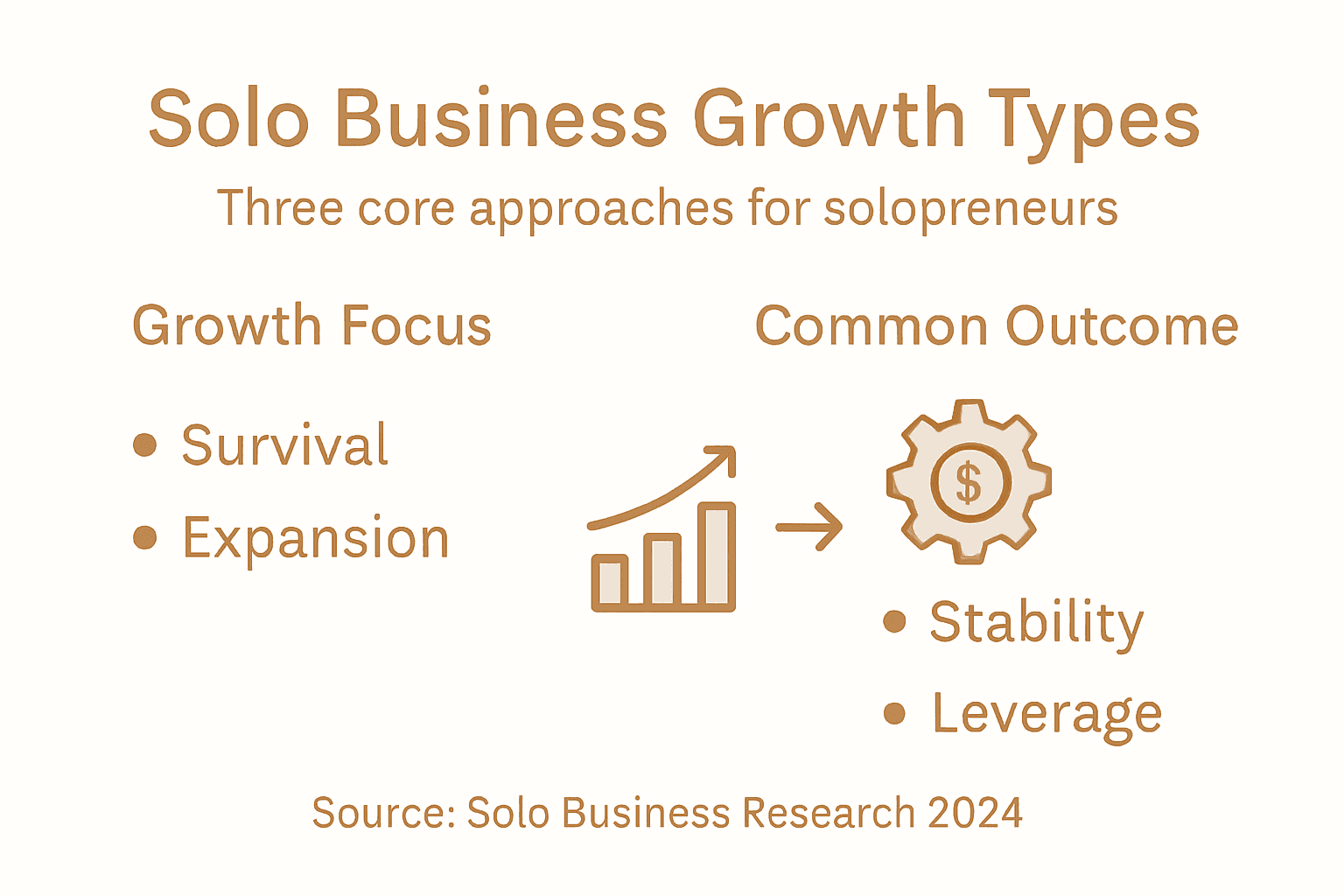
The Three Core Growth Types
Each type serves a different purpose and requires different skills.
Survival Growth
This is pure revenue increase without structural change. You take on more clients, raise prices slightly, or work longer hours. The business model stays the same; you just maximize it.
When it matters: Early stage, or when you need cash flow stability fast.
The trap: You can burn out quickly without operational changes.
Expansion Growth
You add new services, enter new markets, or serve different client types while staying solo. Your business becomes more diverse and less dependent on a single income stream.
When it matters: Mid-stage, when your core offering has matured and you want resilience.
The advantage: Multiple revenue lines reduce risk and create natural growth rhythm.
Scaling Growth
You build systems and processes that let you generate income without proportional time investment. This might mean productizing services, creating digital offerings, or eventually hiring help.
When it matters: When you’ve proven the model works and want leverage.
The reality: Scaling requires upfront work before payoff arrives.
Here’s a quick comparison of the three main solopreneur growth types and their core outcomes:
| Growth Type | Focus Area | Typical Outcome | Common Challenge |
|---|---|---|---|
| Survival | Revenue maximization | Stable income, fast gains | Risk of burnout |
| Expansion | Service diversity | Resilient business, new markets | Managing complexity |
| Scaling | Systems & leverage | Passive income, time freedom | Significant upfront work |
Which Type Fits Your Business?
Here’s how to match your situation:
- Need immediate revenue? Start with survival growth. Raise prices, add clients, optimize existing work.
- Want to reduce burnout? Try expansion growth. Diversify your offerings to spread workload.
- Ready for real leverage? Build scaling growth. Create passive or semi-passive income streams.
Growth isn’t a race. Pick the type that solves your actual problem today, not the problem you think you should have.
Many solopreneurs jump straight to scaling when they actually need expansion. They build products nobody wants because they skipped the market validation step. Start where you are.
The Innovation and Network Element
Sustainable growth depends on two things: innovation capacity and network leverage. You can’t just do the same thing harder forever.
Innovation means:
- Testing new service combinations
- Improving your delivery process
- Offering premium or budget variations
- Experimenting with new formats (group programs, workshops, courses)
Network leverage means:
- Building referral relationships with complementary businesses
- Creating strategic partnerships that expand your reach
- Collaborating with others on larger projects
- Leveraging your audience for joint ventures
The strongest solopreneurs blend both. They stay fresh through constant small innovations while expanding their reach through strategic relationships.
Pro tip: Identify which growth type you’re currently pursuing and write down three specific actions for the next 90 days. Then track which actually moves your needle – your success metric should guide your next move.
Key Drivers of Sustainable Growth
Sustainable growth isn’t accidental. It comes from building on specific foundations that create momentum over time rather than quick wins that fizzle. For solopreneurs, understanding these drivers means you can focus energy where it actually matters.
The real difference between businesses that grow steadily and those that plateau comes down to a few core factors. Sustainable growth in small enterprises depends on innovation capabilities, market orientation, and the ability to adapt to changing environments. You can’t grow faster than your ability to evolve.
The Five Core Drivers
These are non-negotiable for real, lasting growth.
1. Skill and Expertise Development
Your knowledge is your product. As a solopreneur, you are the business. Growing your skills directly translates to growing your earning potential and market value.
This means staying current in your field, learning adjacent skills, and becoming known for specific expertise rather than being a generalist.
2. Market Orientation and Client Understanding
Growth comes from solving real problems people will pay for. You need clear insight into what your ideal clients actually want, their pain points, and how much they value solutions.
Guessing wastes time. Asking and listening accelerates growth.
3. Innovation in Your Delivery or Offerings
You can’t just replicate what worked last year forever. Small, continuous improvements to how you serve clients prevent stagnation and justify price increases.
Innovation doesn’t mean reinventing everything. It means testing new formats, improving processes, or combining services in fresh ways.
4. Strategic Relationships and Networks
No solopreneur truly works alone. Your network becomes your reach, your credibility, and often your access to new opportunities.
Relationships with referral partners, complementary businesses, and your audience compound over time.
5. Financial Foundation and Pricing Power
You can’t grow without resources. This means having cash reserves to invest in tools, learning, or opportunities without desperation.
It also means charging what you’re worth. Underpricing stunts growth more effectively than any external barrier.
For reference, here are the five key drivers of sustainable solo business growth and their practical impact:
| Driver | Business Impact | Actionable Example |
|---|---|---|
| Skill Development | Higher earning potential | Invest in field-specific training |
| Market Orientation | Strong demand, loyal clients | Run feedback surveys |
| Innovation | Justifies price increases | Launch a new service format |
| Strategic Relationships | Expanded reach, new projects | Attend industry networking events |
| Financial Foundation | Enables smart investments | Build up cash reserves |
What Actually Stops Growth
Here’s what kills momentum:
- Staying comfortable with old methods when they stop working
- Ignoring feedback from clients about what they need
- Pricing below your value out of fear
- Isolating instead of building strategic connections
- Skipping learning and skill development
Sustainable growth requires you to evolve faster than your market does. Stagnation is the only real failure.
Most solopreneurs don’t lack opportunity. They lack permission to change direction or invest in themselves.
Building Your Growth Engine
These drivers work together. You can’t just innovate and ignore your finances. You can’t build relationships without developing expertise worth knowing.
Start by auditing where you are weak:
- Are you still delivering the same way you did two years ago?
- Do you know exactly who your ideal client is and what they need?
- Is your pricing based on value or on guessing?
- Who are your strategic partners and referral sources?
- When was the last time you invested in developing a new skill?
Pick one. Build it. Then move to the next.
Pro tip: Schedule a quarterly “growth audit” where you assess each driver and identify one small change for the coming three months. Consistency with incremental improvements beats sporadic aggressive pushes.
Common Pitfalls and How to Avoid Them
Growth sounds simple until you actually try it. Most solopreneurs don’t fail because they lack talent or opportunity. They stumble because they repeat the same mistakes everyone else makes. Learning what to avoid saves you months of wasted effort.
The difference between steady growth and frustrating plateaus often comes down to avoiding predictable traps. Common mistakes include confusing activity with progress, overanalyzing without taking action, and chasing short-term wins at the expense of long-term value. Knowing these pitfalls lets you sidestep them.
The Seven Growth Killers
Watch out for these patterns.
1. Treating Growth Like a Part-Time Project
You can’t grow your business in the leftover hours. Growth requires intentional time and energy. Many solopreneurs work in the business constantly but never work on it.
Block growth time the same way you block client work.
2. Confusing Busy With Progress
Activityisn’t achievement. You can respond to emails, attend meetings, and fill your calendar without moving toward your actual goals.
Ask weekly: What did I do that actually grew revenue or impact? Everything else is noise.
3. Pricing Yourself Into a Corner
Underpricing is a trap disguised as strategy. Low prices attract demanding clients, reduce profit margins, and make growth mathematically impossible.
You cannot grow by working harder for less.
4. Ignoring Your Ideal Client
You can’t grow toward a target you haven’t defined. Without clarity on who you serve and what they value, you chase every opportunity and convert none.
Your ideal client profile shapes every growth decision.
5. Building Without Strategy
Strategy development fails when goals don’t align with your actual capabilities and when there’s poor communication across your work. You need to know where you’re going and why before you start moving.
A plan you’ll actually follow beats a perfect plan you abandon.
6. Waiting for Perfect Conditions
Perfection never arrives. You’ll never have all the information, perfect timing, or zero risk. Growth happens when you decide to move despite uncertainty.
Decision beats deliberation.
7. Isolating Instead of Partnering
Trying to do everything alone throttles growth. Your network, collaborations, and referral relationships multiply your reach without multiplying your time.
Growth accelerates through relationships.
How to Protect Yourself
Here’s what actually works:
- Block 5-10 hours weekly for growth activities, not just client delivery
- Track one clear metric monthly – revenue per hour, new clients, repeat rate
- Review your pricing quarterly and adjust upward if margins feel comfortable
- Write down exactly who your ideal client is and revisit it every quarter
- Build your network intentionally through partnerships and referrals
- Make decisions even with incomplete information; you learn from action
- Measure progress against your own goals, not against what others are doing
The pitfall isn’t knowing what to do. It’s doing the comfortable thing instead of the growth thing.
Pro tip: Every month, identify one pitfall you’re currently falling into and one action to fix it. Small course corrections compound into dramatically different results over a year.
How Growth Transforms a Solo Business
Growth isn’t just about bigger revenue numbers. It fundamentally changes how your business operates, what opportunities you can pursue, and how much control you have over your own life. Understanding these transformations helps you recognize when you’re actually progressing versus just staying busy.
When your solo business grows, everything shifts. The problems you solve change. Your leverage increases. Your options expand. Most importantly, your relationship with work evolves from survival mode to intentional choice.
The Confidence Shift
Early in your solo journey, every client decision feels high-stakes. Losing one client feels like losing everything. You say yes to bad fits because you need the money.
Growth fixes this. With diversified income streams and proven ability to land clients, you gain negotiation power. You can say no to difficult clients without panic. You can raise prices without fear. This confidence compounds into better decisions across the board.
The Time Liberation
Growth through pricing power or productized services gives you something solopreneurs crave: time back.
Instead of trading hours for dollars indefinitely, you earn more per hour. Fewer clients can generate the same revenue. You work less while earning more. This isn’t mythical – it’s the direct result of growth done right.
You also gain time to work on growth itself, creating a virtuous cycle where your business gets stronger instead of staying stuck.
Strategic Positioning and Specialization
Small, struggling businesses take whatever work comes. Growing businesses choose their niche deliberately. Understanding different phases of solopreneurship helps you recognize that specialization becomes possible once you have momentum.
Once you’re known for solving specific problems brilliantly, you attract better clients willing to pay premium prices. This specialization makes marketing easier and delivery more efficient.
What Changes in Your Daily Reality
Here’s what actually transforms:
- Client quality improves – You attract professional, organized clients who respect boundaries
- Decision-making gets easier – You have data and patterns to guide choices instead of guessing
- Stress decreases – Financial stability removes the constant anxiety
- Your offer becomes clearer – Growth forces you to understand exactly what you do and why it matters
- Marketing becomes natural – With real results and happy clients, word-of-mouth accelerates
The Mindset Transformation
Maybe the biggest shift is internal. Early solopreneurs operate from scarcity. Growth shifts you to abundance mindset.
Growth transforms you from a person fighting to survive to a person choosing how to thrive.
You move from “Will I land clients?” to “Which clients will I serve?” From “Can I charge that much?” to “What’s the real value I deliver?” From “I have to do everything” to “What should I delegate or systematize?”
This shift opens doors you couldn’t see before. New partnerships become possible. You can invest in tools and learning. You consider opportunities that seemed impossible when you were just surviving.
When Growth Creates the Most Impact
Growth matters most when it solves your biggest pain point:
- Drowning in delivery work? Focus on pricing power and time leverage.
- Unstable income? Build diversified revenue streams.
- Isolated and struggling? Growth through partnerships and referrals.
- Stuck in one-dimensional service? Expand your offerings strategically.
Identify your biggest bottleneck, then pursue the growth type that fixes it.
Pro tip: Write down one area where growth would give you the most freedom – more money per hour, more time off, better clients, or expanded options. Make that your growth focus for the next six months, then measure the real impact on your actual daily life.
Take Control of Your Solo Business Growth Today
Understanding what business growth truly means for solopreneurs is the first step to overcoming burnout, unstable income, and the overwhelm of juggling every role alone. This article revealed how growth is about more than just increasing revenue – it is about choosing the right growth type for your situation, building strategic relationships, and developing skills that create real momentum. If you find yourself stuck wondering how to move from survival mode toward intentional growth, you are not alone.
Plan Your Business – Your Solo Business offers targeted strategies to align your growth with your unique goals and lifestyle while protecting your autonomy.

Stop guessing and start growing with clarity and confidence. Visit Your Solo Business to explore actionable insights, proven growth tactics, and community support designed specifically for solopreneurs. Dive into practical advice on Business & Strategy – Your Solo Business to refine your approach and build momentum now. Make the choice today to grow your business on your terms and create the freedom you deserve.
Frequently Asked Questions
What is business growth for solopreneurs?
Business growth for solopreneurs means increasing revenue, expanding service offerings, or improving profitability while maintaining autonomy, rather than merely scaling by hiring staff or opening new locations.
Why is growth important for solo businesses?
Growth is essential for financial stability, time control, autonomy protection, sustainable passion, and creating options for potential business exit strategies. It ensures the business serves your life and not the other way around.
How can solopreneurs achieve sustainable growth?
Solopreneurs can achieve sustainable growth by focusing on skill development, market understanding, innovation in offerings, strategic relationships, and maintaining a strong financial foundation alongside appropriate pricing strategies.
What are the different types of growth applicable to solopreneurs?
The three core types of growth for solopreneurs are survival growth (increasing revenue), expansion growth (diversifying services), and scaling growth (building systems for passive income). Each serves different business needs and stages.
Recommended
- Preparing Your Solo Business for a Future Exit – Your Solo Business
- Don’t Sell, Solve: The Powerful Shift That Will Transform Your Solo Business – Your Solo Business
- How to Sell Your Solo Business Faster: 9 Discipline Habits that Work. – Your Solo Business
- What is a Solopreneur Business Roadmap? (And How to Create One) – Your Solo Business