
Productivity is the single lever that converts your limited solo hours into real business results. When you run a one-person operation, there is no team to absorb your inefficiencies, no manager to catch dropped balls, and no buffer between your output and your revenue. The role of productivity in solo business is not a soft concept. It is the architecture that determines whether you grow, plateau, or burn out.
The solopreneurs who thrive in 2026 share one trait: they have built systems that work even when they are not. That means:
- Task batching to cut context switching and protect mental energy
- Systemization of every repeatable process, from client onboarding to invoicing
- Time and energy management aligned with your biological peak performance windows
- Automation handling the routine work so your brain handles the judgment calls
- Metrics like revenue per hour of founder time to track whether your efficiency is actually improving
The payoff goes beyond output. When your business runs on systems rather than willpower, you reclaim the work-life balance that probably motivated you to go solo in the first place.
How productivity drives solo business growth and sustainability
Productivity in solopreneurship is not about cramming more tasks into your day. It is about designing a business that produces consistent results without requiring your constant presence. The most productive solopreneurs recover significant additional hours weekly through automation and systems, then redirect that time into revenue-generating work.

Think about what that actually means. Fifteen recovered hours per week is essentially a part-time employee’s worth of capacity, at zero payroll cost. That is the compounding math behind why systems beat hustle every time.
Sustainability matters just as much as growth. A solo business that depends entirely on your personal effort has a ceiling: your energy. Build systems that run independently, and that ceiling lifts. The goal is a business that can survive a week without you, then a month, then longer.
Core productivity strategies for solopreneurs
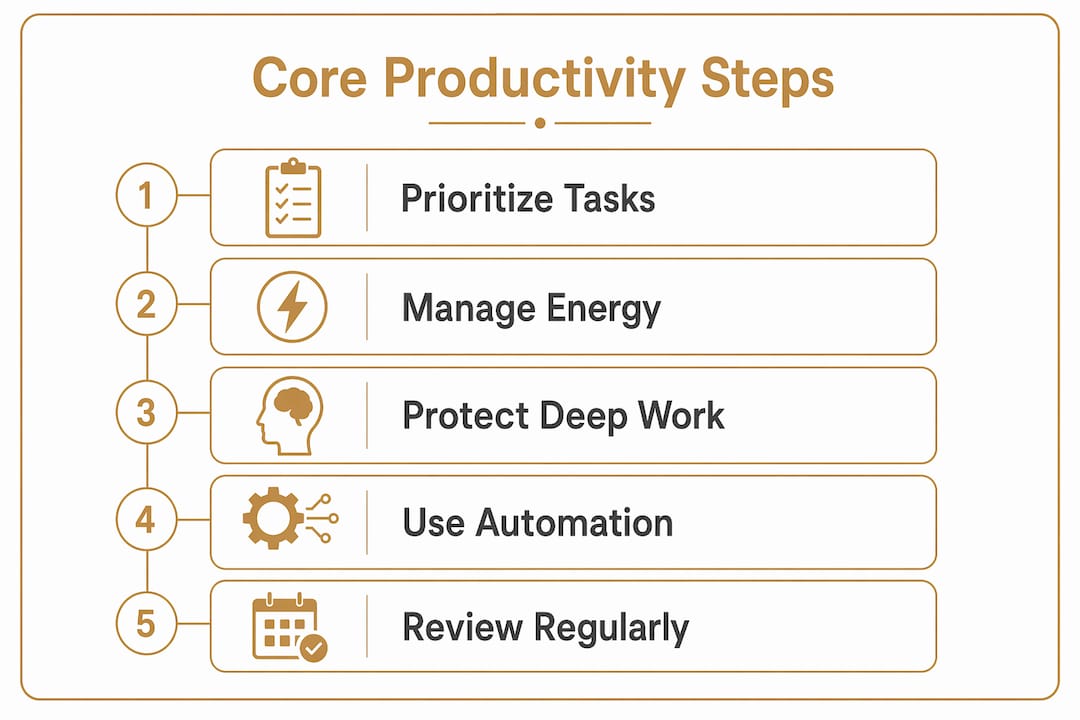
The most effective solopreneurs do not work more hours. They protect the right hours and eliminate everything that dilutes them. Here are the strategies that consistently move the needle:
- Batch similar tasks. Content creation batched into dedicated sessions takes roughly 40% less time than handling it daily. Group emails, invoices, social posts, and admin into defined windows instead of scattering them across the week.
- Commit to three key tasks per day. Not ten. Not a running list. Three tasks that, if completed, make the day a success. This forces real prioritization and gives you a clear definition of done.
- Schedule protected deep work blocks. Two to four hours of uninterrupted focused work, placed at your biological peak, before you check email or messages. Treat these blocks like non-negotiable client meetings.
- Outsource judgment-free tasks. Anything repeatable that does not require your specific expertise is a candidate for delegation or automation. Graphic design, transcription, scheduling, and bookkeeping are common starting points.
Pro Tip: Stop managing your time and start managing your energy. A focused 90-minute block at peak cognitive capacity produces more than a full day of scattered, low-energy effort. Protect your sleep, limit decision fatigue, and schedule your hardest work for when your brain is actually firing.
Discipline is the part nobody talks about enough. Protecting deep work means saying no to the reactive pull of notifications, “quick” questions, and low-priority tasks that feel urgent. That discipline is what separates solopreneurs who grow from those who stay perpetually busy without getting anywhere.
How AI and automation tools can multiply your output
AI business automation is the practice of using artificial intelligence tools to handle repetitive, low-value tasks so you can focus your hours on strategy, relationships, and creative work. For solopreneurs, it is not a luxury. It is how you compete with teams.
About 60–80% of a solopreneur’s work is rule-based and repeatable, meaning it does not actually require your judgment. That is the automation opportunity sitting in your calendar right now.
Here is where AI tools deliver the biggest gains:
- Content creation: AI-assisted workflows can cut content time from four hours to about 45 minutes per piece.
- Customer communication: Automated email sequences and chatbots handle FAQs and first interactions 24/7, freeing you for complex decisions.
- Lead nurturing: A lead magnet, landing page, and automated email sequence can run your entire top-of-funnel without you present.
- Operations: Invoicing, scheduling, bookkeeping, and reporting can all run automatically through connected tools.
The implementation sequence matters. Here is the approach that works:
- Audit your time for one week. Log every task in 30-minute blocks and tag each as income-generating, growth, maintenance, or admin.
- Identify your top automation candidates. Circle everything that happens more than once a week and follows a predictable pattern.
- Build one automation at a time. Pick the highest-impact workflow, build it properly, and test it until it runs without your intervention.
- Expand from a stable foundation. After three to six months of this approach, your business largely runs itself.
Quality control is where most solopreneurs get this wrong. Automate everything that delivers information or handles routine responses. Keep your personal involvement in any interaction where someone is deciding whether to trust you. Automation amplifies your reach. It does not replace your authenticity.
Yoursolobusiness offers a full AI workflow automation guide that walks through exactly which tools to connect and in what order.
Time and energy management insights that actually change your output
The research on this is clear and a little uncomfortable. Task-switching between unrelated activities decreases output quality and increases error rates by 20–40%. For a solo operator, that cognitive tax is not just annoying. It directly cuts your revenue.
The fix is structural, not motivational.
| Strategy | What it does | Why it works |
|---|---|---|
| Peak-hour scheduling | Place creative and strategic work in your top 4 hours | Most solopreneurs have 4 hours of genuinely high-cognitive-function time daily |
| 90-minute deep work blocks | Focused sessions with all notifications off | Operating at peak cognitive capacity in 90-minute blocks produces superior output |
| Admin batching | Two defined windows for email, invoicing, scheduling | Cuts daily context switches from five or six down to one or two |
| Weekly review | 30-minute Friday session to audit what moved the business | Catches drift before it shows up in revenue |
Key metric to track: Revenue per hour of founder time. Divide your gross revenue by actual hours worked each week. If that number keeps rising as your business grows, your systems are working. If it stays flat or drops, something is eating your leverage.
Traditional time management treats every hour as equal. Energy management recognizes that a focused hour at 9:00 AM is worth three scattered hours at 3:00 PM. Build your schedule around that reality, not against it. You can find practical daily habits for solopreneurs that put this into practice at Yoursolobusiness.
Prioritization, effectiveness, and avoiding common productivity pitfalls
Efficiency and effectiveness are not the same thing. Efficiency asks “can I do this faster?” Effectiveness asks “should I be doing this at all?” Many solopreneurs get very good at efficiently doing the wrong things.
The fix starts before you open any tool or build any system. Define your goal first. Once you know what success looks like, you can measure whether your tasks are actually moving you toward it. Automating a process that does not serve your goal just produces the wrong output faster.
Watch out for these common traps:
- Productivity theater. Staying busy with low-impact activities, inbox management, formatting documents, tweaking your website, instead of protected deep work on revenue-generating tasks. It feels productive. It is not.
- Automating before the workflow has stabilized. If you have only run a process four or five times, you have not seen the edge cases yet. Build automations for processes you have repeated at least ten times.
- Premature hiring. Adding full-time hires before automating can degrade focus and add coordination overhead that kills momentum. Automation and fractional contractors usually provide better initial leverage.
- Over-optimizing low-frequency tasks. Do not spend three weeks automating something that only takes 30 minutes a week. The setup cost will not pay back.
Practical habits to stay effective over time:
- Audit your recurring tasks every quarter and cut anything that no longer generates proportional returns.
- Track your “maker hours” (focused time on revenue-generating work) weekly, not just your total hours worked.
- Before adding any new tool or system, ask whether it serves a defined goal or just adds complexity.
- Use business strategy frameworks to keep your priorities anchored to outcomes, not activities.
The solopreneurs who avoid burnout are not the ones who work less. They are the ones who spend the fewest hours on work that does not compound.
Real-world examples of productivity transforming solo businesses
The numbers from working solopreneurs tell a consistent story. One solo founder running four businesses simultaneously works roughly 25 hours per week from Bali, with automation stacks handling the repeatable operations across each business. Without those systems, the same output would require a team of four or five people.
The content workflow example is one of the most concrete illustrations available. A 20-minute voice memo becomes a structured draft through AI transcription and organization, then gets edited in 30 minutes. What previously took four hours now takes about 45 minutes total. That same piece then gets repurposed automatically into LinkedIn posts, email content, and social snippets, with no manual recreation required.
On the operational side, the impact compounds quickly. Automating client onboarding alone typically saves solopreneurs 3–5 hours per week immediately, and it makes the business look more professional in the process. Invoicing, scheduling, and bookkeeping handled automatically can shrink a full day of monthly admin down to about two hours, and when systems are fully built, recovering 15–20 hours per week is achievable for the most productive solopreneurs.
The QuoteLock platform shows a similar pattern in independent professional practices: when follow-up and quote management run on automated workflows rather than manual tracking, the time recovered goes directly back into client-facing work.
The common thread across all these examples is not a particular tool or app. It is the decision to treat automation as a daily habit rather than an occasional project. Solopreneurs who build one solid workflow at a time, consistently, end up with businesses that run largely without them within six months.
Key Takeaways
Productivity in solo business is the core system that converts your time and energy into sustainable revenue growth, not just a collection of tips.
| Point | Details |
|---|---|
| Systems beat effort | Solopreneurs who build automated systems recover 15–20 hours weekly, freeing time for revenue-generating work. |
| Batch and protect deep work | Batching similar tasks cuts time spent by up to 40%; protecting 2–4 daily deep work hours drives the highest-leverage output. |
| Automate the rule-based work | 60–80% of solopreneur tasks are repeatable and suitable for automation, freeing judgment for strategic decisions. |
| Track revenue per hour | Dividing gross revenue by actual hours worked weekly reveals whether your systems are genuinely improving your efficiency. |
| Effectiveness before efficiency | Define your goal before optimizing any process; automating the wrong tasks just produces the wrong output faster. |
Ready to build your productivity system?
If you are still trading hours for output without systems doing the heavy lifting, the gap between where you are and where you want to be is mostly an automation problem.

Yoursolobusiness has put together the tools and frameworks Jay uses to run a one-person business at team-level output. Start with the AI toolkit for solopreneurs to see exactly which tools to connect first, or go deeper with the 2026 automation guide for a step-by-step implementation plan.