
TL;DR:
- Independent entrepreneurship involves building a business on your own without employees, partners, or reliance on others. AI enables solo founders to automate key tasks, operating at team-level output without additional payroll costs.
Independent entrepreneurship means building and running a business entirely on your own, with no employees, no partners, and no one else to fall back on. You own the strategy, the delivery, and the results. The tradeoff is real: you get full autonomy, but you also carry every risk. What changes the math today is AI. A solo founder with the right automation stack can operate at a team-level output without the payroll. That’s the model this guide is built around.
Before you go any further, here are the three moves that matter most first:
- Form your business entity. An LLC gives you liability protection a sole proprietorship doesn’t.
- Design a productized offer. Package your expertise so income isn’t tied to hours.
- Set up core systems. Automate scheduling, invoicing, and client intake before you take your first client.
What is independent entrepreneurship, and how does it differ from freelancing?
Independent entrepreneurship is a deliberate choice to build an owner-operated business with systems, a brand, and repeatable revenue, rather than simply selling your time to clients. The U.S. Chamber of Commerce describes a solopreneur as someone who handles delivery, marketing, and customer service entirely alone, with full control and full accountability.
That’s different from freelancing in one structural way. Freelancers trade time for money. Independent entrepreneurs, or solopreneurs, build systems and brand value so income doesn’t collapse the moment they stop working. A freelance copywriter charges per project. An independent entrepreneur packages that same skill into a monthly content retainer, a course, or a licensed template library.
It also differs from traditional entrepreneurship. Stanford Online notes that entrepreneurs typically pursue hiring and exits. Independent entrepreneurs design for sustainability as a one-person operation, not scale through headcount.
- Freelancer: paid per task or hour, client-driven schedule, no brand asset being built
- Independent entrepreneur: productized offers, systems that run without constant input, brand that attracts clients
- Traditional entrepreneur: builds a team, seeks investment or acquisition, scales through people
Pro Tip: The single mindset shift that marks the move from freelancer to independent entrepreneur is this: stop quoting hours and start quoting outcomes. When you price a result instead of your time, you’ve crossed the line.
What are the essential building blocks to set up first?
Getting the foundation right saves you from rebuilding later. Here’s the priority order.
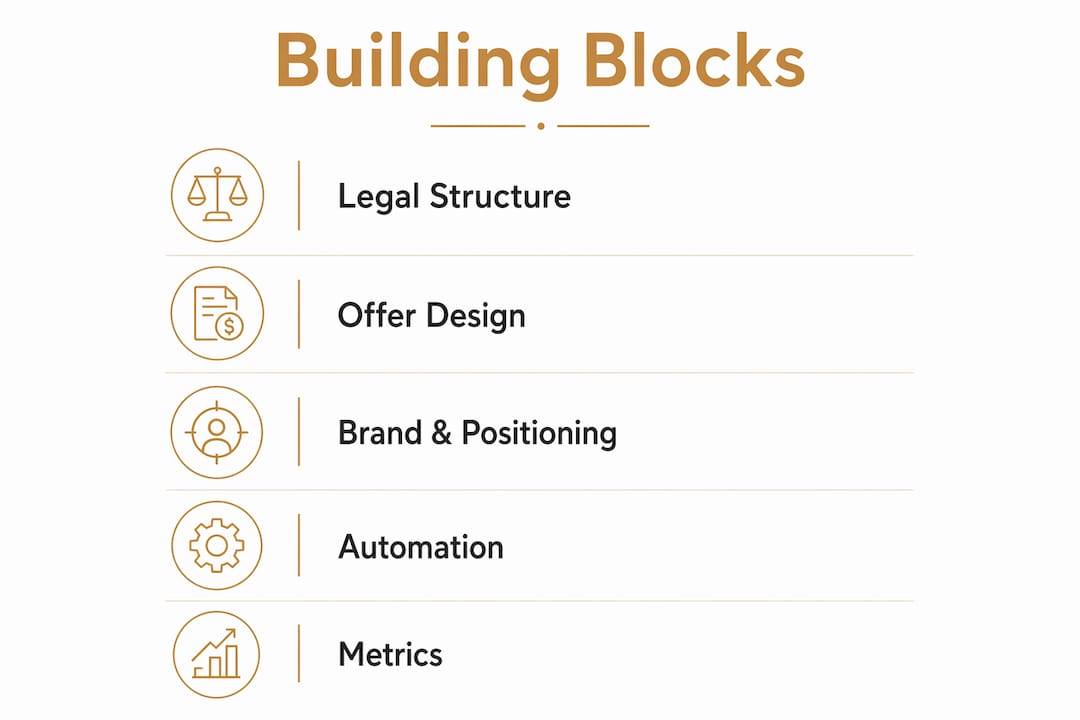
Legal structure
A sole proprietorship is the default, but it offers zero liability protection. Most solo founders benefit from forming an LLC, which separates personal and business assets. The U.S. Chamber of Commerce recommends LLC formation as a standard first step for asset protection. Filing costs vary by state and can range from relatively low to moderate amounts.
Offer design
Productized services, monthly retainers, and digital products are the easiest revenue models to scale while staying one-person-run. The goal is an offer with a fixed scope and a fixed price, so you can deliver it repeatedly without reinventing the wheel.

Systems and automation
AI allows a solo founder to automate scheduling, bookkeeping, and basic client inquiries, effectively acting as a team of one. Priority automation categories:
- Scheduling: Calendly or similar to eliminate back-and-forth
- Invoicing and bookkeeping: Wave or QuickBooks for automated reconciliation
- Client onboarding: a templated intake form plus automated welcome sequence
- CRM and proposals: a lightweight tool like Runera for client management and quotes
Brand and positioning
A clear niche, a simple website, and consistent messaging do more for price power and client acquisition than any ad spend. You don’t need a logo refresh. You need a one-sentence positioning statement that makes the right clients say, “That’s exactly what I need.”
Launch checklist (in order):
- Register your LLC (or sole proprietorship if you’re testing first)
- Open a dedicated business bank account
- Build one productized offer with a fixed price
- Set up a simple website with a contact or booking form
- Automate scheduling, invoicing, and client intake
- Define your positioning and publish it consistently
What are the real tradeoffs of going solo, and how do you manage them?
The autonomy is real. So are the risks. Here’s what you’re actually signing up for:
- Control: Every decision is yours, which is powerful and exhausting in equal measure.
- Low overhead: No payroll means higher retained earnings, but revenue stays tied to your choices.
- Loneliness: No colleagues, no sounding board, no one to cover when you’re sick.
- Administrative overload: Billing, taxes, contracts, and client emails eat hours that don’t generate revenue.
- Income variability: Without recurring revenue, a slow month can become a crisis.
The single-point-of-failure problem is the one most solo founders underestimate. If you’re the only one who knows how to deliver, onboard, and invoice, a two-week illness can stall the entire business. The fix isn’t hiring. It’s building systems that run without you for at least the administrative layer.
Risk mitigation checklist:
- Automate every non-revenue task you touch more than twice a week
- Keep a 3–6 month cash buffer before going full-time
- Carry general liability insurance and, if relevant, professional liability (E&O)
- Identify one contractor you can call for overflow or emergencies
- Document your core delivery process so it can run without you improvising
Pro Tip: The first thing most solo founders should automate isn’t social media. It’s client onboarding. A broken or manual onboarding process kills momentum right when a new client is most excited, and it’s the easiest workflow to template and automate in a single afternoon.
What does a practical 90-day starter plan look like?
Here’s a time-bound plan to get from idea to operating business, or to stabilize one you’ve already started.
- Days 1–14 (Discovery): Define your niche, research competitors, and validate your offer with five real conversations. Done means you can describe your offer in one sentence and at least two people have said they’d pay for it.
- Days 15–28 (Offer design): Write your service page, set your price, and build your intake process. Done means you can send a proposal and collect payment without manual steps.
- Days 29–42 (Automation): Set up scheduling, invoicing, and a basic CRM. Done means a new client can book, pay, and onboard without you touching it manually.
- Days 43–60 (Launch): Publish your website, activate outreach, and land your first paying client. Done means revenue in the bank.
- Days 61–90 (Operations): Deliver, collect feedback, and refine. Done means you have a repeatable process and at least one testimonial.
| Cost bucket | Realistic estimate |
|---|---|
| LLC formation | varies by state |
| Website (basic) | low cost annual fees |
| Core AI subscriptions | varies monthly |
| Initial marketing | varies, organic outreach usually free |
| Bookkeeping software | low monthly cost |
- Keep startup costs under $1,000 for the first 90 days if you’re testing the model before going full-time.
- Organic outreach (LinkedIn, referrals, communities) costs nothing and converts better than paid ads at this stage.
Which metrics should every solo founder track?
You don’t need a dashboard. You need five numbers checked weekly.
- Gross revenue: total income before expenses, tracked monthly
- Gross margin: revenue minus direct delivery costs, expressed as a percentage
- Recurring revenue share: what percentage of your income renews automatically
- Lead-to-client conversion rate: new clients divided by total leads in a period
- Customer acquisition cost (CAC): total marketing spend divided by new clients that month
The formula that matters most early on: CAC = marketing spend ÷ new clients. If your CAC is higher than your first-month revenue from a client, your acquisition channel isn’t working yet.
Early warning signs to watch: two consecutive months of declining leads, a conversion rate below 20%, or a cash buffer dropping below 60 days of expenses. Check revenue and leads weekly; check margin and CAC monthly.
What are the most common myths about independent entrepreneurship?
- Myth: “I can skip formal setup and sort it out later.” Reality: operating without an LLC or a business bank account creates tax headaches and personal liability. Set it up in week one.
- Myth: “I’ll work less than I did at a job.” Reality: most solo founders work more in year one, especially on sales and admin. The payoff is control over when and what, not fewer hours.
- Myth: “AI replaces strategy.” Reality: AI automates execution. It doesn’t tell you which offer to build, which clients to pursue, or when to pivot. Strategy is still yours.
- Myth: “Freelancing and independent entrepreneurship are the same thing.” Reality: the structural difference is intentional brand-building and systems versus client-driven time-trading.
What to do instead: treat setup as a one-time sprint, plan for a full year before judging the model, use AI for tasks not decisions, and productize your first offer before taking on your third client.
Is independent entrepreneurship right for you?
Run through this checklist honestly:
- Do you have 3–6 months of living expenses saved, or a part-time income to bridge?
- Do you want to make every business decision yourself?
- Are you willing to handle admin, sales, and delivery, at least initially?
- Can you build or learn a repeatable system for your core service?
- Do you have a skill or expertise someone will pay for without a company name behind you?
If you answered yes to 4 or 5: you’re ready to form your entity and launch your first productized offer. Start with the 90-day plan above.
If you answered yes to 2 or 3: run a pilot first. Take two freelance clients under your own name, document your process, and test whether you enjoy the full-stack responsibility before committing to formal setup.
If you answered yes to 1 or fewer: build your runway first. A solo business plan and a clear offer can be developed while you’re still employed.
- Connect with a mentor or peer community early. Loneliness is a real risk factor for solopreneurs, and accountability partners reduce it significantly.
What tools and resources should you use?
| Category | Recommended tools | First setup priority |
|---|---|---|
| AI automation | ChatGPT, Claude, Zapier | Automate intake and first-response emails |
| Client management | Runera, HoneyBook | Set up proposals and invoicing |
| Bookkeeping/taxes | Wave, QuickBooks Self-Employed | Connect bank account, automate categorization |
| Contracts/proposals | Bonsai, AND.CO | Template your standard agreement |
| Scheduling | Calendly, TidyCal | Eliminate all manual booking |
| Communication | Google Voice, Grasshopper | Separate business and personal lines |
The single most useful free resource for getting your AI stack in place is Yoursolobusiness’s guide, “I Replaced My Imaginary Team With These 18 AI Tools.” It’s the exact stack Jay uses to run a one-person business at team-level output, covering everything from content generation to client communication. You’ll also find practical scaling examples and implementation checklists across the Yoursolobusiness library.
Key Takeaways
Independent entrepreneurship is a systems-first model: without automation and productized offers, a one-person business is just a stressful job with no boss.
| Point | Details |
|---|---|
| Define the model correctly | Independent entrepreneurship means owner-operated systems and brand, not just working alone. |
| LLC first | Form an LLC before taking clients to separate personal and business liability. |
| Productize early | Package your expertise into fixed-scope offers so income isn’t tied to hours worked. |
| AI as a force-multiplier | Use AI to automate scheduling, invoicing, and onboarding, not to replace your strategy. |
| Yoursolobusiness as your resource hub | The free “18 AI Tools” guide and Yoursolobusiness’s library give you a ready-made implementation stack. |
The part most guides won’t tell you
The biggest mistake I see solo founders make isn’t picking the wrong niche or the wrong tool. It’s treating independence as the goal when sustainability is the actual goal. A lot of people leave jobs for freedom, then accidentally build a business that’s just as constraining, because they never stopped trading time for money or never built a single system that runs without them.
AI changes this, but not automatically. The founders who actually benefit from AI tools are the ones who first got clear on what they needed to automate and why. Dropping ChatGPT into a broken workflow just gives you a faster broken workflow. The sequence matters: offer first, system second, AI layer third.
If you’re just starting, my honest recommendation is to pick one AI tool, use it to automate one specific task you hate doing, and measure the time you get back. That’s a more useful first week than reading every guide on the internet, including this one.
Your next step with Yoursolobusiness
If you’re ready to stop spinning your wheels and actually build the systems behind your solo business, the Yoursolobusiness AI Toolkit is the fastest way to get there. It’s a curated collection of AI tools and ready-to-use prompts built specifically for solopreneurs, covering everything from client communication to content creation to financial tracking.
No fluff, no filler. Just the exact tools and prompts that help you run a one-person business at a level most small teams can’t match. It’s built for founders who are serious about working smarter without burning out or hiring people they don’t need. Head to the AI Toolkit and grab what fits your current stage.