

Launching your own business can feel overwhelming when you are responsible for every decision and outcome. Aspiring solopreneurs from every corner of the globe face the challenge of building a venture that stands out and supports their goals. Creating a solo business plan gives you clarity, structure, and a foundation for personal branding that helps you turn ideas into focused action and long-term growth.
Key Takeaways
| Point | Details |
|---|---|
| Importance of a Solo Business Plan | A solo business plan serves as a personal roadmap for structuring and growing your venture, ensuring clarity and informed decision-making. |
| Core Components | Key areas include market analysis, organizational structure, pricing strategies, and financial projections which guide your business actions. |
| Planning for Clarity | Documenting your plan enhances accountability and reveals gaps in understanding before investing time and resources. |
| Preventing Burnout | A well-structured plan helps manage workload, allocate resources wisely, and prevents the chaos that leads to burnout, ensuring sustainable growth. |
Solo Business Plans Explained Clearly
A solo business plan is your personal blueprint for how you’ll structure, operate, and grow your one-person venture. Think of it as a roadmap that guides your decisions, from the first day you launch to years down the line.
Unlike complex plans designed for large corporations seeking investor funding, a solo business plan can be lean and focused. You’re not trying to impress venture capitalists – you’re creating a practical tool for yourself.
What’s Actually in a Solo Business Plan?
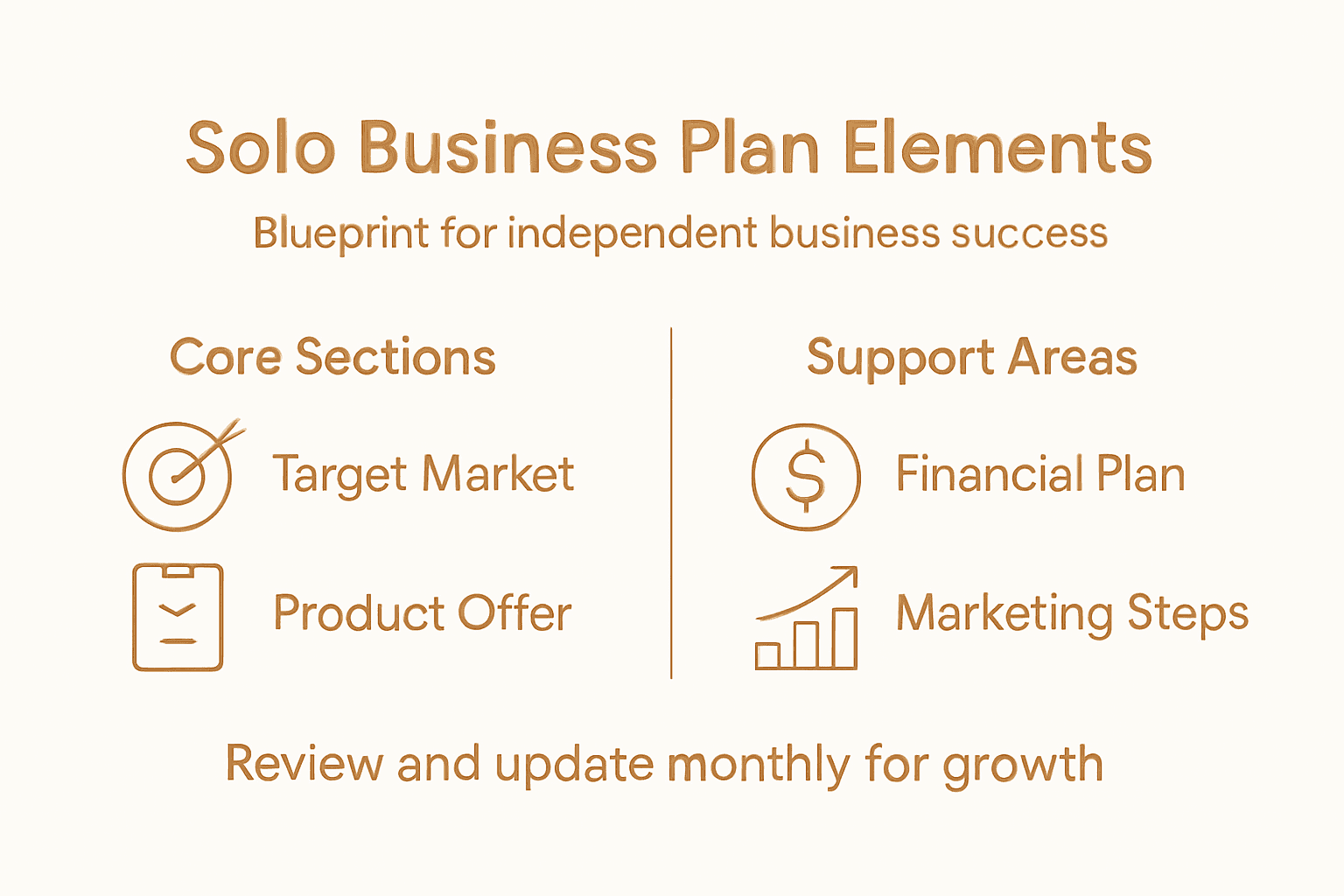
A solid plan typically covers these core areas:
- Market analysis: Who needs what you’re offering? Who are your competitors? What’s the demand?
- Your organization: How will you structure your business legally and operationally?
- Products or services: What exactly will you sell? What makes it different?
- Marketing strategy: How will customers find you? What’s your pricing approach?
- Financial projections: How much will you earn? What are your operating costs?
Your plan doesn’t need to be 50 pages long – it needs to answer the questions that matter most for your specific business.
When developing your business structure, understanding your legal and financial requirements from the start prevents costly mistakes later. This is where your plan becomes a practical document instead of just wishful thinking.
Why This Matters for Solo Operators
You’re making every decision alone. No management team to bounce ideas off. No finance department handling the numbers. Your plan becomes your decision-making framework when things get confusing or when you need to stay accountable.
A written plan forces clarity. It’s easy to have a vague idea in your head. Writing it down reveals gaps. You might realize your pricing doesn’t cover your actual costs. Or you discover your target market is smaller than you thought.
This clarity happens before you’ve invested significant time and money – not after.
Two Formats That Actually Work
- Traditional format: Detailed sections covering all business aspects. Use this if you need to present to lenders or if your business is complex.
- Lean startup format: Focus on the 3-5 critical elements that will make or break your business. Faster to create, easier to update monthly.
Most solopreneurs find the lean approach feels less overwhelming and more practical for their reality.
Pro tip: Start with a simple one-page plan covering your target customer, what you’re selling, how you’ll market it, and basic financials – then expand only the sections that need more detail for your specific situation.
To help you choose the right business plan format, here’s a comparison:
| Format Type | Key Elements Included | Ideal For | Update Frequency |
|---|---|---|---|
| Traditional | Comprehensive documentation | Complex solo businesses | Rare, major changes only |
| Lean Startup | Essential sections only | Most solo ventures | Monthly or as needed |
This summary highlights how your business plan format impacts usability and maintenance.
Core Benefits for Independent Entrepreneurs
A solid business plan transforms your solo operation from a hopeful idea into a strategic advantage. You gain clarity on what actually matters, where your resources should go, and how to measure success along the way.

Without a plan, you’re essentially flying blind. You might work 60-hour weeks building something nobody wants. With one, you validate your assumptions early and adjust before sinking real money into the wrong direction.
The Real-World Benefits That Matter
Here’s what actually changes when you write down your business plan:
- Clarity on your target market: Stop guessing who needs your service. Define exactly who they are, where they hang out, and what problems you solve.
- Financial reality check: Discover whether your pricing works before you’ve built the whole business around the wrong numbers.
- Risk management: Identify potential obstacles early. Maybe you need specific licenses. Maybe your supply chain is fragile. A plan reveals these before they derail you.
- Resource allocation: You have limited time and money. A plan shows you where to invest first for the biggest return.
- Competitive positioning: Understand what others are doing and where your real advantage lives.
A business plan isn’t about impressing lenders – it’s about making smarter decisions with incomplete information.
When you plan your business strategically, you gain the ability to focus your efforts on what actually moves the needle rather than spinning your wheels on activities that feel productive but don’t drive results.
From Validation to Sustainable Growth
Independent entrepreneurs who invest time in planning make smarter decisions about customer needs, market positioning, and growth opportunities. This isn’t about creating a perfect document that never changes – it’s about developing a thinking tool you update regularly.
Your plan becomes your reference point when you’re exhausted and making reactive decisions. It keeps you anchored to strategy instead of chasing every shiny opportunity that crosses your desk.
Most importantly, a plan helps you recognize when something isn’t working so you can pivot faster than competitors who never stopped to think strategically.
Pro tip: Review and update your business plan monthly – not to create busy work, but to compare what actually happened against what you predicted, then adjust your strategy based on real data from your business.
Building Personal Branding Through Planning
Your business plan isn’t just a financial document – it’s the foundation of your personal brand. When you write down your mission, values, and unique approach, you’re defining exactly who you are to potential clients and collaborators.
Many solopreneurs skip this step and wonder why their messaging feels scattered. One day you’re positioning yourself as a luxury expert. The next day you’re undercutting prices to grab any client willing to pay. That inconsistency kills your brand before it starts.
How Planning Clarifies Your Brand Story
Your business plan forces you to answer the questions that shape your brand identity:
- Your unique value proposition: What makes you different from everyone else doing what you do?
- Your target customer: Who actually benefits most from your specific approach?
- Your core message: What’s the one thing you want people to remember about you?
- Your communication channels: Where does your ideal client spend their time?
- Your business values: What do you stand for beyond just making money?
A coherent personal brand comes from clarity, not confidence. Planning gives you that clarity.
When you clarify your unique value proposition and messaging, every piece of content you create, every conversation you have, and every decision you make points in the same direction. People start recognizing you for something specific instead of being confused about what you actually do.
From Internal Clarity to External Recognition
Your plan articulates your mission and vision in writing. This becomes the north star for everything you communicate publicly. Your website copy. Your social media posts. Your elevator pitch. Your podcast episodes. All aligned because they’re all rooted in the same strategic foundation.
Consistency builds recognition. Recognition builds trust. Trust converts into clients willing to pay premium rates instead of shopping purely on price.
Without a plan, you’re improvising your brand message constantly. That exhaustion shows up in your marketing – scattered, inauthentic, and unconvincing.
The Competitive Advantage of Intentional Branding
You’re competing against dozens of people in your space. Most of them have never written down their positioning. They’re reactive, copying what works for others, never standing out. Your planned, intentional brand becomes your competitive moat.
Clients choose you because you’ve thought through who you serve and how you serve them – and you communicate that consistency everywhere.
Pro tip: Write down three words that capture your brand essence, then test every business decision against them – if an opportunity doesn’t align with those words, it’s a distraction from building your actual brand.
Preventing Burnout and Common Pitfalls
Without a business plan, you’re operating on pure reaction. Client demands, market changes, and random opportunities pull you in different directions simultaneously. You work longer hours trying to keep everything afloat, and burnout creeps in before you realize what’s happening.
A solid plan prevents this chaos. It establishes boundaries, clarifies priorities, and helps you recognize when you’re overextended before exhaustion forces you to stop.
How Planning Protects Your Wellbeing
Your business plan includes realistic timelines, resource allocation, and workload expectations. This prevents the silent killer of solo operations: taking on too much because you didn’t think through capacity.
Key protections built into planning:
- Realistic goal-setting: You identify what’s actually achievable with your available time and energy.
- Workload management: You map out tasks and deadlines so nothing sneaks up on you.
- Resource clarity: You know what you can and cannot do alone, prompting you to delegate, automate, or say no.
- Early warning signs: Regular plan reviews reveal when you’re headed toward overwork before it becomes a crisis.
- Work-life boundaries: Planning includes time for rest, because sustainable growth requires it.
Burnout doesn’t happen suddenly. It’s the result of months of poor planning and unrealistic expectations.
When you manage workload and set realistic goals through planning, you catch problems early and adjust before reaching the breaking point where everything falls apart.
Common Pitfalls Your Plan Prevents
Most solopreneurs fail at one of these predictable moments:
Taking on clients you shouldn’t. Without a plan clarifying your ideal client and capacity, you say yes to anyone paying. This creates misalignment and exhaustion.
Ignoring financial reality. You work constantly but never make enough. A plan reveals whether your pricing, scope, or business model actually works.
Skipping systems. You do everything manually because “you know how to do it.” A plan shows where automation or delegation would save you 10 hours weekly.
Chasing every opportunity. New platforms, new services, new directions constantly pull focus. A plan keeps you anchored to strategy.
Never measuring progress. You can’t improve what you don’t measure. Without tracking against your plan, you spin your wheels for months.
Each of these pitfalls leads directly to burnout. A plan is your defense against all of them.
Below is a summary of common pitfalls solo entrepreneurs face, and how planning helps prevent them:
| Pitfall | Planning Prevention | Business Impact |
|---|---|---|
| Taking wrong clients | Clarifies ideal customer | Reduces overwhelm, improves fit |
| Ignoring finances | Sets realistic goals | Protects profit margins |
| Skipping systems | Identifies automation needs | Saves time, boosts efficiency |
| Chasing distractions | Anchors to strategy | Maintains business focus |
| No progress tracking | Enables measurement | Supports improvement and growth |
Planning acts as a safeguard against these risks, increasing long-term sustainability.
Pro tip: Build a monthly 30-minute review into your calendar where you compare what actually happened against your plan – this early warning system catches burnout risks before they become critical.
Comparing Structured Planning With Going Solo
You’ve probably seen solopreneurs succeed without a formal business plan. They wing it, trust their instincts, and somehow make it work. That’s possible. It’s also inefficient, risky, and unsustainable at scale.
The difference between structured planning and going solo isn’t about success versus failure – it’s about the path you take to get there and the obstacles you encounter along the way.
The Going Solo Approach
When you operate without a formal plan, you’re relying on intuition and real-time decision-making. You respond to what’s in front of you rather than working toward predetermined goals.
What this looks like:
- You take clients based on immediate cash needs, not strategic fit.
- You discover problems only after they’ve cost you time and money.
- Your pricing changes based on what you think customers will pay in the moment.
- Marketing happens sporadically when you remember.
- Financial reality hits you quarterly when you file taxes.
Some solopreneurs thrive this way. They’re naturally strategic thinkers who mentally organize their business without writing anything down. But they’re rare.
The Structured Planning Advantage
When you define goals, assess risks, and align resources through structured planning, you reduce uncertainty and establish a framework for measurable progress.
Structured planning delivers:
- Clarity before action: You know your target market, pricing strategy, and revenue goals before investing heavily.
- Risk reduction: You identify obstacles early and prepare for them instead of being blindsided.
- Resource optimization: You allocate your limited time toward activities with the highest return.
- Measurable progress: You track actual results against predictions and adjust systematically.
- Scalability: You build systems that work beyond just you executing everything.
- Investor readiness: If you ever want funding or want to sell, buyers expect documentation.
Structured planning doesn’t guarantee success. It dramatically increases the odds and reduces the cost of failure.
The Real Trade-Off
Structured planning requires upfront time investment. Creating a solid plan takes 10-20 hours. Going solo saves that time initially but costs you later through inefficient decisions and missed opportunities.
Think of it like navigation. You can wander a new city and eventually find your destination. Or you can spend 10 minutes planning the route and arrive faster, less stressed, and without wrong turns.
The solopreneur who plans reaches sustainable profitability faster. They make fewer expensive mistakes. They scale without burning out. And they sleep better knowing they’ve thought through their strategy.
Pro tip: If you’re torn between the two approaches, start with a lean plan – one page covering your target customer, core offer, marketing channels, and basic financials – then expand from there based on what you actually need.
Take Control of Your Solo Business Success with Strategic Planning
Creating a solo business plan is essential for overcoming common challenges like burnout, unclear target markets, and financial uncertainties. This article highlights how a clear plan provides clarity, focus, and protection against costly mistakes while empowering you to build a consistent personal brand. If you find yourself struggling to prioritize, manage resources, or stay aligned with your goals, developing a tailored business plan offers the structure and guidance you need.

Ready to transform your solo venture into a sustainable success story? Explore practical strategies and expert insights in our Plan Your Business – Your Solo Business section. For broader tactics and growth ideas, visit Business & Strategy – Your Solo Business. Discover creative opportunities to expand in Solo Business Ideas – Your Solo Business. Start building your confidently planned business today at Your Solo Business and consider coaching support to accelerate your journey.
Frequently Asked Questions
What is a solo business plan?
A solo business plan is a personal blueprint that outlines how you will structure, operate, and grow your one-person business, serving as a roadmap for your entrepreneurial journey.
Why is a solo business plan important for solo entrepreneurs?
A solo business plan is crucial as it provides clarity, helps identify your target market, ensures financial viability, and serves as a framework for making informed business decisions.
What key elements should be included in a solo business plan?
Essential elements of a solo business plan include market analysis, organization structure, description of products or services, marketing strategy, and financial projections.
How often should I update my solo business plan?
It’s recommended to review and update your solo business plan monthly to compare actual results against your predictions and to adjust your strategy based on real data.