

Starting out on your own as a creative freelancer often means confronting doubts about the stability and potential of a solo business. The truth is, solo ventures now represent a dynamic and sustainable choice, with research showing that independent self-employed workers maintain strong career adaptability across many fields. This article unpacks persistent myths and highlights how embracing a solo path can provide remarkable autonomy, creative control, and a path to financial sustainability – all while offering strategies to protect your well-being from burnout along the way.
Key Takeaways
| Point | Details |
|---|---|
| Solo Businesses Offer Autonomy | Operating a solo business allows individuals complete control over their work processes and projects, fostering empowerment and creativity. |
| Diverse Income Streams are Possible | Various business models, such as freelancing and digital product creation, enable solo entrepreneurs to explore multiple revenue avenues. |
| Mental Health Management is Essential | Establishing work-life boundaries and social interactions are crucial in preventing burnout and maintaining productivity in solo ventures. |
| Adaptability is Key to Success | Successful solo entrepreneurs continuously reassess their business models to align with market demands and personal skills. |
Defining a Solo Business and Common Myths
A solo business represents an independent entrepreneurial venture where an individual operates their enterprise entirely on their own, without traditional employees or extensive corporate infrastructure. These businesses leverage personal skills, expertise, and digital platforms to generate income while maintaining maximum operational flexibility.
The landscape of solo businesses has dramatically transformed in recent years, shifting from a niche concept to a mainstream career path. Solo entrepreneurial dynamics reveal a complex ecosystem of professionals who strategically choose independence over traditional employment models.
Common myths about solo businesses persist, creating unnecessary barriers for potential creators. Here are some key misconceptions:
- Solo businesses are unstable and risky
- Independent creators cannot generate significant income
- Solo entrepreneurs work in isolation with limited growth potential
- Only certain industries support solo business models
Contrary to popular belief, solo businesses offer remarkable advantages. Research indicates that independent self-employed workers demonstrate high levels of career sustainability and adaptability across multiple sectors.
The modern solo business encompasses diverse models, including:
- Freelance services
- Online digital products
- Consulting and coaching
- Content creation
- Digital product development
Sustainability and strategic self-management are critical components that distinguish successful solo entrepreneurs from those who struggle. These professionals develop robust systems, continuously upgrade skills, and maintain flexible business approaches.

Pro tip: Treat your solo business like a professional enterprise by developing clear systems, investing in continuous learning, and maintaining a strategic long-term perspective.
Solo Business Models and Real-World Variations
Solo business models have evolved dramatically, offering creators unprecedented flexibility in designing their professional journeys. Innovative business model strategies reveal multiple approaches that go far beyond traditional employment structures.
The contemporary solo business landscape encompasses several distinct operational models:
- Freelance Service Provider: Offering specialized skills directly to clients
- Digital Product Creator: Developing and selling online courses, ebooks, templates
- Consulting/Coaching: Providing expert guidance in specific domains
- Content Creator: Generating revenue through blogs, podcasts, YouTube channels
- Online Service Entrepreneur: Building digital platforms or subscription-based services
Unique to these models is the ability to scale without traditional workforce expansion. Collaborative networking strategies demonstrate how solo entrepreneurs overcome operational limitations through strategic partnerships and outsourcing.
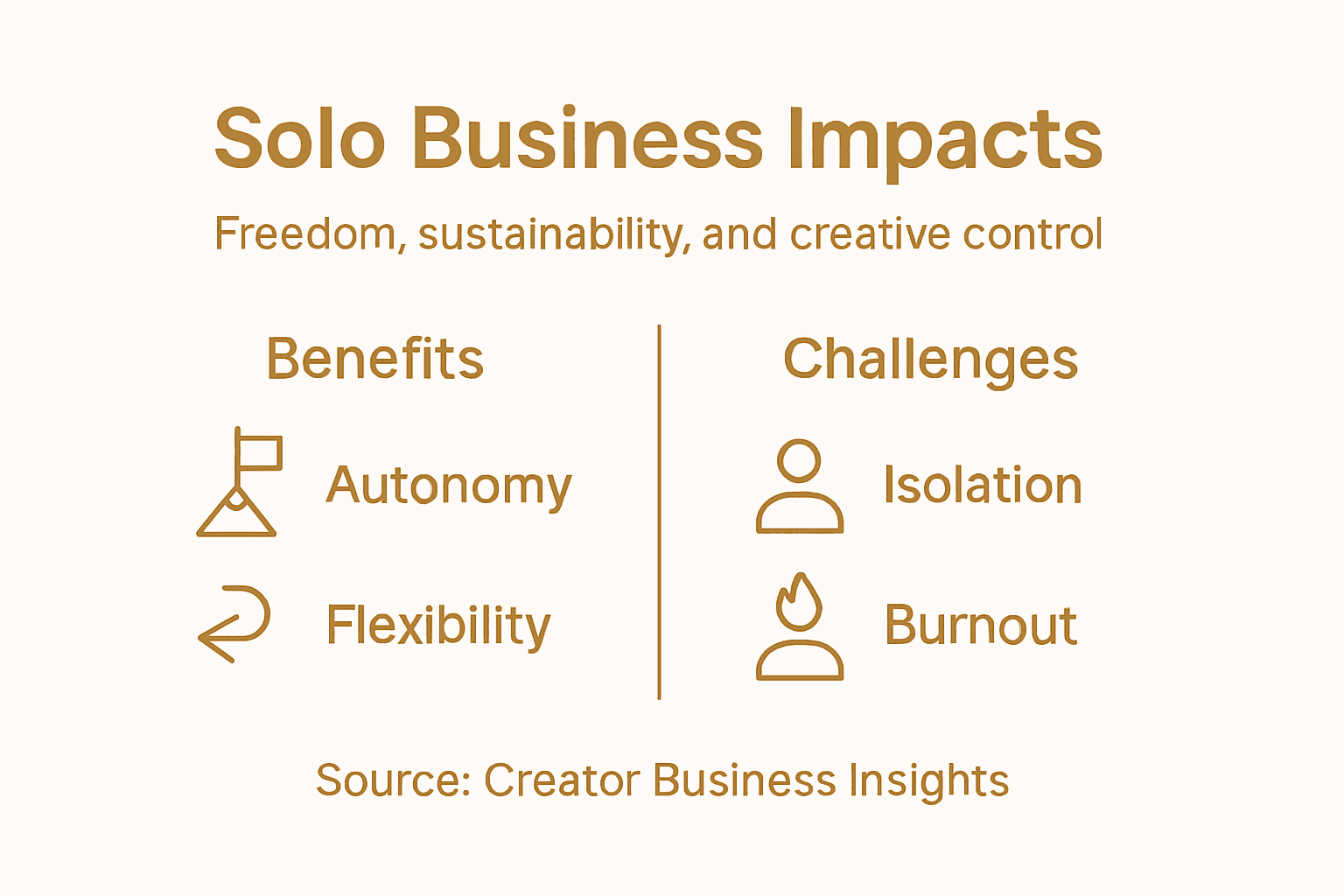
Each model requires distinct skill sets and approaches. Freelance service providers might focus on building a robust client portfolio, while digital product creators invest heavily in marketing and product development. Content creators prioritize audience engagement and monetization strategies.
Key differentiators among solo business models include:
- Revenue generation method
- Required initial investment
- Scalability potential
- Personal skill alignment
- Market demand
Adaptability remains the most critical characteristic across all solo business variations. Successful solo entrepreneurs continuously reassess their models, pivot when necessary, and remain responsive to market dynamics.
Here’s how major solo business models compare on key factors:
| Business Model | Typical Revenue Streams | Scalability Potential | Main Skills Needed |
|---|---|---|---|
| Freelance Service Provider | Client fees, project rates | Moderate | Technical, client management |
| Digital Product Creator | Sales, subscriptions | High | Marketing, content development |
| Consulting/Coaching | Hourly fees, retainers | Moderate | Expertise, communication |
| Content Creator | Ads, sponsorships, affiliate | High | Content creation, audience building |
| Online Service Entrepreneur | Subscriptions, platform fees | High | Tech, business strategy |
Pro tip: Select a solo business model that aligns closely with your existing skills, passion, and market demand to maximize your probability of sustainable success.
Empowerment, Flexibility, and Creative Control
Entrepreneurial empowerment represents the cornerstone of solo business success, transcending traditional workplace limitations. Cognitive flexibility in entrepreneurship reveals how individual creators can transform personal skills into powerful professional trajectories.
The core advantages of solo business empowerment include:
- Complete control over project selection
- Unlimited creative direction
- Personal brand development
- Flexible work scheduling
- Direct financial rewards
- Minimized hierarchical constraints
Entrepreneurial motivation dynamics demonstrate that intrinsic motivation drives solo entrepreneurs toward unprecedented levels of professional autonomy. This motivation stems from a deep desire to craft unique value propositions and maintain absolute creative control over their professional endeavors.
Creative control manifests through several critical dimensions. Solo entrepreneurs can rapidly prototype ideas, pivot strategies, and implement innovations without bureaucratic interference. They design workflows that maximize personal strengths, eliminate inefficient processes, and create direct pathways between creative vision and market execution.
Key psychological benefits of solo business empowerment include:
- Enhanced self-efficacy
- Reduced professional stress
- Increased personal agency
- Direct skill monetization
- Continuous personal development
Autonomy transforms solo business from a mere work arrangement into a profound personal expression of professional identity. Successful solo entrepreneurs view their businesses as dynamic extensions of their creative capabilities.
Pro tip: Regularly reassess your creative boundaries and intentionally design systems that amplify your unique professional strengths and personal vision.
Financial Realities and Profitability Potential
Financial sustainability represents the critical backbone of successful solo businesses, demanding strategic planning and realistic expectations. Solopreneur financial challenges reveal a complex landscape of investment, risk management, and revenue generation.
Essential financial considerations for solo entrepreneurs include:
- Initial capital requirements
- Revenue diversification strategies
- Expense management techniques
- Tax planning and compliance
- Personal and business financial separation
- Emergency fund development
Profitability and business growth demonstrate that financial success depends on more than just generating income. Solo entrepreneurs must develop sophisticated approaches to resource allocation, understanding that profitability involves strategic investment and continuous skill enhancement.
Revenue generation in solo businesses typically follows multiple potential pathways. Digital product creators might develop scalable income streams through online courses and downloadable resources. Service-based entrepreneurs can leverage hourly consulting rates or project-based pricing models. Content creators explore multiple monetization channels including sponsorships, affiliate marketing, and direct audience support.
Key financial metrics solo entrepreneurs should track include:
- Monthly recurring revenue
- Profit margin percentage
- Customer acquisition cost
- Average client lifetime value
- Expense-to-income ratio
Financial intelligence transforms solo businesses from passion projects into sustainable economic engines. Successful entrepreneurs view money as a strategic tool for growth and personal development.
Pro tip: Develop a comprehensive financial tracking system that separates personal and business expenses while providing clear visibility into your revenue streams and spending patterns.
Burnout, Isolation, and Common Pitfalls
Solo entrepreneurship demands exceptional mental resilience, with psychological challenges often emerging as the most significant obstacles. Psychological stressors of solo ventures reveal complex emotional landscapes that can dramatically impact professional sustainability.
Common challenges solo entrepreneurs frequently encounter include:
- Prolonged work hours
- Limited social interaction
- Decision-making fatigue
- Financial uncertainty
- Lack of structured feedback
- Professional isolation
Technology and sole trader challenges demonstrate that modern digital tools can mitigate some traditional solo business limitations. Entrepreneurs can leverage online communities, collaborative platforms, and networking technologies to counteract feelings of isolation and overwhelm.
Psychological pitfalls manifest through multiple interconnected dimensions. Solo entrepreneurs often struggle with boundary management, finding themselves working excessive hours without clear demarcation between professional and personal life. This blurred boundary increases stress, reduces productivity, and accelerates burnout risk.
Priority areas for maintaining mental health include:
- Establishing strict work-life boundaries
- Creating regular social interaction opportunities
- Implementing self-care routines
- Developing professional support networks
- Practicing mindful stress management
Emotional intelligence becomes a critical survival skill for solo business creators. Successful entrepreneurs develop sophisticated self-management strategies that prevent professional exhaustion while maintaining high performance standards.
Pro tip: Schedule weekly check-ins with yourself to assess mental health, energy levels, and emotional resilience, treating your psychological well-being as seriously as your business metrics.
Comparing Solo, Freelancer, and Team Ventures
Entrepreneurial paths represent diverse approaches to professional creativity and business development, each with unique characteristics and strategic implications. Entrepreneurial climate variations reveal nuanced differences between solo, freelance, and team-based ventures.
Key distinctions among business models include:
- Solo Ventures: Single-person operations with complete creative control
- Freelance Ventures: Project-based work with multiple client relationships
- Team Ventures: Collaborative enterprises with shared responsibilities
- Hybrid Models: Combinations of different operational approaches
- Scalable Independent Businesses: Solo ventures with potential for systematic growth
Each model presents distinct advantages and challenges. Solo entrepreneurs prioritize absolute autonomy and direct client relationships, while team ventures distribute risk and leverage collective expertise. Freelancers occupy a middle ground, offering specialized services with flexible engagement models.
Operational characteristics vary significantly across these models:
- Decision-making speed
- Financial risk distribution
- Scalability potential
- Revenue generation strategies
- Skill diversity and complementary capabilities
Adaptability emerges as the most critical factor across all entrepreneurial models. Successful creators understand their preferred operational style and strategically design their business structure to maximize personal strengths.
To better understand venture types, here’s a comparison of their operational traits:
| Venture Type | Decision-Making Speed | Risk Distribution | Skill Diversity |
|---|---|---|---|
| Solo Venture | Very fast | All risk on owner | Limited to one person |
| Freelancer | Fast | Individual risk | Specific professional skills |
| Team Venture | Slower | Shared risk | Collaborative expertise |
| Hybrid Model | Variable | Partial risk sharing | Mixed skill sets |
| Scalable Solo | Fast | Owner risk, can grow | Expanding expertise |
Pro tip: Regularly assess your entrepreneurial model, being willing to pivot and integrate elements from different approaches that enhance your professional effectiveness.
Unlock Your Full Potential as a Solo Entrepreneur Today
Building a solo business brings incredible freedom but also challenges like burnout, financial uncertainty, and isolation. This article highlights how strategic planning, financial intelligence, and creative control are essential to overcome these obstacles and thrive independently. If you are ready to turn these insights into action and create a resilient, sustainable solo venture explore our comprehensive resources on how to Plan Your Business – Your Solo Business and discover tailored Solo Business Ideas – Your Solo Business to match your unique skills and passions.

Empower yourself with proven strategies in Business & Strategy – Your Solo Business and access coaching that guides you every step of the way. Do not wait to build the autonomous, creative, and financially sound business you deserve. Visit Your Solo Business now and start crafting your successful solo enterprise today.
Frequently Asked Questions
What are the major benefits of building a solo business?
Building a solo business offers complete control over project selection, unlimited creative direction, flexible scheduling, and direct financial rewards, allowing entrepreneurs to design their professional journeys freely.
Are solo businesses financially sustainable?
Yes, solo businesses can be financially sustainable with strategic planning, expense management, and diversified revenue streams. Entrepreneurs should track key financial metrics and make informed decisions about investments and expenses.
How can solo entrepreneurs avoid burnout and isolation?
To mitigate burnout and isolation, solo entrepreneurs should establish work-life boundaries, create opportunities for social interaction, implement self-care routines, and develop professional support networks for collaboration and feedback.
What is the difference between a solo business and a freelance venture?
A solo business typically refers to a single-person operation with complete creative control, while a freelance venture involves project-based work for multiple clients, offering a degree of flexibility in engagements but with potential less control over project selection.
Recommended
- How to Choose the Right Solo Business Idea For You: 7 Steps – Your Solo Business
- Freelancer vs. Solopreneur vs. Entrepreneur: Which Path Fits You Best? – Your Solo Business
- How to Create Social Media Content That Works – Your Solo Business
- Understanding B2B Brand Building Explained for SaaS and Startups – Kadima
- Why Choose Sole Trader Status in the UK – Kefihub