
Solo Enterprise refers to two specific commercial software distributions from Solo.io: Solo Enterprise for agentgateway and Solo Enterprise for kagent. Both are production-ready, enterprise-grade distributions of their respective open-source projects, built to provide secure, observable, and governable networking for agentic AI workloads running on Kubernetes. If you’re evaluating infrastructure for MCP or A2A protocol traffic between agents, tools, and LLMs, these are the products you’re looking at.
Before we go deep, a quick heads-up: the phrase “solo enterprise” pulls up three very different things in search results. There’s the Solo.io software product (what this article covers), Solo Enterprise Corporation (a legacy aerospace manufacturer), and the “solo enterprise” business model concept for one-person scalable businesses. We’ll sort all three out clearly in Section 7.
Here’s what the two distributions cover at a glance:
- Solo Enterprise for agentgateway: enterprise packaging of the open-source agentgateway project, adding hardened security, IAM integration, observability, and governance for agentic AI data planes.
- Solo Enterprise for kagent: enterprise packaging of the kagent project, adding a controller that manages agent lifecycle and a tunnel that connects the controller to remote agents or tool servers.
- Protocols supported: MCP (Model Context Protocol) and A2A (Agent-to-Agent), the two emerging standards for agent-to-tool and agent-to-agent communication.
- Core problem solved: traditional proxies don’t handle stateful, context-aware agent networking. Solo Enterprise fills that gap at production scale.
What Solo Enterprise actually does for your AI infrastructure
The core enterprise barrier for agentic AI isn’t just deploying agents. It’s the secure, context-aware networking and observability between agents, tools, and LLMs that generic proxies simply weren’t built for. Solo Enterprise addresses that gap directly.
Here’s what the feature set looks like in practice:
- Enterprise security: centralized key storage, IAM integration, and support for API keys, JWT, and OAuth/OIDC. Fine-grained authorization controls govern which agents can reach which tools or LLM providers.
- Governance: policy controls, multi-tenancy support, and hardened access controls across agentic workflows. You can isolate tenants and enforce policies without manual intervention at each hop.
- Observability: telemetry collection, distributed tracing, and structured logging across agent, tool, and LLM interactions. Full traceability from agent request to LLM response.
- Scale and availability: highly available, stateful connections for MCP and A2A traffic at production load. Not just a proxy pass-through.
- Lifecycle management: controller and operator functions manage agent and tool lifecycle across Kubernetes clusters automatically.
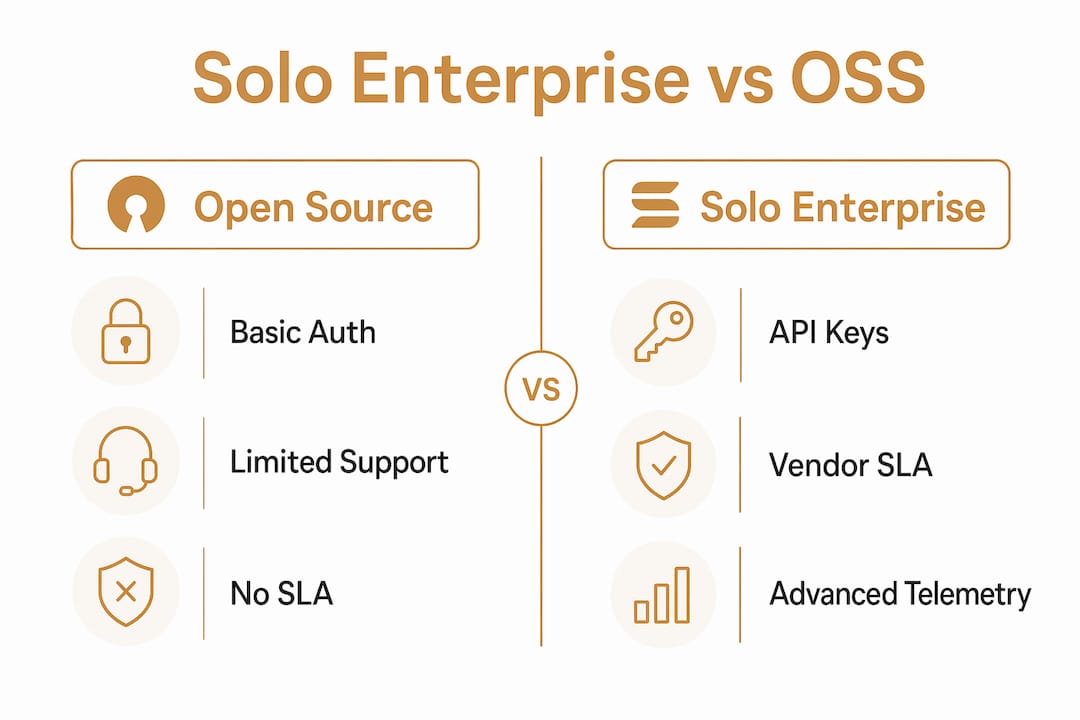
| Dimension | Plain proxy / OSS upstream | Solo Enterprise |
|---|---|---|
| Auth protocols | Basic or none | API keys, JWT, OAuth/OIDC |
| Key management | Manual / external | Centralized, integrated |
| Multi-tenancy | DIY | Built-in isolation |
| Observability | Logs only | Distributed tracing + telemetry |
| Agent lifecycle | Manual | Controller-managed |
| Enterprise support | Community | SLA-backed |
Pro Tip: During your trial, test end-to-end tracing across a full agent→tool→LLM hop under load. Many teams discover telemetry gaps at the LLM provider boundary that only show up under realistic traffic patterns, not in hello-world demos.
How Solo Enterprise is built and deployed on Kubernetes

The architecture you’ll encounter has four main components, and understanding how they fit together saves a lot of confusion during deployment.
| Component | Role | Key Kubernetes resources | Integration touchpoints |
|---|---|---|---|
| Controller | Manages policy, lifecycle, and configuration | Deployment, CRDs, RBAC | IAM, secrets manager, telemetry backend |
| Tunnel | Connects remote tool servers or agents to the controller securely | DaemonSet or sidecar | Network policies, firewall rules |
| Operator | Provisions and reconciles Solo Enterprise resources in-cluster | Operator pod, CRDs | Helm, GitOps pipelines |
| Agent runtime | Maintains stateful MCP/A2A connections between agents and tools | Pod/sidecar | LLM provider APIs, tool servers |
The controller manages agent lifecycle and policy enforcement. The tunnel handles remote connectivity, so tool servers outside the cluster can still participate in the agentic data plane without punching holes in your network perimeter.
Typical deployment patterns include:
- Single-cluster: operator + controller in-cluster, agents and tools co-located. Simplest path for initial POC.
- Multi-cluster: controllers federated across clusters with shared policy. Useful for multi-region or multi-team deployments.
- Hybrid: in-cluster agents connecting to remote tool servers via tunnel. Common when tool servers run on-premises or in a separate cloud account.
For HA and resilience, test connection recovery after controller pod restarts and verify telemetry fidelity during failover. These are the two failure modes that most frequently surface in staging but get missed in basic smoke tests.
How Solo Enterprise differs from the upstream open-source projects
The open-source agentgateway and kagent projects give you the core runtime. Solo Enterprise adds the layer that makes them production-safe for an enterprise environment. Here’s the practical breakdown:
- Hardened security controls: IAM integrations, centralized key storage, and auth protocol support (JWT, OAuth/OIDC) are enterprise-only additions. The OSS projects handle basic connectivity.
- Observability depth: distributed tracing and structured telemetry across the full agent→tool→LLM chain are enterprise features. OSS gives you logs; Solo Enterprise gives you traces.
- Multi-tenancy isolation: tenant isolation and policy enforcement are enterprise additions. OSS is single-tenant by default.
- Enterprise support and SLAs: community support only on the upstream projects. Solo Enterprise includes SLA-backed support, patching cadence commitments, and tested upgrade paths.
- Production testing: Solo Enterprise distributions are tested for scale, HA, and integration compatibility. OSS releases are tested for functional correctness, not production load.
Pro Tip: Before your POC, ask your Solo.io rep to confirm which specific IAM integrations are supported in your cloud environment (AWS IAM, Azure AD, GCP Workload Identity), what the key storage backend options are, and how multi-tenant namespace isolation is enforced at the policy layer. These three items are the most common blockers during enterprise procurement.
When does Solo Enterprise make sense for your team?
Not every agentic AI project needs enterprise infrastructure on day one. Here’s a quick decision framework.
Solo Enterprise is the right call when:
- Your agentic workloads handle regulated data (PII, PHI, financial records) and require audit trails.
- You’re running multi-tenant SaaS with agentic features and need tenant isolation at the networking layer.
- Your team needs SLA-backed support because you can’t afford a production incident with no vendor escalation path.
- You’re integrating with enterprise IAM (Active Directory, Okta, AWS IAM) and need tested, supported connectors.
- You’re running at a scale where stateful MCP/A2A connection management becomes operationally complex.
Solo Enterprise is probably overkill when:
- You’re running a single-developer POC with no production traffic.
- Security requirements are minimal and multi-tenancy isn’t a concern.
- You’re experimenting with agent architectures before committing to a protocol or runtime.
A quick go/no-go checklist: Do you have compliance requirements? Do you need multi-tenancy? Do you need a vendor SLA? Do you need enterprise IAM integration? If you answered yes to two or more, Solo Enterprise is worth a serious evaluation.
Your field-ready evaluation checklist: POC to production
A realistic path from POC to production has five phases. Each needs acceptance criteria before you move forward.
- Baseline deployment: provision the operator and controller in a staging cluster. Verify CRD installation, RBAC, and basic agent-to-tool connectivity over MCP.
- IAM and auth integration: connect your enterprise IAM provider. Test API key, JWT, and OAuth/OIDC flows. Validate that unauthorized agents are blocked at the policy layer.
- Telemetry and tracing validation: run a full agent→tool→LLM transaction and verify end-to-end trace capture in your observability backend (Datadog, Grafana, OpenTelemetry collector).
- Scale and failover testing: simulate realistic agent churn and connection volume. Test controller pod restart and verify connection recovery time meets your SLA target.
- Pilot rollout: deploy to a limited set of tenants or a single business unit. Collect incident response runbooks, performance benchmarks, and trace artifacts as evidence.
Vendor questions to ask before signing:
- What is the patching cadence and how are CVEs communicated?
- What is the backward compatibility policy across minor and major versions?
- Is professional services available for migration assistance?
- Can you access troubleshooting artifacts (heap dumps, trace exports) during incidents?
A conservative timeline: POC (2–3 weeks), pilot (4–6 weeks), production rollout (4–8 weeks). The most common blockers are IAM integration delays and telemetry backend compatibility issues. Budget extra time for both.
Three things “Solo Enterprise” can mean — and how to tell them apart
Search results for “solo enterprise” mix three completely unrelated concepts. Here’s how to spot which one you’re looking at:
- Solo.io’s Solo Enterprise distributions (this article): context clues include docs.solo.io URLs, references to agentgateway, kagent, MCP, A2A, Kubernetes operators, and agentic AI. This is the software product.
- Solo Enterprise Corporation: an aerospace and defense manufacturer established in 1966 that produces precision machine parts for aerospace and military industries. Context clues: CNC machining, AS9100D certification, castings, forgings. Completely unrelated to AI or software.
- “Solo enterprise” as a business model: this refers to designing a one-person business to scale beyond the owner’s time through systems, products, and automation rather than trading hours for dollars. Context clues: revenue, automation, solopreneurship, scalable products. If you’re researching this path, Yoursolobusiness has a full breakdown of solopreneurship vs. solo enterprise and how to scale without hiring.
The business-model meaning is worth understanding on its own terms. Fast Company research highlights that successful solo operators pursue scalable, leveraged opportunities rather than simple income replacement. That’s a different conversation from Kubernetes operators and MCP security, but both are legitimate uses of the term.
Key Takeaways
Solo Enterprise is Solo.io’s production-ready, enterprise-grade distribution of agentgateway and kagent, adding hardened security, observability, and SLA-backed support that the upstream open-source projects don’t provide.
| Point | Details |
|---|---|
| Two distinct products | Solo Enterprise for agentgateway and Solo Enterprise for kagent each address different parts of the agentic AI stack. |
| Enterprise-only features | IAM integration, centralized key storage, multi-tenancy isolation, and distributed tracing are not in the upstream OSS projects. |
| Top evaluation criteria | Validate IAM integration, end-to-end telemetry, and multi-tenant isolation during POC before committing. |
| POC timeline | Budget 2–3 weeks for POC, 4–6 for pilot, and 4–8 for production rollout; IAM and telemetry are the common blockers. |
| Naming collision | “Solo Enterprise” also refers to an aerospace manufacturer and a one-person business model — check context clues before drawing conclusions. |
Why enterprise infrastructure matters even when your team is tiny
Here’s my honest take on this: the instinct to skip enterprise-grade infrastructure when you’re running a lean operation is understandable, but it’s often the wrong call once you’re in production with real users.
The thing that changes the math for small teams is vendor-managed support. When Solo Enterprise handles patching, tested upgrade paths, and incident escalation, you’re not hiring a platform engineer to own that burden. You’re buying back the time and cognitive load that would otherwise eat your week. For a solo founder or a two-person engineering team running production agentic features, that trade-off often pencils out faster than people expect. The lean-ops case for enterprise tools isn’t about prestige. It’s about not becoming your own on-call rotation for infrastructure you didn’t build.
If you’re exploring how AI tools and vendor-managed systems can help you run a leaner operation, the Yoursolobusiness AI Toolkit is a good starting point for the broader stack.
Useful sources for further reading
Official Solo.io technical references:
- Solo Enterprise for agentgateway — Overview and docs: the primary technical reference for architecture, features, and deployment patterns.
Naming disambiguation:
- Solo Enterprise Corporation: official site of the aerospace and defense manufacturer. Use this to confirm you’re not conflating the legacy company with the software product.
Business-model context:
- Solo-Enterprise: How to Build a Scalable One-Person Business: the clearest explanation of the business-model meaning of “solo enterprise.”
- The perks of being a team of one — Fast Company: useful market context on solo-founder trends and the case for leveraged, scalable solo operations.
For technical evaluation, start with docs.solo.io. For business-model research, growingupwell.org and Fast Company give you the clearest framing. And if you’re building a one-person operation and want practical guidance on running it with AI tools, Yoursolobusiness covers that ground in depth.