
TL;DR:
- Building a lifestyle business emphasizes legal, operational, and financial foundations centered on personal values and stability. Solopreneurs prioritize control, automation, and clear decision frameworks to maintain freedom and adapt to changing needs. Most start with minimal costs, avoid outside investors, and focus on sustainable income streams aligned with their desired lifestyle.
Building a business on your own terms is the process of creating a flexible, independent enterprise that matches your personal values and desired lifestyle from day one. Most business advice pushes you toward rapid growth, outside investors, and hiring fast. This guide takes the opposite approach. You will find the legal steps, operational frameworks, and financial models that solopreneurs and independent professionals used to build something sustainable without surrendering control of how they work and live.
What does building a business on your own terms actually mean?
Building a business on your own terms is also called a lifestyle business or sovereign business. The standard industry term is lifestyle entrepreneurship, and it describes a model where the owner designs the business around personal priorities rather than external investor expectations. Freedom, flexibility, and purpose sit at the center of every decision. That is a fundamentally different starting point than the venture-backed growth model most startup content assumes.
The core insight is this: sovereignty depends more on minimizing operational friction and decision bottlenecks than on income level alone. A solopreneur earning $8,000 a month with clean systems and clear decision rights often has more real freedom than a founder earning $30,000 a month while drowning in meetings and approvals. That reframe changes everything about how you design your business from the start.
Three named frameworks guide this article: the SBA’s 10-step startup guide, the Low-Ops CEO system from Trellis Memos, and the lifestyle business financial model popularized by Alex Berman. Together, they cover the legal, operational, and financial dimensions of running a business independently.
What are the foundational steps to legally start your business?
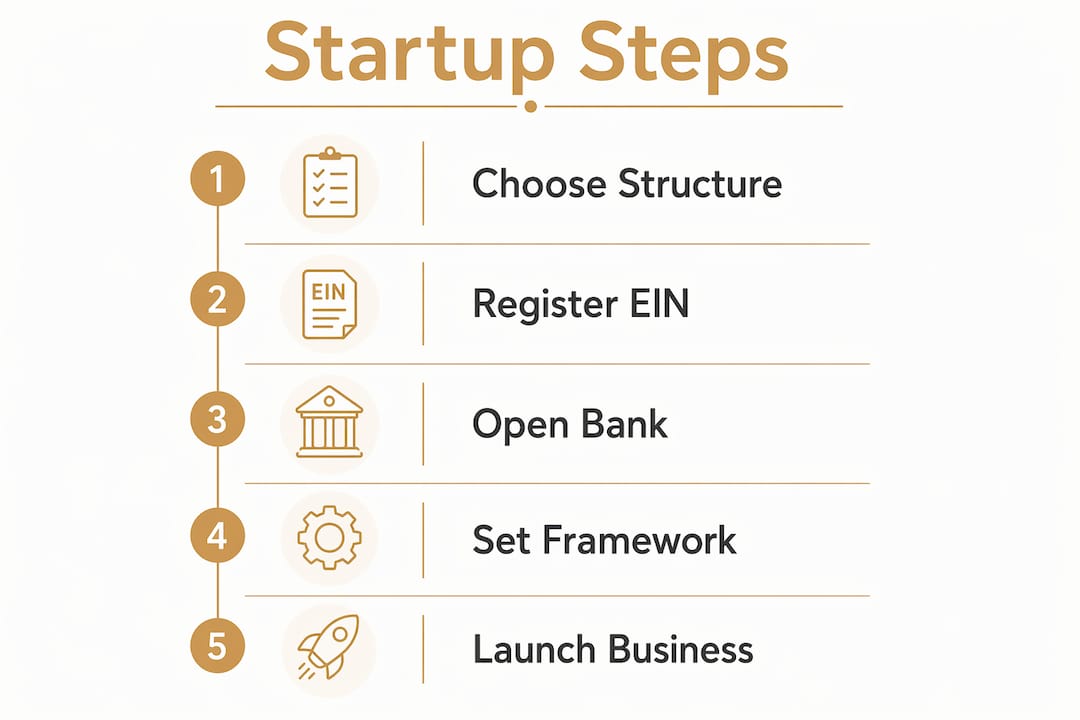
The SBA’s startup checklist covers ten core steps: writing a business plan, choosing a business structure, picking a location, registering your business, getting a federal and state tax ID, applying for licenses and permits, opening a business bank account, securing funding, and setting up accounting. That list sounds long, but most solopreneurs can work through it in a few weeks with the right resources.
Here is a practical sequence to follow:
- Write a one-page business plan. Define your offer, your target client, and your monthly revenue goal before anything else.
- Choose your business structure. Most solopreneurs start as a sole proprietor or single-member LLC. The LLC adds liability protection without much complexity.
- Apply for an EIN. The IRS requires an EIN for most business structures. It takes about 10 minutes online and costs nothing.
- Open a dedicated business bank account. Mixing personal and business finances creates accounting headaches and tax risk.
- Register for state and local licenses. Requirements vary by state and industry, so check your state’s business portal.
- Set up basic accounting software. QuickBooks or FreshBooks both handle invoicing, expense tracking, and tax prep for solo operators.
- Identify your funding source. Most lifestyle businesses start with personal savings or small loans. SBA counseling is free through local partner networks and helps you avoid early mistakes.
- Establish your quarterly tax payment schedule. Missing estimated tax payments triggers penalties from day one.
- Create a simple client contract template. Protect your time and payment terms before you land your first client.
- Set your revenue floor. Know the minimum monthly income you need before you take on any client work.
Pro Tip: Talk to a CPA before you finalize your business structure. Choosing between an LLC and an S-Corp election at the start can save thousands in self-employment taxes over your first few years.
How to design your operations to maximize freedom
Operational friction is the drag on your time and energy created by meetings, unclear decisions, and unnecessary dependencies. Every hour you spend answering questions your systems should answer is an hour you are not doing client work, building products, or resting. The Low-Ops CEO framework addresses this directly.
The framework rests on three pillars:
- Decision rights. Write down which decisions you must make personally and which ones others can handle. Specify dollar thresholds, client escalation rules, and approval processes. Unclear decision authority is the primary cause of owner bottlenecks, not lack of delegation.
- Passive income and automation. Productized services, digital downloads, and subscription offers reduce your dependency on active client hours. Tools like Zapier and Make handle repetitive workflows without human input.
- Purpose alignment. When your daily operations conflict with your values, burnout follows fast. If you hate video calls, build an async-first business. If you need deep work blocks, protect them in your calendar before clients fill them.
The goal is not to eliminate all work. The goal is to eliminate work that does not require you specifically. A well-designed solopreneur business runs on systems that handle the routine, so you can focus on the work only you can do.
Pro Tip: Write your decision framework as a one-page document. List the top 10 decisions in your business and assign each one a clear owner and threshold. Review it quarterly as your business grows.

What does a lifestyle-aligned business look like in practice?
A lifestyle business starts with your expenses, not your ambitions. Reverse-engineer your revenue floor from your true monthly living costs plus a buffer. That number tells you exactly how many clients you need and at what price point.
Here is a simple example. If your monthly expenses total $12,000, you need either 3 clients at $4,000 each or 12 clients at $1,000 each. The math is the same, but the business model is completely different. Three high-value clients give you more time and less administrative load. Twelve smaller clients give you more stability but more management overhead. Neither is wrong. The right answer depends on your lifestyle priorities.
| Approach | Client load | Revenue per client | Best for |
|---|---|---|---|
| High-ticket model | 3–5 clients | $3,000–$6,000/month | Deep work, fewer relationships |
| Mid-tier model | 8–12 clients | $1,000–$2,000/month | Variety, lower dependency risk |
| Productized model | Unlimited | $50–$500/product | Passive income, time freedom |
Bootstrapping and self-funding protect your autonomy better than outside investment. Investors expect growth trajectories that often conflict with lifestyle constraints. Most lifestyle business owners prioritize extracting value now rather than deferring income for a future exit. That is not a lack of ambition. It is a deliberate choice to live well while building.
Pro Tip: Add a 20% buffer to your monthly expense calculation. Taxes, slow months, and unexpected costs will eat that buffer faster than you expect.
How to meet tax and compliance responsibilities without losing control
Tax compliance is not optional, but it does not have to be complicated. The IRS startup checklist covers the core requirements: EIN application, business structure selection, tax year choice, and employee tax forms if you hire anyone. Get these right at the start and you avoid expensive corrections later.
The key compliance tasks for solopreneurs include:
- Self-employment tax. The self-employment tax rate is 15.3% on net earnings. That covers Social Security and Medicare. Budget for it from your first invoice.
- Quarterly estimated taxes. The IRS expects payments four times a year. Missing a deadline triggers penalties that accrue from the due date, not the filing date.
- Entity election timing. An S-Corp election can reduce self-employment tax once your net profit exceeds roughly $40,000 annually. The deadline to elect is March 15 for the current tax year.
- Business bank account. Keeping business and personal funds separate is the single most important accounting habit you can build.
- Accounting software. QuickBooks and FreshBooks both integrate with major banks and generate the reports your CPA needs at tax time.
A CPA consultation in your first year typically costs $300–$600 and can save multiples of that in avoided penalties and missed deductions. Think of it as the cheapest insurance you will buy for your business.
What strategies keep your business sustainable and adaptable?
Income durability is the foundation of long-term independence. A single client paying 80% of your revenue is not freedom. It is a job with extra steps. Layered income streams combining active client work, productized services, and recurring revenue protect your cash flow when any one stream slows down.
The table below compares traditional growth approaches with the lifestyle and low-ops model:
| Dimension | Traditional growth | Lifestyle and low-ops |
|---|---|---|
| Primary goal | Revenue and headcount growth | Time freedom and income stability |
| Funding source | Investors and debt | Personal savings and revenue |
| Decision authority | Shared with investors or board | Owner-controlled with clear frameworks |
| Growth trigger | External pressure | Owner’s choice |
| Success metric | Valuation or exit | Monthly lifestyle conditions met |
Protecting your decision-making capacity is as important as protecting your revenue. Separate the decisions only you can make from those your systems or contractors can handle. Review that separation every six months as your business grows. A solid business strategy built around your lifestyle constraints prevents the slow drift toward a business that owns you instead of the other way around.
Key takeaways
Building a business on your own terms requires legal foundations, operational systems, and a financial model designed around your lifestyle before you chase growth.
| Point | Details |
|---|---|
| Start with legal basics | Apply for an EIN, choose your structure, and open a business bank account before taking clients. |
| Set your revenue floor first | Reverse-engineer your monthly client target from real expenses plus a 20% buffer. |
| Write your decision framework | Specify which decisions you own and which others can handle to prevent owner bottlenecks. |
| Layer your income streams | Combine active work, productized offers, and recurring revenue to protect cash flow. |
| Get tax-compliant early | Pay self-employment tax at 15.3% and file quarterly estimates to avoid day-one penalties. |
Why I think most solopreneurs design their business last
Most people I talk to build their business first and design their life around whatever is left. That is backwards. The lifestyle business model asks you to define your monthly expenses, your non-negotiable time blocks, and your energy limits before you write a single proposal. That sequence feels uncomfortable because it looks like you are limiting your ambition. You are not. You are protecting it.
The hardest lesson I have learned running a solo operation is that friction accumulates silently. You say yes to one extra client call. You skip writing down a decision rule because it feels obvious. Six months later, you are the bottleneck in every process and you cannot figure out why you feel stuck. The audit that fixes this is simple: track every hour for one week and mark which tasks genuinely required you. The answer is usually humbling.
Discipline and flexibility are not opposites in this model. Discipline is what keeps your lifestyle conditions intact when a client pushes for more. Flexibility is what lets you adapt your offers without rebuilding from scratch. You need both. The solopreneurs I see thrive long-term are the ones who choose the right business idea for their actual strengths, then build systems that protect their energy relentlessly.
— Jay
Tools and resources to build your solo business smarter
Running a business independently means your systems have to work as hard as you do. The right planning and productivity tools are not luxuries. They are the infrastructure that keeps your lifestyle conditions intact when client demand spikes.
Yoursolobusiness has two resources built specifically for this. The solopreneur productivity toolkit covers seven strategies and ten tools that solo operators use to get more done without adding hours. The solopreneur business planning guide walks you through the planning process step by step, from setting your revenue floor to mapping your first 90 days. Both are practical, not theoretical, and built for the way solo businesses actually operate.
FAQ
What is a lifestyle business?
A lifestyle business is an independent enterprise designed around the owner’s personal values, expenses, and desired daily routine rather than external growth targets. The owner sets a revenue floor based on living costs and builds the business to meet that number sustainably.
How much does it cost to start a solo business?
Most solopreneurs start for under $1,000 using personal savings. Core costs include LLC registration ($50–$500 depending on state), accounting software, and a business bank account. SBA counseling is free through local partner networks.
What taxes do solopreneurs pay?
Solopreneurs pay self-employment tax at 15.3% plus federal and state income tax on net profit. Quarterly estimated payments are required to avoid IRS penalties.
How do I avoid becoming the bottleneck in my own business?
Write a one-page decision framework that specifies which decisions you must make and which ones your systems or contractors can handle. Unclear decision authority is the leading cause of owner bottlenecks, not lack of delegation.
Do I need investors to build a sustainable solo business?
No. Most lifestyle businesses are bootstrapped using personal savings or small loans. Outside investors typically require growth trajectories that conflict with lifestyle-first priorities, so most solopreneurs avoid them intentionally.