
TL;DR:
- A one person business system uses processes, tools, and AI automation to manage all key functions without hiring employees. It covers content creation, client management, finance, and marketing automation, enabling solopreneurs to layer revenue streams and grow sustainably. Regular weekly reviews and validated product launches are essential to maintaining efficiency and avoiding overwhelm.
One person business systems are defined as integrated frameworks of processes, tools, and AI-driven automation that let a solopreneur run every key business function without hiring a single employee. The industry term for this is a “solo operating system,” and it covers everything from content production to client management to finance. 5.5 million new business applications were filed in 2023, marking a record year for solo entrepreneurship. That number tells you this model is not a trend. It is a structural shift in how people build businesses. At Yoursolobusiness, we believe the right system is what separates a thriving solo founder from one who is constantly spinning their wheels.
What are the essential one person business systems categories?
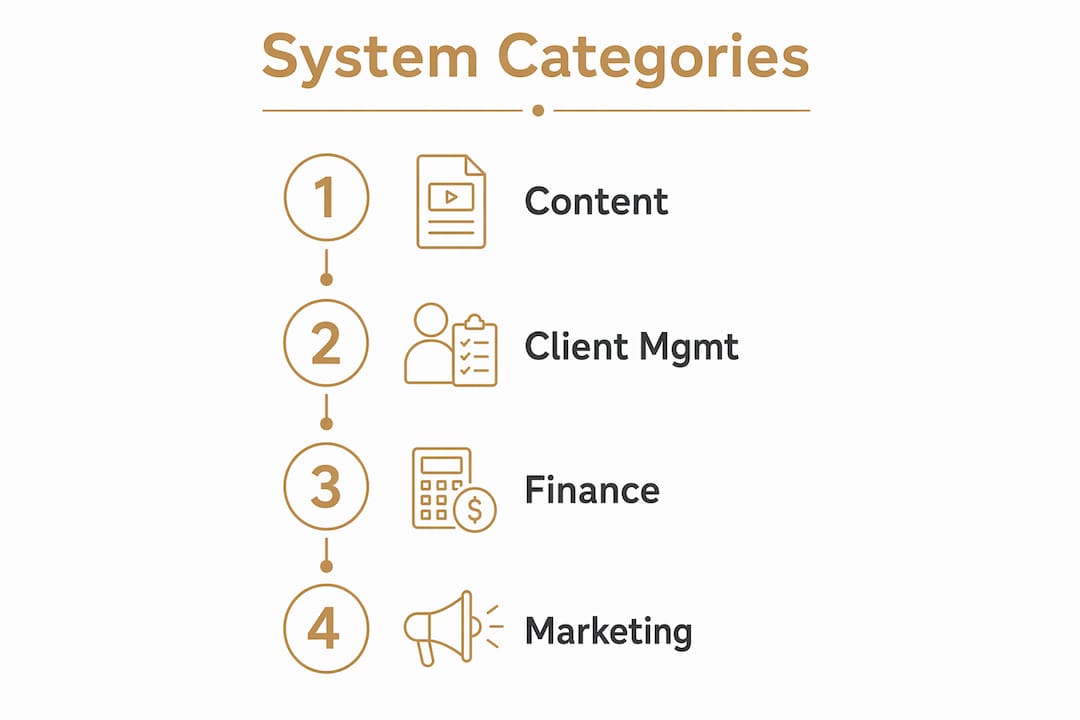
One-person business systems replace employees with owned assets like content marketing, digital products, and automation that run the business infrastructure. Every solo operating system covers four core categories. Miss one, and the whole thing starts to crack.
Here is how each category functions:
- Content production. This covers blog posts, social media, email newsletters, and any content that builds your audience. Without a system here, content becomes reactive and inconsistent.
- Client management. This includes lead tracking, onboarding, communication, and relationship follow-up. A CRM or automated pipeline replaces what a sales assistant would do.
- Finance and delivery. Invoicing, expense tracking, contract management, and project delivery all live here. Automating this category protects your cash flow and your time.
- Marketing automation. Email sequences, sales funnels, and audience nurturing run on autopilot. This is how you acquire customers consistently without manually chasing every lead.
The real power of this structure is layering. Effective solo systems allow founders to layer revenue models such as productized services, digital products, and subscription communities on top of the same four-category foundation. You build the system once, then add revenue streams without rebuilding from scratch.
| Category | Core function | What it replaces |
|---|---|---|
| Content production | Blog, social, email creation | Content team |
| Client management | CRM, onboarding, follow-up | Sales assistant |
| Finance and delivery | Invoicing, contracts, fulfillment | Bookkeeper, project manager |
| Marketing automation | Email sequences, funnels | Marketing coordinator |

Which AI tools power solo business systems in 2026?
The good news is that you do not need a technical background to implement a solo operating system. No-code tools like Notion, Zapier, and ConvertKit make the whole stack accessible. Here is how AI tools map to each category.
Content production tools:
- AI writing assistants like ChatGPT or Claude draft blog posts, email copy, and social captions in minutes.
- Scheduling platforms like Buffer or Later automate social media publishing once content is created.
- Tools like Descript handle podcast and video editing with AI-assisted transcription and clip creation.
Client management tools:
- A lightweight CRM like HubSpot’s free tier or a Notion-based pipeline tracks every lead and client touchpoint.
- Calendly automates booking and sends reminders, removing back-and-forth emails entirely.
- AI email tools draft follow-up messages based on conversation history, so nothing falls through the cracks.
Finance and delivery tools:
- FreshBooks or Wave handle invoicing and expense tracking with minimal manual input.
- Stripe automates payment collection and sends receipts automatically.
- DocuSign or HelloSign manages contracts without printing a single page.
Marketing automation tools:
- ConvertKit or MailerLite run email sequences triggered by subscriber behavior.
- A simple funnel builder like Carrd or Systeme.io connects your lead magnet to your email list automatically.
Pro Tip: Connect your tools with Zapier or Make. When a new client books a call in Calendly, Zapier can automatically create a project in Notion, send a welcome email, and add the client to your CRM. That single automation saves 20 minutes per new client.
A tech and marketing stack under $500 per month is entirely achievable for a solo founder. That budget covers most of the tools listed above with room to spare.
How do you build a shock-absorbing solo operating system?
The system architecture matters more than the tool stack. This is the insight most solopreneurs miss. They spend hours picking tools and almost no time designing the loops that keep those tools working together.
Solo founders who mistake “working” for systematizing often fail because they neglect the invisible 75% of their operation: the input, decision, and review loops that prevent fragmentation. Only about 25% of a solo founder’s time is actual output work. The rest is processing information, making decisions, and reviewing what is working.
Vikas Malpani’s six-loop model gives this structure a name. The loops are Trend, Build, Context, Evals, Distribution, and Cash. Each loop runs on a schedule, with AI handling the labor and the founder handling the judgment calls. The four-part solo operating system of inputs, decisions, work, and review makes the review step the engine of continuous improvement.
Here is how to build this into your week:
- Set a fixed weekly review session. Block 60–90 minutes every Friday or Monday. This is a decision-making session, not a journaling exercise. You review metrics, clear your inbox of decisions, and set your top three priorities for the week ahead.
- Run a daily input sweep. Spend 15 minutes each morning processing new information: emails, client messages, market signals. Route each item to the right category (content idea, client task, finance action).
- Schedule build blocks. Protect two to three focused work blocks per week for actual creation. Guard these like meetings you cannot cancel.
- Do a monthly cash and distribution review. Check revenue, expenses, and which content or offers drove the most leads. Adjust your next month based on data, not gut feeling.
“The weekly review is not optional. It is the single session that keeps your entire system from collapsing into a never-ending to-do list.” — Vikas Malpani
Pro Tip: Use a simple Notion dashboard with four columns: Inputs, Decisions, Work in Progress, and Review. Move tasks through the columns daily. This visual system shows you exactly where your energy is going and where things are getting stuck.
What are best practices for validating and launching a solo business system?
Validation is the step most solopreneurs skip, and it is the most expensive mistake you can make. Building a product or service before confirming real demand wastes time, money, and energy.
Validation through 30 days of 10–15 deep customer interviews before building any assets is the standard practice for avoiding wasted startup capital. These are not surveys. They are real conversations where you ask about problems, current solutions, and willingness to pay. The answers shape everything you build next.
Here is the validated launch sequence that works for solo systems:
- Week 1–2: Conduct 10–15 customer interviews. Focus on pain points, not your solution idea. Listen more than you talk.
- Week 3–4: Build a minimum viable product (MVP). This could be a one-page offer, a simple digital product, or a service package. Ship it within 14 days of finishing interviews.
- Month 2: Sell to your first 3–5 paying customers before investing in branding, a full website, or paid ads.
- Month 3+: Incorporate your business only after revenue is consistent. Legal structure follows proof of concept, not the other way around.
AI coding tools reduce product development time to days, but getting to your first paying customer often takes two to four times longer than building the product itself. Plan your distribution strategy before you finish building. Know exactly how you will reach your first ten customers before you write a single line of copy.
The solopreneur business planning guide at Yoursolobusiness walks through this validation sequence in detail, including templates for customer interview questions and MVP scoping.
How can solopreneurs avoid overwhelm with better system habits?
Random task execution is the enemy of a solo business. When you jump from client email to content creation to invoicing without a structure, you lose momentum and make more errors. A structured daily workflow fixes this.
Time management tactics and digital tools like accounting software and CRMs significantly improve solopreneur efficiency without requiring delegation. The key is consolidating tools and reducing context switching. Every time you switch between apps or task types, you lose focus and time.
Here are the daily and weekly habits that keep a solo system running:
- Morning input sweep (15 minutes). Process email, messages, and notifications. Assign each item to a category. Do not respond to anything yet.
- Deep work block (2–3 hours). Work on your highest-priority creation task with notifications off. This is where your actual product gets built.
- Client and admin block (1 hour). Respond to emails, send invoices, update your CRM. Batch all communication into one window.
- End-of-day review (10 minutes). Note what you finished, what moved to tomorrow, and any decisions you need to make. This clears your head and sets up tomorrow’s morning sweep.
Pro Tip: Audit your tool stack every quarter. If you are using more than eight to ten tools regularly, you likely have overlap. Consolidating to fewer, better-integrated tools cuts the mental load of managing your own system.
The daily habits guide at Yoursolobusiness covers specific routines that solo founders use to protect their energy and maintain output without burning out.
Key takeaways
A well-designed solo operating system replaces the need for employees by automating repeatable tasks across content, client management, finance, and marketing, with the weekly review session as the engine that keeps everything running.
| Point | Details |
|---|---|
| Four core categories | Every solo system must cover content, client management, finance, and marketing automation. |
| Weekly review is non-negotiable | A 60–90 minute decision session each week prevents fragmentation and keeps priorities clear. |
| Validate before you build | Conduct 10–15 customer interviews over 30 days before creating any product or service asset. |
| AI handles labor, you handle judgment | Use AI tools for repetitive tasks and protect your time for decisions only you can make. |
| System architecture beats tool selection | How your loops connect matters more than which specific apps you choose. |
What I have actually learned running a one-person business with AI
Here is the honest truth: I spent my first year as a solo founder collecting tools instead of building systems. I had a beautiful Notion setup, three different project management apps, and an AI writing tool I barely used. None of it worked together. I was busy, but I was not productive.
The shift happened when I stopped asking “which tool should I use?” and started asking “what decision do I need to make, and how do I make it faster?” That reframe changed everything. My weekly review went from a vague journaling session to a structured 75-minute block where I check revenue, review content performance, and set my three non-negotiable priorities for the week. That one habit alone cut my decision fatigue by more than half.
The AI tools I rely on daily are ChatGPT for drafting and brainstorming, Zapier for connecting my apps, and a simple CRM in Notion for tracking client relationships. Nothing exotic. The magic is in how they connect, not in the tools themselves.
What most new solopreneurs miss is that systematizing feels like it takes time away from “real work.” It does not. It is the real work. Every hour you spend building a repeatable process saves you five hours next month. The solopreneurs who build sustainable businesses are the ones who treat their system as a product they are constantly improving, not a chore they do when things get chaotic.
— Jay
Build your solo business system with Yoursolobusiness
Running a one-person business at full capacity takes more than good intentions. It takes a tested system and the right tools to back it up.

Yoursolobusiness has the resources to help you build that system from the ground up. The Ultimate Productivity Toolkit for Solopreneurs gives you seven proven strategies and ten curated tools that work together as a complete solo operating system. If you want a faster path to results, the solopreneur productivity workflow guide shows you exactly how to cut wasted time and increase output. Both resources are built for solo founders who are serious about working smarter, not harder.
FAQ
What is a one person business system?
A one person business system is an integrated set of processes, tools, and AI automations that lets a solo founder run all key business functions without employees. It typically covers content production, client management, finance, and marketing.
How do I start building a solo operating system?
Start by mapping your four core categories: content, clients, finance, and marketing. Then identify the single most time-consuming repeatable task in each category and automate it first before adding more tools.
Which tools are best for one person management?
No-code tools like Notion, Zapier, ConvertKit, and FreshBooks cover most solo business needs. The best stack is the one where all tools connect and reduce manual work, not the one with the most features.
How often should I review my solo business system?
A weekly review session of 60–90 minutes is the standard practice for solo founders. Monthly cash and distribution reviews add a second layer of feedback that keeps your system aligned with your revenue goals.
Do I need technical skills to run a one-person business system?
No technical background is required. Tools like Zapier, Notion, and ConvertKit are built for non-technical users and handle complex automations through simple drag-and-drop interfaces.