
TL;DR:
- Building disciplined habits is crucial for solo founders to increase capacity and reduce burnout. Documenting and automating recurring tasks enables habits to persist and guarantees predictable revenue and efficient decision-making.
Building disciplined solo business habits is the fastest way to increase capacity, reduce burnout, and make judgment, not hustle, the product of your one-person company. Purpose-connected habits are significantly more likely to persist over months than orphaned productivity rituals, and the field standard is simple: if a task repeats more than three times, document, template, or automate it — otherwise you’re choosing to be the bottleneck. At Yoursolobusiness, that principle is the backbone of every system and resource we build for solo founders.
Here’s the TL;DR:
- Capacity: Habits replace willpower with autopilot, freeing your best thinking for high-leverage decisions.
- Consistency: Repeatable systems produce predictable revenue and protect your margins without adding headcount.
- Burnout reduction: Structured routines reduce the mental drain of constant context-switching and reactive decision-making.
- Start today: Pick one recurring task you do manually three or more times a week and write a one-page template for it before Friday.
Why developing solo business habits changes your business outcomes
Running a one-person business without habits is like trying to fill a bucket with a hole in it. You can work harder, but the output never compounds. Habits are the patch.
The most direct benefit is capacity. When you stop re-deciding how to handle a client onboarding, a weekly invoice run, or a content draft, you reclaim the cognitive bandwidth those micro-decisions were burning. That freed-up attention goes toward the work only you can do: strategy, relationships, and creative judgment. Top-performing solo founders were significantly more likely to build AI-native offerings, use recurring billing, and sell internationally, which shows that systems and distribution, not raw effort, are what expand the one-person ceiling.
Habits also protect you from decision fatigue. Every unstructured choice you make during the day draws from the same finite pool of mental energy. A nightly planning habit, for example, moves tomorrow’s decisions to tonight, when the stakes are lower and the pressure is off. You wake up knowing exactly what to do first, and that clarity compounds across weeks and months.
There’s a real revenue argument here too. When your delivery process is documented and repeatable, you can productize your offer: same scope, same price, same outcome. That predictability makes it easier to forecast cash flow, set boundaries with clients, and work smarter, not harder without sacrificing quality. A solo founder who runs on habits can take a week off without the business going silent. One who runs on hustle cannot.
Three benefits worth bookmarking:
- Habits reduce context-switching, which is one of the biggest hidden costs in solo work.
- Repeatable delivery systems let you raise prices without raising hours.
- Goal-linked habits are far more durable than motivation-dependent routines.
The highest-impact solo business habits to build right now
Not all habits are equal. These eight are the ones that move the needle fastest for solo founders, ranked roughly by leverage.
-
Nightly planning (10 minutes). Before you close your laptop, write tomorrow’s top three tasks. This is decision batching in practice: you make the “what do I work on?” call when you’re calm, not when you’re already behind. Early signal: you stop starting mornings by checking email first.
-
Weekly financial check (20 minutes). Know your monthly numbers and basic cash runway without relying on a bookkeeper. A simple founder financial dashboard tracking revenue, outstanding invoices, and runway is enough to make confident decisions. Early signal: you can answer “how’s the business doing?” in under 60 seconds.
-
Productized offer documentation. Write a one-page scope document for every service you sell more than once. This is the habit that turns a freelancer into a solopreneur. Early signal: you stop writing custom proposals from scratch.
-
Template creation for recurring tasks. If you write the same email, brief, or report more than three times, document and template it. This is the automation threshold rule in its simplest form. Early signal: your response time drops without extra effort.
-
Consistent marketing cadence. Top solo founders used recurring billing and early retention strategies more than median performers. A weekly publishing or outreach habit, even one post or one email, keeps your pipeline warm without a sales team. Early signal: inbound inquiries start arriving without you pitching.
-
Clear client boundaries (documented). Write a one-paragraph “how I work” policy and include it in every onboarding email. Boundaries without documentation are just intentions. Early signal: scope creep conversations become rare.
-
Habit stacking for creative work. Attach creative tasks to an existing anchor. After your morning coffee, open your draft document before anything else. This borrows the momentum of an established routine. Early signal: creative output becomes more consistent week over week.
-
Ship weekly, not perfectly. The “ship reflex” — preferring “done and live this week” over “perfect later” — is a durable guardrail against the perfectionism spiral that kills solo momentum. Early signal: you publish or deliver something every single week.
Pro Tip: Use the draft-and-approve pattern for any task that requires your voice but not your typing. Let an AI tool generate the first draft of a client email, proposal, or social post, then spend two minutes editing it. You keep the judgment; you lose the blank-page friction.
How do you pick which habits to build first?
The honest answer: most solopreneurs try to build too many habits at once and end up with none. The fix is a simple impact × ease filter.
The impact × ease matrix works like this:
- List every habit you’re considering.
- Rate each one from 1–5 on impact (how much will this change my business outcomes?) and ease (how naturally does this fit my current routine?).
- Start with the habit that scores highest on both. That’s your first 30 days.
Diagnostic questions to run before committing:
- Does this habit connect directly to a revenue or capacity goal? If not, it’s decoration.
- Can I do this habit in under 20 minutes a day to start?
- What existing routine can I stack it onto?
- What’s the measurable signal I’ll look for in 30 days?
- Am I building this habit because it solves a real problem, or because it sounds productive?
That last question matters more than it seems. Precrastination, acting before you validate the work, is a common failure mode for solo founders. Building a habit around a task that shouldn’t exist at all is just organized busywork.
Red flags that mean “not yet”:
- You’re trying to start more than two new habits simultaneously.
- The habit has no clear connection to a business goal.
- You’d need to restructure your entire day to fit it in.
- You haven’t finished the habit you started last month.
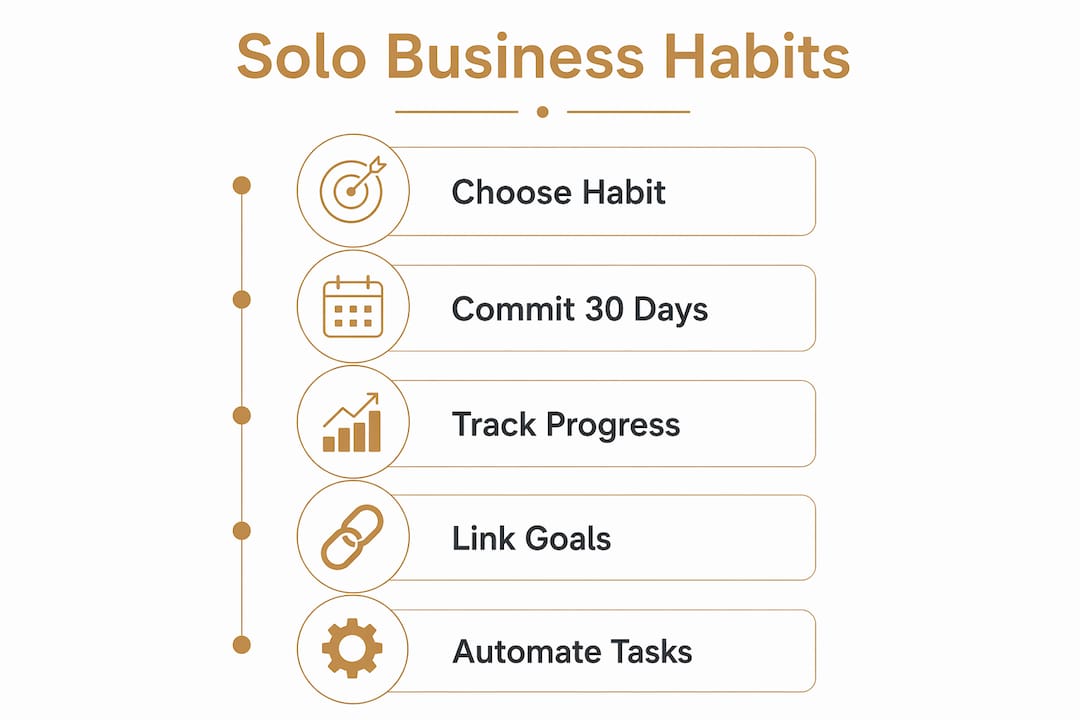
Pick one. Commit for 30 days. Then add the next.
Practical steps to form and keep your solo business habits
Knowing which habit to build is half the battle. Here’s how to make it stick.
Your 30/60/90-day habit plan:
- Days 1–30: Run the habit in its smallest possible form. If the goal is a weekly financial check, spend 10 minutes every Monday reviewing one number: cash in the bank. Reduce the friction until starting feels automatic.
- Days 31–60: Expand the habit to its full intended scope. Add the second and third metrics to your financial check. Start tracking your output in a simple log (date, task completed, time spent).
- Days 61–90: Evaluate and adjust. Is the habit producing the early signal you expected? If not, change the format, not the goal. If yes, consider stacking a second habit onto it.
Habit stacking examples for solopreneurs:
- After sending a client invoice, spend five minutes reviewing your pipeline for the next 30 days.
- After publishing a piece of content, log the topic and engagement signal in a one-row spreadsheet.
- After your nightly planning session, set your phone to Do Not Disturb until 10 AM the next day.
What to track weekly (keep it simple):
- Did I complete the habit? Yes/No.
- What was the output? (One sentence.)
- What friction did I hit? (One sentence.)
- What will I adjust next week?
A daily habit tracker doesn’t need to be elaborate. A plain text file or a sticky note works. The point is to create a feedback loop, not a second job.
Pro Tip: Reduce behavioral friction to near zero for the habits you want to keep. If your weekly financial check requires opening three apps, consolidate everything into one dashboard before the habit starts. The easier the start, the more likely the follow-through.

Field-tested rules: link habits to goals and automate recurring work
Here’s where most habit advice falls short: it treats habits as ends in themselves. For solo founders, a habit only earns its place if it connects to a milestone and a measurable goal.
The three-link rule for durable habits is: habit → milestone → goal. For example: the habit of a weekly financial check connects to the milestone of knowing your cash runway at all times, which connects to the goal of never making a pricing decision from fear. That chain is what makes the habit worth protecting when life gets busy.
The automation threshold rule is equally direct. When a task repeats three or more times, you have three options: document it (write the steps), template it (create a reusable format), or automate it (remove yourself from the loop entirely). The tradeoff is real: automation handles execution, but judgment still belongs to you. Don’t automate decisions; automate the delivery of decisions you’ve already made.
Implementation checklist for any recurring task:
- Validate: Does this task actually need to exist? Run the three-question pause (goal, evidence, fit) before building a system around it.
- Document: Write the steps in plain language, once.
- Template: Turn the document into a reusable format (email template, proposal skeleton, checklist).
- Automate: Use a tool to trigger or pre-fill the template when the condition is met.
- Monitor: Check the output weekly for the first month to catch errors before they compound.
The draft-and-approve AI pattern fits here naturally. Use an AI tool to generate the first version of any templated output, review it for accuracy and tone, then send or publish. You stay in the loop on judgment; you exit the loop on typing. This is the core of what Yoursolobusiness covers in depth across its AI workflow resources.
Pro Tip: Before automating anything, run it manually three times and document each step. Automation built on an undocumented process just makes the mess faster.
What is a solopreneur, and why do habit priorities differ?
A solopreneur is someone who deliberately runs a one-person business by building systems, productized offers, and assets rather than selling hours. The key word is deliberately. This isn’t someone who hasn’t hired yet; it’s someone who has decided the one-person shape is the goal.
The clearest distinction: freelancers sell hours; solopreneurs build systems so income can compound without direct hourly input. That difference changes everything about which habits matter. A freelancer’s most important habit might be time tracking. A solopreneur’s most important habit is probably offer documentation, because that’s what makes delivery repeatable and scalable.
Compared to a small team, a solopreneur has no one to delegate to, no one to catch errors, and no one to cover when they’re sick. That constraint makes solopreneurship a systems problem first and a skills problem second. The habits in this guide are designed specifically for that shape.
How solopreneur habit priorities differ from a small team:
- Judgment and decision quality matter more than speed of execution.
- Systems replace people, so documentation habits are non-negotiable.
- Vacation engineering (building a business that runs without you for a week) is a goal, not a luxury.
Common challenges in building solo business habits and how to beat them
The biggest obstacle isn’t motivation. It’s structure, or the lack of it.
No external accountability. Without a team, there’s no one to notice when you skip your weekly financial check or let your marketing cadence slip. The fix is lightweight self-accountability: a weekly review log and, if possible, a peer check-in with one other solo founder. Even a brief message to a colleague saying “here’s what I shipped this week” creates enough social pressure to matter.

Too many priorities competing at once. Solo founders wear every hat, and that makes it tempting to build habits for every role simultaneously. The result is usually that none of them stick. Commit to one habit per 30-day cycle, full stop. The discipline habits that compound fastest are the ones you actually repeat, not the ones that look impressive on a list.
Confusing activity with progress. Spinning your wheels on low-leverage tasks while calling it “building habits” is a real trap. If your habit doesn’t connect to a measurable business outcome within 30 days, it’s worth questioning whether it belongs in your routine at all. This is where the impact × ease matrix from the previous section earns its keep.
Burnout from over-engineering. Some solo founders build elaborate systems before they’ve validated the underlying habit. Start with the minimum viable version. A one-column spreadsheet beats a 12-tab dashboard you’ll abandon by week three. Complexity is a reward for consistency, not a prerequisite for it.
Isolation and motivation dips. Working alone is genuinely hard. Motivation will dip, and that’s normal. The goal of habit design is to make the behavior automatic enough that motivation becomes irrelevant. Habit stacking, environmental design (a dedicated workspace, a start-of-day ritual), and small consistent rewards all help bridge the gap when energy is low.
Real solopreneurs, real habits: what actually works in practice
The habits that show up repeatedly among successful solo founders aren’t glamorous. They’re boring, consistent, and directly tied to outcomes.
One pattern that appears across high-performing solo founders is the hardest-task-first rule. Tackling the most demanding work before checking messages or social feeds protects peak cognitive energy for the work that actually moves the business forward. One solo founder described it simply: once the hard task is done, everything else feels lighter.
Another common thread is the end-of-day journal. Not a diary, but a structured three-field log: what did I complete today, what’s the top priority tomorrow, and what’s one thing I learned? This habit takes under five minutes and creates a daily accountability loop that replaces the manager most solo founders don’t have.
The ship reflex shows up in practice as a weekly publishing or delivery commitment. Solo founders who commit to shipping something every week, whether a newsletter, a client deliverable, or a new offer, build momentum that compounds. The alternative, waiting until it’s perfect, usually means nothing ships at all.
Finally, the most durable habit among experienced solopreneurs is offer documentation. Writing down exactly what a service includes, what it costs, and what the client gets creates the foundation for every other system: pricing, onboarding, delivery, and referrals. It’s the habit that separates a solopreneur from a freelancer in practice, not just in theory. Yoursolobusiness’s solopreneur productivity tips cover this pattern in detail, with templates you can adapt immediately.
Key Takeaways
Disciplined solo business habits increase capacity, protect revenue margins, and make judgment the primary product of a one-person company.
| Point | Details |
|---|---|
| Habits beat willpower | Purpose-connected habits are 42–300% more likely to persist than motivation-dependent routines. |
| Automate at three repetitions | If a task repeats more than three times, document, template, or automate it — otherwise you’re choosing to be the bottleneck. |
| Start with one habit | Use the impact × ease matrix to pick one habit, commit for 30 days, and track one measurable signal weekly. |
| Link every habit to a goal | The three-link rule (habit → milestone → goal) is what separates durable systems from orphaned rituals. |
| Yoursolobusiness resources | The AI toolkit and planning guides at Yoursolobusiness give you templates, prompts, and checklists to implement these habits faster. |
The habits that actually matter are the ones you’ll defend
Most habit advice focuses on what to build. I think the harder question is what you’re willing to protect.
Here’s what I’ve observed running a one-person business: the habits that survive are the ones attached to something you genuinely care about, not the ones that sound productive in a blog post. A nightly planning habit sticks when you connect it to the goal of never starting a day reactive. A weekly financial check sticks when you connect it to the goal of never making a pricing decision from a place of fear. Strip the goal connection, and the habit becomes just another item on the never-ending to-do list.
There’s also a tradeoff worth naming honestly. Building strong solo business habits does increase capacity, but it doesn’t eliminate the structural challenges of working alone: the isolation, the fact that you’re always the face of the business, and the reality that vacation engineering takes real work to set up. Habits make those challenges more manageable; they don’t make them disappear.
My encouragement is this: treat every habit as an experiment, not a commitment to a perfect system. Start smaller than feels ambitious. Measure one signal. Adjust after 30 days. The solopreneurs who build the most durable practices aren’t the ones who designed the best system on day one. They’re the ones who kept iterating until the system fit their actual life.
Your next step: put these habits to work with the right tools
If you’ve read this far, you already know which habit you want to start with. The gap between knowing and doing usually comes down to one thing: not having the right template or tool in front of you when you need it.

The Yoursolobusiness AI Toolkit is built exactly for this moment. It gives you the AI tools, prompt templates, and implementation checklists to turn the habits in this article into actual workflows, without hiring a team or spending weeks figuring out the setup. Whether you’re building your first offer documentation template, setting up a weekly financial check, or implementing the draft-and-approve pattern for client communications, the toolkit has a starting point for each one. You can also dig deeper into the solopreneur business planning guide for a full implementation roadmap. Head to the AI Toolkit, pick the resource that matches your first habit, and run it this week.