
TL;DR:
- Monetizing your skills involves converting what you know into a paid offer with minimal setup.
- Starting with a simple skill audit and validating demand on platforms like Upwork or Fiverr helps you find active markets.
Monetizing your skills means converting what you already know into a paid offer, and the single next step is a 20-minute skill audit: write down the three things people most often ask you to help with, then search those topics on Upwork or Fiverr to confirm active demand exists. That’s it. You don’t need a website, a logo, or a business plan to start.
Here’s the short version of why this matters right now:
- Income diversification. A single paycheck is a single point of failure. Turning a skill into a side offer gives you a second income stream that doesn’t depend on one employer.
- Higher earning ceiling. When you package expertise as an outcome rather than an hour, your income stops being capped by the number of hours you can work.
- Control over your work. You choose the clients, the schedule, and the scope. That control compounds over time into genuine financial freedom.
As of 2026, the global freelance economy is worth over $1.5 trillion, reflecting real, sustained demand for skill-based independent work. Yoursolobusiness exists precisely to help solopreneurs tap into that demand without burning out or building a team they don’t need.
What does “monetize your skills” actually mean?
Turning an ability, knowledge set, or repeatable process into a paid offer is the core definition. The industry term for this is skill commercialization, but most practitioners just call it monetization. The key word is repeatable: if you can do something consistently and someone else benefits from the result, you have a monetizable skill.
The delivery format is what varies:
- Service model: You do the work directly (freelance writing, bookkeeping, design, coaching).
- Product model: You package the knowledge once and sell it repeatedly (templates, ebooks, digital downloads).
- Content model: You share expertise publicly and earn through ads, sponsorships, or affiliate links.
One distinction worth locking in early: hourly pricing trades time for money, so your income ceiling is fixed by your calendar. Outcome-based pricing charges for the result you deliver, not the hours you log. A copywriter charging $75/hour earns $600 for an 8-hour sales page. That same copywriter charging $1,200 for “a sales page that converts” earns double for the same work, and the client is happier because they bought a result. That shift in framing is where real income growth begins, and it’s something you can learn more about here.
Why monetize your skills? The real benefits
The financial case is obvious, but the nonfinancial benefits are what keep people going long-term.
Financial benefits:
- A second income stream that doesn’t require a raise or a promotion
- An income ceiling that rises as you package and price more strategically
- Faster progress toward financial freedom when skill income compounds with savings
Nonfinancial benefits:
- You reuse knowledge you already have, so the marginal effort per dollar earned drops over time
- You work with clients and projects you actually choose
- You build a professional identity that isn’t tied to one employer
The World Economic Forum’s Future of Jobs Report 2023 estimates that 44% of workers’ core skills will be disrupted between 2023 and 2027. That disruption cuts both ways: it makes some skills obsolete, but it also creates urgent demand for people who can teach, consult on, or deliver the skills that replace them.
Realistic framing matters here. For most people, skill monetization starts as a side income of a few hundred to a few thousand dollars per month. It becomes a full-time business when the income consistently covers your living expenses, usually after 12–24 months of focused effort. Neither outcome is better than the other. What matters is that you start.
How do you know which of your skills are marketable?
The three-filter approach cuts through the noise fast. Run every skill you’re considering through these questions in order:
- The “someone pays for this” test. Search the skill on Upwork, Fiverr, or LinkedIn Jobs. If you find active listings with real reviews, demand is proven. A 20-minute marketplace search is the most efficient early validation step you can take.
- The “consistent output” test. Can you produce a solid result every time, not just on your best days? Clients pay for reliability, not occasional brilliance.
- The “better than average” test. You don’t need to be the world’s best. You need to be meaningfully better than the average person your potential client could hire or do it themselves.
Skills that pass all three filters quickly include copywriting, social media management, video editing, graphic design, virtual assistance, bookkeeping, tutoring, and AI-assisted services. These are high-demand, low-startup-cost skills that beginners can start offering within days.
Validation beyond the marketplace check:
- Search the skill as a keyword on Google and note whether courses, job boards, and paid communities exist around it. Active paid communities signal willingness to spend.
- Post a question in a relevant Facebook Group or Reddit community: “Would you pay someone to help you with [skill]?” The responses tell you more than a week of research.
- Reach out to five people in your network who might need the skill and offer a free or discounted first session in exchange for honest feedback.
Pro Tip: The skills most worth monetizing are often the ones you take for granted. Ask three colleagues or friends: “What do you always come to me for?” Their answers will surface abilities you’ve stopped noticing because they feel effortless to you.
The monetizable sweet spot sits at the intersection of what people already ask you to do, tasks you can do for a full workday without exhaustion, and skills with active paying markets. Use those three filters to decide which skill to lead with, and commit to it for 6–12 months before adding a second stream.
What are the best ways to profit from your skills?
The five primary monetization models that appear consistently across successful solo operators are freelancing and consulting, teaching and courses, digital products, memberships and subscriptions, and content monetization. Here’s how they stack up:

| Model | Speed to first dollar | Scalability | Weekly maintenance | Income ceiling |
|---|---|---|---|---|
| Freelancing / consulting | Fast (days–weeks) | Low (time-bound) | High | $50K–$200K+ |
| Productized services | Medium (2–4 weeks) | Medium | Medium | — |
| Online courses | Slow (1–3 months) | High | Low after launch | Unlimited |
| Digital products | Medium (2–6 weeks) | High | Low | Unlimited |
| Memberships / subscriptions | Medium (4–8 weeks) | High | Medium | Recurring floor |
| Content / affiliate | Slow (3–12 months) | High | Medium | Variable |
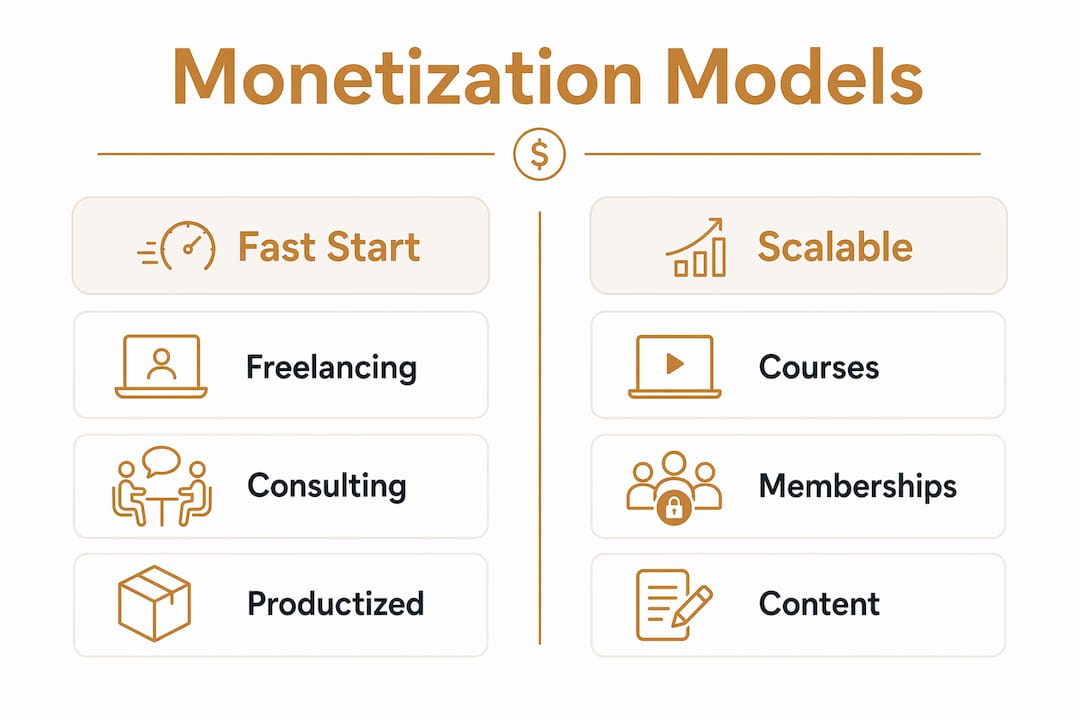
Freelancing and consulting gets you to your first paid dollar fastest. You sell your time and expertise directly to clients. Entry-level freelancers commonly charge $25–$50/hour, mid-level specialists $50–$150/hour, and experts $150–$500+/hour. Quick start: create a profile on Upwork or LinkedIn and pitch five potential clients this week.
Productized services are fixed-scope, fixed-price offers that remove the “custom quote” friction from every sale. Think “LinkedIn profile audit for $299, delivered in 48 hours.” They act as the bridge between hourly billing and higher-margin offers by giving you repeatability and buyer data. Quick start: write out your most-requested service as a one-page offer with a clear deliverable and a fixed price.
Online courses and digital products take longer to build but scale without adding hours. A $197 course sold to 50 students earns $9,850 with no additional delivery time. Quick start: outline a five-module course around your most common client problem before building anything.
Memberships and subscriptions create a predictable monthly revenue floor. Even a small membership of 50 people at $49/month generates $2,450 in recurring income. Quick start: test a low-ticket community or resource library before investing in a full platform.
Content and affiliate monetization is the slowest path to income but the highest-leverage long-term play. It works best as a layer on top of another model, not as a standalone starting point. For passive income strategies that complement active income, Yoursolobusiness has a dedicated guide worth reading.
One warning worth heeding: beginners often pick the wrong model for their skill type. A consultant trying to scale through a low-ticket ebook, or a course creator trying to get fast cash through content ads, will spin their wheels for months. Match the model to the natural delivery mechanism of your skill first, then layer others later.
How do you package and price a skill offer?
The shift from “I charge by the hour” to “I charge for the outcome” is the single biggest income lever most solopreneurs have available. Outcome-based packaging attracts higher-quality clients and raises your income ceiling because clients aren’t buying your time. They’re buying a transformation.
Here’s a simple offer template you can fill in today:
- Who it’s for: [specific client type]
- The problem it solves: [one sentence]
- What they get: [3–5 concrete deliverables]
- The outcome: [measurable result or transformation]
- Timeline: [days or weeks to delivery]
- Price: [fixed fee, not hourly]
A real example: “I help e-commerce founders write product descriptions that convert. You get 10 optimized descriptions, a brand voice guide, and one round of revisions, delivered in five business days. $750 flat.”
Pricing bands to anchor your thinking:
- Entry-level offer: $100–$500 (quick wins, templates, audits)
- Mid-tier offer: $500–$2,500 (productized services, short courses)
- Premium offer: $2,500–$10,000+ (consulting packages, done-for-you services)
To test your price, launch at the lower end of your target band and raise it with each new client until you start hearing “no” regularly. That resistance point tells you where the market ceiling sits for your current positioning. You can also explore revenue-increasing tactics that go beyond pricing alone.
Pro Tip: When presenting a price, always anchor it to the outcome, not the work. “This package gets you a fully optimized sales page” lands better than “this is 8 hours of copywriting.” Clients buy results, not labor.
Burnout often comes from selling skills without systems. Packaging a repeatable process into a defined offer reduces the bespoke work that drains energy and makes every project feel like starting from scratch.
What does a realistic 30/60/90-day plan look like?
Here’s a concrete action plan you can follow from day one:
- Days 1–30: Audit and validate. Run your skills through the three-filter checklist. Pick one skill to lead with. Do the marketplace validation search. Write your first offer using the template above. Share it with five people and ask if they’d pay for it.
- Days 31–60: Launch and land your first client. Post your offer on one platform (Upwork, LinkedIn, or a relevant community). Pitch 10 potential clients directly. Deliver your first paid project and collect a testimonial. Refine the offer based on what you learned.
- Days 61–90: Iterate and systematize. Raise your price by 20%. Build a simple intake process so onboarding doesn’t eat your time. Identify one repeatable task in your delivery that you can template or automate. Start thinking about a second income stream.
Typical startup costs:
| Item | Low-cost option | Mid-range option |
|---|---|---|
| Website / portfolio | Free (Carrd, Notion) | $10–$20/month (WordPress) |
| Scheduling tool | Free (Calendly basic) | $8–$12/month |
| Payment processing | Free (PayPal, Stripe) | Stripe at 2.9% + $0.30/transaction |
| Email list tool | Free (Mailchimp up to 500) | $9/month (ConvertKit) |
| Course platform | Free (Gumroad) | $29–$99/month (Teachable) |
You can get started for close to $0 using free tiers of existing tools. The biggest time sinks to avoid in the first 90 days: over-designing a logo, building a website before you have a client, and trying to be active on every social platform at once. None of those activities earn you money. Pitching clients does.
For a deeper planning framework, the Yoursolobusiness solopreneur business planning guide walks through goal-setting and revenue stacking in detail.
How do you stabilize income and avoid the feast-or-famine cycle?
The most resilient solo businesses build a recurring revenue floor first, then layer project income on top. Recurring models lower income volatility and give you the mental bandwidth to make strategic decisions instead of constantly chasing the next client.
Recurring revenue options and typical pricing:
- Monthly retainer (ongoing consulting or content): $500–$3,000/month per client
- Membership community (resources, templates, Q&A): $29–$99/month per member
- Subscription service (monthly deliverable, e.g., newsletter writing): $200–$800/month per client
- Group coaching program (cohort-based, 6–8 weeks): $500–$2,000 per participant
Even two retainer clients at $1,000/month each creates a $2,000 revenue floor. Everything above that becomes upside, not survival income.
AI workflow checklist for solopreneurs:
- Client intake: Use a Typeform or Google Form linked to a Notion database. An AI tool like Zapier or Make can auto-route new inquiries to your calendar and send a welcome email without you touching it.
- Content repurposing: Write one long-form piece per week, then use a tool like Claude or ChatGPT to repurpose it into three social posts, an email, and a short video script.
- Customer support: Set up a simple FAQ page and use an AI chatbot (Tidio or Intercom’s free tier) to handle common questions before they reach your inbox.
- Proposal generation: Build a proposal template in Notion or Google Docs. Use an AI writing tool to customize the intro paragraph for each new prospect in under five minutes.
A practical transition path: start as a freelancer taking project work, then offer your best clients a monthly retainer for ongoing access. One freelancer who builds websites might charge $3,000 per project. Offering a $500/month “website maintenance and updates” retainer to each completed client converts one-off revenue into recurring income with almost no additional selling. Add AI-assisted delivery tools and that retainer becomes nearly passive. Yoursolobusiness’s AI workflow automation guide covers exactly how to build those systems.
Pro Tip: Don’t wait until you’re fully booked to introduce a retainer offer. Pitch it to your second or third client, while you still have capacity to deliver well. The worst they can say is no, and you’ll learn how to frame it better for the next one.
For readers ready to scale a consulting practice beyond the early retainer stage, that partner resource covers the systems and positioning shifts that move a solo practice toward seven figures.
Key Takeaways
Turning your skills into income is a decision you can act on today, and the fastest path is picking one marketable skill, packaging it as a clear outcome-based offer, and landing your first paying client before you build anything else.
| Point | Details |
|---|---|
| Start with one skill | Use the three-filter checklist to pick the skill with proven demand and commit to it for 6–12 months. |
| Shift to outcome pricing | Package your offer around a result, not hours; entry-level offers start at $100–$500, premium at $2,500+. |
| Validate before you build | A 20-minute marketplace search on Upwork or Fiverr confirms demand faster than any business plan. |
| Build a recurring floor | Even two retainer clients at $1,000/month each creates a $2,000 revenue floor that reduces feast-or-famine stress. |
| Use Yoursolobusiness resources | Yoursolobusiness provides AI toolkits, prompt libraries, and implementation checklists to help you automate delivery and scale faster. |
The real reason to start small and iterate
Here’s my honest take: most people who want to monetize their skills get stuck in preparation mode. They spend weeks on a logo, a website, a brand color palette, and a business name, and then wonder why no money has come in. The offer is the business. Everything else is decoration until you have paying clients.
Start with the smallest possible version of your offer. One service. One price. One way to pay you. Then deliver it so well that the client tells someone else. That first testimonial is worth more than any marketing campaign you could run in year one.
The other thing I’d push back on is the idea that you need a big audience to monetize. You don’t. You need five clients, not five thousand followers. Five clients at $500 each is $2,500. Five clients at $1,500 each is $7,500. The math works at small numbers, which means you can start earning before you’ve built anything resembling a platform.
Where AI changes the game is in delivery and systems, not in finding clients. Use AI tools to automate your intake, repurpose your content, and handle repetitive tasks so you can serve more clients without working more hours. That’s the Yoursolobusiness approach: lean systems, smart tools, and a clear offer that earns while you sleep. The freelancer business strategies guide on Yoursolobusiness is a good next read if you want the tactical detail on moving from gigs to a scalable model.
What Yoursolobusiness gives you to get started faster
Knowing why to monetize your skills is one thing. Having the templates, checklists, and AI tools to actually do it is another. Yoursolobusiness cuts the setup time dramatically by giving you the exact resources solo operators need to go from idea to income without reinventing the wheel.
The Yoursolobusiness AI Toolkit includes prompt libraries for writing offers and proposals, implementation checklists for building your first productized service, AI tool recommendations tested for solo workflows, and a starter guide for automating client intake and content repurposing. These aren’t generic templates. They’re built for the one-person business that needs to move fast and deliver well.
If you’re ready to pick your path, the solopreneurship paths guide maps seven distinct revenue models with honest pros and cons for each. Start there, grab the AI Toolkit, and you’ll have everything you need to land your first client within 30 days.
Useful sources and further reading
- How to Monetize a Skill: The Ultimate Step-by-Step Guide — Covers the full monetization process from skill identification to pricing, with practical examples and market-size context.
- How to Make Money With Skills You Already Have — A framework-first guide that includes the World Economic Forum skills-disruption data and model-selection advice.
- How to Monetize Your Knowledge & Expertise — Luisa Zhou’s five-step guide with strong coverage of outcome-based pricing and the five core monetization models.
- How to Monetize Your Expertise: Turn Your Knowledge Into a $5,000/Month Business — Detailed breakdown of recurring revenue models, productized services, and pricing bands for solo operators.
- How to Monetize Your Talents (without burning out) — Practitioner perspective on packaging expertise into a system and avoiding the burnout trap.
- How to Use Your Talents for Side Employment — Practical overview of platforms, marketing tactics, and financial planning for building a side income from skills.
- Yoursolobusiness: Monetization Strategies for Solopreneurs — Yoursolobusiness’s own guide to shifting from hourly billing to outcome-based and productized revenue models.
- Yoursolobusiness: How to Monetize Your Expertise — Step-by-step execution guide for solopreneurs ready to package and launch their first offer.