
Solopreneur burnout is primarily a business-design and cognitive-load problem, not a willpower failure. If you’re running on empty right now, here are three things you can do today:
- Set a hard stop tonight. Pick a time, close the laptop, and protect it like a client deadline.
- Delegate or automate one task. Pick the most repetitive thing on your plate and hand it off or template it.
- Schedule a non-negotiable recovery window this week. Even two hours of genuine rest changes your trajectory.
This article walks through the real causes of burnout, the early warning signs, why solo business design makes you especially vulnerable, and a practical 30/90-day recovery plan with an AI-assisted toolkit to help you build something sustainable.
Pro Tip: If you caught early-stage burnout, recovery often takes just 2–4 weeks with immediate load reduction and rest. Left untreated, it takes far longer and can threaten the business itself.

Why solopreneurs burn out: the structural causes nobody talks about
Most burnout conversations stop at “you’re doing too much.” That’s true, but it misses the deeper machinery. The real drivers are structural, baked into how solo businesses get built.

Role overload and identity fusion hit solopreneurs in a way that salaried workers rarely experience. You’re the salesperson, the delivery person, the accountant, the customer service rep, and the strategist, often in the same afternoon. Role strain is consistently cited as one of the primary stressors for the self-employed, and the switching costs between those roles add up invisibly. When your business is your identity, a slow month doesn’t just feel financially stressful. It feels like personal failure.
Decision fatigue is the quieter killer. Every micro-decision, from which email to answer first to whether to take on a borderline client, draws from the same cognitive budget. Solo founders bear sole responsibility for far-reaching decisions with limited resources, and that pressure compounds daily.
Financial uncertainty runs as a chronic background stressor. Irregular income, unpredictable client timelines, and the pressure to stay flexible even when your time is maxed out create a state of low-grade anxiety that never fully switches off.
Emotional labor adds load that never shows up on a time-tracking app. Managing client expectations, staying upbeat in sales calls, and absorbing frustration without showing it all cost real energy. And technology anxiety compounds this: the pressure to keep pace with new tools, platforms, and AI shifts adds a coordination tax that solo operators carry alone.
The Year Two Trap is where many of these forces converge. The initial rush of building something new fades, and the absence of durable systems becomes impossible to ignore. Early hustle is not a business model.
How to spot burnout early before it takes you down
Burnout rarely announces itself dramatically. More often, it looks like spinning your wheels: putting in the hours, doing all the things, and still feeling like you’re getting nowhere. Recognizing the early signals is what separates a two-week recovery from a two-month one.
Mental and cognitive signs:
- Inbox avoidance or dreading the open of your laptop
- Slowed decision-making on tasks that used to feel automatic
- Memory slips, losing track of where you left off
- More hours worked but noticeably less output
Emotional signs:
- Cynicism about clients or projects you used to find energizing
- Irritability that bleeds into personal relationships
- Loss of enjoyment in work that once felt meaningful
- “Sunday dread” that starts creeping in by Saturday afternoon
Physical signs:
- Sleep disruption, either trouble falling asleep or waking up exhausted
- Persistent aches, headaches, or tension that don’t resolve with rest
- Fatigue that a good night’s sleep doesn’t fix
A recent survey found that 72% of founders reported mental health effects from their work, with solo-founder burnout rates around 54%. That’s not a fringe problem; that’s the majority.
Severity guide:
| Level | Signs | Response |
|---|---|---|
| Mild | Occasional dread, low energy on Mondays | Adjust schedule, add one recovery ritual |
| Moderate | Persistent cynicism, sleep disruption, output drop | Load reduction, boundary audit, peer check-in |
| Urgent | Inability to function, severe sleep loss, self-harm thoughts | Seek professional help immediately |
A practical early-detection habit: a 15-minute Friday Review asking “What drained me this week?” and “What gave me energy?” catches patterns before they become crises.
Why solo business design intensifies your burnout risk
The core paradox of solo work is that you’ve built an institution with unbounded demand, and you’re the only human resource available to meet it. There’s no colleague to absorb overflow, no manager to triage priorities, and no HR policy that enforces a lunch break.
A useful way to think about it: Role load × Decision load × Buffer deficit = Burnout risk. When all three are high simultaneously, which is the default state for most solopreneurs, the system breaks.
Organizational psychologist Melissa Doman puts it plainly:
Offer design makes this worse in specific ways. Unlimited revisions, always-on messaging, and vague project scopes all signal to clients that your time is infinitely available. They’re not being unreasonable. You built the system that way. The good news is that burnout is a solvable business-design problem, not a character flaw. Restructuring your offers and systems is a more durable fix than any self-care routine.
Understanding your own working style and stress triggers can also sharpen this picture. Personality assessments for small business owners can reveal which roles drain you fastest and where a mismatch between your natural style and your daily tasks is quietly burning you out.
Practical strategies to prevent and fix burnout (prioritized by impact)
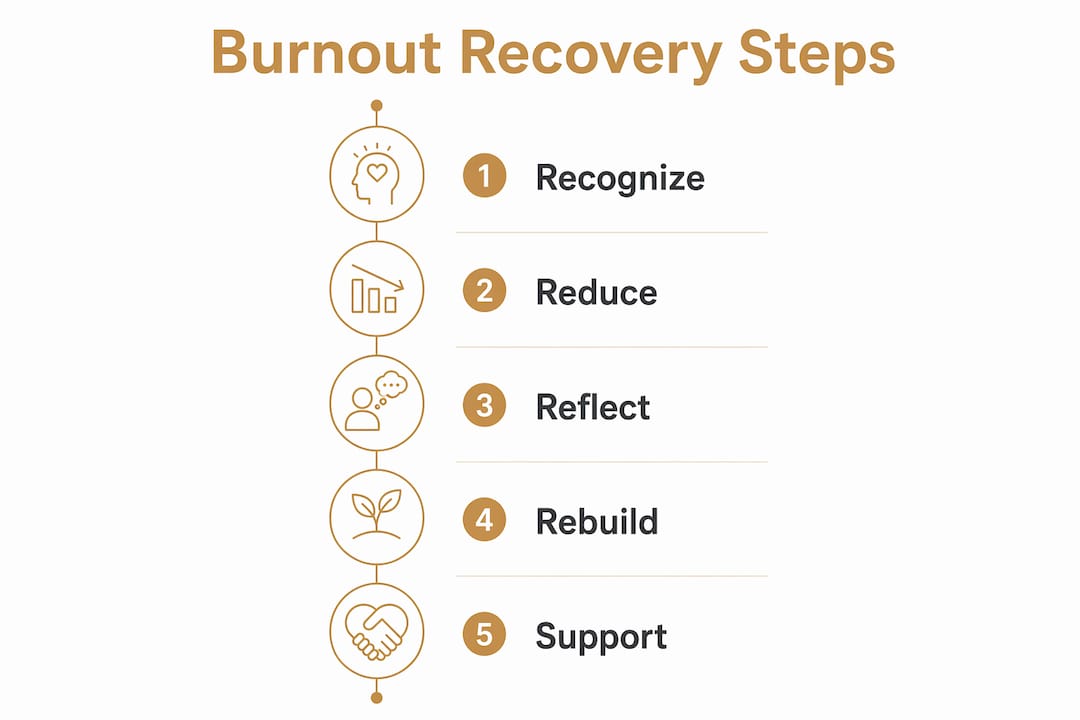
You don’t fix burnout by working harder at recovery. You fix it by redesigning the system that caused it. Here’s where to start, in order of impact.
Priority 1: Hard stops and recovery rituals
- Set a daily end time and treat it like a client commitment.
- Protect at least one full evening per week with zero work contact.
- Build a weekly recovery window (a Sunday morning walk, a Saturday afternoon off) into your calendar before anything else fills it.
Sleep is not a productivity hack. It’s the foundation everything else runs on.
Priority 2: Reduce cognitive load
- Batch similar tasks (all email at 9 AM and 3 PM, all invoicing on Fridays).
- Build decision rules: “I respond to new client inquiries within 48 hours, not same-day.”
- Use intake forms so clients answer your questions before a call, not during it.
- Create templates for your five most common email responses.
Priority 3: Design offers that limit open-ended demand
Scope creep is a burnout accelerant. Build revision limits, response windows, and project boundaries into your contracts before the work starts. Learning how to create a business strategy that includes offer design is one of the highest-leverage moves you can make.
Priority 4: Financial buffers
Aim for three months of operating expenses in a separate account. Price your services to include the emotional labor of client management, not just the delivery hours. Retainer arrangements stabilize income and reduce the feast-or-famine cycle that keeps financial anxiety running in the background.
Priority 5: Social support
Isolation is a documented stressor for solo self-employed workers. A weekly check-in with one peer founder, a monthly call with a mentor, or a small mastermind group gives you a sounding board and a reality check when your own perspective narrows.
Pro Tip: This week, automate one repeatable task. Set up a scheduling tool like Calendly so clients book themselves, or create a canned response template for your most common inquiry. That’s one decision permanently removed from your daily load.
A practical 30/90-day recovery plan with measurable goals
Recovery is not linear, but it is predictable. Here’s a time-bound plan that works for mild-to-moderate burnout.
| Week | Focus | Measurable goal |
|---|---|---|
| Week 1–2 | Immediate load reduction | Cut working hours; identify top two energy drains |
| Week 2–4 | Rest anchors + triage | Daily hard stop; drop or defer one high-drain client |
| Month 2 | Systems implementation | Automate one workflow; add intake form to all new projects |
| Month 2–3 | Boundary lockdown | Revise contracts with scope and revision limits; set response windows |
| Month 3 | Financial and social rebuild | Build one month of runway; add one peer check-in per week |
30-day urgent recovery: The first priority is stopping the bleed. Reduce your active workload immediately, even if that means a difficult conversation with a client. Add one daily rest anchor (a walk, a meal away from your desk, a hard stop) and commit to it for 30 days without negotiation. Triage your client list: which relationships are draining more than they’re paying?
60–90-day rebuild: Once the acute exhaustion lifts, this is when you build the systems that prevent the next crash. Lock new boundaries into your contracts and offer language. Set a financial target for your runway account. Add a peer support touchpoint to your weekly schedule. The Year Two Trap catches most solopreneurs because they rebuild the same system that broke them. Use this window to build differently.
Check in weekly with three metrics: hours worked, deep-work blocks completed, and sleep hours. If any of the three is trending wrong, that’s your signal to adjust before it compounds.
Field-tested systems and an AI workflow checklist
The operating principle here is simple: offload coordination, standardize decisions, and automate repeatable tasks. The coordination tax is the hidden energy cost of constant role-switching between admin, delivery, and sales. Reducing it is the fastest path to sustainable output.
AI and automation checklist for solo founders:
- Client intake: Use a form tool (Typeform, JotForm) to collect project details before the first call. Pair it with an AI tool to draft a scoped proposal from the intake answers.
- Scheduling: Automate booking entirely. No more back-and-forth email chains.
- Invoicing: Set up recurring invoices and automated payment reminders. This alone removes a weekly decision cluster.
- Templated responses: Build a library of AI-assisted email templates for onboarding, scope changes, and project wrap-ups.
- Content repurposing: Use an AI writing tool to turn one long-form piece into social posts, email snippets, and short-form content.
| Task | Tool type | Implementation note |
|---|---|---|
| Client intake | Form builder + AI draft | Set up once; review quarterly |
| Scheduling | Calendar automation | Replace all manual booking |
| Invoicing | Accounting software | Automate recurring and reminders |
| Email responses | AI writing assistant | Build 5–10 core templates |
| Content repurposing | AI content tool | Batch weekly, not daily |
The goal is not to remove human judgment. It’s to stop spending human judgment on tasks that don’t need it. Yoursolobusiness’s AI workflow automation guide walks through exactly how to build these systems step by step. You can also explore how behavioral assessments help you match outsourcing decisions to your actual working style, so you hand off the right tasks rather than just the obvious ones.
When to get professional help and where to start in the U.S.
Some burnout is a DIY fix. Some isn’t. Knowing the difference matters.
Seek immediate clinical attention if you experience:
Simple rules of thumb:
- Call a therapist when the emotional weight feels persistent, disproportionate, or tied to deeper patterns around self-worth and identity.
- Call a financial planner when cash-flow anxiety is the primary driver and you need a concrete runway plan, not just reassurance.
- Call a business coach when the problem is strategic: offer design, client selection, or business model clarity.
Where to start:
- SAMHSA’s National Helpline: free, confidential, 24/7 (1-800-662-4357)
- APA’s therapist locator: find licensed psychologists by location and specialty
- Open Path Collective: reduced-fee therapy for individuals and small business owners
- Fee-for-service business coaches (ask for a 30-minute intro call before committing)
A 72% mental health impact rate among founders means professional support is not a last resort. For many solopreneurs, it’s the most practical investment they can make.
Key Takeaways
Solopreneur burnout is a business-design problem: fixing the systems, offers, and boundaries that created the overload is more durable than any self-care routine alone.
| Point | Details |
|---|---|
| Burnout is structural | Role overload, decision fatigue, and financial stress are the real drivers, not lack of willpower. |
| Early action shortens recovery | Caught early, burnout recovery takes 2–4 weeks; left untreated, it threatens the business. |
| Hard stops protect everything | A daily end time and weekly recovery window are the highest-leverage habits you can build. |
| Automate the coordination tax | Intake forms, scheduling tools, and AI templates remove daily decision clusters permanently. |
| Yoursolobusiness as your toolkit | Yoursolobusiness’s AI guides and implementation checklists give you the systems to prevent the next crash. |
The real reason most solopreneurs stay stuck in the burnout cycle
Here’s the thing that most burnout articles won’t say directly: the advice to “set better boundaries” and “practice self-care” is not wrong. It’s just incomplete. It treats burnout as a personal habit problem when it’s actually an architectural one.
I’ve seen this pattern repeatedly in the solopreneur community. Someone hits a wall, takes a week off, feels better, and then rebuilds the exact same business that burned them out in the first place. Same unlimited revisions. Same always-on availability. Same feast-or-famine income cycle. The week off was a patch, not a fix.
The solopreneurs who actually break the cycle do something different. They use the recovery window to redesign the system. They scope their offers more tightly. They automate the tasks that were eating their decision budget. They build a financial buffer so a slow month doesn’t feel like an emergency. They add one peer relationship that gives them honest feedback instead of just validation.
AI tools have genuinely changed what’s possible here. Not because they replace human judgment, but because they handle the coordination work that used to drain it. When a scheduling tool handles your booking, an intake form handles your discovery, and a template handles your onboarding email, you’ve freed up cognitive space for the work that actually moves your business forward.
That’s the philosophy behind Yoursolobusiness: build lean, build smart, and build something you can sustain without a team you don’t need.
Yoursolobusiness helps you build the system, not just survive the week
If you’ve read this far, you already know the problem isn’t effort. You’re putting in the work. What’s missing is the system that makes the work sustainable.

Yoursolobusiness’s AI Toolkit is the practical starting point: a curated set of AI tool recommendations and setup guides built specifically for solo operators who want to replace repetitive coordination tasks without hiring a team. It’s the same stack used to run a one-person business at team-level output, and it’s designed to reduce cognitive load from day one. If you want the step-by-step build, the AI workflow automation guide walks you through exactly how to set up the automations that matter most. Start with one workflow this week.
Useful resources and further reading
These are the sources worth bookmarking, organized by when you’ll need them.
For mental health support:
- SAMHSA National Helpline: free, 24/7 crisis and referral support
- American Psychological Association: therapist locator and burnout research
For business systems and implementation:
- Yoursolobusiness AI workflow automation guide: step-by-step automation setup for solo founders
- Yoursolobusiness simple ways to avoid burnout: practical hard-stop and recovery ritual methods
For the research behind the claims:
- Frontiers in Psychology, 2024: peer-reviewed study on self-employed stress, workload, and mental health
- PLOS One: technology anxiety and independent workers: research linking digital change stress to solo-operator burnout
This article is general information, not professional medical, financial, or legal advice. If you’re experiencing severe symptoms, please consult a licensed clinician or qualified professional for your specific situation.