

TL;DR:
- Selling digital products online allows freelancers to generate recurring revenue from their existing knowledge.
- Starting with micro-products priced between $5 and $30 helps test demand and reduces buyer friction.
- Marketplaces provide immediate traffic for beginners, while owned stores offer greater control for established audiences.
Selling digital products online is the fastest way for a freelancer or solopreneur to turn existing expertise into recurring revenue without trading hours for dollars. A digital product is any intangible asset you create once and sell repeatedly, including ebooks, templates, mini-courses, checklists, and toolkits. Consumer spending on digital goods represented 2.7% of global consumer wallets in 2023, and that share keeps climbing. Beginners with consistent marketing effort typically earn $50 to $300 monthly from their first one or two products. That is not life-changing money on day one, but it is proof of concept. The real win is owning your audience and your income stream, not renting attention from a platform.
How to sell digital products online: choosing the right product type
The best digital product for you is one you can create from knowledge you already have. You do not need to build a full course on day one. The formats that work best for freelancers and solopreneurs fall into a few clear categories.
Popular digital product formats:
- Ebooks and guides: A 20-page PDF on a specific problem you solve every day for clients. Fast to create, easy to price, and simple to deliver.
- Templates: Spreadsheets, Notion dashboards, Canva designs, or proposal frameworks. Buyers want to skip the blank-page problem, and you can charge for that shortcut.
- Mini-courses and video lessons: A focused 60-minute course on one skill beats a bloated 10-hour program for beginners. Platforms like Udemy make hosting simple.
- Checklists and toolkits: A bundled set of resources around a single workflow. I’ve sold toolkits that took a weekend to build and generated sales for months.
- Swipe files and prompt libraries: Especially relevant if your expertise is in writing, marketing, or AI. Buyers pay for curated, ready-to-use assets.
Starting with low-cost micro-products priced between $5 and $30 reduces buyer friction and lets you test demand before investing weeks in a larger product. Think of it as a market research tool that also pays you.
Pro Tip: Before you build anything, post a question to your audience or email list: “Would you pay $15 for a template that does X?” A handful of yes responses is all the validation you need to start.
Different formats serve different buyer needs. A busy professional wants a checklist they can use today. A freelancer building a new skill wants a structured mini-course. Matching your format to your buyer’s urgency is what separates products that sell from ones that sit untouched. You can also learn more about packaging your expertise into digital offerings at Yoursolobusiness.
What platform should you use to sell digital files?
Platform choice is the decision that trips up most first-time sellers. The core trade-off is simple: marketplaces give you traffic, and independent stores give you control.

Marketplaces provide built-in traffic immediately, which matters when you have zero existing audience. Etsy works well for templates and printables. Udemy is the go-to for video courses. The downside is real: platform fees range from 0% on owned sites to up to 30% on marketplaces. That fee comes straight off your margin.
| Approach | Traffic | Fees | Brand control | Best for |
|---|---|---|---|---|
| Marketplace (e.g., Etsy, Udemy) | Built-in | Up to 30% | Low | Beginners with no audience |
| Independent storefront (e.g., Shopify) | You build it | Near 0% | High | Established audience owners |
| Hybrid (marketplace + own site) | Both | Mixed | Medium | Scaling sellers |
Traffic generation is the biggest bottleneck on a personal storefront. If you already have an email list or active social following, an independent store makes financial sense. If you are starting from scratch, a marketplace gets your first sales faster, even with the fee hit.
Payment gateways that integrate with digital delivery automate fulfillment and prevent manual errors. Stripe, for example, connects directly with most storefronts and course platforms. You set it up once, and buyers receive their files automatically after purchase.
Pro Tip: Start on a marketplace to get your first 10 sales and collect real buyer feedback. Then build your own storefront once you know exactly what your buyers want.
How do you create, price, and launch your first product?
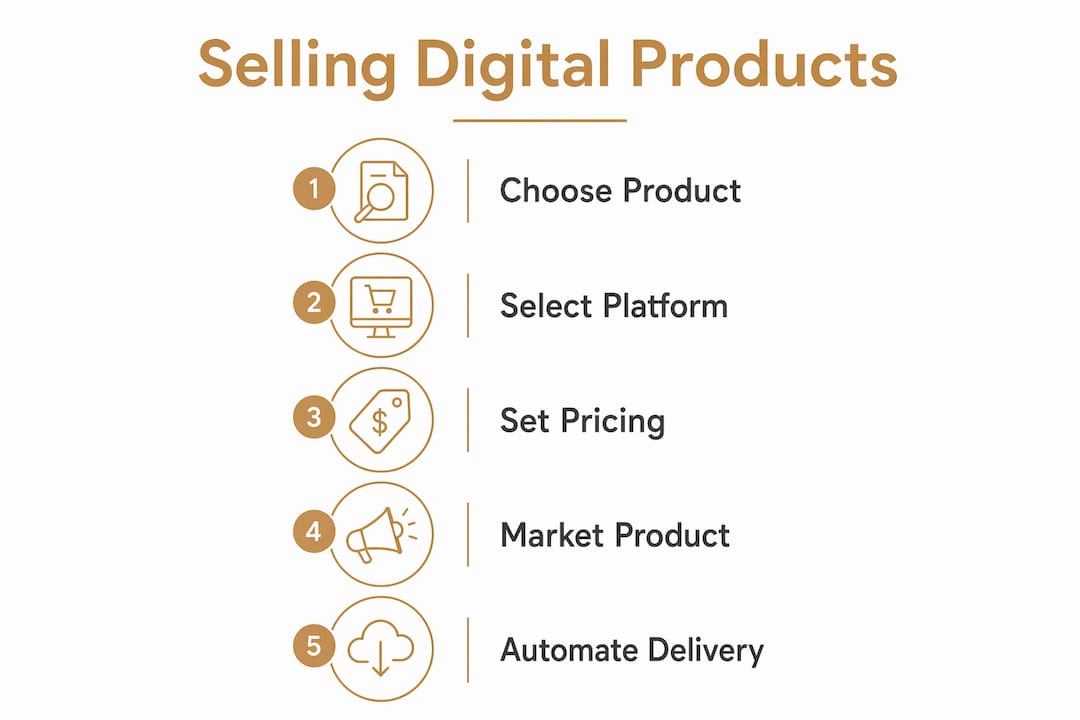
Creating your first digital product does not require perfection. It requires a clear promise and a buyer who has that problem. Here is the process I recommend.
-
Validate before you build. Run a simple poll on LinkedIn or Instagram. Ask your email list directly. A pre-sale, where you collect payment before the product is finished, is the strongest validation signal you can get.
-
Build a minimum viable product. Your first ebook does not need 80 pages. Your first template does not need 15 tabs. Solve one specific problem completely. A focused product that delivers a clear result beats a sprawling one that overwhelms buyers.
-
Write a sharp product description. Lead with the outcome, not the format. “A 12-page guide that helps you write a client proposal in 30 minutes” sells better than “A PDF about proposals.” Buyers buy results.
-
Create simple visual assets. A clean mockup image of your ebook cover or template screenshot builds trust instantly. You can create these in Canva in under an hour.
-
Price with confidence. Over-complicating pricing early hinders sales. Start with a single price point. For micro-products, $9 to $27 is a proven range. For a mini-course, $47 to $97 is realistic. You can always raise prices after you collect reviews. For deeper guidance on this, Yoursolobusiness has a dedicated pricing guide for solopreneurs worth bookmarking.
-
Optimize for platform search. Use the exact words your buyers type when searching. On Etsy, that means keyword-rich titles. On Udemy, it means a clear course subtitle. SEO on a marketplace works the same way as Google SEO: match the search intent.
How to market digital products and grow sales over time
Creating the product is only half the job. The other half is getting it in front of the right people, repeatedly.
Email lists provide the best audience control and conversion rates compared to social media algorithms. Social platforms can change their rules overnight. Your email list is yours. Every solopreneur selling digital goods should be building an email list from day one, even before the first product exists. A simple lead magnet, like a free checklist or mini-guide, is enough to start growing it.
Sustainable marketing habits that actually work:
- Content marketing: Share one piece of expertise per week on the platform where your buyers hang out. Solve a real problem in the post, then mention your product as the deeper solution.
- Social proof: Screenshot buyer feedback and share it. Even three or four positive responses from early buyers build credibility fast.
- Product bundling: Bundling digital products drives significantly more revenue because the incremental cost of adding another digital file is essentially zero. Bundle two related templates or a guide plus a checklist and price the bundle at a 20% discount.
- Simple upsells: After someone buys your $15 template, offer them a $37 mini-course that teaches them how to use it. The buyer is already warm.
- Consistent promotion: Treat your products as living assets. Successful sellers update and re-market their products regularly instead of publishing once and moving on.
Pro Tip: Set a recurring calendar reminder every 30 days to re-promote your existing products. Most buyers need to see an offer three to five times before they purchase.
Automation of product delivery prevents manual fulfillment bottlenecks and keeps your business running while you sleep. Pair automated delivery with an email sequence that nurtures new buyers toward your next product. That sequence is your most reliable upsell engine. For more ways to grow your income as a solo operator, check out these proven revenue strategies at Yoursolobusiness.
Key Takeaways
Selling digital products online works best when you start small, choose your platform based on your current audience size, and treat marketing as an ongoing habit rather than a one-time launch.
| Point | Details |
|---|---|
| Start with micro-products | Price between $5 and $30 to test demand before building larger offerings. |
| Match platform to audience size | Use marketplaces when starting out; switch to owned stores once you have traffic. |
| Build your email list first | Email converts better than social media and gives you full audience control. |
| Bundle products to grow revenue | Combining related digital files costs nothing extra and increases average order value. |
| Automate delivery from day one | Integrated payment and delivery tools remove manual work and prevent fulfillment errors. |
What I’ve learned selling digital products as a solopreneur
Here is the honest truth: your first product will not be your best one. Mine was a guide I spent three weeks perfecting, and it sold exactly four copies in the first month. The lesson was not that the product was bad. The lesson was that I had no audience and no marketing plan.
The solopreneurs I see succeed fastest are the ones who ship something simple, collect feedback, and iterate. They do not wait until the product is perfect. They treat the first version as a paid beta. That mindset shift changes everything.
I also wasted months on the wrong platform early on. I built a beautiful storefront before I had any traffic to send to it. A marketplace would have gotten me real buyers and real data in half the time. Traffic generation is the real bottleneck, not product quality.
The other mistake I see constantly is skipping the email list. Social media followers are borrowed. An email list is owned. If you are serious about selling online courses or any other digital product long-term, your email list is the asset that compounds over time. Start building it before you have anything to sell.
– Jay
Tools and resources to help you sell smarter as a solopreneur
Running a digital product business solo means your time and systems need to work together efficiently. The right tools make the difference between spinning your wheels and building real momentum.

At Yoursolobusiness, the Ultimate Productivity Toolkit for Solopreneurs brings together seven strategies and ten tools designed specifically for solo operators. It covers the workflows that support a digital product business, from content creation to sales systems, without requiring a team. If you want a clear-eyed look at the different paths a solopreneur can take, the Solopreneurship 101 guide is a strong starting point for mapping your own model.
FAQ
What are the easiest digital products to sell for beginners?
Templates, checklists, and short guides are the easiest starting points. They are fast to create, simple to price, and solve a specific problem buyers already know they have.
How much can a beginner earn selling digital products?
Beginners with consistent marketing typically earn $50 to $300 monthly from one or two products. Earnings grow as you add products, build your email list, and refine your marketing.
Do I need my own website to sell digital products?
No. Marketplaces like Etsy and Udemy let you start selling immediately with no website required. An independent storefront makes more sense once you have an existing audience to drive traffic to it.
What is the best way to market digital products?
Building an email list is the most reliable long-term strategy. Email converts better than social media because you own the audience and are not subject to algorithm changes.
How do I price my first digital product?
Start with a single, simple price point in the $9 to $27 range for micro-products. Avoid complex pricing tiers early on. Raise your price after you collect positive reviews and proof of results.