

TL;DR:
- Working smarter involves prioritizing high-impact tasks and eliminating unnecessary busywork. Solopreneurs can boost productivity by focusing on the 20% of efforts that deliver 80% of results and automating routine processes. Building consistent habits and protecting deep focus time are essential for sustainable growth and efficiency.
Working smarter, not harder, is defined as directing your energy toward the tasks that generate the most results, rather than simply logging more hours. For solopreneurs, this distinction is everything. Global employees spend 60% of their time on “work about work,” meaning status updates, meetings, and administrative busywork, and only 27% on skilled, high-value work. That gap is where your growth lives. This guide covers the 80/20 rule, deep work, batching, automation, and the mindset shifts that help solo business owners reclaim their time and build something sustainable.
How to work smarter not harder: start with the right tasks
The 80/20 principle, formerly known as the Pareto Principle, is the foundation of every effective productivity system. 80% of your business results come from just 20% of your tasks. That means most of what fills your day is not moving the needle.
Peter Drucker drew a line that every solopreneur needs to understand: efficiency means doing tasks right, while effectiveness means doing the right tasks. Drucker’s distinction tells us that you can be perfectly efficient at a task that should not exist at all. Most solopreneurs optimize how they work but never stop to question whether the work is worth doing. Elimination is a higher-leverage move than optimization.
A practical way to apply this is the Eisenhower Matrix, which sorts your tasks into four quadrants: urgent and important, important but not urgent, urgent but not important, and neither. Your solopreneur productivity tips practice starts here. Anything in the “neither” quadrant gets cut. Anything “urgent but not important” gets deferred or batched.
Here is a quick audit you can run on your current task list:
- Identify your top three revenue-generating activities. These are your 20%. Protect them first.
- List every recurring task you do weekly. Flag anything that does not directly serve a client, generate revenue, or build your brand.
- Ask “what happens if I stop doing this?” If the answer is “nothing much,” stop doing it.
- Defer low-value tasks to a single weekly block rather than letting them interrupt your best hours.
Pro Tip: Apply elimination before optimization. Before you look for a faster way to do something, ask whether it needs to be done at all. Cutting one low-value task saves more time than speeding up ten of them.
What techniques help maintain deep focus and reduce distractions?
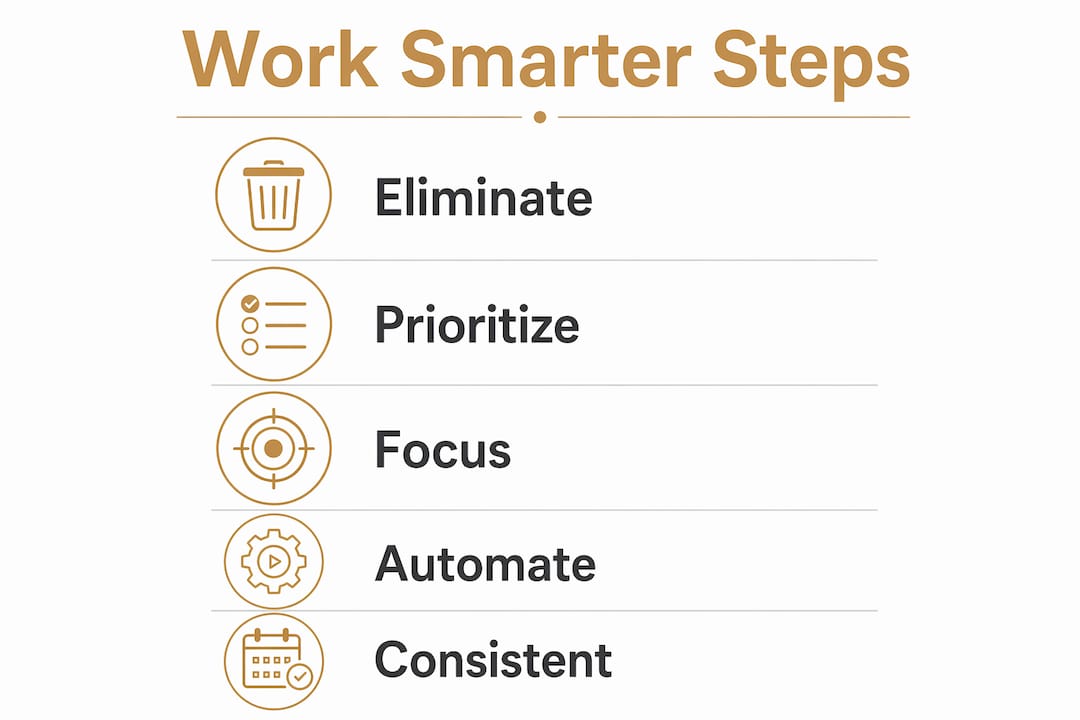
Distraction is not just annoying. It is expensive. Context switching costs up to 23 minutes of refocus time after each interruption. If you check your email five times before noon, you may have already lost nearly two hours of productive capacity before you have done any real work.

The concept of deep work, popularized by Cal Newport, describes the ability to focus without distraction on a cognitively demanding task. Deep work produces your best output and is the skill that separates high-performing solopreneurs from those who stay busy but never move forward. Single-tasking and deep work dramatically increase output quality compared to multitasking and fragmented attention.
Here is a practical system for protecting your focus:
- Identify your peak energy window. Most people have two to four hours of peak cognitive performance per day, usually in the morning. Schedule your most demanding work there.
- Use time blocking. Assign specific tasks to specific time slots on your calendar. Treat these blocks like client appointments you cannot cancel.
- Batch reactive tasks. Check email and messages twice a day at fixed times, such as 10:00 AM and 4:00 PM. This alone can recover hours each week.
- Design your environment. Close browser tabs, silence notifications, and use a dedicated workspace. Batching and environment design create behavioral constraints that outperform willpower-based focus strategies.
- End with a shutdown ritual. Write tomorrow’s top three priorities, close all tabs, and say “shutdown complete” out loud. This signals your brain that work is done and prevents evening rumination.
Pro Tip: Try a “no meeting” morning policy. Block your first three hours for deep work only, and watch your weekly output shift dramatically. Even two weeks of this practice will show you what you are actually capable of.
The productivity workflow behind this approach is not complicated. It just requires consistency. Start with one protected deep work block per day and build from there.
How can technology and systems automate routine work?
Working smarter multiplies results without adding hours, and automation is the clearest example of this principle in action. When you automate a task, you do the work once and collect the benefit indefinitely. That is exponential thinking applied to a solo business.
The categories of work most worth automating for solopreneurs include:
- Scheduling: Use a calendar booking tool to eliminate the back-and-forth of finding meeting times. One setup saves dozens of emails per month.
- Client onboarding: Build a reusable onboarding sequence with a welcome email, intake form, and contract template. New clients get a professional experience every time, with no extra effort from you.
- Invoicing and follow-up: Automate invoice creation and payment reminders. Chasing payments manually is one of the biggest time drains in solo business.
- Content repurposing: Create a template for turning one long-form piece into social posts, email newsletters, and short-form clips. One idea becomes five assets.
Reusable templates reduce decision overhead. Every time you start from scratch, you spend mental energy that could go toward higher-value thinking. A library of templates for proposals, emails, reports, and project briefs means you spend your energy customizing, not creating from zero.
| Routine task | Automation or system | Time saved per week |
|---|---|---|
| Scheduling meetings | Calendar booking tool | 2–3 hours |
| Client onboarding | Email sequence + intake form | 1–2 hours |
| Invoicing | Auto-billing software | 1 hour |
| Social media posting | Scheduled content queue | 2–4 hours |
| Weekly reporting | Dashboard or template | 1–2 hours |
Yoursolobusiness covers this territory in depth, including a business automation guide built specifically for freelancers and solo operators who want to reclaim time without hiring anyone.
Pro Tip: Start with one automation, not ten. Pick the task that eats the most time and build a system for that first. Run it for two weeks before adding anything else. Complexity added too fast creates new problems instead of solving old ones.
What mindset shifts support sustained smarter working?
Efficiency in the workplace is a behavior before it is a system. The habits and beliefs you hold about productivity determine whether any framework actually sticks. The biggest mindset shift for solopreneurs is moving from measuring time spent to measuring results produced.
A few shifts that make a real difference:
- Say no by default. Every “yes” to a low-priority request is a “no” to your most important work. Protect your priorities by treating your time as a finite resource, because it is.
- Measure outputs, not hours. Did you close a deal, finish a deliverable, or publish a piece of content? That matters more than whether you worked eight hours or four.
- Build a weekly review habit. A weekly review practice takes 20–30 minutes and recalibrates your focus before the week starts. It is one of the highest-return habits in solo business.
- Manage energy, not just time. Energy management is more critical than time management for sustained productivity. A tired brain working four hours produces less than a rested brain working two.
- Commit to one system for at least seven days. Consistent practice over 7+ days builds the habit foundation that yields compounding time savings. Switching systems every few days resets the clock.
The daily habits that support smarter working are not dramatic. They are small, repeated choices that compound over weeks and months into a fundamentally different way of running your business.
Key Takeaways
Working smarter requires eliminating low-value tasks first, protecting deep focus time, automating repetitive work, and measuring results instead of hours spent.
| Point | Details |
|---|---|
| Apply the 80/20 rule | Focus on the 20% of tasks that generate 80% of your results and cut the rest. |
| Protect deep work time | Block your peak energy hours for high-value work and batch reactive tasks separately. |
| Automate before you delegate | Build reusable systems and templates to eliminate repetitive work without hiring anyone. |
| Shift to results-based metrics | Measure what you produce, not how long you work, to stay focused on real outcomes. |
| Build habits gradually | Commit to one new system for at least seven days before adding another layer of change. |
What I have learned about working smarter as a solopreneur
The hardest part of working smarter is not finding the right system. It is giving yourself permission to stop doing things that feel productive but are not.
When I first started batching my email to twice a day, I felt guilty. It seemed like I was being unresponsive. Within two weeks, I realized no client had noticed, and I had reclaimed nearly an hour each day. That hour went into writing, which built my audience, which grew my business. The guilt was a false signal.
The same thing happened when I started saying no to low-value projects. My instinct was that every opportunity was worth taking. The reality is that every “yes” to the wrong thing delays the right thing. Saying no is a skill, and it gets easier with practice.
My honest advice: do not try to overhaul your entire workflow in one weekend. Pick one thing. Maybe it is a daily shutdown ritual, or batching your admin tasks on Friday afternoons. Run it for two weeks. Notice what changes. Then add the next piece. Slow and steady here is not a cliché. It is the only approach that actually sticks.
Celebrate the small wins, too. If you protected your deep work block three days in a row, that is a real achievement. Progress compounds when you acknowledge it.
– Jay
Tools and resources to help you work smarter at Yoursolobusiness
Running a solo business at full capacity does not require more hours. It requires better systems.

Yoursolobusiness has built a library of practical resources specifically for solopreneurs who want to work more efficiently without adding headcount. The solopreneur productivity toolkit covers seven proven strategies and ten tools that solo business owners can put to work immediately. If you are ready to set up the systems behind a leaner operation, the solo business systems guide walks you through a complete 2026 setup. Both resources are built for the way solopreneurs actually work.
FAQ
What does it mean to work smarter not harder?
Working smarter means focusing your time and energy on the tasks that generate the most results, rather than simply working more hours. It involves prioritizing high-value work, eliminating busywork, and using systems to handle repetitive tasks.
What is the 80/20 rule in productivity?
The 80/20 rule, or Pareto Principle, states that 80% of your results come from 20% of your efforts. For solopreneurs, this means identifying the small number of tasks that drive most of your revenue and protecting time for those first.
How does context switching hurt productivity?
Context switching costs up to 23 minutes of refocus time after each distraction. Frequent interruptions can eliminate hours of productive capacity each day, which is why batching tasks and protecting focus blocks matter so much.
What is the difference between efficiency and effectiveness?
Efficiency means doing a task correctly; effectiveness means doing the right task in the first place. Peter Drucker’s distinction reminds us that being efficient at the wrong work still produces poor results.
How long does it take to build a smarter working habit?
Committing to one productivity system consistently for at least seven days is enough to begin forming a reliable habit. The compounding benefits grow significantly when you stick with a single approach rather than switching systems frequently.