
Create a business plan because it measurably raises growth, cuts failure risk, and forces you to answer the decisions that matter most before they cost you money. Research shows that planning improves business outcomes, with one study of 622 new ventures finding that writing a plan raised average annual employment growth by 33.4 percentage points. The SBA is clear: there is no single wrong format, and lean one-page plans often work best for solo operators. At Yoursolobusiness, the whole platform is built around this idea: a focused solopreneur with the right tools and a clear plan can outperform businesses ten times their size.
Three things a business plan does for you right away:
- Boosts performance and survival. The research is unambiguous: planning raises growth rates and reduces the chance of disbanding by a significant margin.
- Sharpens your thinking. Writing forces you to test assumptions on paper, not with real money.
- Opens doors beyond fundraising. Banks, grant committees, and enterprise clients all respond better to a tidy one-page document than to a verbal pitch.
A lean one-page plan takes 2–6 hours. A fleshed-out 1–3 page living plan takes 1–2 focused days. Either way, you will finish faster than you think.
Why the evidence on business planning is hard to ignore
The numbers are not subtle. That meta-analysis of 46 studies is the largest synthesis of its kind, and one study of 622 new ventures found writing a plan raised average annual employment growth by 33.4 percentage points. Planning works, and it works across industries and business sizes.
The Springer review identifies three distinct effects: economic (revenue, survival), external/symbolic (credibility with banks and clients), and internal/psychological (clearer thinking, fewer reactive decisions). Most solopreneurs only think about the first two. The internal benefit is actually the one you feel every week, because it replaces spinning your wheels with a clear next action.
The SBA adds practical weight: lean startup formats are often the right call for simple, service-based businesses. You do not need a 40-page document to get the benefits. A formal plan also helps you open a business bank account, apply for grants, or convince an enterprise client you are a real operation.
What a lean solopreneur plan actually looks like
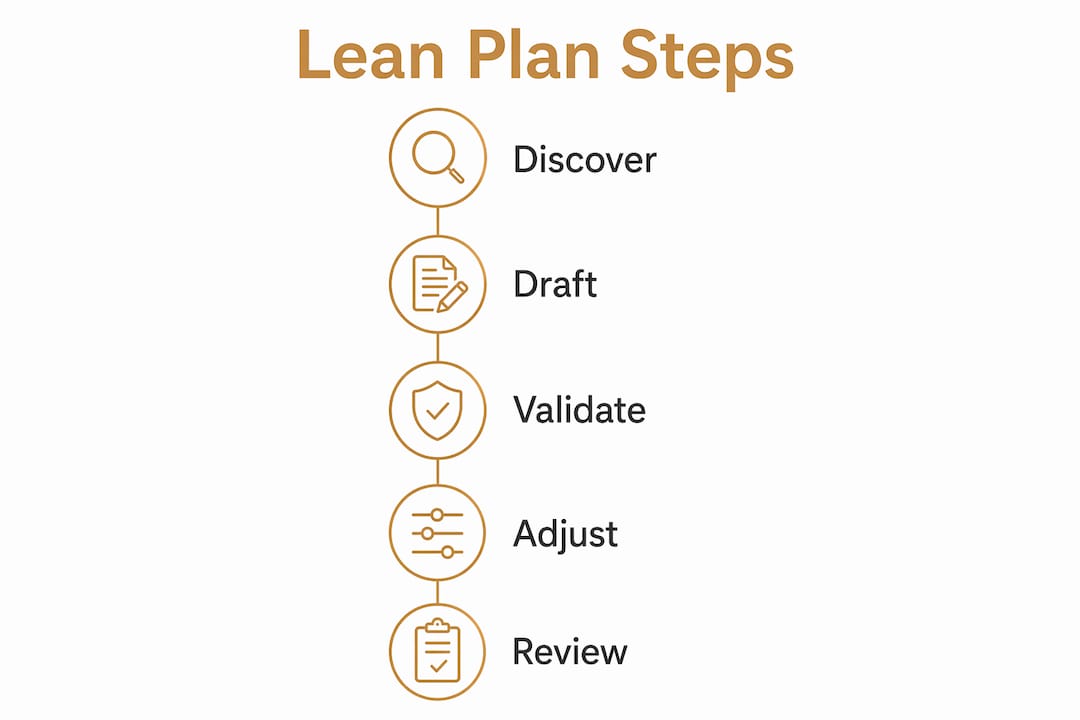
The SBA recommends choosing the format that meets your needs, and for most solopreneurs that means a one-page or 1–3 page living plan. Here is a copy-and-paste template you can drop into Google Docs or Notion right now:
| Section | Fill-in prompt |
|---|---|
| Value proposition | I help [customer] achieve [outcome] without [pain point]. |
| Target customer | My best client is [role/industry] who struggles with [specific problem]. |
| Offer and pricing | I offer [service/product] at [$X per month / per project]. |
| Revenue model | I need [N] clients at [$X] to hit my monthly target of [$Y]. |
| Key costs | Fixed: [$X/month]. Variable: [$Y per project]. |
| Milestones | 30 days: [first paying client]. 90 days: [revenue target]. |
| Key metrics | Revenue per client, conversion rate, cash runway. |
Two quick examples of how terse entries can be:
- Service consultant: “I help mid-market ops teams cut reporting time by 40%. Three retainer clients at $3,000/month covers all costs with a 60% margin.”
- Digital-product freelancer: “I sell Notion templates to solopreneurs. Goal: 200 sales at $47 in 90 days via an email list of 1,500.”
Pro Tip: Keep each entry to one or two sentences. If you need a paragraph, you are still thinking, not planning. Terse entries are a sign of clarity, not laziness.
The writing process itself is where most of the value lives. Putting assumptions on paper surfaces the risky ones before you spend a dollar. For a deeper look at solo business plan benefits, Yoursolobusiness has a dedicated guide worth bookmarking.
How to write your plan fast with an AI workflow
The fastest reliable workflow is a three-stage process: Discover → Draft → Validate. Most solopreneurs can finish all three stages in a single focused afternoon.

| Stage | Key actions | Time budget |
|---|---|---|
| Discover | Market sketch, customer profile, assumption list | 60–90 min |
| Draft | Value proposition, one-page plan, revenue model | 60–90 min |
| Validate | Financial snapshot, risk check, peer review | 30–60 min |
Prompt library to get you started:
- Discovery: “Describe my ideal customer for [service] in three sentences. What are their top three frustrations and what do they search for when looking for help?”
- Drafting: “Write a one-sentence value proposition for a [role] who helps [customer] achieve [outcome]. Make it specific and free of jargon.”
- Financial snapshot: “Build a simple monthly revenue table for a solopreneur with [N] clients at [$X], fixed costs of [$Y/month], and a target cash runway of [Z months].”
Use AI as your draft-first writer, not your final editor. Feed it your raw assumptions and let it structure them. Then you edit for accuracy and tone. Prompt chaining works well here: run the discovery prompt first, paste the output into the drafting prompt, and use the result as input for the financial snapshot.
Pro Tip: Always add a guardrail to financial prompts: “Flag any assumption that requires more than 10 new clients in the first 90 days as high-risk.” AI will not push back on unrealistic numbers unless you tell it to.
The act of writing the plan is a low-cost way to fail fast on assumptions. The process surfaces risky bets long before capital is spent.
A quick implementation checklist before you move on:
- [ ] Run the discovery prompt and save the output
- [ ] Fill the one-page template using the draft prompt
- [ ] Build your financial snapshot (three rows: revenue, costs, runway)
- [ ] Schedule a 30-day review on your calendar
For a full solopreneur planning checklist, Yoursolobusiness has a step-by-step resource that maps directly to this workflow.
When a short plan is enough — and when you need more
If you are not raising capital and your model is service-based with predictable pricing, a one-page living plan is almost always enough. If you are applying for a bank loan, bidding on enterprise contracts, or building a product with genuinely unknown demand, expand it.
Here is a fast decision guide:
- Time horizon under 12 months and model is proven? One-page plan, updated quarterly.
- Customers are clearly defined and reachable? One-page plan with a simple marketing section.
- Regulatory complexity is high (licenses, certifications)? Add a compliance section to your lean plan.
- Seeking a bank loan or SBA-backed financing? You need a traditional plan with financial projections.
- Building a product with uncertain demand? Add a market-validation section and update monthly.
Research confirms that startups in fast-changing environments get the most value from shorter, frequently updated plans. Established businesses in stable markets benefit from more detail. Know which camp you are in.
Pro Tip: If you are a freelancer or consultant just starting out, a partner resource like this founder guide offers visual lean templates that make the format decision much easier.
How to keep your plan alive and working for you
A plan only pays off when you treat it as a living document with scheduled reviews and trigger-based updates. Here is a simple cadence to copy into your calendar:
| Review type | Frequency | What to update |
|---|---|---|
| Quick check | Monthly | Key metrics, cash runway, next milestone |
| Revision | Quarterly | Offer, pricing, customer profile |
| Strategy refresh | Annually | Full plan rewrite if model has shifted |
Trigger events that require an immediate update:
- A new major client changes your revenue mix
- You raise or lower prices
- A product pivot shifts your target customer
- A cash-flow alarm (runway drops below 60 days)
- You land or lose a significant partnership
Track these five metrics at every monthly check: revenue per client, conversion rate, cash runway, new leads per month, and client retention rate. They tell you whether the plan is working before a crisis forces the question. For help setting measurable goals that connect to these metrics, Yoursolobusiness has a dedicated resource.
Copy-and-paste templates: one-page plan, financial snapshot, 30/60/90 checklist
One-page plan template (paste into Google Docs or Notion):
- Value proposition: I help [customer] achieve [outcome] without [pain].
- Target customer: [Role, industry, company size, top frustration].
- Offer and pricing: [Service/product name] at [$X per month / per project].
- Revenue model: [N] clients × [$X] = [$Y/month target].
- Key costs: Fixed [$X/month] + variable [$Y/project].
- Milestones: 30 days: []. 60 days: []. 90 days: [___].
- Key metrics: [Revenue per client / conversion rate / cash runway].
Financial snapshot (three rows is all you need):
| Row | Fill-in prompt |
|---|---|
| Monthly revenue | [N clients] × [$X per client] = [$Y total] |
| Fixed monthly costs | Software + tools + any recurring fees = [$Z] |
| Cash runway | [Current savings] ÷ [Monthly costs] = [X months] |
30/60/90 checklist:
- [ ] Day 1–30: Fill the one-page template, run AI discovery prompts, land first paying client or confirm first sale
- [ ] Day 31–60: Review conversion rate, adjust pricing or offer if needed, add one new lead source
- [ ] Day 61–90: Run quarterly revision, update financial snapshot, set next 90-day milestone
Key Takeaways
A lean, frequently updated business plan measurably raises growth, reduces failure risk, and gives you the decision clarity that keeps a solo business moving forward.
| Point | Details |
|---|---|
| Planning raises growth | A study of 622 new ventures found writing a plan raised average annual employment growth by 33.4 percentage points. |
| Lean formats work best | The SBA recommends choosing the format that fits your needs; one-page plans often suit solopreneurs best. |
| AI cuts writing time | A three-stage Discover → Draft → Validate workflow with AI prompts fits in a single afternoon. |
| Treat it as living | Monthly quick checks, quarterly revisions, and trigger-based updates keep the plan useful year-round. |
| Yoursolobusiness resources | The Solopreneur Business Planning Guide 2026 and AI Toolkit include templates, prompts, and checklists for every step. |
The case for planning that most solopreneurs miss
Here is the part that most planning articles gloss over: the biggest benefit of writing a business plan is not the document. It is the argument you have with yourself while writing it.
Most solopreneurs I see spinning their wheels are not short on ideas. They are short on constraints. A one-page plan forces you to pick one customer, one offer, and one revenue target. That act of elimination is where the real value lives. The MDPI integrative review frames this as the internal/psychological effect of planning, and it is the one that shows up in your daily decisions, not just your annual revenue.
The conventional wisdom says “write a plan to get funding.” That is true but incomplete. Write a plan because it replaces reactive decision-making with a filter. Every new opportunity, distraction, or shiny tool gets measured against the plan. Most of them fail the test, and that is exactly the point.
At Yoursolobusiness, Jay built the platform’s planning resources around this idea: that a solopreneur with a clear one-page plan and a small AI toolkit can make faster, smarter decisions than a team with a 40-page strategy document and weekly meetings.
Yoursolobusiness has the tools to get your plan done today

The Solopreneur Business Planning Guide 2026 at Yoursolobusiness gives you the full planning workflow in one place: a copy-and-paste one-page template, the complete AI prompt library from this article, a financial snapshot spreadsheet, and a 30/60/90 implementation checklist. Everything maps directly to the Discover → Draft → Validate stages covered above. If you want the AI tools that power the drafting and validation stages, the AI Toolkit has the full prompt library and a curated stack of tools Jay uses to run a one-person business at team-level output. Pick the guide, grab the toolkit, and have a working plan by the end of the day.
Useful sources and further reading
Primary research and official guidance:
- Meta-analysis and 622-venture growth study — read this first if you want the evidence that planning works
- SBA: Write your business plan — official format guidance and lean startup template overview
- Springer: Business plan as a multi-user tool — the cognitive and decision-quality benefits in depth
- MDPI: Is Business Planning Useful for Entrepreneurs? — balanced review of economic, symbolic, and psychological effects
- Investopedia: Business plan guide — practical primer on external uses (banking, grants, clients)
Yoursolobusiness resources for templates and tools:
- Why develop a solo business plan — core reasons and advantages specific to solopreneurs
- How to create a business strategy for solopreneurs — pairs with the one-page plan for readers who want to go deeper
- Business growth roadmap for solopreneurs — longer-term planning after your first plan is live