

TL;DR:
- Solopreneurs build financial stability by combining active services, retainers, and digital products. Success depends on stacking revenue streams, starting with one and scaling gradually with repeatable systems. Content creation and audience building generate long-term income, but require consistent effort over 6 to 18 months.
Monetizing a solo business means generating consistent income by combining service offerings, digital products, and audience engagement methods that fit your unique expertise and market. The industry term for this approach is income stacking, and it is the most reliable way for a solopreneur to build financial stability without hiring a team. You can start with one active service, add a retainer agreement, and eventually layer in digital products on platforms like Gumroad or paid newsletters on Beehiiv or Substack. This guide breaks down exactly how to monetize a solo business at every stage, from landing your first client to building income that runs while you sleep.
What are the primary revenue streams for solo businesses?
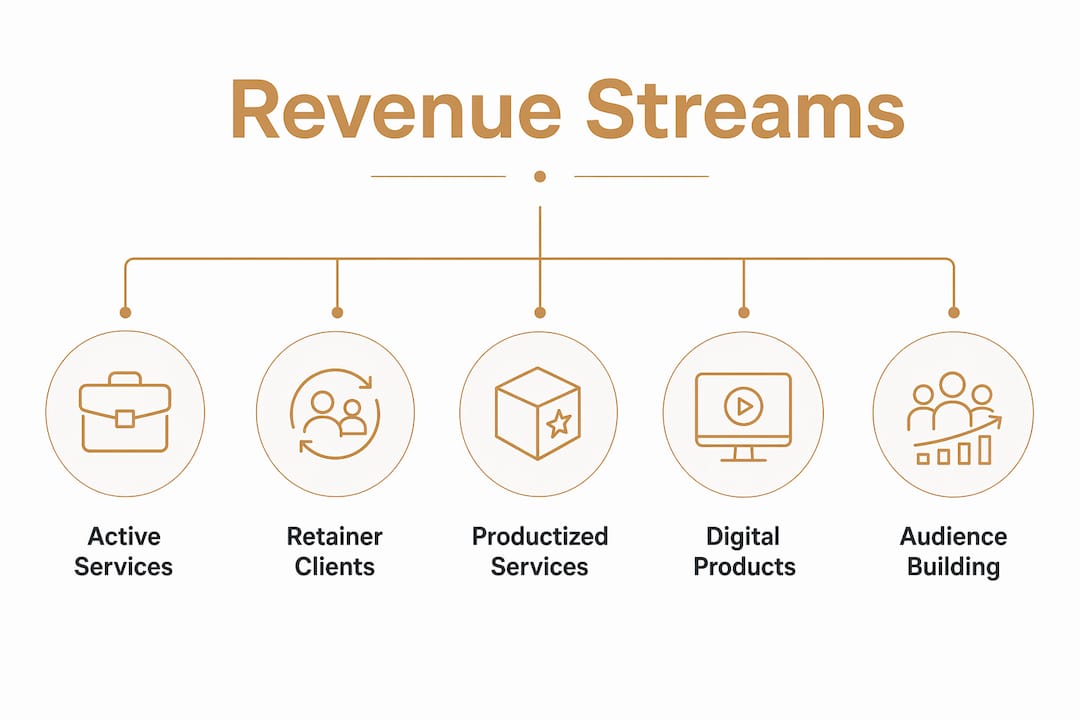
The four core income streams for a solo business are active services, retainer agreements, productized services, and digital products. Each one plays a different role, and combining them is what creates real financial stability.

Active services are your fastest path to cash. You trade time for money, but the speed of income is unmatched when you are just starting out. Consulting, copywriting, design, and coaching all fall here.
Retainer agreements convert one-off project work into predictable monthly income. The sweet spot is 3–5 retainer clients. Fewer than three creates dangerous dependency on any single client. More than five risks overwork and quality decline.
Productized services sit between active work and passive income. A website audit at $500, an SEO package at $1,200, or a brand identity kit at $2,500 flat are fixed-scope, fixed-price offerings that are far easier to sell and deliver than open-ended projects. They also make your calendar predictable.
Digital products and paid newsletters are your long-game plays. Here is how the numbers can stack up:
| Revenue stream | Example pricing | Monthly potential |
|---|---|---|
| Retainer clients (2–3) | $300–$800 each | $600–$2,400 |
| Paid newsletter (100 subscribers) | $9/month | $900 |
| Digital product sales | $50–$200 per unit | Varies by volume |
| Productized service (2–4 per month) | $500–$2,500 flat | $1,000–$10,000 |
The math is clear. Combining newsletter subscribers and retainer clients alone can build a reliable $3,000+ monthly income baseline. That number matters because it covers most solopreneurs’ basic operating costs, which removes the panic from slow months.
The key insight here is that no single stream is enough on its own. Active services pay the bills today. Retainers smooth out the feast-or-famine cycle. Digital products and newsletters create income that does not require your direct time every month.
How to start monetizing quickly with your first clients
Speed matters when you are starting out. The biggest mistake new solopreneurs make is building a full website, course, or product suite before they have a single paying client. Focus on one revenue stream first and pitch at least 10 prospective clients before you build anything beyond a simple service description.
Your minimum viable setup has four parts:
- A clear service description. One paragraph that explains what you do, who it is for, and what the client gets. No fluff, no jargon.
- A simple pricing structure. One or two packages with fixed prices. Hourly rates invite scope creep and undervaluing your work.
- A payment collection method. Stripe, PayPal, or Wave work fine. Do not wait until you have a fancy invoicing system.
- A documented delivery process. A simple checklist or Notion template that covers every step from onboarding to final delivery.
Your first clients almost always come from warm outreach, not cold pitching or SEO. Email former colleagues, post in LinkedIn groups you already belong to, and ask past employers if they need project help. Referrals from your existing network convert at a much higher rate than any paid channel.
Once you have two or three paying clients, bring in AI tools to handle repetitive work. ChatGPT handles first drafts, client email templates, and research summaries. Zapier automates client onboarding tasks like sending welcome emails, creating folders, and logging new projects. These tools do not replace your expertise. They free up the hours you would otherwise spend on admin.
Pro Tip: Before building a digital product, run a “beta offer” to three clients at a discount. Their feedback shapes the final product and their testimonials sell it for you.
How can content and audience-building tools increase solo business revenue?
Content is the highest-leverage long-term asset a solopreneur can build. A newsletter, YouTube channel, or podcast does not pay you in month one. But by month 12 or 18, it becomes a traffic engine that feeds every other income stream you have.
Content channels require 6–18 months of consistent effort to generate meaningful revenue. That timeline is not a warning. It is a planning tool. If you start a newsletter today, you are investing in a revenue channel that compounds over time, unlike a single client project that ends.
Here is how content converts into income:
- Paid subscriptions. Platforms like Beehiiv and Substack let you charge readers directly. Even a small paid tier at $9/month adds up fast with a loyal audience.
- Sponsorships. Brands pay to reach niche audiences. A newsletter with 2,000 engaged readers in a specific industry can command $200–$500 per sponsored issue.
- Affiliate programs. Recommend tools you already use and earn a commission. Gumroad, ConvertKit, and many SaaS products offer affiliate programs with recurring payouts.
- Traffic to your own products. Your content funnels readers directly to your services and digital products without any ad spend.
“The goal of content is not to go viral. The goal is to attract the right 1,000 people who will eventually buy from you, refer you, or subscribe to you.” This is the mindset that separates solopreneurs who build durable income from those who chase follower counts.
One critical point on measurement: email open rates are inflated due to privacy protections from tools like Apple Mail Privacy Protection. Open rates are no longer a reliable signal of engagement. Track link clicks and conversions instead. Those numbers tell you what your audience actually cares about.
What mistakes should you avoid when monetizing a solo business?
The most common mistake solopreneurs make is launching three or four income streams at once. It feels productive. It is actually the fastest way to deliver mediocre results across the board and burn yourself out.
Here is what to avoid and what to do instead:
- Do not chase passive income before you have active income. A digital product with no audience earns nothing. Build the audience or the client base first.
- Do not price by the hour longer than you have to. Hourly pricing caps your income at the number of hours you can work. Value-based pricing for productized services breaks that ceiling.
- Do not ignore your delivery systems. Undocumented processes mean every new client starts from scratch. Document once, reuse forever.
- Do not measure vanity metrics. Follower counts and open rates feel good but do not pay bills. Conversions and client inquiries do.
- Do not skip the retainer conversation. After a successful project, ask the client if they need ongoing support. Most will say yes if you frame it as a monthly maintenance package.
Pro Tip: Set a rule for yourself: master one income stream before adding another. Your second stream should only launch once your first stream runs on a documented, repeatable system.
Your first $1,000 in revenue validates your business model. Everything after that is about systemization and scaling, not reinvention. Solopreneurs who scale successfully are not the ones with the most income streams. They are the ones who run each stream cleanly.
Key takeaways
The most effective way to monetize a solo business is to stack income streams in order: active services first, then retainers, then productized offerings, then content-driven revenue.
| Point | Details |
|---|---|
| Start with active services | One clear service offering generates immediate cash flow before you build anything else. |
| Add retainers for stability | Three to five retainer clients convert unpredictable project work into reliable monthly income. |
| Productize your best service | Fixed-scope, fixed-price packages are easier to sell and deliver than open-ended projects. |
| Build content for the long term | Newsletters, YouTube, and podcasts take 6–18 months but create compounding revenue over time. |
| Track conversions, not vanity metrics | Link clicks and client inquiries are the only numbers that predict actual revenue. |
What I have learned about building solo income that actually lasts
The honest truth is that most solopreneurs, myself included, overcomplicate monetization in the early stages. We read about passive income and immediately want to build a course or a membership site before we have proven that anyone will pay us for anything.
The thing that changed everything for me was landing two solid retainer clients. That predictable monthly income removed the anxiety that was quietly killing my creativity and my ability to think clearly about growth. When you are not worried about next month’s rent, you make better decisions about which opportunities to pursue.
I also learned that AI tools are not a shortcut to passive income. They are a shortcut to capacity. ChatGPT and Zapier did not replace my thinking. They gave me back the hours I was wasting on repetitive tasks, which I then reinvested into content and client relationships. That is the real return on AI for a solo operator.
My advice is to resist the urge to diversify too fast. Pick the income stream that matches your current skills and audience size. Build it until it runs on a documented system. Then, and only then, add the next layer. Incremental diversification beats chaotic expansion every single time. If you want a practical framework for combining services with digital products, start there before you think about newsletters or courses.
The solopreneurs I see thriving in 2026 are not the ones with ten income streams. They are the ones with three clean, well-run streams and the systems to support them.
– Jay
Tools and resources to help you build your solo income stack
Running a solo business at full capacity requires the right systems behind you, not just good ideas.

Yoursolobusiness has built a library of practical resources specifically for solopreneurs who want to earn more without working more hours. The Ultimate Productivity Toolkit for Solopreneurs covers the exact tools and workflows that help solo operators deliver more, faster, and with less mental overhead. If you are ready to structure your business for real income growth, the solopreneur business planning guide gives you a step-by-step framework to map your revenue streams, set targets, and build the systems that make scaling possible without burning out.
FAQ
What is income stacking for a solo business?
Income stacking is the practice of combining multiple revenue streams, such as active services, retainer agreements, and digital products, to create financial stability as a solopreneur.
How long does it take to monetize a solo business?
Your first $1,000 in revenue can come within weeks through warm outreach and active services. Content-driven revenue from newsletters or YouTube typically takes 6–18 months of consistent effort.
How many retainer clients does a solopreneur need?
The ideal range is 3–5 retainer clients. Fewer than three creates high dependency on a single client, while more than five risks overwork and declining quality.
What are the best platforms for selling digital products as a solopreneur?
Gumroad is the most accessible starting point for digital products. Beehiiv and Substack are the leading platforms for paid newsletters with built-in subscriber management.
Should I price my services by the hour or by the project?
Fixed-price, productized services generate more income than hourly billing because they are not capped by the number of hours you can work. Shift to value-based pricing as soon as your delivery process is documented and repeatable.