
TL;DR:
- Building an audience solo requires focusing on one platform and publishing consistently for 90 days. Engaging with niche creators through replies accelerates growth, and starting an email list early ensures owned access to your community. Prioritizing manageable content routines and tracking pipeline metrics prevents burnout and fosters sustainable growth.
Building an audience solo is defined as the practice of growing a dedicated community around your work independently, without a marketing team, agency, or hired help. For solopreneurs and freelancers, this is not a nice-to-have skill. It is the foundation of every sustainable one-person business. The 2026 “Rule of 100” commits solo builders to 100 minutes of daily content creation for 100 consecutive days to find their voice and discover what resonates. Pair that with LinkedIn’s organic reach advantage for B2B founders and a permission-based email list, and you have a repeatable system that works without a team behind it.
How to build an audience solo: start with one platform
The single biggest mistake solo founders make is spreading content across five platforms at once. You end up producing mediocre content everywhere instead of excellent content somewhere. LinkedIn personal profiles generate 3–8x more organic reach than company pages for B2B services. That gap is enormous when you are working alone and every post needs to pull its weight.
Choosing your platform is not complicated, but it does require honesty. Ask yourself three questions before committing:
- Where does your audience already spend time? A freelance designer finds clients on Instagram and Behance. A B2B consultant finds them on LinkedIn.
- What content format do you actually enjoy producing? Short video, long-form writing, and audio all perform well on different platforms.
- Can you sustain this format for 90 days without burning out? Sustainability beats production quality every time at the start.
The right content medium is one you do not dread. Consistency beats high-effort, unsustainable production styles. A solo founder who publishes three LinkedIn posts a week for six months will outperform one who launches a podcast, a newsletter, and a YouTube channel simultaneously and abandons all three by week eight.
Pro Tip: Pick the platform where you already consume content. If you spend 30 minutes a day reading LinkedIn posts, you already understand the format intuitively. That familiarity cuts your learning curve in half.

What does a sustainable content creation workflow look like?
Consistency is the engine of solo audience growth. The first 90–100 days are a quantity-over-quality phase. Your job is not to produce perfect content. Your job is to produce enough content to generate data about what your audience responds to. Daily publishing for 90–100 days generates the feedback you need to refine your strategy effectively.
Here is a practical workflow that works for solo operators:
- Choose one narrow niche and one repeatable angle. “Marketing for freelancers” is a niche. “One marketing tactic per week that takes under 30 minutes” is a repeatable angle. The angle is what makes your content recognizable.
- Batch your content creation. Set aside one two-hour block per week to write or record four to five pieces of content. Schedule them in advance so publishing becomes automatic, not a daily decision.
- Use AI tools to handle the repetitive parts. Repurposing a LinkedIn post into a newsletter section or generating three headline variations takes minutes with the right tools. Yoursolobusiness covers the exact AI stack that makes this possible for one-person operations.
- Review your metrics every two weeks, not every day. Daily metric checking creates anxiety and distorts your judgment. Bi-weekly reviews give you enough data to spot real patterns.
- Adjust one variable at a time. If engagement drops, change your posting time before changing your topic. Isolating variables helps you learn faster.
Pro Tip: Publish before you feel ready. The gap between “good enough to post” and “perfect” is where most solo founders stall. Your tenth post will be better than your first regardless of how long you wait. Ship it.
The personal branding work you do in this phase compounds. Every post teaches you something about your audience’s language, pain points, and preferences. That data is worth more than any content strategy template.
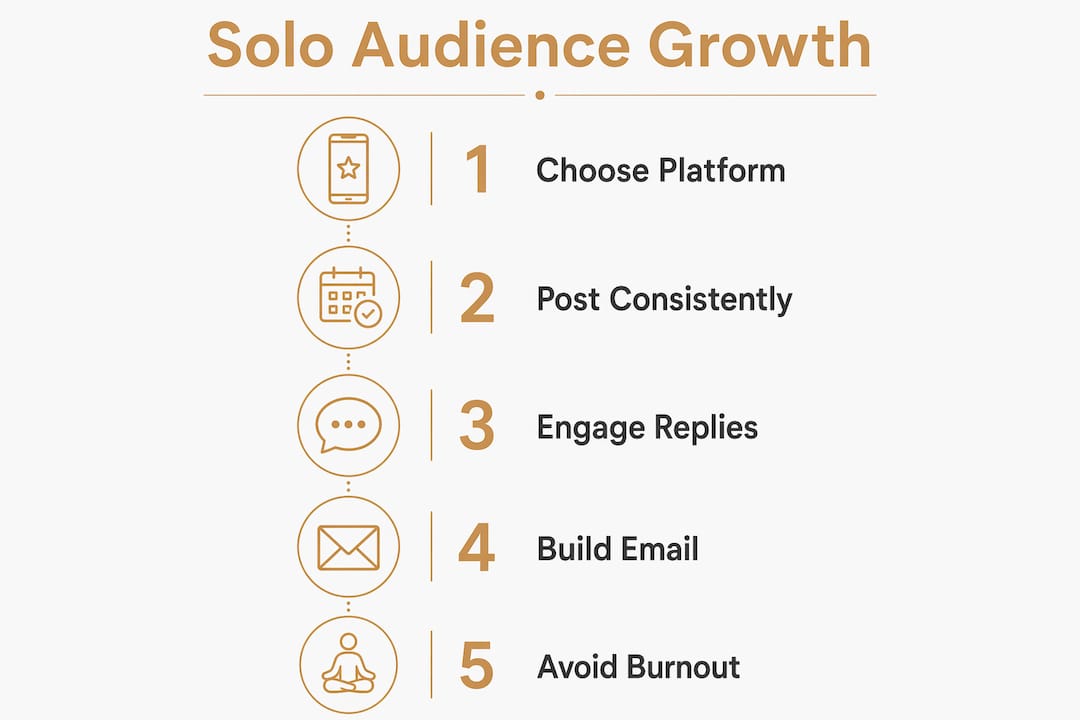
Why does the reply-first strategy accelerate solo audience growth?
Growing an audience alone does not mean broadcasting into a void and hoping people find you. The most effective early-stage tactic is reply-first growth. Adding 10–20 value-driven replies daily to posts from niche creators with 5,000–50,000 followers yields roughly 0.3–1 new follower per reply. That is a measurable, repeatable path to an audience when you are starting at zero.
The mindset shift here is significant. Stop thinking of yourself as a content creator broadcasting to an audience. Start thinking of yourself as a conversationalist who happens to publish content too. Successful solo operators build attention one person at a time through personal, consistent engagement.
Practical ways to execute the reply-first approach:
- Reply to posts in your niche every morning before you create anything. Spend 20–30 minutes adding genuine, specific value to three to five conversations.
- Avoid generic replies. “Great post!” adds nothing. “This matches what I saw when I tried X, and here is what changed” adds credibility and invites a response.
- Target mid-sized accounts, not mega-influencers. A creator with 12,000 followers has an engaged, readable comment section. A creator with 500,000 followers has a comment section full of noise where your reply disappears.
- Track recurring dialogues. When the same person replies to your comments twice, follow up directly. That is a relationship forming, not just an interaction.
The social media strategy behind reply-first growth is simple: you borrow existing audiences by adding value to their conversations. Over time, those readers follow you back to your own content.
Why is an email list your most important solo audience asset?
Your social media following is rented space. The platform owns the algorithm, and the algorithm decides how many of your followers actually see your content. An email list is the only permanent audience asset you fully control. Starting an email list in parallel with your content publishing moves your audience from discovery channels to a permission-based, reliable communication stream.
Start your list the same week you publish your first piece of content. Do not wait until you have 1,000 followers. The solopreneurs who build the most durable audiences treat email as the destination and social media as the funnel.
Here is how to structure your email approach from day one:
- Choose a beginner-friendly platform. Beehiiv and ConvertKit both offer free tiers and clean interfaces. Beehiiv is particularly well-suited for content-first solopreneurs because it combines newsletter publishing with audience growth tools in one place.
- Offer one specific reason to subscribe. “Get my weekly breakdown of one marketing tactic under 30 minutes” converts better than “subscribe for updates.”
- Publish on a fixed schedule. Weekly or bi-weekly works for most solo operators. Consistency matters more than frequency.
- Cross-promote every week. Every LinkedIn post, every podcast episode, and every YouTube video should include a single clear invitation to join your list.
The email list guide at Yoursolobusiness walks through the full setup process for solo founders who want to build this asset from scratch without technical headaches.
How do you avoid burnout while building a community by yourself?
Burnout is the number one reason solo audience-building efforts fail. Most solo founders experience little to no visible growth during the first four weeks. Compound growth typically becomes visible between weeks 9 and 12. That gap is where most people quit.
The fix is not motivation. The fix is managing your expectations and your metrics.
- Stop tracking follower counts daily. Follower counts are a lagging indicator. They tell you what happened, not what is working right now.
- Track pipeline metrics instead. Inbound DMs, newsletter sign-ups, and conversion replies are the signals that matter. These connect your audience directly to your business outcomes.
- Set a minimum viable publishing schedule. Three posts a week is sustainable. Seven posts a week is not, for most solo operators. Start with what you can maintain on a bad week, not a good one.
- Use automation for distribution, not creation. Scheduling tools handle the repetitive work. Your creative energy goes into the content itself.
Pro Tip: Commit to a 90-day experiment, not a 90-day grind. Frame your first three months as a research project. You are collecting data, not chasing fame. That reframe makes the slow weeks feel productive instead of discouraging.
True audience growth shows up as repeat commenters and recurring DMs, not just visible follower counts. When the same three people comment on every post you publish, you have an audience. When 50 people open every email you send, you have a community. Those numbers matter far more than a vanity follower count.
Key Takeaways
Building an audience solo requires one-channel focus, consistent output, and owned distribution. The solopreneurs who win are the ones who reply before they broadcast, publish before they feel ready, and build their email list from day one.
| Point | Details |
|---|---|
| Master one platform first | Pick the channel where your audience lives and commit to it for at least 90 days before expanding. |
| Publish consistently for 90 days | Daily or near-daily content for 90–100 days generates the data you need to refine your voice and topics. |
| Use reply-first growth | Add 10–20 value-driven replies daily to mid-sized niche accounts to gain followers without a pre-existing audience. |
| Build your email list from day one | Start collecting emails the same week you publish your first post to own your distribution permanently. |
| Track pipeline metrics, not vanity metrics | Measure inbound DMs, newsletter sign-ups, and replies, not follower counts, to tie growth to business results. |
What I have learned from building in public without a team
Here is the honest truth: the first 60 days of building an audience solo feel like shouting into an empty room. I have been there. You publish something you are genuinely proud of, and it gets four likes, two of which are from people you already know. That experience is not a sign that your content is bad. It is a sign that you are early.
The reply-first tactic changed everything for me. I spent less time obsessing over my own content and more time showing up in other people’s conversations. Within three weeks, I started recognizing names in my notifications. Those names became followers, then email subscribers, then clients. The sequence is almost always the same when you do it consistently.
What I wish I had understood earlier is that the email list is not a “later” project. Every week you delay starting your list is a week of audience growth that lives on someone else’s platform. Social media reach is borrowed. Email reach is owned. The moment I treated my newsletter as the primary product and social media as the promotional channel, everything clicked.
One more thing: choose a content format you actually enjoy. I tried video for three months and dreaded every recording session. I switched to written posts and a newsletter, and my output doubled because I stopped procrastinating. The marketing strategies that work long-term are the ones you can sustain without white-knuckling through every session. Pick your format, commit to your platform, and show up consistently. The compounding takes care of itself.
— Jay
Tools and systems to support your solo audience growth
Building an audience solo is one thing. Running the rest of your business at the same time is another challenge entirely.
Yoursolobusiness is built for exactly this situation. The productivity toolkit for solopreneurs covers the tools and systems that let you handle content creation, audience engagement, and business operations without a team slowing you down. If you want a complete picture of how to structure your solo operation for 2026, the one-person business systems guide walks through the full setup, from content workflows to distribution and monetization. Both resources are built for solo founders who are serious about growing without burning out.
FAQ
How long does it take to build an audience solo?
Most solo founders see little to no growth in the first four weeks. Visible compound growth typically appears between weeks 9 and 12, making a 90-day commitment the minimum viable timeline.
What is the best platform for growing an audience alone?
The best platform is where your audience already spends time and where you can produce content consistently. LinkedIn personal profiles generate 3–8x more organic reach than company pages for B2B founders, making it a strong default for consultants and freelancers.
Do I need an email list if I already have social media followers?
Yes. Social media reach depends on algorithms you do not control. An email list is a permanent, owned asset that gives you direct access to your audience regardless of platform changes.
What is reply-first growth?
Reply-first growth is the practice of adding 10–20 value-driven replies daily to posts from niche creators with 5,000–50,000 followers. It is a proven tactic for gaining followers when you are starting from zero.
How do I avoid burnout while building a community by myself?
Set a minimum viable publishing schedule you can maintain on a bad week, track pipeline metrics like DMs and email sign-ups instead of follower counts, and treat your first 90 days as a data-collection experiment rather than a performance.