
For a one-person business, the best starting point is the Yoursolobusiness AI Toolkit paired with Perplexity for live-web queries. That combination covers most research jobs in a single afternoon setup. Here’s how the shortlist maps to your five core jobs:
- Market sizing: Perplexity (live web + inline citations) and Google Trends (free, real-time search interest)
- Competitor monitoring: SimilarWeb (traffic and channel mix), BuzzSumo (content engagement signals), Google Alerts (free, zero-friction mention tracking)
- Content/SEO research: Semrush or Ahrefs (keyword and backlink data); both offer free trials
- Customer insights: Hotjar / FullStory (on-site behavior) and Brandwatch / Talkwalker (social listening)
- Automation: Zapier (no-code, large connector library), Make / Integromat (complex multi-step flows), n8n (self-hosted, privacy-first), SerpAPI (programmatic SERP data for developers)
Live-web capability is non-negotiable. Effective AI research assistants combine web search, structured outputs, persistence, and source citations — static model outputs alone won’t cut it for current competitor pricing or market signals.
Key Takeaways
The most effective AI research setup for solopreneurs pairs live-web tools with a grounded document layer and at least one automation connector to eliminate repetitive manual tasks.
| Point | Details |
|---|---|
| Live web is required | Tools without live search miss current competitor pricing and market signals. |
| Start with one job | Automate your single most time-consuming research task first; measure hours saved. |
| Verify before publishing | Cross-check AI outputs against BLS, Census, or BEA before any client-facing claim. |
| Free tiers exist | Google Trends, Google Alerts, and Perplexity’s free tier cover early experimentation at no cost. |
| Yoursolobusiness AI Toolkit | Offers a turnkey starter pack with prompts, automations, and checklists for one-person research workflows. |
What my actual solo research stack looks like
The goal isn’t a perfect 40-page report. Fast, adversarial validation answers a few high-value questions — market size, who’s paying, what competitors charge, and whether the idea holds up under pressure. A fast “no” saves more time than a slow “yes.”
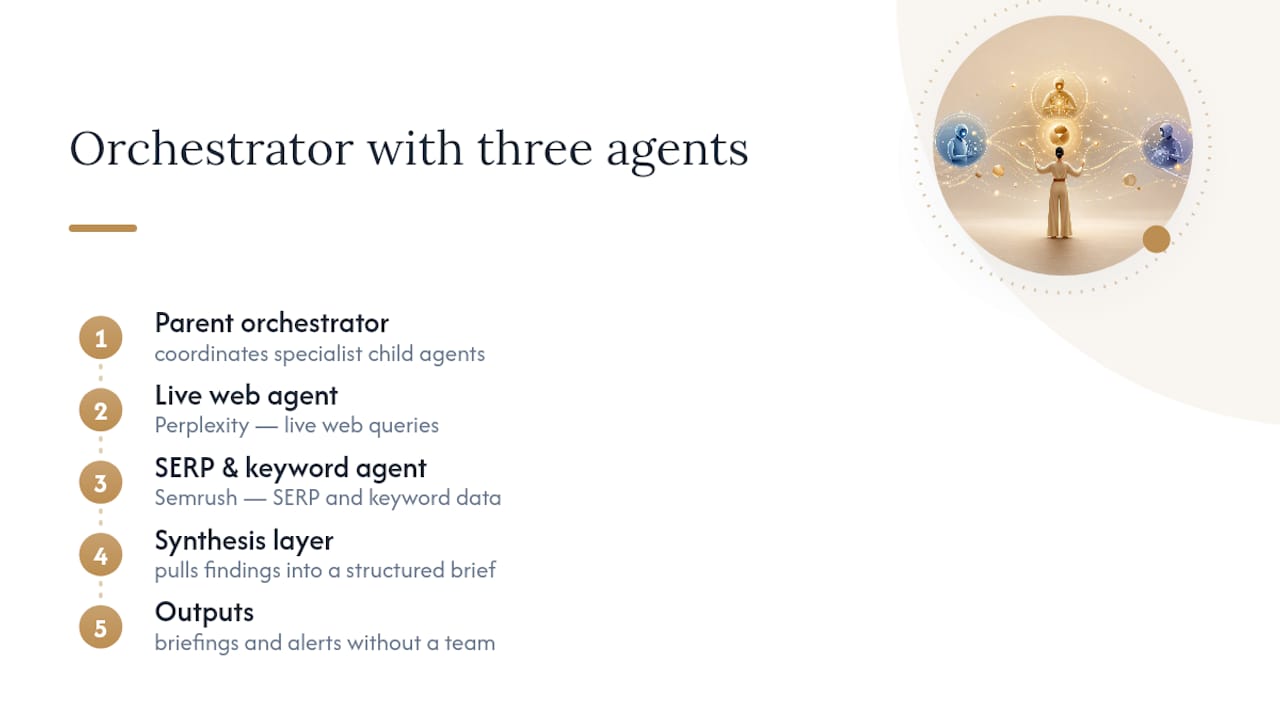
My practical setup runs three lightweight agents: one for live web queries (Perplexity), one for SERP and keyword data (Semrush), and one synthesis layer that pulls findings into a structured brief. A parent orchestrator with specialist child agents produces briefings and alerts without requiring a team. You don’t need six tools on day one. Pick one research job, time how long it takes manually, automate it, then measure what you get back.
For client-facing work, I switch to a grounded approach. Document-based tools like NotebookLM return citations to source passages, which reduces hallucination risk for client-safe answers. Live-web tools are faster; grounded tools are safer. Know which mode you’re in.
Pro Tip: Before acting on any AI output, cross-check the key claim against two live authoritative sources — BLS.gov, Census.gov, or BEA.gov for market figures, or a direct SERP check for competitor claims. Any factual claim in a client report without a source link gets flagged for manual verification.
For readers who want a reproducible, open-source workspace, the research-hub project connects Zotero, Obsidian, and NotebookLM into AI-operable pipelines with a CLI and REST API.
The faster path: skip the setup sprint
Assembling this stack from scratch takes time you may not have. The Yoursolobusiness AI Toolkit is built for exactly this situation: field-tested prompts, starter automations, and a recommended connector setup designed for one-person workflows.
You get a research checklist, pre-built automation templates, and a prompt library that covers market research, competitor monitoring, and content briefs. Most people have their first automation running within an afternoon. If you want the full solo automation playbook alongside it, that’s your next read. Start with the toolkit, run the first automation, and measure what it saves you.
Sources
The sources below are worth bookmarking as you build your stack.
- The Solo Founder’s Research Stack: How to Validate a Startup Idea Like a VC (Without the Team) | RiseMore Blog
- Build an AI Research Team for Solo Founders (2026)
- The Solopreneur’s Guide to NotebookLM: Turn Your Documents Into a Research Assistant That Knows Your Business in 2026 | AI Productivity Daily





[…] hours of work, and that’s the filter every resource on the site runs through. Pair it with the Best AI Research Tools guide if you’re still gathering proof points and benefits to ground your next sequence in […]