

Running a solo business often feels like spinning plates while juggling flaming torches. You wear every hat, from marketing guru to accountant to customer service rep, and the constant context switching leaves you exhausted and wondering if there’s a better way. The good news? There is. Structured business planning paired with smart productivity systems and early personal branding can transform your solo venture from chaotic hustle to sustainable growth engine in 2026.
Key Takeaways
| Point | Details |
|---|---|
| Structured planning increases success | Business planning raises solopreneur success rates by 30% through clear goal setting and resource allocation. |
| Project management tools boost organization | Digital tools like Trello and Asana improve task organization by 25%, reducing mental load. |
| Time-blocking drives completion rates | Implementing time-blocking techniques can boost task completion by 40% through focused work sessions. |
| Early branding increases engagement | Starting personal branding efforts early drives 60% stronger customer engagement and loyalty. |
| Quarterly reviews prevent neglect | Regular review sessions prevent 53% of planning neglect cases and keep strategies current. |
Prerequisites and Essential Tools
Before diving into your business plan, you need the right foundation. Success starts with mindset: you must commit to regular planning sessions, honest self-assessment, and willingness to adapt as market conditions shift. Basic business knowledge helps, but you don’t need an MBA to start.
Digital tools form the backbone of modern solopreneur operations. Project management platforms improve organization by 25%, freeing mental bandwidth for creative work. Consider these essential tools:
- Cloud storage for document access anywhere (Google Drive, Dropbox)
- Project management software to track tasks and deadlines (Trello, Asana, Notion)
- Time tracking apps to understand where hours actually go (Toggl, RescueTime)
- Accounting software for financial clarity (QuickBooks, FreshBooks)
- Social media scheduling tools for consistent presence (Buffer, Hootsuite)
Entrepreneur coaching increases planning success by 35%, providing accountability and expert guidance when you feel stuck. Whether you work with a coach or self-direct, commit to weekly planning blocks and monthly reviews.
Pro Tip: Use trial versions of project management tools before committing to annual subscriptions. Spend two weeks testing each platform with real tasks to find the interface that matches your workflow naturally.
Your solopreneur business planning checklist should include both digital tools and analog backup systems. Some entrepreneurs prefer paper planners for daily tasks while maintaining digital files for client work and finances. Find your balance, but prioritize systems that reduce friction rather than adding complexity. The business planning checklist for solopreneurs covers these essentials in detail, ensuring you don’t miss critical setup steps when creating your business strategy.
Step-by-Step Business Planning Process
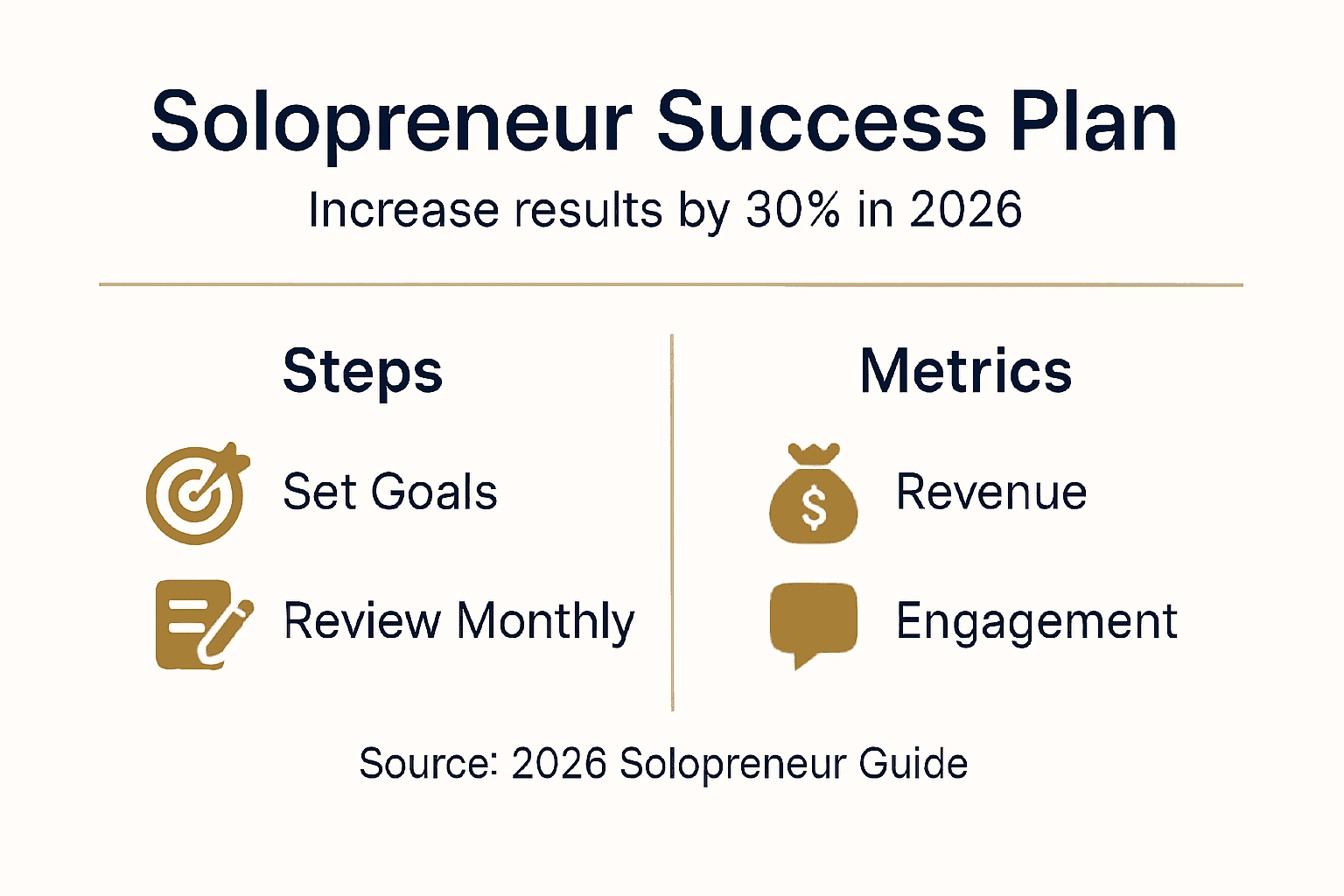
A solid business plan transforms vague ambitions into actionable roadmaps. Structured planning raises success chances by 30% because it forces clarity around goals, resources, and timelines. Follow these seven steps to build your custom plan:
- Define your vision and mission. Write one sentence describing where you want your business in three years, then articulate why this business exists beyond making money.
- Set SMART goals. Create specific, measurable, achievable, relevant, and time-bound objectives for revenue, audience size, and product launches in 2026.
- Identify your ideal customer. Build detailed profiles including demographics, pain points, online behavior, and purchasing triggers.
- Develop your personal brand foundation. Choose your core message, visual identity, and voice before creating content.
- Outline marketing and sales strategies. Select three primary channels where your customers spend time, then create content calendars and outreach plans.
- Project finances and set budgets. Estimate startup costs, monthly operating expenses, pricing structure, and break-even timeline.
- Schedule quarterly reviews. Block calendar time every 90 days to assess progress, adjust tactics, and celebrate wins.
Pro Tip: Set SMART goals using the format “Increase [specific metric] from [current number] to [target number] by [date] through [method].” This structure makes progress tracking simple and accountability automatic.
Integrate personal branding from step one rather than treating it as an afterthought. Your brand shapes how customers perceive your expertise and trustworthiness, directly impacting conversion rates. The 7 essential business planning steps provide templates and worksheets to streamline this process, while understanding the benefits of solo business planning keeps you motivated through the initial heavy lifting.
Your plan should live as a working document, not a PDF gathering digital dust. Update it monthly with actual numbers, quarterly with strategic pivots, and annually with major vision shifts. This iterative approach keeps your business responsive to market changes while maintaining strategic direction.
Productivity Optimization for Solopreneurs
Planning means nothing without execution, and execution demands productivity systems that work with your energy patterns instead of against them. Time-blocking can boost task completion by 40% by eliminating decision fatigue and protecting deep work sessions from constant interruptions.

Start by tracking one week of activity to identify your peak performance hours. Most people have 3-5 hours of high-focus capacity daily, use these windows for revenue-generating work like client projects, content creation, or strategic planning. Reserve low-energy periods for administrative tasks, email responses, and social media engagement.
Implement these core productivity techniques:
- Prioritize ruthlessly. Each morning, identify your top three must-complete tasks before checking email or social media.
- Batch similar tasks. Group all email responses into two 30-minute blocks, schedule all social media posts on Mondays, handle all invoicing on Fridays.
- Take strategic breaks. Work in 90-minute sprints followed by 15-minute complete disconnection to maintain mental stamina.
- Use your tools properly. Set up project templates in Asana or Trello so recurring tasks require one click instead of rebuilding from scratch.
- Protect boundaries fiercely. Communicate your availability clearly to clients, and turn off notifications outside working hours.
Over-commitment causes 70% of solopreneurs to experience burnout within their first two years. Saying no to opportunities that don’t align with your core business goals preserves energy for high-impact work. The productivity habits for solopreneurs guide offers detailed systems for maintaining sustainable output without sacrificing personal wellbeing.
Remember that productivity isn’t about cramming more tasks into each day. It’s about completing the right tasks efficiently so you build momentum toward your bigger vision. Review your productivity systems quarterly alongside your business plan to ensure they still serve your evolving needs.
Building and Integrating Personal Branding
Your personal brand determines whether potential customers choose you or your competitor when both offer similar services. Early branding efforts drive 60% stronger engagement because consistency builds recognition, and recognition builds trust over time.
Start with clarity about your unique value proposition. What specific problem do you solve better than anyone else? What experiences or perspectives do you bring that competitors lack? Your brand message should answer these questions in one clear sentence that resonates with your ideal customer’s deepest needs.
Execute your branding strategy through these fundamentals:
- Define your core message. Choose three main themes you’ll consistently discuss that showcase your expertise and values.
- Create cohesive visuals. Use the same color palette, fonts, and photo style across your website, social profiles, and marketing materials.
- Maintain social media consistency. Post on your primary platform at least three times weekly with content that educates, entertains, or inspires.
- Develop a content strategy. Plan quarterly themes, monthly topics, and weekly posts that position you as the go-to expert in your niche.
- Engage authentically. Respond to comments, join relevant conversations, and share others’ content generously to build community.
Authenticity matters more than polish. Customers connect with real people who share struggles, lessons learned, and behind-the-scenes glimpses into their business journey. Don’t wait until everything feels perfect to start building your presence. Your brand evolves as you grow, and early audience members become your most loyal advocates.
Building your personal brand on LinkedIn offers particular advantages for B2B solopreneurs, while Instagram and TikTok serve visual and creative businesses better. Choose platforms where your ideal customers already spend time rather than spreading yourself thin across every network. These personal branding tips for solopreneurs provide platform-specific strategies to maximize your impact.
Common Mistakes and How to Fix Them
Even experienced solopreneurs fall into predictable traps that slow growth and drain energy. More than 53% neglect quarterly plan updates, while 70% face burnout risk without proper productivity planning. Recognizing these patterns early prevents months of frustration.
The most damaging mistakes include:
- Skipping regular reviews. Fix: Schedule quarterly planning sessions as non-negotiable appointments, complete with location change and agenda to treat them seriously.
- Ignoring productivity systems. Fix: Implement time-blocking immediately, starting with just your three peak hours daily before expanding the system.
- Delaying personal branding. Fix: Create your brand foundation this week by defining your message, choosing your colors, and posting your first piece of educational content.
- Avoiding project management tools. Fix: Choose one platform today, migrate your current task list, and commit to logging everything there for 30 days to build the habit.
- Saying yes to everything. Fix: Develop a decision matrix based on your annual goals, revenue targets, and energy costs to evaluate each opportunity objectively.
Perfectionism paralyzes more solopreneurs than lack of knowledge. Your first business plan won’t be flawless, your initial branding will evolve, and your productivity system will need tweaking. Start with good enough, then iterate based on real results rather than waiting for perfect conditions that never arrive.
The essential steps to avoid common solopreneur mistakes include building accountability through coaching, peer groups, or public commitments. External accountability increases follow-through rates dramatically when internal motivation wanes during difficult seasons.
Alternative Business Planning Approaches and Tradeoffs
Not every solopreneur needs the same planning depth. Traditional comprehensive planning works for complex businesses with multiple revenue streams, significant startup capital, or plans to seek outside funding. Lean planning suits early-stage solopreneurs who need flexibility and speed over exhaustive detail.
| Criteria | Traditional Planning | Lean Planning |
|---|---|---|
| Upfront cost | High (40+ hours) | Low (8-12 hours) |
| Detail level | Comprehensive | Essential only |
| Adaptation speed | Slower (quarterly) | Faster (monthly) |
| Best for | Complex businesses | Early-stage ventures |
| Documentation | 20-40 page document | 1-2 page canvas |
Traditional planning requires deep market research, detailed financial projections, and comprehensive competitor analysis. This approach provides thorough roadmaps but demands significant time investment before launching. It reduces risk through extensive preparation but can delay market entry and limit pivoting ability.
Lean planning focuses on core assumptions, minimal viable products, and rapid testing. You create hypothesis statements about your customers and business model, then validate them through small experiments before committing major resources. This method reduces upfront costs by 40% and accelerates learning, but provides less detailed guidance for complex decisions.
Choose your approach based on three factors: available capital, time until you need revenue, and business complexity. Service-based solopreneurs with low overhead often thrive with lean methods, while product-based businesses requiring inventory investment benefit from traditional planning’s financial rigor. Many successful solopreneurs start lean, then deepen their planning as revenue and complexity grow. Explore alternative business planning approaches to find your best fit.
Expected Outcomes and Success Metrics
Clear metrics transform abstract goals into trackable progress. Within six to twelve months of implementing structured planning, productivity systems, and branding strategies, expect measurable improvements across multiple business dimensions.
| Metric | 3-Month Target | 6-Month Target | 12-Month Target | Measurement Method |
|---|---|---|---|---|
| Monthly revenue | 20% increase | 50% increase | 100% increase | Accounting software |
| Task completion rate | 30% improvement | 40% improvement | 50% improvement | Project management tool |
| Social media engagement | 25% increase | 60% increase | 100% increase | Platform analytics |
| Email list growth | 15% increase | 40% increase | 80% increase | Email marketing platform |
| Client satisfaction | 10% improvement | 20% improvement | 30% improvement | Survey responses |
Revenue growth varies by industry and starting point, but consistent application of business planning and productivity techniques typically produces 30% improvement in the first year. Your task completion rates should improve fastest, often showing 40% gains within three months as time-blocking and project management systems take effect.
Customer engagement metrics respond directly to personal branding consistency. Expect 60% increases in social media interactions, email open rates, and website traffic within six months of publishing regular educational content. These engagement improvements precede revenue growth, serving as leading indicators of future sales.
Quarterly reviews remain essential for tracking these metrics and adjusting strategies. Compare actual results against your projections, identify which tactics delivered the strongest ROI, and double down on what works while cutting activities that consistently underperform. Celebrate wins to maintain motivation through inevitable challenges.
Document your progress through before and after snapshots, customer testimonials, and revenue milestones. These tangible results validate your effort during difficult periods and provide social proof when marketing to new customers. Your success story becomes part of your personal brand, attracting opportunities and collaborations that accelerate growth further.
Empower Your Solo Business Growth with Our Tools and Resources
You’ve absorbed the framework, now it’s time to implement. Building a successful solo business requires more than knowledge; it demands action guided by proven systems and expert insights. Our comprehensive business planning checklist walks you through each decision point with templates that eliminate guesswork and reduce planning time by half.

Your personal brand serves as your business’s greatest asset in 2026 and beyond. Learn how to build your personal brand on LinkedIn with strategies that drive engagement without consuming your entire day. Our personal branding tips cover platform selection, content creation, and community building tactics tailored specifically for busy solopreneurs juggling multiple responsibilities. These resources transform overwhelming concepts into manageable weekly tasks that compound into significant visibility over time.
FAQ
What tools are best for managing a solopreneur business plan?
Project management platforms like Trello, Asana, or Notion work well for task tracking and deadline management. Pair these with accounting software like QuickBooks for financial clarity and Google Workspace for document collaboration. Choose tools that integrate with each other to reduce data entry and context switching.
How often should I review and update my business plan?
Quarterly reviews are essential for strategic adjustments, while monthly check-ins track progress toward short-term goals. Annual reviews reassess your overall vision and three-year targets. Schedule these as recurring calendar events to prevent the 53% neglect rate that undermines planning effectiveness.
Can personal branding really impact a solo business that much?
Yes, early branding efforts drive 60% stronger customer engagement by building recognition and trust before purchase decisions. Your brand differentiates you from competitors offering similar services and creates emotional connections that turn customers into advocates. Consistency matters more than perfection when starting.
What is time-blocking and how does it help productivity?
Time-blocking assigns specific tasks to dedicated calendar slots, eliminating constant decision-making about what to work on next. This technique boosts task completion by 40% because it protects deep work from interruptions and ensures high-priority projects receive your peak energy hours. Start by blocking your three most important tasks each morning.
How do I choose between traditional and lean business planning approaches?
Consider your available capital, time until you need revenue, and business complexity. Service-based solopreneurs with low overhead often succeed with lean methods that reduce upfront costs by 40%. Product businesses requiring inventory or significant equipment investment benefit from traditional planning’s detailed financial projections. You can start lean and deepen your planning as complexity grows.