
Affiliate links and a single digital product are the fastest, lowest-friction ways to start earning from your content. You can have your first revenue path live within a week using free or near-free tools.
Two first actions to take right now:
- Add one affiliate link to your most popular buying-intent page (Amazon Associates is the easiest entry point; direct SaaS programs often pay more)
- Create a $5–$30 digital checklist or template and list it for sale using a simple delivery platform
Your single first step: Pick one page on your site with clear buyer intent, add a relevant affiliate link, and submit it today. That’s it. One page, one link, under 60 minutes.
Platforms like Google AdSense, Amazon Associates, Patreon, Substack, and Buy Me a Coffee make it possible to make money online as a beginner solopreneur without a technical background. Yoursolobusiness has helped hundreds of solo operators build exactly this kind of lean, testable revenue stack.
What does ‘monetization’ actually mean, and how is it different from a revenue model?
Monetization is the tactical act of turning audience attention into money through specific mechanisms: ads, affiliate links, product sales, memberships, or tips. It answers the question, “How does this page or piece of content generate a dollar?”
A revenue model sits one level higher. It’s the strategic choice about how your business earns overall: recurring vs. one-time, high-margin vs. high-volume, direct vs. platform-mediated. Think of monetization as the engine and the revenue model as the blueprint for which engines you run and why.
Why does the distinction matter? Because beginners often mix up the two and end up spinning their wheels. They pick a revenue model (say, “subscriptions”) without first validating whether their audience will pay, or they bolt on ads everywhere without thinking about whether their traffic intent actually supports ad revenue. Getting clear on both levels saves you months of wasted effort.
One more thing you can’t skip: U.S. creators must report all online income to the IRS, regardless of the amount. Platforms like Google AdSense, Amazon Associates, Patreon, Substack, and Buy Me a Coffee will issue a 1099-NEC or 1099-K once you hit their reporting thresholds, and you’re required to disclose affiliate relationships under FTC guidelines. More on the legal basics in the sections below.
Core monetization methods: how each one works and which fits you
Content sites realistically monetize through three primary paths: display ads, affiliate links, and your own product. Sponsorships, memberships, tips, and licensing round out the picture. Here’s how each one works, who it fits, and what to expect.
Display advertising
You place ad code on your site and earn revenue based on impressions or clicks. Google AdSense is the standard entry point: create an account, paste a code snippet, and Google serves contextually relevant ads automatically. Setup takes a few hours, approval usually arrives within a few days to two weeks.
Pros: Passive, scales with traffic, no product to create.
Cons: Low RPMs at small scale; aggressive placement erodes reader trust; switching to a premium ad network at the right traffic threshold can increase revenue significantly, but those networks require a meaningful traffic baseline before they’ll work with you.
Affiliate marketing
You recommend a product, a reader clicks your link, and you earn a commission on the sale. Amazon Associates is the most accessible program for beginners. Direct SaaS affiliate programs (software tools, hosting, email platforms) typically pay higher recurring commissions and are worth pursuing once you know your niche.
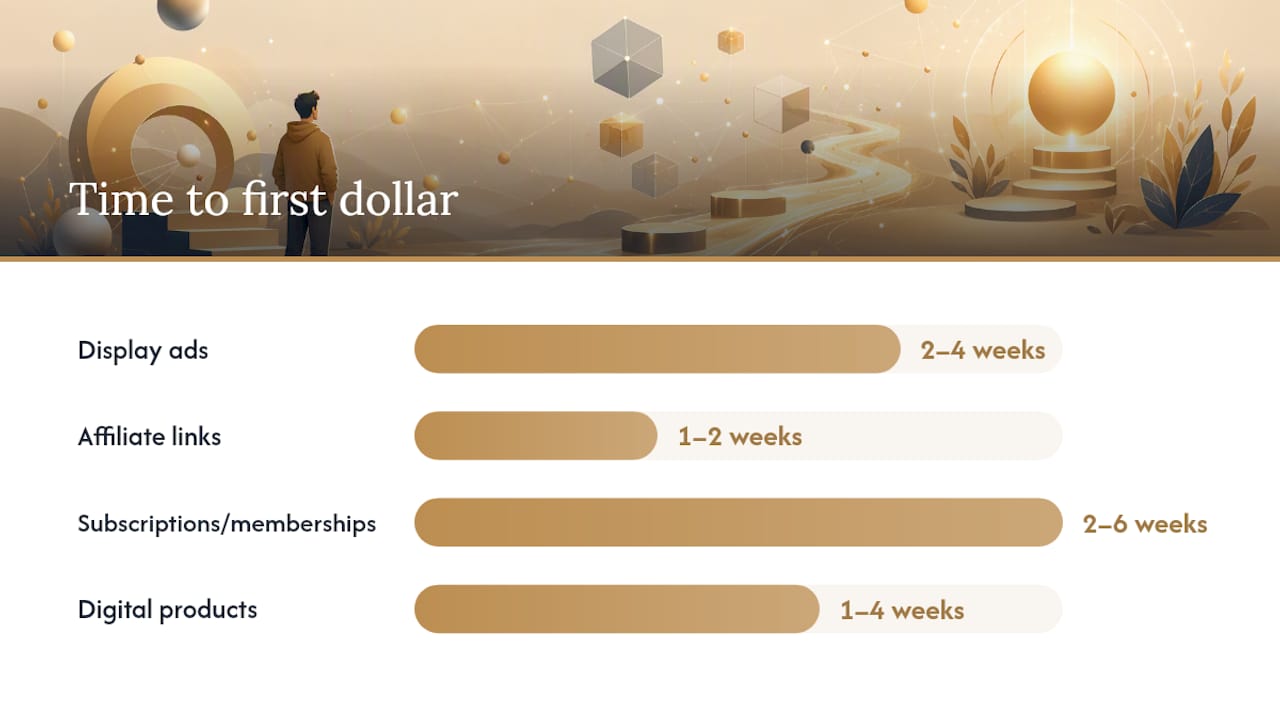
Affiliate marketing pays fastest for creators at any audience size because there’s no product to build and no traffic minimum to hit. The catch: it only converts well on pages with clear buyer intent.
Pros: Fast to first dollar, no inventory, scales with content volume.
Cons: Amazon’s physical-goods commissions are low; income depends on traffic quality, not just quantity.
Subscriptions and memberships
Platforms like Patreon and Substack let you offer exclusive content, community access, or early releases behind a paywall. Buy Me a Coffee sits in a lighter tier: it’s a tip-jar-plus-membership hybrid that works well for creators who want recurring support without a heavy content commitment.
Publishers are increasingly moving toward subscriptions and commerce media to reduce dependence on ad impressions. For a beginner, Substack is the easiest entry point for newsletter monetization; Patreon fits video and community creators better.
Pros: Predictable recurring income, direct audience relationship.
Cons: Requires consistent content output; churn is real if value delivery slips.
Digital products and services
Templates, checklists, mini-courses, and prompt libraries are high-margin and deliver automatically once set up. A $15 checklist that solves a specific problem can outsell a $197 course because the buyer’s commitment is lower. For a deeper look at building this out, the digital products guide for consultants on Yoursolobusiness walks through the full creation and delivery process.
Pros: High margin, no ongoing time cost after creation, scales without extra effort.
Cons: Requires upfront creation time; needs a validated audience problem to sell well.
Sponsorships and brand deals
Brands pay you to feature their product in your content. This works best once you have a defined niche and a consistent audience, even a small one. Micro-sponsorships (flat-fee newsletter placements, for example) are accessible earlier than most beginners realize.
Pros: High per-unit revenue, relationship-based.
Cons: Inconsistent, requires outreach, can feel transactional if not handled carefully.
Donations and tips
Buy Me a Coffee and similar platforms let readers support you directly with no subscription commitment. This works best for creators with a loyal, engaged audience who feel a personal connection to the creator’s work.
Pros: Zero friction to set up, no content obligation.
Cons: Unpredictable, rarely scales to meaningful income on its own.
Licensing and transaction fees
Less common for beginners, but worth knowing: you can license original content, photography, or tools to other publishers or platforms. Transaction fees apply if you build a marketplace or community platform.
Pros: Passive once licensed, high leverage on existing assets.
Cons: Requires established IP or audience; complex to set up.
Practical comparison at a glance
| Method | Best for | Setup effort | Time to first dollar | Startup cost | Income predictability | UX impact |
|---|---|---|---|---|---|---|
| Display ads | High-traffic informational content | Low | 2–4 weeks | $0 | Low (impression-based) | Medium (placement matters) |
| Affiliate links | Buyer-intent and comparison content | Low | 1–2 weeks | $0 | Medium (intent-driven) | Low if disclosed |
| Subscriptions/memberships | Loyal newsletter or community audiences | Medium | 2–6 weeks | $0–$20/mo | High (recurring) | Low |
| Digital products | Problem-aware, niche audiences | Medium | 1–4 weeks | $0–$50 | Medium-high | Low |
| Sponsorships | Niche audiences with clear demographics | High | 3–6 months | $0 | Low (deal-dependent) | Medium |
| Tips/donations | Engaged personal-brand audiences | Very low | Days | $0 | Very low | Very low |
How to choose the right monetization path for your audience
The fastest way to pick the wrong path is to ignore reader intent. Here’s a short decision framework that cuts through the noise.
-
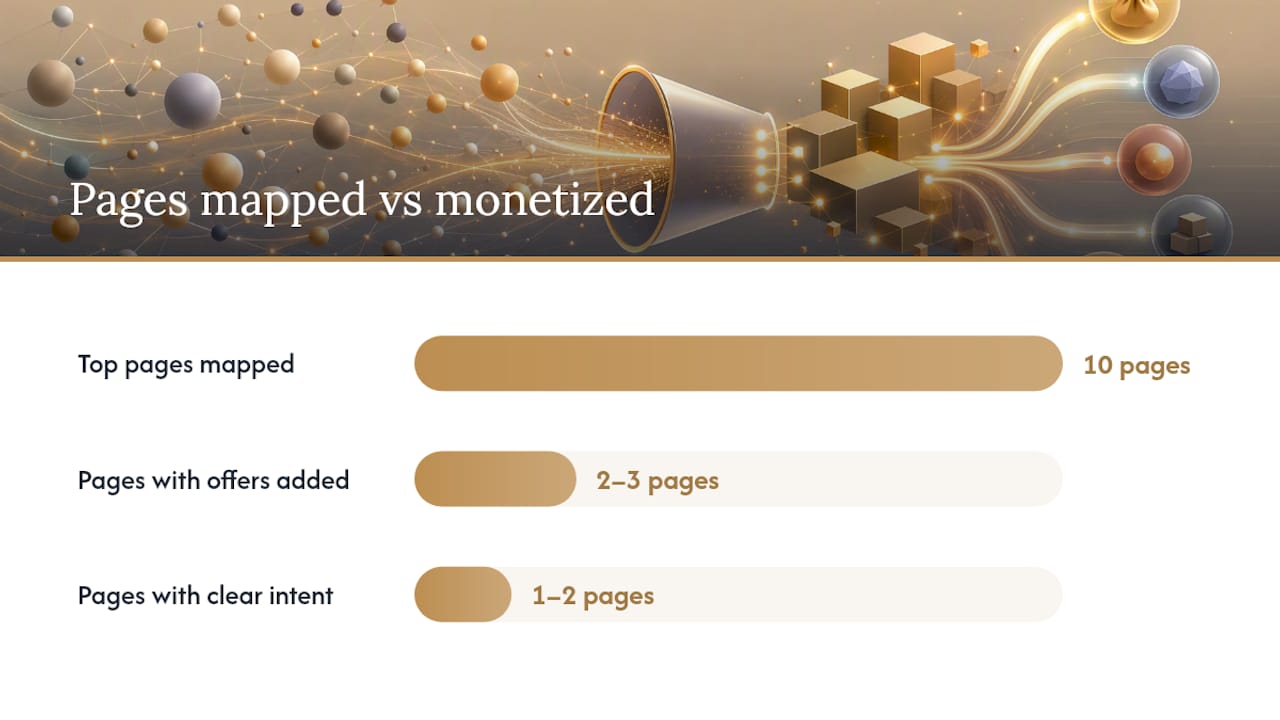
Pull your top 10–20 pages by traffic. Use Google Search Console or a basic analytics tool to find which pages actually get visitors. These are your monetization candidates.
-
Classify each page by intent. Informational pages (“how does X work?”) support display ads. Comparison and review pages (“best X for Y”) convert best with affiliate links. Problem-aware pages (“I need to solve X”) are where your own product or paid service belongs. Mapping your top articles by intent and matching monetization paths to that intent is the single most effective audit a beginner can run.
-
Pick one primary path to test first. Don’t split your attention across three models simultaneously. If most of your high-traffic pages are informational, start with AdSense. If you have comparison content, start with affiliates. If you have a specific problem you solve, build a $15–$30 product first.
-
Watch for the mismatch traps. Affiliate links buried in broad how-to posts rarely convert because the reader isn’t in buying mode. Ads on pages with fewer than a few hundred monthly visitors generate almost nothing and slow your site down. Match the mechanism to the intent, not to what’s easiest to set up.
-
Add a second stream only after you have a consistent signal. A reasonable rule of thumb: once you’re generating consistent income for three or more months from your primary path, you have enough data to layer in a complementary stream without losing focus.
Your 30/90/180-day plan to start earning
Realistic timelines matter. Most monetization strategies need three to six months of consistent effort before income becomes predictable, so the goal in the first 30 days isn’t to get rich. It’s to validate one path and measure it.
30-day sprint: validate and launch
- Audit your top 10 pages by intent (30 minutes, free with Google Search Console)
- Add one affiliate link to your highest buyer-intent page, or list one digital product priced at $5–$30
- Set up Google Analytics 4 (free) and a basic email capture form (free tiers available on most email platforms)
- Estimated cost: $0–$20
90-day plan: optimize and test a second element
- Review affiliate click-through rates and conversion data; swap underperforming links
- If your monthly sessions justify it, apply to Google AdSense (no hard minimum, but thin traffic produces negligible revenue) or evaluate whether a managed network makes sense for your volume
- Launch a small membership pilot on Substack or Buy Me a Coffee if you have an engaged email list
- Estimated cost: $0–$50/month
180-day scale: add a complementary stream
- Add a second revenue stream that complements your primary path (e.g., affiliate + digital product, or ads + newsletter sponsorship)
- Automate product delivery and affiliate tracking using simple tools
- Iterate pricing on any paid offering based on conversion data
- Estimated cost: $50–$150/month depending on tools
Timeline at a glance
| Period | Primary task | Estimated cost | Key metric to watch |
|---|---|---|---|
| Days 1–30 | Validate intent, add first affiliate link or product | $0–$20 | Affiliate CTR, page sessions |
| 30–90 days | Optimize conversions, consider AdSense or membership pilot | $0–$50/mo | RPM, email list growth, conversion rate |
| 90–180 days | Add second stream, automate delivery, iterate pricing | $50–$150/mo | Revenue per visitor, churn rate (if membership) |
Pro Tip: Before applying to any ad network, check your traffic source mix. Networks optimize on data, and a site with mostly direct or social traffic will underperform compared to one with strong organic search. Fix the traffic foundation first.
How to grow revenue while protecting reader trust
User experience is the primary constraint on monetization growth. Aggressive ad density or intrusive placements erode trust, and once a reader bounces, they rarely come back. The good news: a few simple rules protect both your earnings and your audience relationship.
The single most impactful rule: Keep your content the obvious main event. Ads and affiliate links should feel like helpful suggestions, not a tollbooth. Always disclose affiliate relationships with a clear, plain-language statement near the top of any page that contains them. The FTC requires this for U.S. creators, and readers actually trust disclosed recommendations more than hidden ones.
Practical UX rules to follow:
- Limit display ads to two or three placements per page; avoid interstitials and pop-ups that block content
- Place affiliate links within naturally relevant sentences, not in standalone “click here” blocks
- Label sponsored content clearly (“Sponsored” or “This post contains affiliate links”) at the top of the page
- Never sacrifice page speed for ad revenue; a slow page loses readers before they see any ad
Metrics to track:
- Bounce rate (high bounce on monetized pages signals UX friction)
- Average session duration (longer sessions mean more ad impressions and more affiliate exposure)
- Page speed / Core Web Vitals (use Google PageSpeed Insights, free)
- RPM (revenue per thousand impressions) for ad pages
- Affiliate CTR and conversion rate per page
Core Web Vitals now influence Google search rankings directly, so a slow, ad-heavy page doesn’t just annoy readers. It also loses organic traffic, which compounds the revenue problem. Prioritize fixing Largest Contentful Paint (LCP) and Cumulative Layout Shift (CLS) first; these have the most direct impact on both user experience and ad viewability.
Building a small, resilient monetization mix at every traffic stage
The goal isn’t to run every monetization model at once. It’s to run the right one for your current stage, then add a complementary stream once the economics justify it. Diversifying across ads, affiliates, and products protects you from algorithm and platform shocks that can wipe out a single-stream income overnight.
| Traffic stage | Primary path | Complementary path | When to move up |
|---|---|---|---|
| Under 10K monthly sessions | Affiliate links | One digital product ($5–$30) | When affiliate income is consistent for 2–3 months |
| 10K–50K monthly sessions | Affiliate links + AdSense | Email list + membership pilot | When ad RPM covers basic costs |
| 50K monthly sessions | Affiliate links + display ads | Sponsorships or paid community | When traffic is stable and niche is defined |
| 100K monthly sessions | Premium ad network + affiliates | Digital products + consulting | When RPM uplift from a managed network justifies the switch |
At the under-10K stage, ads are almost never worth the UX cost. Your time is better spent on one well-placed affiliate link than on setting up AdSense for a few dollars a month. At 50K sessions and above, managed header-bidding or premium networks can materially raise RPMs, but they need a real traffic profile to optimize against.
One caution: don’t hop between monetization paths every few weeks because results feel slow. Give each path a genuine three-to-six-month test before drawing conclusions. Most beginners quit affiliate marketing after a month of low clicks, not realizing that the pages they chose had informational intent, not buying intent. The path wasn’t wrong; the page selection was.
How a solopreneur built a simple stack and scaled it with AI tools
Here’s a replicable example of how this plays out in practice. A solopreneur starts with a content site in a specific niche: a handful of how-to articles, a small email list, and no product yet. The first move is simple: identify the two or three pages with the clearest buyer intent and add affiliate links to relevant SaaS tools. No ad network, no membership, no course. Just one revenue path, measured weekly.
Within the first 30–60 days, the data shows which pages convert and which don’t. The solopreneur then creates a single digital checklist solving the most common problem those converting pages address, prices it at $19, and delivers it automatically through a simple payment and delivery tool. Email capture on the highest-traffic pages feeds a short nurture sequence that promotes both the checklist and the affiliate links.
The tool categories that make this stack run without a team:
- Email capture and delivery: A free-tier email platform handles capture, sequences, and broadcast
- Payment and product delivery: A simple digital-product platform handles checkout and file delivery automatically
- Affiliate link management: A link management tool keeps affiliate URLs organized and trackable
- Analytics: Google Analytics 4 (free) plus Search Console for intent mapping
The replicable 3-step checklist:
- Step 1 — Validate intent: Map your top 10 pages by traffic, classify each by reader intent, and identify the one or two with the clearest buyer signal
- Step 2 — Publish a conversion-optimized page: Add a well-placed affiliate link or a simple product offer to those pages; write a clear, honest recommendation
- Step 3 — Automate delivery and measure: Set up automatic product delivery and a weekly check of your one key metric (affiliate CTR or product conversion rate)
What to expect: affiliate income typically starts small and grows as you add more buyer-intent content. A digital product at $15–$30 can generate its first sale within days if the page traffic is there. Consistent effort over three to six months is what separates the creators who build real income from those who give up too early. Yoursolobusiness’s resources on AI workflow automation show exactly how to remove the repetitive manual work from this stack so you can focus on content and conversion.
Key Takeaways
Start with one intent-matched monetization path, measure it for 30–90 days, and only add a second stream once your first produces consistent results.
| Point | Details |
|---|---|
| Match method to intent | Informational pages fit ads; comparison pages fit affiliates; problem-aware pages fit your own product. |
| Start with affiliates or a digital product | These are the fastest paths to a first dollar and require no traffic minimum to test. |
| Protect UX from day one | Limit ads to two or three placements per page and disclose all affiliate links clearly per FTC rules. |
| Diversify only after consistency | Add a second revenue stream once your primary path generates consistent income for two to three months. |
| Yoursolobusiness as your next step | Use Yoursolobusiness’s monetization strategies guide and AI toolkit to build and automate your stack. |
U.S. creators: all online income is taxable regardless of amount. Platforms issue 1099 forms at their reporting thresholds, but you owe tax on every dollar earned. Consult a tax professional or the IRS self-employment resources for your specific situation.
What beginners consistently get wrong about monetization
Most beginners treat monetization as something you add to a site after it’s “ready.” That framing costs months of income. The smarter move is to build with monetization intent from the first piece of content: choose topics with buyer intent, structure pages to support a recommendation, and capture email addresses from day one.
The other thing I see constantly is the urge to run every model simultaneously. Someone sets up AdSense, joins three affiliate programs, launches a Patreon, and lists a course, all in the first month. None of it gets enough attention to work, and the data is too scattered to learn from. Pick one path, run it hard for 90 days, and let the numbers tell you what to do next.
At Yoursolobusiness, the focus is on using AI tools to remove the friction from this process: automating email sequences, generating product outlines, tracking affiliate performance, and freeing up the hours you’d otherwise spend on repetitive tasks. A well-equipped solopreneur with the right systems can run a monetized content site at a level that used to require a small team. That’s not a promise; it’s what the tools actually make possible when you use them with intention.
One habit I’d recommend above all others: pick one conversion metric and check it every week, at the same time, without fail. Affiliate CTR, product conversion rate, email list growth rate. One number, tracked consistently, tells you more than a dashboard full of vanity metrics ever will.
Yoursolobusiness has the tools to help you implement this plan
If you’ve read this far, you have a clear picture of where to start. The gap between knowing and doing is usually a systems problem, not a motivation problem. That’s exactly what Yoursolobusiness is built to close.

The AI Toolkit on Yoursolobusiness gives you the practical stack to automate the repetitive parts of your monetization workflow: email sequences, content briefs, affiliate tracking setups, and product delivery. It’s built for solopreneurs who want to move fast without hiring help. Pair it with the free solopreneurship paths guide to clarify which monetization model fits your skills and audience before you build anything.
The next step is simple: visit the AI Toolkit, pick the one tool that matches your first 30-day task, and use it this week. Small, consistent actions compound faster than you’d expect.
Useful resources and next steps
These are the most authoritative starting points for each part of your monetization setup. Use them alongside the playbook above.
- 10 Proven Strategies for Monetization Without Complexity (MicroStartups): Practical setup notes for non-technical creators, including print-on-demand and marketplace delivery options.
- Content Site Monetization: Ads vs Affiliates vs Products (AI Tools Guidebook): The clearest breakdown of RPM ranges and intent-matching logic available for free; use it to build your page audit.
- Publisher Monetization Strategies Beyond Advertising (Stripe): Stripe’s guide to subscriptions, commerce media, and recurring payment mechanics for publishers.
- How to Monetize Your Website (Scott DeLong): A no-fluff, experience-backed guide from a publisher who has run large content sites; strong on RPM terminology and practical placement advice.
- 6 Monetization Strategies for Publishers and Content Creators (Playwire): Covers diversity of streams and user-experience balance from an ad-network perspective.
- How to Monetize Content as a Creator: 7 Revenue Streams (CreatorFlow): Maps seven revenue streams to speed-to-first-payout and minimum audience thresholds.
- Content Monetization Platforms for Creators (Thinkific): Compares platform fit by content type (newsletters, blogs, video) to help you pick the right home for your product or membership.
- Yoursolobusiness Monetization Strategies for Solopreneurs: The Yoursolobusiness primer on monetization models tailored to solo operators; the best starting point if you want a framework built for one-person businesses.
Measure your results every 30 days, compare against the metrics in the timeline table above, and adjust one variable at a time. That’s the whole system.