

TL;DR:
- Scaling without hiring involves replacing manual tasks with automation to grow revenue efficiently. Solopreneurs can leverage AI tools across key business layers to increase output, reduce costs, and prevent silent failures through proper documentation. Success requires understanding which tasks need human judgment and which can be automated, with systematized processes guiding sustainable growth.
Scaling without hiring is the process of growing your revenue and output by replacing repeatable manual tasks with automated systems, while keeping human effort focused on high-value judgment work. For solopreneurs and independent professionals, this is not a workaround. It is the growth model. AI-powered tools now save solo operators 8–12 hours weekly, replicating the output of multiple staff members at a fraction of the cost. The shift is real, and the playbook is clearer than ever.
How to scale without hiring: operational leverage explained
Operational leverage is the engine behind growing without adding staff. It measures how much revenue you generate relative to your headcount. Businesses with leverage above 2.0 scale revenue without proportional staffing increases. That means doubling output does not require doubling your payroll.

The 80/20 rule applies directly here. 20% of business activities drive 80% of results, while the remaining 80% create drag. Systematizing that critical 20% is what allows you to grow revenue two to three times before hiring becomes necessary. Most solopreneurs are doing the opposite: spending the majority of their time on low-impact volume work.
The four core layers where operational leverage lives are Acquisition, Conversion, Delivery, and Reporting. Think of these as the Decision Flow Engine of your business. Each layer contains repeatable processes that can be templated, automated, or systematized. When you replace repeated human judgment in these layers with rules and workflows, your output per hour increases without adding a single person.
Here is what that looks like in practice:
- Acquisition: Automated lead magnets, SEO content pipelines, and scheduled social publishing replace manual outreach.
- Conversion: CRM sequences and lead scoring replace manual follow-up emails.
- Delivery: Templates, SOPs, and AI-assisted drafts replace starting from scratch every time.
- Reporting: Automated dashboards replace manual data gathering and spreadsheet updates.
Pro Tip: Map your week in 30-minute blocks for one week. Anything you do more than three times that follows the same steps is a candidate for automation or templating.
What should you automate vs. keep human-led?
The decision rule is simple: would you hire a full-time person to do this task if budget were unlimited? If the answer is no, it is a process-true task. Automate it. If the answer is yes because it requires relationship, judgment, or nuance, it is a people-true task. Keep it human.
Human judgment is irreplaceable for complex negotiations, legal compliance, and relationship-led sales. AI excels at volume work like scheduling, triage, content drafts, and data entry. The line between the two is clearer than most solopreneurs realize.
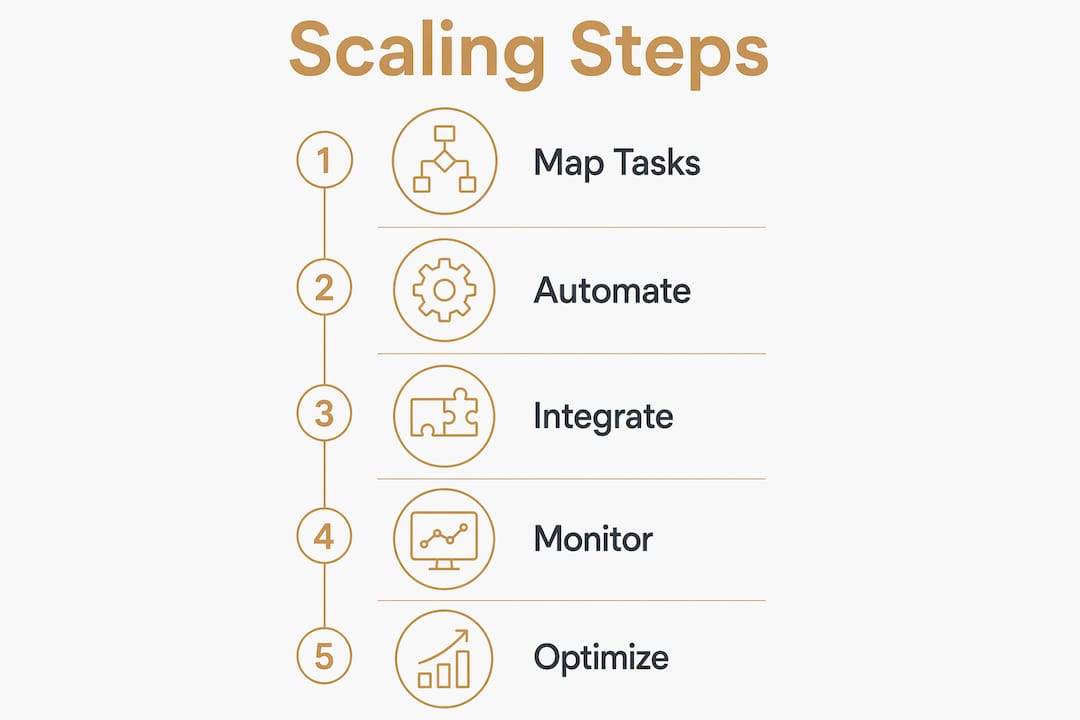
Here is a practical audit process you can run this week:
- Track your time for five days. Log every task in 15-minute increments. Note whether each task is volume-based or judgment-based.
- Categorize each task. Label it process-true (same steps every time) or people-true (requires your specific expertise or relationships).
- Identify your top five time drains. These are your first automation targets.
- Map the exact steps. Write out the process before you automate it. Vague workflows produce brittle automations.
- Define the success condition. What does “done correctly” look like? If you cannot answer this, the process is not ready to automate.
The most common mistake is skipping step four. Automating vague workflows fails every time. You need a precise, documented process before any tool can replicate it reliably. Think of it as writing a job description before you hire. The clearer the spec, the better the outcome.
Pro Tip: Create a simple two-column doc: “Process-True Tasks” and “People-True Tasks.” Review it monthly. As your business grows, some people-true tasks become process-true once you have done them enough times to see the pattern.
Which AI tools actually help solopreneurs grow without additional staff?
The cost difference alone makes the case. AI systems cost $50–$500 per month versus $60,000–$90,000 annually for a full-time hire with onboarding and overhead. That gap funds a lot of experimentation.
Here is a breakdown of the highest-impact automation categories for solopreneurs:
| Business Layer | What to Automate | Example Tools |
|---|---|---|
| Customer support | FAQ responses, ticket triage | AI chat tools, help desk platforms |
| Content creation | Draft generation, social scheduling | AI writing assistants, scheduling apps |
| Lead management | Scoring, follow-up sequences | CRM platforms with automation |
| Accounting | Invoicing, expense categorization | Accounting software with AI features |
| Reporting | Dashboard updates, performance summaries | Analytics integrations |
AI customer support tools can resolve up to 80% of tickets without human involvement. That is the equivalent output of a 10-person support team handled by a single automated system. For a solopreneur, that frees up hours every week for client work that actually moves the needle.
The key is integration. Individual tools running in silos create more management overhead, not less. The goal is a connected system where outputs from one tool feed automatically into the next. A lead captured through your website should flow into your CRM, trigger a follow-up sequence, and log activity in your reporting dashboard, all without you touching it. Yoursolobusiness covers this kind of one-person business setup in detail, including which tools connect well together.
Solo and two-person teams have reached over $1 million ARR by automating manual workflows with AI systems. That is not a fluke. It is what happens when you treat your business architecture as seriously as your client work.
What mistakes kill solo scaling efforts before they start?
The biggest mistake is hiring before you have systems. Hiring before product-market fit increases runway burn and raises your break-even point. Automation-first approaches preserve runway and reduce structural risk. Adding a person to a broken process does not fix the process. It just makes the broken process more expensive.
Watch for these warning signs:
- Flat revenue per head over multiple quarters. Flat or declining revenue per head signals a leverage problem, not a headcount problem. More staff will not fix it.
- Automating before documenting. If you cannot explain the process in writing, no tool can replicate it reliably.
- Ignoring audit trails. As you add AI agents to your workflow, you need a record of what each agent did, what data it touched, and where human review happened. Without this, errors compound silently.
- Treating fractional hires as a scaling strategy. Fractional and gig-economy talent solve immediate capacity gaps but do not replace system-level automation for sustainable growth.
Scaling without hiring means shifting from manual labor to an operationally leveraged model where humans supervise AI and automated workflows instead of doing volume work themselves. The solopreneur’s job is not to do the work. It is to design the system that does the work.
The governance piece is underrated. Build an automation registry: a simple log that records what each automated process does, when it runs, and what triggers a human review. This is not bureaucracy. It is the difference between a system you trust and one that quietly breaks while you are focused elsewhere. You can learn more about building systems for productivity at Yoursolobusiness.
Key Takeaways
Solopreneurs who scale without hiring do so by building operational leverage across four business layers, automating only well-defined process-true tasks, and using AI tools that cost a fraction of a full-time hire.
| Point | Details |
|---|---|
| Operational leverage is the foundation | Systems that grow revenue without growing headcount are the core of solo scaling. |
| Automate process-true tasks only | Document every step before automating; vague workflows produce unreliable results. |
| AI tools replace staff cost effectively | AI systems cost $50–$500 per month versus $60,000–$90,000 for a full-time hire. |
| Audit trails prevent silent failures | Log every automated process and define human review checkpoints to maintain accountability. |
| Revenue per head reveals leverage gaps | Flat revenue per head signals a systems problem, not a staffing shortage. |
Why I think most solopreneurs automate in the wrong order
Here is what I have seen over and over: solopreneurs get excited about a new AI tool, plug it into a messy workflow, and then wonder why it creates more problems than it solves. The tool is not the issue. The sequence is.
The work that actually moves your business forward is never the volume work. It is the thinking, the positioning, the client relationships, the decisions only you can make. Everything else is a candidate for a system. But you have to define what “everything else” looks like before you hand it off to automation.
I spent too long doing things manually because I told myself I needed to understand a process before I could systematize it. That part is true. What I got wrong was thinking “understanding it” meant doing it myself indefinitely. You understand it once, document it clearly, then build or buy a system to handle it. That is the shift.
The solopreneurs I see scaling well are not the ones with the most tools. They are the ones who treat their business planning process as seriously as their client delivery. They know their four layers. They know which tasks are people-true. And they protect that time fiercely.
AI agents are changing what is possible for a one-person business. But they work best when you are the architect, not the operator. Design the system. Supervise the output. Do the judgment work yourself. That is the whole game.
– Jay
Tools and resources to put this into practice
If you are ready to move from concept to action, Yoursolobusiness has the resources to get you there without spinning your wheels.

The productivity toolkit for solopreneurs pulls together seven proven strategies and ten tools specifically chosen for solo operators who want team-level output without team-level overhead. It is the practical companion to everything covered in this article. You will find tool recommendations, workflow templates, and implementation guidance built around the four-layer model. If you want a complete system rather than a collection of disconnected apps, that is the place to start.
FAQ
What does “scaling without hiring” actually mean?
Scaling without hiring means growing your revenue and output by automating repeatable tasks and building systems, rather than adding staff. The goal is to increase what you produce per hour, not the number of hours worked.
How much can AI tools really save a solopreneur?
AI-powered tools save solopreneurs 8–12 hours weekly and cost $50–$500 per month, compared to $60,000–$90,000 annually for a full-time hire. The savings compound quickly when tools are integrated across your core business layers.
What is the biggest mistake when trying to automate business processes?
Automating before documenting is the most common failure point. A process must be clearly mapped with defined steps and success conditions before any tool can replicate it reliably.
How do I know if I have a leverage problem vs. a capacity problem?
Flat or declining revenue per head over multiple quarters signals a leverage problem. Adding staff to a low-leverage business reduces margins. Fix the systems first, then evaluate whether hiring makes sense.
Can fractional hires replace automation for solo scaling?
Fractional talent solves short-term capacity gaps but does not create sustainable scaling. Long-term growth depends on integrating automation into your core business architecture, not on temporary human hires.