
Yes, invest in community — but only in the right kind, at the right time. The role of community for solopreneurs is not about attending every networking event or joining every Slack group. It’s about finding two or three relationships that sharpen your thinking, hold you accountable, and occasionally send you a referral. If you’re running an AI-first solo business, community handles the judgment calls that no prompt can replace.
Quick decision check:
- ✅ Invest in community if you’re stuck on pricing, positioning, or a decision that requires lived experience.
- ✅ Invest if you’ve been working in isolation for more than a month and your decisions feel untested.
- ⛔ Skip community (for now) if the problem is repetitive, mechanical, or scale-limited — that’s an automation job.
- ⛔ Skip if you’d be lurking passively in a large group with no clear reciprocity.
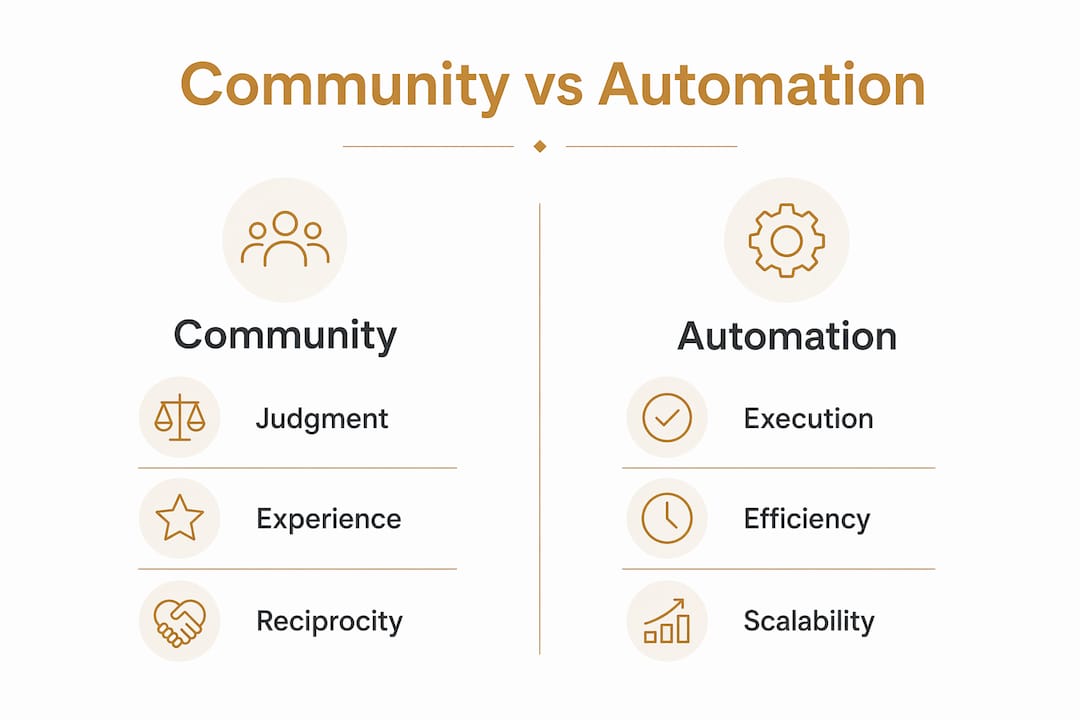
Your one-sentence rule: Use community for judgment; use AI for execution.
Pro Tip: Block one 60-minute peer call this week before you do anything else in this guide. That single slot will tell you more about what kind of community you need than any framework.
Why does community matter for one-person businesses?
Community is strategic infrastructure, not a nice-to-have. For more insight on turning community referrals into bookings, see these helpful practical business and sales resources. For solopreneurs, it delivers four things that directly affect business outcomes: feedback that pressure-tests your ideas, accountability that converts intention into follow-through, referrals that reduce cold-outreach grind, and emotional ballast that keeps burnout at bay.
Isolation is the default for a solopreneur. Research cited in practitioner coverage notes high rates of loneliness among freelancers, and that isolation quietly erodes creativity and decision quality long before it feels like a crisis.
The downstream effects are real. When you share a stuck point with a peer who’s been there, you compress weeks of trial-and-error into a single conversation. Regular sharing produces higher follow-through and better decisions — not because peers are smarter, but because articulating a problem out loud forces clarity you can’t manufacture alone.
The psychological signal that separates productive community from networking noise is simple: after a good interaction, you feel clearer and more motivated. After a bad one, you feel drained. Track that signal ruthlessly.
What kinds of communities actually deliver results for solos?
Not all community formats are equal. Here’s what each one actually produces:
- Small mastermind (3–6 peers): The highest-ROI format for most solos. Provides outside perspective, accountability, and the kind of frank feedback you’d get from a colleague. Works best when members are at a similar operational stage.
- Mentor lane (1-on-1 with a more experienced operator): High-value for specific decisions — pricing, positioning, a pivot. Lower frequency, higher signal. Learn more about integrating mentors into your support network.
- Niche online forums (Reddit, Circle, Slack communities): Good for ambient learning and occasional quick answers. Low accountability, high noise risk. Limit active involvement to one or two spaces where you can genuinely contribute.
- Local coworking and meetups: Reduces physical isolation and creates serendipitous connections. Not a substitute for structured peer accountability, but a valuable complement.
- Audience vs. community: Your newsletter subscribers or social followers are an audience, not a community. Conflating the two is a common trap — social channels support community but don’t replace it.
Generic entrepreneur groups are often the worst fit for solopreneurs because they lack understanding of one-person workflows. Small, stage-matched peer groups consistently outperform large, open-access ones.
When should you join a community vs. invest in AI/automation?
Prefer community when the problem requires human judgment, lived experience, or reciprocity. Prefer AI/automation when the problem is mechanistic, repetitive, or scale-limited.

| Problem type | Community | AI/Automation |
|---|---|---|
| Pricing strategy | ✅ Peer input essential | ❌ No lived context |
| Accountability | ✅ Human commitment | ❌ Bots don’t care |
| Invoicing, follow-ups | ❌ Overkill | ✅ Automate fully |
| Content repurposing | ❌ Inefficient | ✅ AI handles at scale |
| Positioning/messaging | ✅ Needs market feedback | ⚠️ AI drafts, humans validate |
| Emotional resilience | ✅ Irreplaceable | ❌ Not applicable |
Use this quick-score checklist to evaluate any real decision in under two minutes:
- Does this require someone who’s been through it? → Community
- Will I face this same problem weekly? → Automate
- Is the cost of a wrong decision high? → Community first
- Can I describe the task in a repeatable set of steps? → Automate
- Do I need someone to hold me to a commitment? → Community
Solopreneurs who treat community as recurring infrastructure — scheduling it like a business expense — report that it changes how solo work feels, not just how it performs.
Pro Tip: Run your weekly business review with one question: “Which stuck points this week needed a human, and which needed a better system?” That split tells you exactly where to invest next.
How do you choose or design a community that actually works?
Start with these selection criteria before you commit time to any group:
- Member stage alignment: Are they running businesses at a similar scale and complexity to yours?
- Reciprocity expectations: Does the group have a clear norm of give-and-take, or is it mostly one-way promotion?
- Meeting cadence: Consistent, scheduled meetings beat ad-hoc ones every time.
- Clear purpose: Can you describe what the group is for in one sentence?
- Facilitation style: Is there a structured agenda, or does it drift into venting sessions?
Red flags that predict networking noise:
- Constant pitching with no listening
- No agenda or rotating hot seat
- Membership that’s too broad (any entrepreneur welcome)
- Meetings that cancel more than twice in a row
- No shared commitment mechanism
Six pre-join questions to ask before committing:
- What does a typical meeting look like?
- How do members hold each other accountable?
- What’s the average tenure of active members?
- How are new members vetted?
- What’s the expected time commitment per week?
- Can I attend one session before joining?
If no suitable community exists, build your own. Recruit three to five peers at your stage, set a bi-weekly 60-minute call, agree on a simple agenda (wins, stuck points, commitments), and run it for eight weeks before evaluating.
Pro Tip: Coworking rhythms and scheduled one-on-ones create ambient contact that supplements peer groups — even one café work session per week reduces the isolation that quietly degrades your judgment.
How do you get real value without turning community into a time sink?
Show up with a specific ask, contribute first, and timebox your participation. That’s the whole playbook in one sentence.
Meeting-level agenda (60 minutes):
- Wins round (10 min) — one win per person, no elaboration
- Stuck points (20 min) — one person shares a real problem
- Hot seat (20 min) — group gives focused feedback
- Commitments (10 min) — each person states one action before next meeting
Templates to use immediately:
- DM request: “Hey [name], I’m working on [specific problem] and think your experience with [relevant area] would be useful. Could we do a 20-minute call this week?”
- Feedback request: “I’m testing [offer/message]. What’s your gut reaction — does this feel credible to someone in [target situation]?”
- Hot seat prep: “Here’s my situation: [context in 3 sentences]. Here’s what I’ve tried: [2–3 attempts]. Here’s the specific question: [one sentence].”
Rules for sustainable engagement:
- Limit active groups to two maximum
- Timebox community activity to 90 minutes per week
- Track ROI monthly: did a community interaction change a decision or generate a lead?
How do you build a micro-community from scratch in 8 weeks?
A reproducible 8-week schedule turns strangers into a high-ROI peer group. Here’s the blueprint:
- Weeks 1–2 (Recruit): Identify 4–5 peers at your stage. Reach out personally with a specific invitation. Use LinkedIn, niche forums, or existing one-on-ones as your starting pool.
- Week 3 (Onboard): Hold a 30-minute kickoff call. Agree on cadence (bi-weekly), format (agenda above), and a shared doc for commitments.
- Weeks 4–5 (First meetings): Run two structured sessions. Rotate the hot seat. Keep the agenda tight.
- Week 6 (Mid-check): Ask each member: “Is this worth your time?” Cut or replace members who aren’t contributing.
- Weeks 7–8 (Accountability and review): Add a commitment-tracking column to the shared doc. At week 8, vote: continue, adjust, or dissolve.
Tools that keep friction low: Google Calendar for recurring invites, a shared Google Doc for the agenda and commitments, and a simple group chat (Slack or WhatsApp) for between-meeting check-ins.
Success signals at week 4: Every member showed up to both meetings. At least one person changed a decision based on group feedback. At week 8: at least two members report a measurable business outcome (a new client, a pricing change, a dropped project).
Pro Tip: Treat the recurring meeting slot as immovable — schedule it like a client call, not a suggestion. Groups that reschedule casually dissolve within 60 days.
How do community feedback and AI workflows complement each other?
Use community for judgment; use AI for execution. That principle scales into concrete workflows.
Workflow 1: Positioning test → AI copy sprint
| Step | Who does it |
|---|---|
| Bring positioning question to mastermind hot seat | Community |
| Capture raw feedback and objections | You |
| Feed objections into AI prompt to draft landing page variants | AI (Claude, ChatGPT) |
| Share variants back with one peer for gut-check | Community |
| Publish and measure | AI analytics |
Workflow 2: Community FAQ → AI knowledge base
Collect the top five questions your peer group asks repeatedly. Feed them into an AI tool to draft an FAQ or knowledge base. Set up an AI agent (Zapier, Make) to auto-respond to those questions in your inbox or client portal. Review monthly with your peer group to update.
Tips for passing community learnings into automations:
- Tag feedback by theme (pricing, positioning, delivery) in your shared doc
- Version-control your prompts when community input changes your messaging
- Always keep a human approval gate before publishing AI-generated content that reflects community-sourced strategy
- Review automation outputs quarterly with a peer to catch drift
This loop, community insight feeding AI execution, is where scaling without hiring actually becomes practical rather than theoretical.
Key Takeaways
Community delivers the judgment calls that AI can’t replicate, but only when it’s small, structured, and scheduled as deliberately as any other business system.
| Point | Details |
|---|---|
| Use community for judgment | Pricing, positioning, and accountability need human lived experience — AI can’t substitute. |
| Limit active groups to two | Passive lurking creates false connection; active reciprocity in one or two groups beats ten passive memberships. |
| Schedule it like a business expense | A recurring, immovable meeting slot is what separates productive peer groups from ones that dissolve in 60 days. |
| Feed community insight into AI workflows | Use peer feedback to sharpen prompts and messaging, then let AI handle execution and scale. |
| Yoursolobusiness resources | The AI Toolkit and workflow automation guide pair directly with community-sourced strategy decisions. |
The part most solopreneurs get backwards
Here’s my honest take: most solopreneurs either over-invest in community (joining every group, attending every event, feeling busy but not moving forward) or under-invest entirely (going full-automation-hermit and wondering why their decisions feel shaky six months in).
The conventional wisdom says “build your network.” What it doesn’t say is that a network of 500 loose contacts is worth less than three peers who will tell you when your pricing is wrong. I’ve seen solopreneurs spend 10 hours a week in communities and get nothing measurable back, while others spend 90 minutes bi-weekly in a tight mastermind and close their best clients from referrals inside that group.
The AI-first model doesn’t eliminate the need for community. It raises the bar for what community has to deliver. When AI handles your invoicing, content repurposing, and follow-up sequences, the only reason to spend human time in a group is if that group is changing decisions and generating outcomes. If it’s not doing that, it’s just a more social version of spinning your wheels.
The personal branding work you do, the marketing strategies you test, the automations you build — all of them get sharper faster when a small, honest peer group is pressure-testing them. That’s the real role of community in a one-person business: not emotional support (though that matters), but a forcing function for better thinking.
AI tools and guides that pair with this approach
Running a tight peer community frees up mental bandwidth. Pairing that with the right AI systems is where the real leverage lives.

At Yoursolobusiness, the resources below are built specifically for solopreneurs who want both the human judgment layer and the automation layer working together:
- AI Toolkit: The curated stack Jay uses to run a one-person business at team-level output. Start here if you’re not sure which tools to automate with first.
- AI Workflow Automation Guide: Step-by-step workflows for replacing repetitive tasks — pairs directly with community-sourced strategy decisions.
- Scale Without Hiring Playbook: For solopreneurs ready to grow using community referrals and AI systems together.
Pick one resource, apply it to one workflow this week, and bring the results to your next peer call.
Sources and further reading
- Solopreneur community building: why connection is a competitive advantage — Practical framework for separating professional support from personal social needs; covers reciprocity and healthy community signals.
- How to build community as a solopreneur (beating isolation) — Covers mastermind design, scheduling community as infrastructure, and ambient contact tactics.
- Community for solopreneurs: career insurance (30-day plan) — Practical 30-day steps for building useful connections without turning it into a chore.
- 5 reasons why solopreneurs should build a community of partners — Fast Company coverage on loneliness among freelancers and community as mitigation.
- How to build community as a solopreneur — Fast Company practical guide on one-on-one relationships and finding peers on existing platforms.
- Success for solopreneurs who tap into community support networks — Forbes coverage on how peer networks and mentors drive solo business outcomes.