
Here’s the fastest way through this: nine sections, one task each, done in order. Executive summary last, market research first, financials in the middle once you know your numbers. A finished draft looks like a 10 to 20 page traditional plan or a one-page lean plan with worksheets linked behind it. Either one counts as done.
This checklist mirrors the structure the Small Business Administration recommends, and it works whether you’re chasing a bank loan or just trying to stop guessing about your own numbers.
- Company description: Write two paragraphs covering your mission, legal structure, and location.
- Products/services: Describe what you sell and the specific problem it solves, in three sentences.
- Market research: Pull one TAM/SAM/SOM estimate and profile three competitors.
- Marketing and sales plan: Pick two acquisition channels and set a target customer acquisition cost.
- Operations plan: List your suppliers, tools, and the three milestones that prove traction.
- Management and team: Note who does what, even if that’s just you for now.
- Financials: Build a 12-month monthly projection and calculate your break-even point.
- Funding request (if applicable): State the amount, the use of funds, and the milestones tied to each tranche.
- Executive summary: Write this last, once every other section is finished.
A completed draft is one you could hand to a banker, a co-founder, or your future self in six months and have it still make sense.
Pro Tip: Block three 90 minute sessions. Session one covers company description through operations. Session two is financials, because numbers take longer than you think. Session three is the executive summary, revision, and a gut check against your original goal.
Key Takeaways
A finished business plan follows a fixed sequence: market research and unit economics first, financials second, and the executive summary last, once every other section is locked.
| Point | Details |
|---|---|
| Finish the executive summary last | Write it only after every other section is complete, since it synthesizes the full plan. |
| Run your first 12-month projection | Build monthly revenue and expense estimates as part of preparing for funding requests. |
| Get an outside review | A SCORE mentor or trusted peer review catches gaps you can’t see in your own draft. |
| Set a revision trigger | Update the plan after every major milestone or whenever actuals diverge from projections. |
| Use the Yoursolobusiness workbook | The Solopreneur Business Planning Guide provides fill-in templates for every section in this checklist. |
How Do You Choose Between a Traditional and Lean Business Plan?
Pick a traditional plan when you’re asking someone else for money. Pick a lean plan when you’re the only person who needs to be convinced. That’s the entire decision tree, and most people overcomplicate it.
A traditional plan runs multiple pages and covers every section in detail, because banks and investors need to see the full picture before they write a check. A lean plan fits on a single page, built around assumptions you intend to test rather than promises you intend to keep. Shopify’s step-by-step framework treats the plan as a living document regardless of format, which matters more than which template you pick.
| Factor | Traditional plan | Lean plan |
|---|---|---|
| Purpose | Secure loans or outside investment | Internal roadmap, fast validation |
| Typical length | 10 to 20+ pages | One page |
| Audience | Bankers, investors, partners | Founder, small team |
| Level of detail | Full financials, appendix, market data | Key assumptions and next tests |
| Time to draft | 15 to 25 hours | 1 to 2 hours |
Here’s how that plays out in practice:
- A solopreneur validating a coaching offer before quitting a day job needs a lean plan, not a 20-page document nobody but them will ever read.
- A small retail business applying for an SBA-backed loan needs the traditional format, because the lender’s checklist requires financial projections, management bios, and market analysis in full.
- A freelancer pivoting to a productized service sits in between: start lean, expand sections into a traditional format only if a bank or investor asks.
Identifying your audience before you write a word saves you from over-building sections nobody will read or under-building the one section a loan officer actually flips to first.
What Belongs in a Business Plan Executive Summary?
Your executive summary should be concise and typically a couple of pages long, and you should write it dead last. That’s not a stylistic preference. The U.S. Chamber of Commerce notes that a summary has to synthesize the finished analysis from every other section, so writing it first means rewriting it twice.
The summary needs to hit four things, in this order:
- Business concept: what you sell and to whom, in two sentences.
- Target market: the size of the opportunity and why now.
- Traction or forecast: what’s already working, or what your 12-month projection shows.
- The ask: funding amount and use of funds, if this plan is going to a lender or investor.
Here’s a fill-in-the-blank starter you can build from once the rest of your plan exists:
“[Company name] provides [product/service] to [target customer], solving [specific problem]. The [market size] opportunity is growing because [trend]. In the first 12 months, we project [revenue/traction milestone]. We’re seeking [funding amount] to [use of funds], with [collateral or projected repayment terms].”
Tone shifts depending on who’s reading. Investors want growth and upside; write with energy and back it with numbers. Bankers want repayment certainty; lead with cash flow stability and collateral. If this plan never leaves your desk, skip the pitch tone entirely and write it like a memo to yourself.
Pro Tip: Read your executive summary out loud to someone outside your industry. If they can’t repeat back what you sell in one sentence, the summary isn’t done yet.
What Legal Structure and Company Details Should You Document?
Your company description needs to answer three questions: what are you, why do you exist, and where are you registered. Skip any of them and a lender’s first question becomes a delay instead of a formality.
Cover your mission in one or two sentences, your business model (how you actually make money), any relevant history, and your location. If you haven’t already recorded your NAICS code, do it now. It’s a small task with outsized payoff. It simplifies market benchmarking, insurance classification, and tax categorization down the line, and it’s one of those details that’s ten times easier to grab now than to reconstruct later.
Legal structure isn’t just a formality either. It changes your tax filing, your liability exposure, and how easily you can bring on a partner or investor.
| Structure | Best for | Planning implication |
|---|---|---|
| Sole proprietorship | Solopreneurs testing an idea | Simplest to set up, but no liability separation |
| LLC | Most solo and small businesses | Liability protection, flexible tax treatment |
| S corporation | Profitable solo businesses managing self-employment tax | Payroll requirements, stricter compliance |
| C corporation | Businesses raising venture capital | Double taxation, but standard for equity investors |
| Partnership | Two or more founders sharing ownership | Requires a clear partnership agreement up front |
If you’re a team of one, your “org chart” is a short list: your name, your role, and which tasks you outsource or automate. If you have partners or early hires, note who owns which function (sales, delivery, operations) so a reader isn’t left guessing who actually runs the business day to day.
How Do You Describe Your Product and Pricing Model?
Describe what you sell in terms of the problem it solves, not the features it has. A lender or investor doesn’t care that your app has a dashboard. They care that your dashboard saves a bookkeeper four hours a week.
Start with a short value-proposition template: “[Product/service] helps [customer] achieve [outcome] by [mechanism], unlike [alternative], which [limitation].” Fill that in and you’ve got a paragraph, not just a sentence.
Pricing model matters more than most first-time plan writers assume, because it drives every number in your financials section:
- Subscription pricing fits recurring-value offers like software, coaching retainers, or content memberships.
- One-time sale pricing fits products or projects with a clear delivery endpoint, like a website build or a physical good.
- Usage-based pricing fits offers where cost scales with consumption, common in API products or pay-per-project freelance work.
Once you’ve picked a model, run the unit economics before you write a single revenue projection:
- Price per unit: what the customer actually pays.
- Cost of goods sold: direct cost to deliver one unit.
- Gross margin: price minus COGS, as a percentage of price.
- Contribution margin: gross margin minus variable selling costs (ad spend, payment processing).
If your contribution margin is thin, no amount of marketing volume fixes that. Fix the pricing model before you fix the funnel.
How Do You Research Your Market and Competitors?
Estimate three numbers before you write a single sentence of market analysis: total addressable market (TAM), serviceable available market (SAM), and serviceable obtainable market (SOM). TAM is everyone who could theoretically buy what you sell. SAM narrows that to the segment you can actually reach given your location, channel, or niche. SOM is the realistic slice you could capture in year one or two.
You don’t need a market research firm to build these. Data gives you demographic and household-spending data to size your customer base. County Business Patterns shows you how many competing businesses already operate in your target geography, which helps you sanity-check whether your SOM estimate is realistic or wishful thinking. BEA’s consumer spending data rounds out the picture if you’re selling to consumers and need category-level spending trends to validate demand.
Trustworthy sources to pull from:
- data.census.gov for population and household income by zip code or metro area.
- Your NAICS code lookup, cross-referenced against County Business Patterns for local competitor counts.
- BEA consumer spending series for category-level demand trends.
- Direct competitor websites and pricing pages for positioning data you can’t get from government databases.
For competitors, build a simple matrix rather than a narrative. For each rival (labeled generically, like “Competitor A” or “low-cost alternative”), answer: What do they charge? What’s their core weakness? What’s their customer complaint pattern, based on public reviews? Three questions, answered honestly, beat two paragraphs of vague comparison every time.
Pro Tip: Search your top competitor’s name plus “reviews” or “complaints” before you write their row in the matrix. The gap between what they promise and what customers actually say is usually where your opening lives.
How Do You Build a Marketing and Sales Plan?
Pick two channels, not six. Most solopreneurs stall out trying to run a presence on every platform at once instead of getting good at one or two that actually convert.
Channel choice depends on your customer, not your comfort level:
- Content and SEO works well for high-consideration purchases where buyers research before deciding, but it’s slow, often three to six months before real traffic shows up.
- Paid social or search ads works for offers with a clear, immediate value proposition and gives you data fast, at the cost of ongoing spend.
- Direct outreach (email, LinkedIn, cold calls) works when your customer base is small and identifiable, which is common in B2B and high-ticket services.
- Referral and partnership channels work once you have even a handful of happy customers willing to vouch for you.
Two numbers matter more than any others in this section: customer acquisition cost (CAC) and lifetime value (LTV). If it costs you $150 to acquire a customer who pays you $600 over their lifetime, that’s a 4:1 ratio and a business that can scale. If it costs $150 to acquire a customer worth $180, you have a leak somewhere, and no amount of extra ad spend fixes a broken ratio.
A simple 90-day calendar to start testing:
- Days 1 to 30: Launch one channel, track CAC weekly, and set a spending cap you won’t exceed until you see conversion data.
- Days 31 to 60: Cut whatever isn’t converting, double down on whatever is, and add a second channel only once the first is stable.
- Days 61 to 90: Introduce a referral ask to your first paying customers and measure how much of your new volume comes from word of mouth.
How Do You Plan Operations, Management, and Milestones?
Operations is where plans go vague, and vague operations sections are exactly what makes a lender or investor nervous. List your actual suppliers, your fulfillment method, and the tools that keep the business running. If you rely on a single supplier for a critical input, name the backup plan, because “we have no backup plan” is a real risk a reader will notice even if you don’t say it out loud.
A supplier checklist worth running through:
- Who supplies your core input or platform, and what’s your contract term?
- What’s your fulfillment or delivery timeline, and where does it bottleneck under volume?
- Which software tools are mission critical, and what happens if one goes down for a day?
For a solopreneur, your team-roles template is short: your name against every function, with a note on what’s automated or outsourced. If you use contractors or a small team, list each person’s core responsibility rather than a job title, since responsibilities are what actually show up in a milestone timeline.
Speaking of milestones, use SMART criteria: specific, measurable, achievable, relevant, time-bound. “Grow the business” is not a milestone. “Sign 10 paying customers by month four” is. Each milestone should have a gating criterion, meaning a clear signal for whether you move forward, pivot, or stop. A growth roadmap built around these checkpoints keeps you honest about what “on track” actually means three months in.

How Do You Build Your Financials and a Funding Request?
Investors and bankers expect three things: a 12-month monthly projection, a 3 to 5 year annual forecast, and a break-even calculation. Skip any of the three and you’ll get asked for it in the first follow-up call.
Here’s a simplified monthly sketch you can copy into a spreadsheet and build out:
These are illustrative figures meant to show the format, not a benchmark for your industry. Build yours from your actual pricing model and cost structure.
Break-even math is simpler than it sounds: fixed costs divided by (price per unit minus variable cost per unit) tells you how many units you need to sell before you stop losing money. If your fixed monthly costs are $3,000 and each sale nets $50 after variable costs, you need 60 sales a month to break even.
If you’re requesting funding, structure it around three things: the exact amount, a use-of-funds breakdown (equipment, marketing, working capital), and milestone-linked tranches if the lender or investor prefers staged funding over a lump sum. Adjust your cost assumptions for inflation using the Consumer Price Index if your projections stretch past 12 months, and if debt financing is part of the plan, check current Federal Reserve interest rate releases so your interest assumptions aren’t pulled from thin air.
Pro Tip: Build your break-even number before your revenue projection, not after. It forces you to work backward from a realistic sales volume instead of picking a growth curve that looks good on a chart but has no basis in your actual funnel.
What Documents Belong in Your Business Plan Appendix?
The appendix is where supporting evidence lives so your main plan stays readable. Common items include founder and team resumes, signed contracts or letters of intent, intellectual property filings, detailed market research data you summarized in the body, and sample customer agreements if you have them.
Label every appendix item and cross-reference it from the section that mentions it. If your market research section cites a competitor pricing study, note “See Appendix C” right there in the text, so a reader isn’t flipping through 15 pages hunting for the source of a claim.
Before you share a draft with a potential investor or partner, consider whether any appendix content is sensitive enough to warrant a confidentiality agreement first. Detailed financials, proprietary processes, or unreleased product plans are exactly the kind of thing worth protecting with an NDA before they leave your hands.
Which Templates and Calculators Should You Use to Draft Faster?
You don’t need to build every worksheet from scratch. Three resources cover almost everything a first-time plan writer needs.
The SBA’s business plan guide includes both traditional and lean templates alongside startup-cost calculators, and it’s the closest thing to an industry-standard structure for U.S. founders. SCORE’s startup business plan template takes a more mentoring-oriented approach, with fillable worksheets that walk you through each section with prompts rather than blank pages. Shopify’s business plan resources round things out with sample plans you can study for tone and structure, particularly useful if you’re building a product-based business.
Use a startup-cost calculator early, before you draft financials, so your projections start from real numbers instead of guesses. Paste the output directly into your 12-month projection as your baseline operating expenses, then adjust monthly as you refine assumptions.
If you’re building a traditional plan, download the SBA’s full template. If you’re staying lean, SCORE’s worksheet format compresses cleanly into a one-pager. Match the resource to the format you picked in step one, not the other way around.
What Does a One-Page Lean Plan Look Like for a Solopreneur?
Here’s a lean plan you could realistically finish in an afternoon, built around the way solopreneurs actually validate ideas rather than the way a 20-page traditional plan assumes you will.
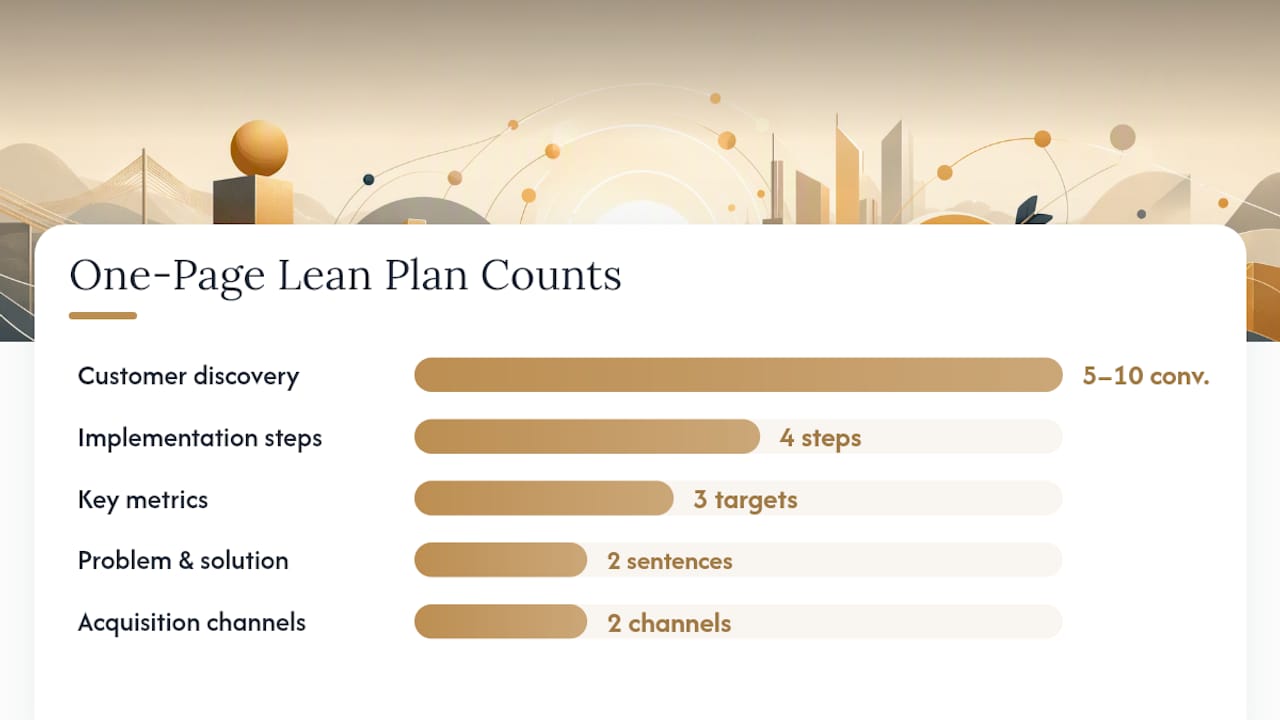
- Problem and solution: two sentences, no more.
- Target customer: one specific segment, not “everyone who needs X.”
- Revenue model: your pricing approach and expected price point.
- Key metrics: CAC target, break-even sales volume, and one traction milestone for 90 days out.
- Channels: the two acquisition channels you’re testing first.
- Costs: your monthly fixed costs and the sales volume needed to cover them.
The implementation sequence matters as much as the template itself. Start with customer discovery, meaning actual conversations with five to ten potential buyers before you finalize your offer. Move to a minimum viable offer, the leanest version of your product or service you can sell without building everything first. Test pricing against real buyers, not hypothetical ones, before you lock in a rate. Only then launch marketing at any real budget, once you know the offer converts.
AI tools speed up nearly every step here. Market research that used to take a week of manual digging can be compressed into an afternoon with the right prompts pointed at public data sources. Drafting your executive summary or company description goes faster with a structured prompt library instead of a blank page. Financial forecasting tools can build out projection scenarios in minutes once you’ve input your core assumptions. Yoursolobusiness’s step-by-step planning checklist maps directly onto this sequence if you want a printable version to work from.
Pro Tip: Don’t skip customer discovery to save time. A lean plan built on assumptions nobody tested is just a guess with a nice template around it.
What Mistakes Sink Most First-Draft Business Plans?
The executive summary written first is the single most common mistake, and it’s an easy one to catch because the summary always ends up vague or wrong once the rest of the plan changes underneath it.
Market research fails when founders skip TAM/SAM/SOM entirely and jump straight to a revenue number with no math behind it. A number without a method is a guess dressed up as a projection, and experienced readers spot that gap immediately.
Financials break down in three common ways: no break-even calculation, projections that assume linear growth with no seasonality or ramp-up period, and a funding request with no clear use-of-funds breakdown attached to it. A number without a plan for how it gets spent invites more questions, not fewer.
Operations sections often skip the failure case: no backup supplier, no answer for what happens if a key tool goes down. Marketing plans frequently list five or six channels with no prioritization, which usually means none of them get the attention needed to actually work. And appendix material gets forgotten entirely, then scrambled together the night before a meeting instead of built in from the start.
The fix for nearly all of these is the same: draft in the order this guide lays out, and don’t skip market research or unit economics just because the executive summary feels like the “real” starting point. It isn’t.
Why a Step-by-Step Plan Saved Me From a Mistake I Didn’t See Coming
I’ve watched more solo businesses stall from a fixable operations gap than from a bad product idea. The plan itself isn’t what saves you. What saves you is being forced to write down the supplier dependency, the break-even number, or the single acquisition channel you’re betting everything on, before that gap turns into a Tuesday-afternoon crisis.
The step-by-step order matters more than most people give it credit for. Skip straight to the executive summary and you write a story about a business you haven’t fully thought through yet. Build the plan section by section, in sequence, and the summary becomes a five-minute exercise in restating what you already know cold. That’s the whole trick. Not more effort. Different order.
The other thing worth saying plainly: a plan doesn’t need outside funding attached to it to be worth the hours. A solopreneur who never talks to a bank still benefits enormously from confronting their own break-even number on paper instead of finding it out three months into a cash crunch. That’s not a nice-to-have exercise. It’s the difference between a business that knows its own numbers and one that’s flying on vibes.
If there’s one place people cut corners that they shouldn’t, it’s the competitor matrix. Not because competitors decide your fate, but because writing down what a rival actually does badly, in plain language, is usually the fastest way to find your own opening. Most founders skip it because it feels like busywork. It’s the opposite.
Speed Up Your Draft With the Right Templates and Prompts
Every step in this guide gets faster with the right templates already built. The Solopreneur Business Planning Guide from Yoursolobusiness gives you fill-in-the-blank worksheets for every section covered here, from the executive summary starter to the break-even calculator, so you’re not building spreadsheets from scratch at midnight.

Three things in the guide directly cut drafting time. First, section-by-section templates that mirror the checklist you just read, so you copy your notes straight into a structured document instead of staring at a blank page. Second, a library of AI prompts built specifically for market research and financial forecasting, the two sections that eat the most hours in a typical draft. Third, worksheets for unit economics and CAC/LTV math, pre-built so you plug in your numbers instead of rebuilding formulas.
Pair the workbook with the AI Toolkit if you want to automate the research and drafting steps even further. Download the one-page lean plan template first if you want a quick win, then expand into the full guide once you know which sections need the most work.
Where to Find Reliable Data for Your Business Plan
Pull your industry classification from NAICS before anything else, since it feeds directly into benchmarking and insurance decisions later. Use data.census.gov for demographic and household-spending figures that support your TAM/SAM/SOM math, and County Business Patterns to estimate local competitor density. For cost projections that stretch beyond a year, check the Consumer Price Index to adjust for inflation, and if debt financing is part of your funding request, reference current Federal Reserve interest rate data for realistic borrowing assumptions.
When you cite any of these sources inside your plan, name the source and the date you pulled the data directly in the text or a footnote, since market figures shift and a reader will want to know how current your numbers are.
Frequently Asked Questions
How long does step by step business planning actually take?
A lean one-page plan takes one to two hours once you have your numbers ready. A full traditional plan with financials, market research, and an appendix typically takes 15 to 25 hours spread across several sessions.
What’s the very first section I should write?
Start with your company description and product/service section, not the executive summary. Save the summary for last since it depends on every other section being finished.
Do I need a business plan if I’m not seeking a loan or investors?
Yes. A written plan forces you to confront operational gaps, calculate a real break-even number, and set measurable milestones, even if no outside party ever reads it.
How often should I update my business plan?
Treat it as a living document. Revisit it after any major milestone, a significant shift in your numbers, or at minimum once a quarter, and revise projections based on actual results rather than your original guesses.
What’s the difference between a business plan and a pitch deck?
A business plan is a detailed written document covering every operational and financial detail. A pitch deck is a shorter, visual summary built for a live presentation, usually pulling its core numbers directly from the plan.
This article is general information, not a substitute for advice from a qualified financial advisor. Consult a qualified financial professional about your own circumstances before acting on anything here.
Sources
- Write your business plan | U.S. Small Business Administration
- NAICS – U.S. Census Bureau
- Consumer Price Index – Bureau of Labor Statistics





[…] A Step-by-Step Business Planning Checklist You Can Finish Today […]