
An AI content audit uses large language models to score every page in your library against a rubric you define, then hands you a prioritized retrofit roadmap sorted into keep, refresh, merge, or prune. The AI scales the scoring; you set the standard and check the risky calls. The result is a traffic-weighted action list you can start executing the same week.
TL;DR:
- AI content audits can quickly evaluate hundreds of pages against a defined rubric, providing structured scores and justifications for each page.
- The process works best with a hybrid approach, where AI handles scale and humans perform judgment on key pages and complex claims.
- Running full-library audits quarterly or after major business changes helps prevent content decay and keep your library current.
- AI excels at pattern matching tasks like voice consistency and structural checks but struggles with strategic judgment and factual accuracy without guidance.
- Using simple tools like Google Search Console and CMS exports, combined with a stable rubric and few-shot examples, allows solo owners to conduct effective, scalable content reviews.
How Does an AI Content Audit Differ From a Manual One?
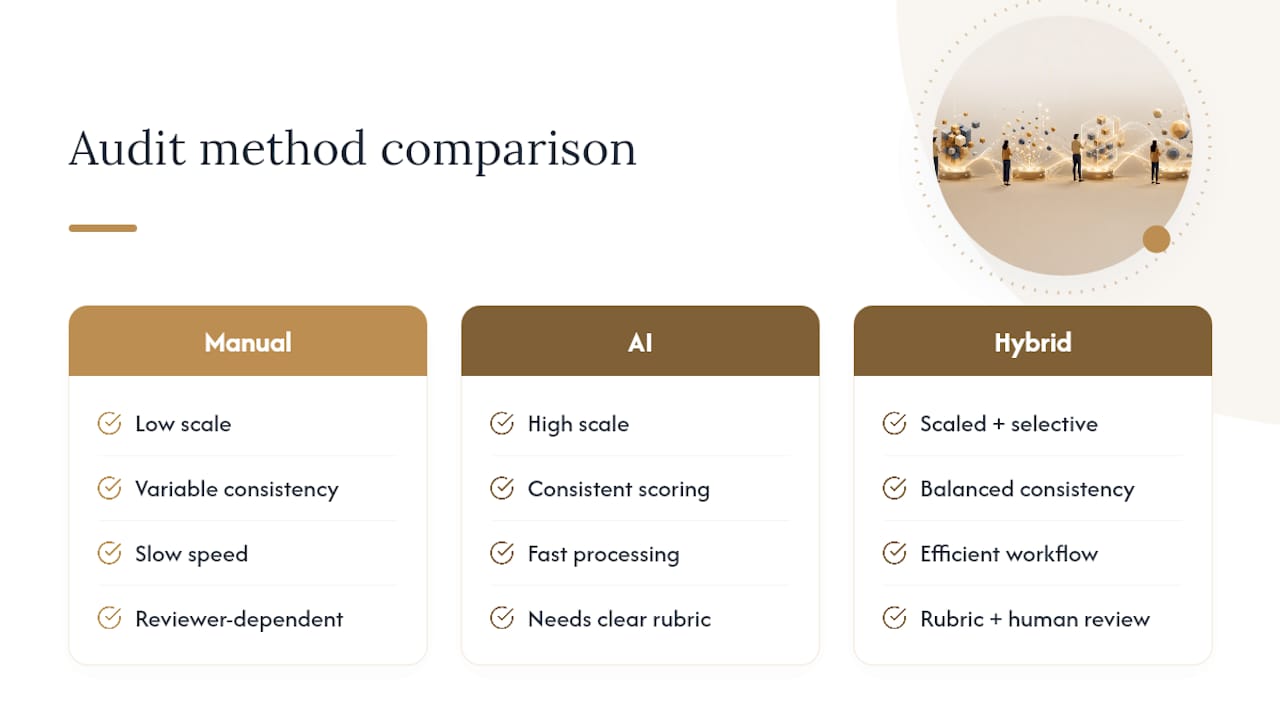
A traditional content audit means a human (usually you, at midnight, with a spreadsheet) reading every page and eyeballing quality, freshness, and keyword targeting. It works, but it does not scale. An AI content audit replaces that manual read-through with a large language model that applies a fixed rubric across hundreds of pages in one sitting, producing consistent, comparable scores instead of gut feelings that drift depending on how tired you are by page 40.
The output usually looks like structured data, not prose. A single row might read: voice fit: 3/5, AEO structure: 2/5, depth: 4/5, SEO health: 3/5, justification: “strong keyword coverage but no direct-answer block near the top.” That structure is the entire point. You cannot triage 300 blog posts on vibes, but you can sort 300 rows by score gap in about ten seconds.
Consistency is where this beats a human reviewer outright. A person’s judgment shifts with mood, caffeine, and how many pages they have already read that day. A model applying the same rubric to page one and page 300 does not get tired, though it does need a well-built rubric to avoid getting things systematically wrong instead. That is the trade you are making: less fatigue drift, more dependency on your instructions being right.
The smartest audits do not pick a side. They pair automated content analysis for scale with human review for judgment calls, because large language models can systematically evaluate a library against editorial and SEO criteria far faster than a person, but they still need someone to define what “good” means for your brand. Think of it as a hybrid model: AI does the first pass on everything, humans do the second pass on what matters most.
When Should You Run One, and How Wide Should It Go?
Run a full-library audit on a fixed schedule, and run a focused audit whenever something breaks. Both matter, and they solve different problems.
Cadence and triggers that justify an audit:
- A quarterly or twice-yearly full sweep, just to catch decay before it compounds
- A sudden traffic drop on a page or section that used to perform
- A rebrand, tone shift, or messaging pivot that makes old copy sound off
- A product launch or pricing change that makes existing pages factually stale
- A new competitor entering search results for your core terms
Comprehensive audits catch problems you did not know existed, buried deep in your archive. Their downside is time and token cost. Agent-driven audit platforms work well on a recurring schedule specifically because content decay is ongoing, not a one-time event you fix and forget.
A quick way to pick scope: if you have never audited before, go comprehensive once to build a baseline. After that, default to focused audits triggered by traffic or business changes, and save the full sweep for once or twice a year.
What AI Gets Right, and Where You Still Have to Step In
AI is genuinely strong at three things in a content audit: applying a rubric with zero fatigue, spotting voice drift between an old post and your current brand tone, and running structural checks for AEO, like whether a page has a clear direct-answer block near the top. These are pattern-matching tasks at scale, and pattern matching is what language models do well.
Where AI still struggles is anything that requires judgment beyond the pattern. It cannot reliably tell you whether a claim is strategically novel or just re-hashed conventional wisdom. It cannot fact-check a specialized claim in, say, tax law or clinical nutrition without real risk of confidently stating something wrong. And transformer-based models still need representative labeled examples to avoid overfitting when you ask them to judge something outside their training patterns, which is a technical way of saying: garbage examples in, garbage scores out.
The fix is not to avoid AI for these tasks. It is to build in checkpoints. Feed the model three to five few-shot examples of what a 5/5 page and a 2/5 page actually look like for your brand, and it will anchor its scoring far more accurately than if you just describe the rubric in the abstract. Then spot-check a sample of its output before you trust the full run.
Pro Tip: Write your few-shot examples from real pages you have already scored by hand. A model anchored on your actual best and worst content outperforms one anchored on a generic description of “good writing” almost every time.
The Six-Step Workflow: From Inventory to Action
This is the part that actually gets the audit done. Six steps, minimal tooling, and a time budget a solo owner can realistically fit into a few working days.
1. Build the inventory. Pull every URL from your sitemap, CMS export, or a manual CSV. Attach whatever metrics you can get next to each URL: organic traffic, last-modified date, conversions, and current word count. This spreadsheet is the backbone of the entire audit. Without traffic and freshness data attached, you are just scoring pages in a vacuum with no way to prioritize afterward.
2. Define the rubric. Pick five to seven criteria that actually matter for your content. A workable starting set: brand voice fit, AEO structure (does it answer the query directly and fast?), SEO health (keyword targeting, internal links, metadata), depth (does it actually cover the topic or skim it?), and conversion potential (does it move a reader toward an action?). Score each on a 1 to 5 scale. Then write three to five few-shot examples per criterion, pulled from real pages, showing what a 1 and a 5 look like.
3. Run the batch. Feed the model your rubric, your few-shot examples, and a batch of pages, and ask for structured output, ideally JSON with a numeric score per criterion plus a one-line justification for each. Watch your context window; most tools handle a handful of full articles per batch comfortably, so plan your batching around that limit rather than trying to force 50 pages into one prompt. A pragmatic audit workflow like this typically compresses what would be many human hours of manual review into a few days of setup and batch runs (https://www.mqlmagnet.com/post/ai-content-audit), plus the time you spend spot-checking.
**4. If the model’s scores mostly match your own judgment, you are in good shape. If you spot a pattern of disagreement, for instance, the model consistently rating thin pages too generously, go back and tune your few-shot examples or your rubric wording, then rerun that batch. This feedback loop is what separates a trustworthy audit from a rubber-stamped one.
5. Prioritize with a traffic weight. Once scores are validated, rank retrofit candidates by traffic-weighted score gaps so a low-scoring page getting 5,000 visits a month outranks a low-scoring page getting 50. Sort everything into four buckets:
- Keep — scores well, no action needed
- Refresh — good traffic, low score, worth the rewrite
- Merge — overlapping topic with another page, combine them
- Prune — low traffic, low score, not worth saving
6. Act on the roadmap. Convert the refresh list into drafts inside your CMS, starting with the highest traffic-weighted gaps first. Track the pages you touch so you can measure recovery afterward, whether that is a traffic lift, a ranking improvement, or a new appearance in an AI-generated answer.
Which Tools Actually Cover This Workflow?
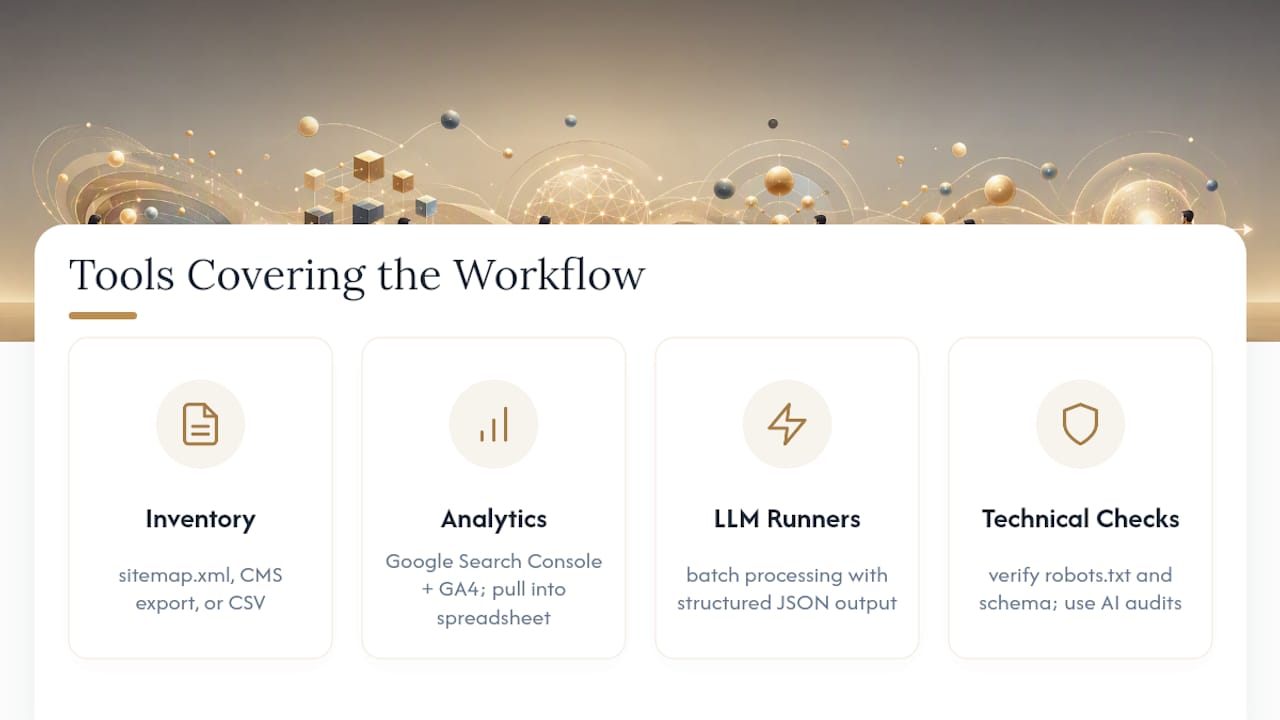
You do not need an enterprise martech stack to run this. A solo owner can cover every step above with four categories of tool, most of which have a usable free tier.
Inventory sources start with whatever you already have: a sitemap.xml export, a CMS content export, or a manually built CSV. Any of these works as your base spreadsheet, as long as it lists every URL.
Analytics connectors attach the traffic and conversion data your prioritization step depends on. Google Search Console gives you impressions and clicks per page; GA4 gives you sessions and conversion events. Pull both into your inventory spreadsheet before you run any scoring, because a rubric score without a traffic number attached is not actionable.
LLM runners and prompt platforms are where the actual scoring happens. Choose a platform that supports batch processing and structured JSON output so you are not copy-pasting scores out of chat responses by hand. Your Solo Business keeps a running list of AI research tools worth testing for this kind of work if you want a shortcut past the trial-and-error phase.
Technical checks round out the audit and matter more than most solo owners assume. Verify that GPTBot and ClaudeBot are not blocked in your robots.txt, and that your schema markup is intact(https://www.yotpo.com/blog/how-to-run-ai-content-audit/), because a routine site update can silently break structured data and quietly cut off AI-driven citations without ever showing up as a traditional ranking drop. Platforms built specifically for AI-readiness audits can score pages for answer-shape, freshness, and entity gaps and suggest fixes automatically, which is useful if you want a second pass beyond your own rubric. For the SEO layer underneath all of this, tools like Semrush’s Content Optimizer score both traditional ranking factors and AI-extraction signals side by side, and pairing that kind of tool with your AI rubric scoring rather than relying on either alone catches issues neither method finds solo. For a broader checklist covering visibility, UX, and lead generation together, this AI search optimization guide is worth a read before you finalize your rubric.
How Do You Know the Audit Actually Worked?
Track five numbers before and after your retrofit work: organic traffic recovered on refreshed pages, search impressions, click-through rate, conversions, and, where you can measure it, how often your brand gets cited in AI-generated answers for relevant queries.
A simple prioritization formula makes the “what to fix first” decision less subjective. Multiply the score gap (5 minus the page’s current average rubric score) by monthly traffic, then weight that by a conversion proxy, like the page’s historical conversion rate or its position in your funnel. A page scoring 2/5 with 8,000 monthly visits and a strong conversion history should outrank a page scoring 1/5 with 200 visits, every time.
For thresholds, set a short-term check at 60 to 90 days post-refresh, since search engines typically need weeks to fully re-crawl and re-rank updated content(https://www.mqlmagnet.com/post/ai-content-audit), and a long-term check at 6 months to see whether the traffic gain held or decayed again. If you want a deeper walkthrough of connecting these numbers back to your analytics setup, this guide on AI-driven content analytics covers the connector side in more detail.
Where to Find the Templates That Make This Faster
Your Solo Business keeps a working set of rubric templates, few-shot example libraries, and a retrofit tracking spreadsheet built specifically for solo content owners running this exact process, not an agency team with a dozen reviewers on standby.
Jay built the current version of these templates while running content audits on his own library, then refined the scoring criteria after seeing where the first draft rubric produced scores that did not match his own read of the pages. That kind of adjustment loop, tune the rubric, rerun the batch, is normal and expected, not a sign something went wrong. If you want the tools that pair well with this workflow, the research tools roundup lists the platforms best suited to batch scoring and prompt iteration.
Adapting the templates to your own business mostly means changing two things: swap in your own few-shot examples pulled from your best and worst real pages, and adjust the rubric weighting toward whatever your business actually optimizes for, whether that is lead generation, ad revenue, or affiliate clicks.
A Solo Founder’s Take on Running This for Real
Here is the uncomfortable truth about content audits: most solo owners avoid them because the word “audit” sounds like a multi-week project reserved for agencies with a team of five. It is not. The AI does the heavy lifting on volume. Your job is to spend your limited hours where they actually count, which is writing the rubric and checking the borderline scores, not reading every single page yourself.
The biggest shortcut is treating validation as a sample, not a full re-read.
The clearest win I have seen from this process is boring, which is exactly why it works: a batch of old “how to” posts scoring low on AEO structure got a direct-answer paragraph added near the top of each one, nothing else changed, and traffic on those pages climbed within two months of the refresh going live. No rewrite, no redesign, just a structural fix a rubric caught and a human confirmed made sense.
Start with the templates, trust the scores enough to act on them, and check your work often enough to trust it more next time.
— Jay
Ready to Run Your Own Audit? Start With the Right Tools
You do not need a content team or an enterprise SEO platform to run a proper audit. What you need is the right set of AI tools already vetted for this kind of batch scoring work, so you are not burning your first week testing five different platforms to find one that handles structured output well.

Your Solo Business keeps a running, tested list of the best AI research tools for solopreneurs, covering the exact platforms suited to rubric-based batch scoring, few-shot prompting, and structured JSON output, the categories this entire workflow depends on. Instead of guessing which LLM handles large batches well or which prompt tool supports the JSON output your prioritization step needs, you get a shortlist built from actually running this process. Check the list, pick a tool that fits your budget and batch size, and run your first inventory export this week.
Sources
- Challenges and opportunities for automated content analysis with transformer-based models
- How to Use AI to Audit Your Content Library ⎸ MQL Magnet
- Content Audit | Reaudit Docs
- Enhance Your Content and Rank Higher with Semrush Content Optimizer





Leave a Reply