

Running a solo business means juggling client work, marketing, finances, and operations all by yourself. Without structure, you drown in tasks and lose precious hours to chaos. A proven productivity workflow transforms overwhelm into momentum, helping you complete tasks 30% faster while protecting your sanity and personal time.
Key takeaways
| Point | Details |
|---|---|
| Structured workflows boost efficiency | Time-blocking and prioritization reduce task completion time by up to 30% within three months. |
| Prerequisites matter | Essential digital tools, focused mindset, and dedicated workspace enable consistent workflow execution. |
| Automation saves hours | Automating repetitive tasks reclaims up to 10 hours weekly for strategic business growth. |
| Avoid multitasking | Single-tasking improves productivity while multitasking reduces output by 40%. |
| Track and adjust regularly | Weekly metrics review identifies bottlenecks and increases workflow efficiency by 20%. |
Introduction to solopreneur productivity workflows
A solopreneur productivity workflow is your personalized system for managing tasks, time, and energy without a team. It combines strategic planning, focused execution, and regular review to keep your business moving forward.
You face unique challenges other business owners don’t. You’re the CEO, marketer, accountant, and customer service rep all at once. Distractions pile up. Priorities blur. Without clear processes, you spend entire days busy but accomplish little that actually grows your business.
Implementing a structured workflow delivers measurable benefits:
- Streamlined daily operations that reduce decision fatigue
- Clear priorities that eliminate time wasted on low-impact tasks
- Protected focus time for deep work on revenue-generating activities
- Improved work-life boundaries that prevent burnout
- Consistent progress toward business goals
These productivity tips for solopreneurs form the foundation of sustainable solo business success. The right workflow adapts to your business type while maintaining structure that keeps you accountable.
Prerequisites: tools, mindset, and conditions you need
Before building your workflow, gather essential tools and create conditions for success. Half-baked preparation leads to abandoned systems.
Your digital toolkit should include:
- Calendar app for time-blocking and appointment management
- Task manager to capture and organize all work items
- Communication platform for client interactions
- Cloud storage for document access anywhere
- Password manager for security without friction
Explore comprehensive options in this productivity toolkit for solopreneurs to match tools with your specific business needs.
| Tool Category | Purpose | Impact |
|---|---|---|
| Calendar | Visual schedule and time boundaries | Reduces overcommitment by 40% |
| Task Manager | Centralized work capture and priorities | Eliminates forgotten tasks |
| Automation | Handles repetitive administrative work | Saves 8-10 hours weekly |
| Communication | Streamlines client interactions | Reduces response time |
Your mindset matters as much as your tools. You need discipline to follow your workflow even when motivation dips. Flexibility helps you adapt when unexpected issues arise. Trust in your system prevents constant second-guessing.
Your workspace directly impacts focus. Create a dedicated area free from household distractions. Good lighting reduces eye strain during long work sessions. Comfortable seating supports extended focus periods. When starting your solopreneur journey, workspace setup often gets overlooked but profoundly affects daily productivity.

Pro Tip: Test tools for one week before committing. Free trials reveal whether features match your actual workflow needs.
Step-by-step productivity workflow for solopreneurs
Implement these proven steps to build momentum and maintain consistency. Each step addresses specific productivity challenges solopreneurs face.
-
Set up your core tools and workspace. Install your chosen calendar, task manager, and communication apps. Configure your workspace for minimal distractions. This foundation takes 2-3 hours but enables everything that follows.
-
Create daily time blocks aligned with energy levels. Schedule your most challenging work during peak energy hours. Block 90-minute focus sessions with 15-minute breaks. Morning hours often work best for strategic thinking and creative work. Reserve low-energy afternoon periods for administrative tasks and emails.
-
Prioritize tasks using proven frameworks. Using task prioritization methods such as the Eisenhower Matrix helps reduce decision fatigue and improves task completion rates by 25%. Sort tasks into urgent/important, important/not urgent, urgent/not important, and neither categories. Focus your best hours on important work that moves your business forward.
-
Automate repetitive administrative tasks. Set up email filters, automated invoicing, scheduled social posts, and template responses. Initial setup requires 5-10 hours but reclaims that time within two weeks. These productivity tips help identify automation opportunities you’re missing.
| Workflow Step | Time Investment | Productivity Gain |
|---|---|---|
| Tool Setup | 2-3 hours | Foundation for all gains |
| Daily Time-blocking | 15 min/day | 30% faster task completion |
| Task Prioritization | 10 min/day | Eliminates 40% of low-value work |
| Automation Setup | 5-10 hours | Saves 8-10 hours weekly |
| Weekly Review | 30 min/week | 20% efficiency improvement |
-
Implement weekly themes for sustained focus. Dedicate Mondays to planning and client outreach. Use Tuesdays and Wednesdays for deep work on core services. Reserve Thursdays for content creation and marketing. Handle administrative tasks and reviews on Fridays. This structure reduces context switching that kills productivity.
-
Track productivity metrics and adjust weekly. Measure tasks completed, time spent per project type, and revenue per hour worked. Review these numbers every Friday. Identify patterns showing what works and what drains time without results. Adopt daily habits to boost productivity based on your unique metrics.
Pro Tip: Use weekly review questions to systematically evaluate what’s working and what needs adjustment in your workflow.
Common mistakes and how to avoid them
Even with solid systems, solopreneurs fall into predictable traps that sabotage productivity. Recognize these patterns early.
Multitasking destroys your output. Research shows it reduces productivity by 40% compared to single-task focus. When you split attention between email, client work, and social media, you complete everything slower and with more errors. Block distractions during focus sessions. Close email. Silence phone notifications. Single-task your way to better results.
Neglecting work-life boundaries leads straight to burnout. Without a boss or coworkers, you easily work evenings and weekends. Set firm stop times. Create shutdown rituals that signal your workday ends. Protect personal time as fiercely as client commitments. These productivity tips for solopreneurs emphasize sustainable pacing over hustle culture burnout.
Your workflow should serve your life, not consume it. Productivity without boundaries isn’t success; it’s a recipe for burning out and resenting your business.
Skipping productivity tracking leaves you blind to problems. You can’t improve what you don’t measure. Spend 30 minutes weekly reviewing completed tasks, time logs, and revenue generated. Notice which activities produce results and which just feel busy. Cut or delegate low-value work ruthlessly.
Resisting workflow adjustments when something isn’t working wastes months. Your first workflow won’t be perfect. Test changes for two weeks, then evaluate results. Adapt based on data, not feelings. Flexibility within structure beats rigid adherence to broken systems.
Pro Tip: Schedule monthly workflow audits to catch subtle inefficiencies before they become ingrained habits.
Alternative approaches and tradeoffs
No single workflow fits every solopreneur. Evaluate these alternatives based on your business type and working style.
Manual workflows give you complete control but consume significant time. You physically manage every task, schedule, and follow-up. This works for simple businesses with few moving parts. Automation requires upfront investment learning tools and building systems. It saves massive time long-term but demands patience during setup. Most solopreneurs benefit from hybrid approaches automating repetitive tasks while manually handling strategic decisions.
Time-blocking provides structured focus sessions but can feel rigid when unexpected issues arise. You assign specific tasks to calendar blocks throughout your day. This prevents scattered attention but requires discipline to respect your schedule. Flexible scheduling offers freedom to work when inspiration strikes but risks procrastination without external accountability.
| Approach | Best For | Tradeoff |
|---|---|---|
| Manual Workflow | Simple businesses, few clients | Time-intensive, hard to scale |
| Heavy Automation | Repetitive tasks, many clients | Setup time, ongoing maintenance |
| Rigid Time-blocking | Easily distracted, need structure | Less flexibility for surprises |
| Flexible Scheduling | Creative work, variable energy | Requires strong self-discipline |
| Hybrid System | Most solopreneurs | Balanced complexity |
Your tool choices depend on business complexity. Freelance writers need simple task managers and invoicing. E-commerce solopreneurs require inventory management and email automation. Consultants benefit from CRM systems and proposal templates. Match tools to actual needs rather than aspirational complexity. When developing your business strategy for solopreneurs, workflow decisions directly impact execution capacity.
Consider your natural working style. Morning people should schedule deep work early. Night owls can shift focus sessions to evenings. Respect your energy patterns rather than forcing productivity during low-energy hours. Your workflow should enhance your strengths, not fight your biology.
Expected results and measurable outcomes
Implementing a structured productivity workflow delivers concrete improvements you can measure. Set realistic expectations about timelines and gains.
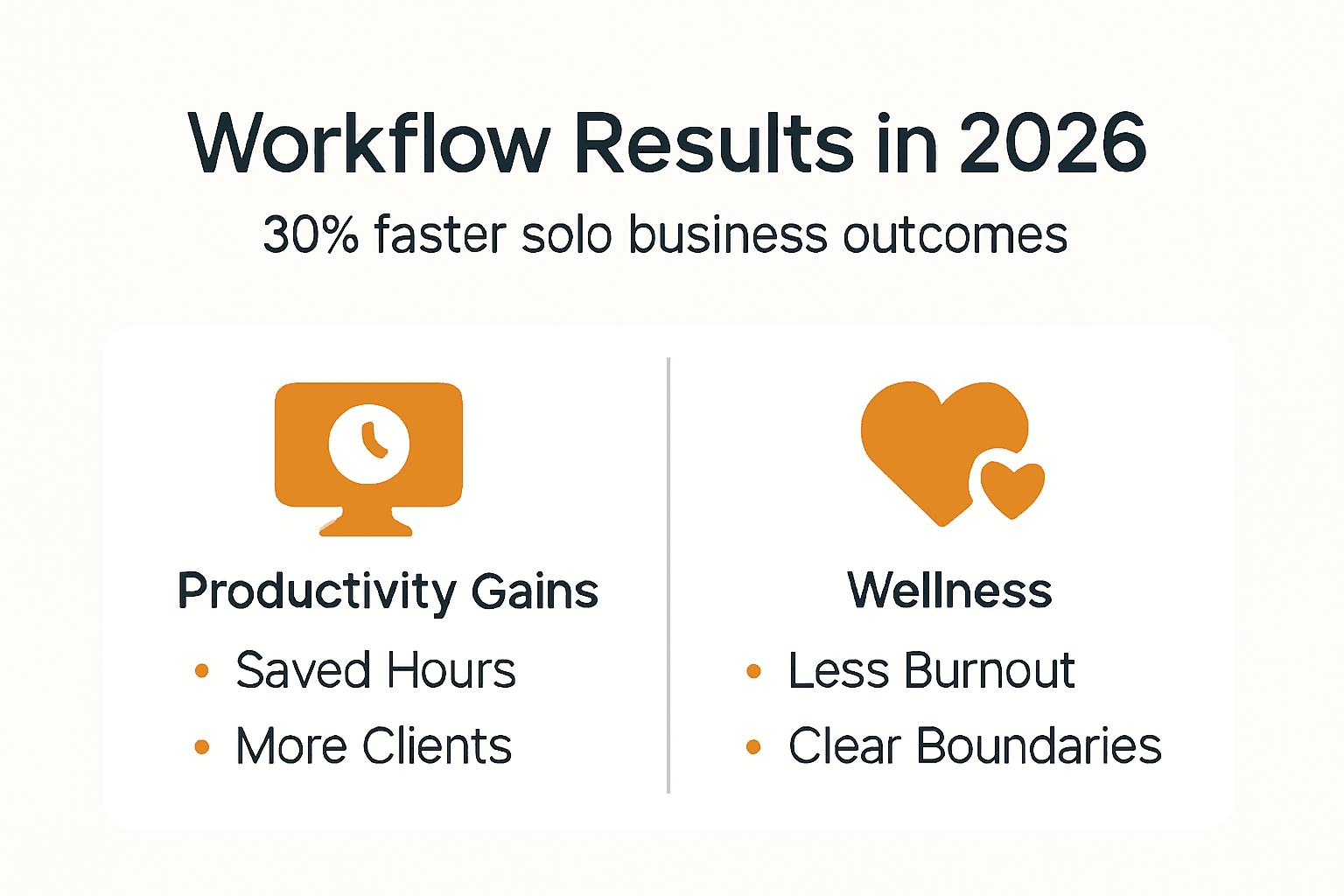
Time-blocking typically increases productivity by up to 30% within three months. You’ll notice faster task completion and fewer unfinished projects. Track weekly output to document improvements. Early gains come from eliminating context switching and protecting focus time.
Automation reclaims substantial hours once systems run smoothly:
- Email filters and templates save 3-5 hours weekly
- Automated invoicing and payment reminders save 2-3 hours weekly
- Scheduled social media posts save 2-4 hours weekly
- Total potential time savings: 8-10 hours per week
These hours redirect toward revenue-generating activities like client acquisition and service delivery. Initial setup requires 5-10 hours but pays for itself within two weeks.
Productivity Boost: Metric tracking improves workflow efficiency by 20% within two months through identifying bottlenecks and eliminating time wasters. You’ll discover which tasks generate results and which merely create busyness.
Long-term benefits extend beyond immediate productivity gains. Structured work-life boundaries reduce burnout risk significantly. You maintain energy and enthusiasm for your business over years rather than months. Consistent workflows build client trust through reliable delivery and communication. This business planning guide helps translate productivity gains into strategic business growth.
Expect a learning curve during the first month. You’ll refine time estimates and adjust automation rules. Stick with your system through initial awkwardness. Meaningful results emerge after 6-8 weeks of consistent implementation.
Summary and next steps
You now have a complete framework for building a solopreneur productivity workflow that delivers measurable results. Let’s recap the essentials.
Successful workflows combine the right tools, disciplined time-blocking, strategic task prioritization, and smart automation. Prerequisites like dedicated workspace and focused mindset enable consistent execution. Avoiding common mistakes like multitasking and boundary neglect protects your productivity gains.
Your next steps:
- Choose and set up your core productivity tools this week
- Implement daily time-blocking starting tomorrow
- Identify three tasks to automate within 30 days
- Schedule your first weekly review for Friday afternoon
- Track productivity metrics to measure progress
Consistent discipline matters more than perfect systems. Start simple and refine based on results. Explore business coaching benefits if you want personalized guidance implementing these strategies. Use this business planning checklist to ensure workflow improvements align with broader business goals.
Your productivity directly determines your business success and personal well-being. Invest time building systems now to reclaim hours for growth and life balance later.
Get more support for your solopreneur journey
Building an effective productivity workflow is just one piece of creating a thriving solo business. You need comprehensive strategies that connect daily operations with long-term growth.

Working with experienced business coaching for solopreneurs accelerates your progress by helping you avoid costly mistakes and implement proven systems faster. Our coaches specialize in the unique challenges solo entrepreneurs face, from productivity struggles to scaling limitations.
Explore our detailed business planning guide 2026 to align your workflow improvements with strategic business objectives. When you’re ready to expand your influence and attract better clients, learn how to build your personal brand on platforms where your ideal customers spend time.
Frequently asked questions
What is a solopreneur productivity workflow?
A solopreneur productivity workflow is a structured system combining time management, task prioritization, automation, and regular reviews specifically designed for solo business owners. It helps you manage all business aspects efficiently while maintaining work-life balance and preventing burnout through consistent routines.
How long does it take to see productivity improvements?
Most solopreneurs notice meaningful improvements within 2-3 months of consistently following a structured workflow. Time-blocking and automation deliver measurable gains during this period, with task completion rates increasing up to 30% as systems become habitual.
Can automation really save me 10 hours per week?
Yes, though initial setup requires 5-10 hours of focused work configuring tools and building systems. Once running, automation handles email management, invoicing, social media scheduling, and routine communications, reclaiming 8-10 hours weekly that you can redirect toward business growth activities.
What are common mistakes that reduce productivity for solopreneurs?
Multitasking reduces output by 40% compared to focused single-tasking. Neglecting clear work-life boundaries leads directly to burnout within months. Failing to track productivity metrics leaves you blind to inefficiencies. Resisting workflow adjustments when systems aren’t working wastes time and energy on broken processes.