
Authenticity in branding converts trust into measurable advantage. It’s the alignment of purpose, behavior, and experience, and you can start fixing misalignment today. When your brand consistently delivers what it promises, customers stop second-guessing you. They buy more, refer more, and forgive the occasional stumble. The mechanism is straightforward: perceived sincerity lowers the mental risk of a purchase, consistent product quality confirms the promise, and a coherent heritage or purpose gives customers a story worth sharing. Here are three things you can do this week to get started:
- Run a 1-week brand alignment audit. Pull your last 10 customer complaints and map each one against your stated brand values. Every mismatch is a gap between promise and delivery.
- Publish one piece of evidence-based content. Share a real result, a client outcome, or a behind-the-scenes process. Specificity signals credibility faster than any tagline.
- Fix the single most-cited customer complaint. Pick the top recurring issue and address it publicly. Naming the problem and showing the fix is one of the most credible moves a brand can make.
Key Takeaways
Brand authenticity is an operational discipline, not a content style: it requires aligning values, operations, and proof before any messaging will hold.
| Point | Details |
|---|---|
| Authenticity is a floor, not a differentiator | Research shows authentic brands outperform inauthentic ones, but not neutral ones, making it a baseline expectation in most categories. |
| Fix operations before narrative | Product quality decline is cited by many consumers as the top killer of perceived authenticity; fix the product before the story. |
| Measure both perception and behavior | Track a composite authenticity survey score quarterly alongside behavioral KPIs like repeat purchase rate and NPS monthly. |
| Specificity beats aspiration | Content only you could have written (real outcomes, named processes, honest mistakes) signals credibility faster than any tagline. |
| Sequence your investment | Audit in weeks 1–2, fix visible gaps in 30–90 days, build operational systems in 3–12 months, invest in culture at 12+ months. |
What does the role of authenticity in branding actually mean?
Brand authenticity is the degree to which a brand is perceived as genuine, consistent, and true to its stated values across every touchpoint. That’s the operational definition you can drop into a strategy document. It’s not a vibe or a content style. It’s a measurable construct rooted in consumer psychology.
Three academic models shape how practitioners think about it.
The Perceived Brand Authenticity model breaks authenticity into four dimensions: continuity (the brand has a consistent identity over time), credibility (it delivers on its promises), integrity (it acts on its stated values), and symbolism (it helps customers express something meaningful about themselves). This four-part framework is the most widely cited in marketing research and maps directly onto survey items you can use in brand trackers.
The sincerity-heritage-commitment model, common in consumer research, focuses on whether a brand is honest in its communications (sincerity), has a genuine origin story or craft tradition (heritage), and follows through on its purpose over time (commitment). You’ll see this model behind the brand decisions of companies like Patagonia, which leans heavily on all three dimensions.
The trait vs. state authenticity distinction comes from psychology. Trait authenticity is a stable, enduring characteristic of a brand’s identity. State authenticity is situational: how authentic a brand feels in a specific campaign, product launch, or crisis response. A 2024 review by Sedikides and Schlegel synthesizes both psychological and marketing literature, confirming that perceived authenticity predicts consumer quality perceptions, satisfaction, and purchase intentions across multiple studies.
Why does the trait vs. state distinction matter for your work? Because the interventions are different. Trait-level inauthenticity requires structural fixes: realigning your pricing, product quality, or hiring practices with your stated values. State-level inauthenticity can sometimes be addressed with a single campaign correction or a public acknowledgment. Misdiagnosing one as the other wastes budget and credibility.
Why does brand authenticity drive real business outcomes?
The business case is solid, and it goes beyond “people like honest brands.” Authenticity affects specific, trackable KPIs.
Shopify’s brand authenticity guide reports that in a 2023 survey, 79% of Gen Z said trust in brands is more important than before. That’s not a soft preference. It’s a purchasing signal from the fastest-growing consumer segment. Perceived authenticity clarifies what customers can expect from you, which directly reduces the friction that kills conversions.
The KPIs authenticity influences most reliably:
- Trust scores (measured via brand perception surveys)
- Repeat purchase rate (behavioral confirmation that the promise held)
- Net Promoter Score (willingness to refer is a proxy for emotional confidence in the brand)
- Willingness-to-pay premium (authentic brands consistently command higher prices in category research)
- Share of voice via word-of-mouth (customers who feel a brand is genuine talk about it unprompted)
LBBOnline’s practitioner analysis cites Clutch and Edelman research showing that 97% of consumers say authenticity influences their purchase decisions.
One important boundary condition: authenticity doesn’t always produce extra reward. A three-experiment study with 1,617 participants found that authentic brands produced more positive consumer responses than inauthentic brands, but not more positive responses than a neutral baseline. The implication is that in many categories, authenticity functions as a floor expectation rather than a differentiator. You won’t win by being authentic alone. But you will lose customers by being caught being inauthentic.
What are the core elements that make a brand feel authentic?
Authenticity isn’t one thing. It’s a cluster of signals that customers read simultaneously. Here’s how each element works in practice, followed by a quick audit you can run on your own brand.
| Core element | What it looks like in practice | Business outcome it drives | How to measure it | Risk if absent |
|---|---|---|---|---|
| Sincerity | Honest communication, no spin, acknowledging flaws | Trust, reduced purchase friction | Brand perception survey items | Cynicism, disengagement |
| Heritage/craftsmanship | Origin story, founder narrative, process transparency | Brand love, willingness-to-pay premium | Qualitative brand interviews | Perceived commoditization |
| Commitment | Long-term consistency in values and actions | Loyalty, repeat purchase | Repeat purchase rate, NPS trend | Perceived opportunism |
| Transparency | Open pricing, supply chain visibility, public accountability | Trust scores, share of voice | Social sentiment, review analysis | Backlash when gaps surface |
| Product quality | Delivering on the core functional promise | Satisfaction, word-of-mouth | Return rate, review scores, NPS | Fastest route to lost authenticity |
| Purposeful action | Values-aligned decisions (hiring, sourcing, giving) | Brand love, emotional loyalty | Brand tracker, social listening | Accusations of performative activism |
Mini-audit: five questions to surface your biggest misalignments
- Does your most common customer complaint contradict a value you publicly claim?
- Could a competitor have made your last three pieces of content without changing a word?
- Has your product quality or service consistency changed in the past 12 months?
- Do your employees describe the brand the same way your marketing does?
- When you made your last major business decision, did your stated values influence it?
If you answered “yes” to the first three or “no” to the last two, you have a trait-level authenticity gap that content alone won’t fix.
How do you build or repair brand authenticity step by step?
Think of this as a layered playbook. You don’t tackle culture on day one. You triage first, fix the visible gaps, then build the systems that make authenticity self-sustaining.
Immediate triage (this week)
- Pull your top 5 negative reviews and identify the single most common complaint.
- Map that complaint against your brand values document. Name the gap explicitly in an internal brief.
- Assign one owner to that gap with a 30-day resolution deadline.
- Publish one piece of content that shows real process, real results, or real customer outcomes. No stock photos, no generic claims.
30-day fixes
- Audit your website copy for claims you can’t substantiate. Remove or qualify each one.
- Run a cross-functional workshop with product, marketing, and support. Ask: “What do we promise that we don’t consistently deliver?” Document every answer.
- Update your brand guidelines to include values as decision filters, not just visual rules. Frontify’s brand management platform is a practical tool for centralizing these guidelines so every team member works from the same source of truth.
- Fix or publicly acknowledge the top complaint you identified in week one.
90-day operational changes
- Build a customer feedback loop that surfaces quality issues before they become review patterns.
- Align your hiring criteria and onboarding with your brand values. Employees who don’t understand or believe the values will undermine authenticity at every customer touchpoint.
- Create a content calendar that prioritizes evidence (case studies, data, process transparency) over aspiration (taglines, lifestyle imagery).
- Establish a social listening cadence to track how customers describe your brand unprompted.
12-month culture investments
- Tie performance reviews and team incentives to values-aligned behaviors, not just revenue metrics.
- Commission an annual brand perception survey with validated authenticity items (see the measurement section below).
- Build a public accountability mechanism: an annual impact report, a transparent pricing page, or a supplier transparency document.
Pro Tip: If you’re a solopreneur or running a small team, your biggest authenticity asset is your origin story. You don’t need a cross-functional workshop. You need one honest, specific answer to: “Why did I build this, and what do I actually know how to do?” Put that answer on your About page, your LinkedIn summary, and your first email to new subscribers. Specificity is the shortcut to credibility. For more on building that kind of personal brand foundation, the personal branding tips for solo business owners at Yoursolobusiness are worth bookmarking.
What can brands like Aerie, Nike, and Patagonia teach you?

These three brands are cited constantly in authenticity discussions, and for good reason. Each one made a specific, costly decision that proved their stated values weren’t just marketing copy.
Aerie’s #AerieREAL campaign
In 2014, Aerie stopped retouching photos of models in its swimwear advertising. That’s a decision that costs something: it runs against decades of industry convention and risks alienating buyers conditioned to aspirational imagery. The proof offered to customers was literal and visible. The measurable outcome was a sustained sales increase over multiple consecutive quarters, widely attributed to the trust signal the campaign sent to younger women who felt misrepresented by traditional beauty advertising. The lesson isn’t “stop retouching photos.” It’s “find the industry convention that contradicts your stated values and publicly abandon it.”
Patagonia’s “Don’t Buy This Jacket” ad
Patagonia ran a full-page ad in the New York Times on Black Friday 2011 urging customers not to buy their jacket unless they truly needed it. The ad detailed the environmental cost of producing a single fleece. It was a direct conflict with short-term revenue. The long-term result was a deepening of brand loyalty among Patagonia’s core audience, who saw the ad as proof that the company’s environmental commitment wasn’t a tagline. Heritage, commitment, and purposeful action all fired at once. That’s the combination that produces brand love, not just brand preference.
Nike and the Colin Kaepernick campaign
Nike’s 2018 “Believe in Something” campaign featuring Colin Kaepernick was polarizing by design. It cost Nike some customers and generated significant short-term controversy. But it was consistent with Nike’s long-standing brand positioning around athletic courage and pushing past limits. The campaign worked because it was coherent with Nike’s heritage, not because it was brave in the abstract. Authenticity without coherence is just controversy.
The solopreneur version
A freelance brand strategist who publishes a monthly “what I got wrong this month” post on LinkedIn is doing the same thing Aerie did, at a fraction of the cost. Naming a real mistake, explaining what you learned, and showing the corrected approach is evidence-based content that no competitor can copy, because it’s genuinely yours. That’s the personal brand growth strategy that compounds over time.
Cross-case pattern: Every one of these moves shared three traits. The brand made a decision that cost something. The proof was visible and specific, not claimed. And the decision was coherent with an existing brand identity, not a pivot to chase a trend.
How do you measure perceived authenticity and track it over time?
Measurement is where most authenticity programs fall apart. Teams invest in values workshops and storytelling guides, then track only revenue, which is too lagged and too noisy to tell you whether authenticity is working.
Sample survey items mapped to constructs
Use a 5-point agreement scale (Strongly Disagree to Strongly Agree) for each item:
- “[Brand] is honest about its products and limitations.” (Sincerity)
- “[Brand] has a clear and consistent identity that hasn’t changed just to follow trends.” (Continuity/Heritage)
- “[Brand] follows through on its stated values, even when it’s costly.” (Commitment)
- “[Brand] is transparent about how it operates.” (Transparency)
- “[Brand] genuinely cares about the people it serves.” (Integrity)
- “I trust [Brand] to do what it says it will do.” (Overall trust anchor)
Average the six items for a composite authenticity perception score. Run this quarterly with a consistent sample of 150–300 respondents to detect meaningful shifts. For A/B testing campaign-level authenticity (state authenticity), a minimum of 200 respondents per cell gives you adequate statistical power to detect moderate effect sizes.
Dashboard KPIs to track monthly and quarterly
| KPI | Frequency | What it signals |
|---|---|---|
| Composite authenticity perception score | Quarterly | Trait-level brand health |
| Net Promoter Score | Quarterly | Emotional confidence and loyalty |
| Repeat purchase rate | Monthly | Behavioral confirmation of trust |
| Review sentiment score | Monthly | Real-time quality and sincerity signals |
| Social mention sentiment | Monthly | Unprompted brand perception |
| Conversion rate on brand content | Monthly | Whether authenticity signals are reducing friction |
Common measurement pitfalls: Don’t benchmark your authenticity score against competitors without controlling for category. Authenticity perceptions vary significantly by industry. A financial services brand and a food brand face different baseline expectations. Also, avoid conflating brand awareness with brand authenticity. High awareness with low authenticity scores is a warning sign, not a success metric.
A practical guide from Inkbot Design’s authentic branding resource recommends combining perception surveys with behavioral KPIs like NPS and repeat purchase rate to get a full picture. Perception without behavior is aspiration. Behavior without perception is luck.
What mistakes kill perceived authenticity fastest?
These are the red flags that show up most often, and each one has a fast remediation path.
Values-action mismatch. You claim to prioritize sustainability, then launch a product line with no environmental consideration. Consumers notice this faster than you think, especially in the post-AI content environment where audiences have become skilled at spotting generic claims. LBBOnline’s analysis identifies this as one of the top three killers of perceived authenticity. Remediation: Audit your last three major business decisions against your stated values. Publish the results internally. Fix the most visible gap first.
Decline in product or service quality. Nothing destroys authenticity faster than a product that used to be great and isn’t anymore. Customers who loved you become your loudest critics because the gap between expectation and experience is widest for them. Remediation: Pull your review trend data for the past 18 months. If scores are declining, treat it as a brand emergency, not a customer service issue.
Generic or robotic messaging. Content that could have been written by any brand in your category signals that you have nothing specific to say. In 2026, with AI-generated content flooding every channel, the “brand test” matters more than ever: would only your brand have made this? Remediation: Apply the brand test to your last five content pieces. Rewrite any that fail it with specific proof, named outcomes, or genuine perspective.
Trend-chasing without coherence. Jumping on a social cause, a content format, or a cultural moment that has no connection to your brand history reads as opportunistic. Remediation: Before any trend-driven campaign, ask whether it’s coherent with your brand’s existing identity. If you have to explain why it fits, it probably doesn’t.
Crisis handling when inauthenticity is exposed. When a gap between values and behavior becomes public, the worst response is silence or spin. The most credible response is a specific acknowledgment of what happened, a clear explanation of why, and a concrete commitment with a timeline. Vague apologies accelerate distrust. Specific accountability slows it.
What’s a realistic timeline and budget for authenticity work?
Here’s the honest version, because most guides skip this part.
Phase 1: Audit (1–2 weeks). Pull existing data: reviews, NPS scores, customer complaints, and brand perception surveys if you have them. Map gaps between stated values and customer experience. Cost: low. A freelance brand strategist charges roughly $1,500–$3,500 for a focused audit. An internal team can do a lighter version in a week with no external spend.
Phase 2: Quick fixes (30–90 days). Address the most visible gaps: update misleading website copy, fix the top recurring complaint, publish evidence-based content. Cost: low to medium. Mostly staff time, plus content production costs of $500–$2,000 if you’re outsourcing.
Phase 3: Operational changes (3–12 months). Align hiring, onboarding, product quality controls, and customer feedback loops with brand values. This is where authenticity becomes structural rather than cosmetic. Cost: medium. Expect $5,000–$25,000 for a small-to-mid business, depending on whether you bring in a brand consultant or run it internally.
Phase 4: Culture shifts (12+ months). Tie performance management, incentives, and leadership behavior to values. Commission annual brand perception surveys. Cost: high. Organization-wide cultural change programs at mid-sized companies typically run $50,000–$200,000+ when you factor in facilitation, measurement, and sustained internal communication.
Where does budget deliver the highest return? Fix core product and service quality first. Every dollar spent on messaging authenticity while the product is declining is a dollar accelerating distrust. The sequence matters: operations first, then narrative.
What does academic research actually tell us about authenticity’s limits?
The research is more nuanced than most practitioner guides admit, and that nuance is useful.
The 2024 Sedikides and Schlegel review synthesizes psychological and marketing literature to show that authenticity predicts consumer quality perceptions, satisfaction, and purchase intentions across multiple studies and product categories. Positioning products as authentic increases consumer preference and purchase behavior in categories as different as beauty products, wine, and front-line service interactions. The review also confirms that both trait and state authenticity are measurable and that interventions at either level can shift consumer responses.
The more surprising finding comes from a three-experiment study with 1,617 participants, including one preregistered study with a nationally representative sample. Authentic brands produced more positive responses than inauthentic brands, but not more positive responses than a neutral baseline. The practical implication: authenticity may function as a hygiene factor in many categories. You need it to avoid losing customers, but it may not be sufficient on its own to win them.
This explains something practitioners often observe but struggle to articulate: authentic brands don’t just earn repeat purchases. They earn emotional loyalty that survives price increases, product stumbles, and competitive pressure. The mechanism is meaning, not just trust.
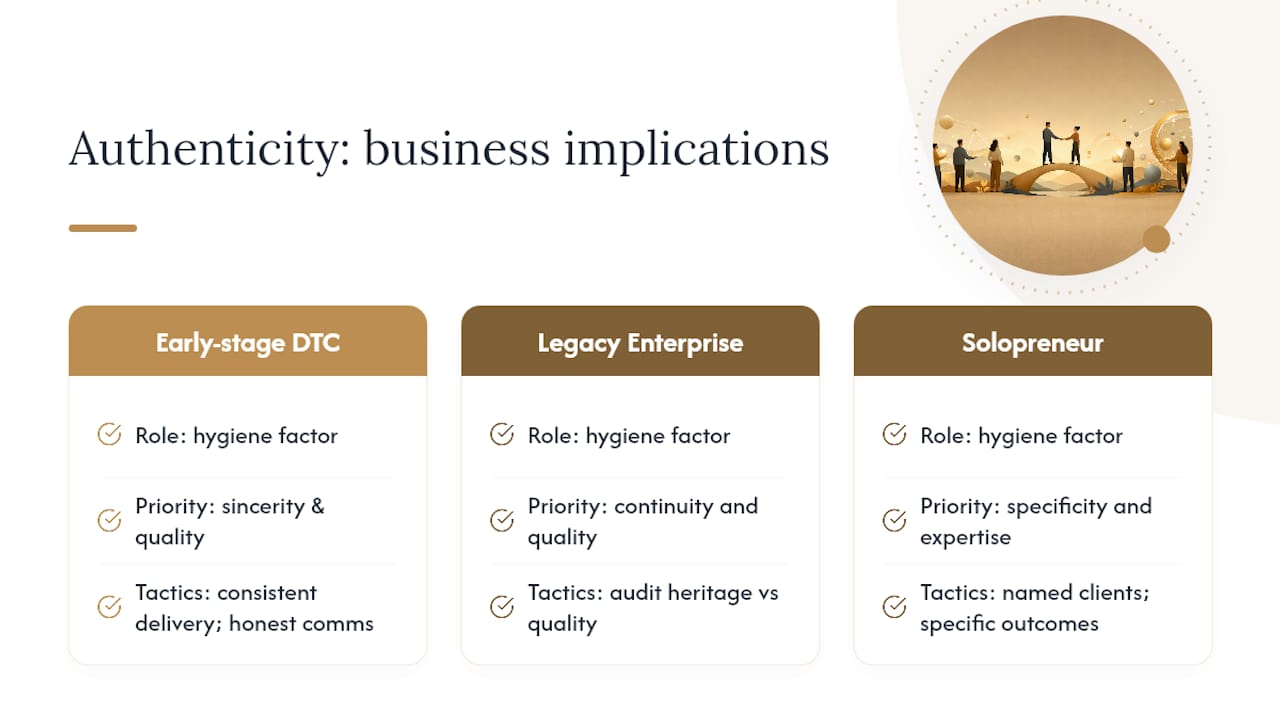
Practical implications by business type:
Early-stage DTC brand: Prioritize sincerity and product quality above all else. You don’t have heritage yet. Build it through consistent delivery and honest communication.
Legacy enterprise: Your heritage is an asset, but it can also be a trap. Continuity matters, but continuity with a declining product is a liability. Audit whether your heritage claims are still backed by current quality.
Solopreneur: Your biggest authenticity advantage is specificity. You can demonstrate expertise in ways a large brand cannot: named clients, specific outcomes, real process transparency. Use it. The 2026 solopreneurship trends at Yoursolobusiness cover how AI is reshaping this dynamic.
Caveats on generalizability: Most authenticity research is conducted in Western consumer markets with relatively high brand literacy. Results may not transfer directly to categories where functional performance dominates purchase decisions or to markets where brand trust operates through different cultural mechanisms.
Where should you actually start? A practitioner’s take
The most common mistake I see is treating authenticity as a content problem. Teams brief their agencies on “more authentic storytelling” while the product quality is slipping, the customer service response time is getting worse, and the pricing has drifted away from the value proposition. No amount of behind-the-scenes Instagram content fixes a structural gap between promise and delivery.
My recommendation: start with the gap, not the story. Run the five-question mini-audit from the components section. If your most common customer complaint contradicts a stated value, that’s your first project. Fix it, then tell the story of how you fixed it. That sequence, operations first, narrative second, is what produces credibility rather than just content.
For solopreneurs specifically, the lowest-cost authenticity win I’ve seen repeatedly is publishing a specific, evidence-backed piece of content that only you could have written. Not a listicle. Not a trend roundup. A piece that shows your actual thinking, your actual process, or your actual results. It’s the equivalent of Aerie’s unretouched photos: it costs something (vulnerability, specificity, time), and that cost is exactly what makes it credible. If you want a framework for building that kind of presence systematically, the personal brand growth strategies at Yoursolobusiness are a solid starting point.
The research backs this up. The Cambridge paper on authenticity and meaning in life argues that authenticity helps people connect their choices to a deeper sense of purpose. For a solopreneur, that’s not abstract philosophy. It’s the reason a client chooses you over a cheaper alternative: they trust that your work means something to you, and that meaning transfers to the quality of what you deliver.
Sources
These are the core references behind this guide, organized for easy follow-up.
Academic and research sources
Practitioner guides