
Running a solo business means juggling everything yourself with limited time and budget. Traditional marketing tactics like paid ads or event sponsorships demand resources most solopreneurs simply don’t have. Content marketing offers a different path: it’s affordable, scalable, and builds the authentic personal brand that solo entrepreneurs need to attract clients and grow sustainably.
Key takeaways
| Point | Details |
|---|---|
| Content marketing fits solopreneurs’ constraints | It requires minimal budget, can be done solo, and scales with your available effort and time. |
| Consistent publishing multiplies lead generation | Regular content creation generates 300% more leads compared to sporadic posting. |
| Cost advantage over traditional marketing | Content marketing costs 62% less than outbound methods while delivering superior long-term ROI. |
| Trust building drives conversions | Sharing valuable insights and authentic stories increases purchase likelihood by 70% through established credibility. |
| Frameworks enable efficient execution | Practical models like Attract-Engage-Convert-Retain help solopreneurs systematically implement content marketing despite resource limits. |
The unique needs of solopreneurs and why content marketing fits
Solopreneurs operate without teams, marketing departments, or large budgets. You’re the strategist, creator, and executor all at once. Traditional marketing channels like television ads, direct mail campaigns, or trade show booths require substantial financial commitments and specialized skills that simply aren’t realistic when you’re managing every aspect of your business alone.
Content marketing addresses these constraints directly. It works on your schedule and budget because you control the production, distribution, and timeline. Instead of paying for ad placements that disappear the moment your budget runs out, you create assets that continue attracting prospects months or years later.
For solo businesses, your personal brand is your business brand. Content marketing lets you showcase expertise, share your unique perspective, and demonstrate the specific value you bring to clients. This direct connection between your knowledge and your audience builds relationships that convert.
Key advantages for solopreneurs:
- Start with minimal investment in tools or platforms
- Scale effort up or down based on your current capacity
- Reach targeted audiences without competing for expensive ad space
- Build owned assets rather than renting attention
- Establish authority in your niche through consistent valuable sharing
Exploring marketing strategies for solopreneurs reveals how content serves as the foundation for sustainable growth without requiring resources you don’t have.
Why content marketing is vital for personal branding and trust
People buy from experts they trust. Content marketing transforms you from an unknown solo operator into a recognized authority in your field. Every article, video, or post demonstrates your knowledge and problem-solving ability before a prospect ever contacts you.
Authentic storytelling separates successful solopreneurs from competitors. When you share real challenges you’ve overcome, lessons learned from failures, and insights gained through experience, you create emotional connections that generic marketing messages can’t match. These connections build the trust that drives purchasing decisions.
The impact is measurable. Content marketing increases purchase likelihood by 70% because prospects who consume your content arrive already confident in your expertise. They’ve seen your thinking, benefited from your advice, and decided you’re the right fit before the sales conversation even starts.
“The most powerful marketing comes from consistently showing up with genuine value. Your content proves your expertise better than any advertisement ever could.”
Consistent content deepens these relationships over time. First-time visitors become regular readers. Regular readers join your email list. Email subscribers eventually become clients, then advocates who refer others. This progression happens naturally when you maintain visibility through regular valuable content.
Building your presence on professional platforms accelerates this trust-building process. Learning to build your personal brand on LinkedIn helps you reach decision-makers actively seeking solutions you provide.
Benefits of content-driven personal branding:
- Positions you as the obvious choice in your niche
- Reduces price sensitivity because expertise commands premium rates
- Attracts ideal clients who already understand your value
- Creates referral momentum through shareable insights
- Differentiates you from competitors relying solely on paid advertising
The impact of consistent content publishing on business growth
Consistency matters more than volume in content marketing. Solopreneurs who publish consistent content see a 300% increase in lead generation compared to those posting sporadically. This isn’t about daily content creation. It’s about reliable, predictable value delivery that keeps you visible and top of mind.

Real data proves the long-term impact. One solopreneur consultant tracked 450% organic traffic growth over 12 months by publishing one in-depth article weekly and sharing insights on social platforms three times per week. The compound effect of searchable, shareable content creates momentum that irregular posting never achieves.
| Publishing frequency | Lead generation increase | Time to results | Sustainability |
|---|---|---|---|
| Daily rushed content | 50-80% | 1-2 months | Low, leads to burnout |
| Weekly quality content | 250-300% | 3-6 months | High, manageable long-term |
| Bi-weekly strategic content | 180-220% | 4-8 months | Very high, fits limited capacity |
| Monthly sporadic content | 30-50% | 9-12 months | Variable, minimal momentum |
Long-term consistency builds cumulative advantages. Each piece of content adds to your searchable archive, creating more entry points for discovery. Your older content continues working while you sleep, attracting prospects who find you through search engines or social shares months after publication.
Pro Tip: Use a content calendar to plan topics quarterly and batch-create content in focused sessions. This approach reduces decision fatigue and maintains consistency even during busy periods when daily creation feels impossible.
Benefits from maintaining publishing consistency:
- Higher engagement rates as audiences anticipate your content
- Improved search rankings from fresh, relevant content signals
- Stronger lead nurturing through regular touchpoints
- Increased repeat business from staying visible to past clients
- Compounding authority as your content library grows
Discovering how to create social media content that works helps you maintain this consistency across platforms without overwhelming your schedule.
Cost-effectiveness of content marketing compared to traditional marketing
Budget constraints limit most solopreneurs’ marketing options. Paid advertising demands ongoing investment with results that disappear the moment spending stops. Content marketing flips this model. Content marketing is 62% less expensive than outbound marketing while delivering sustained returns that grow over time.
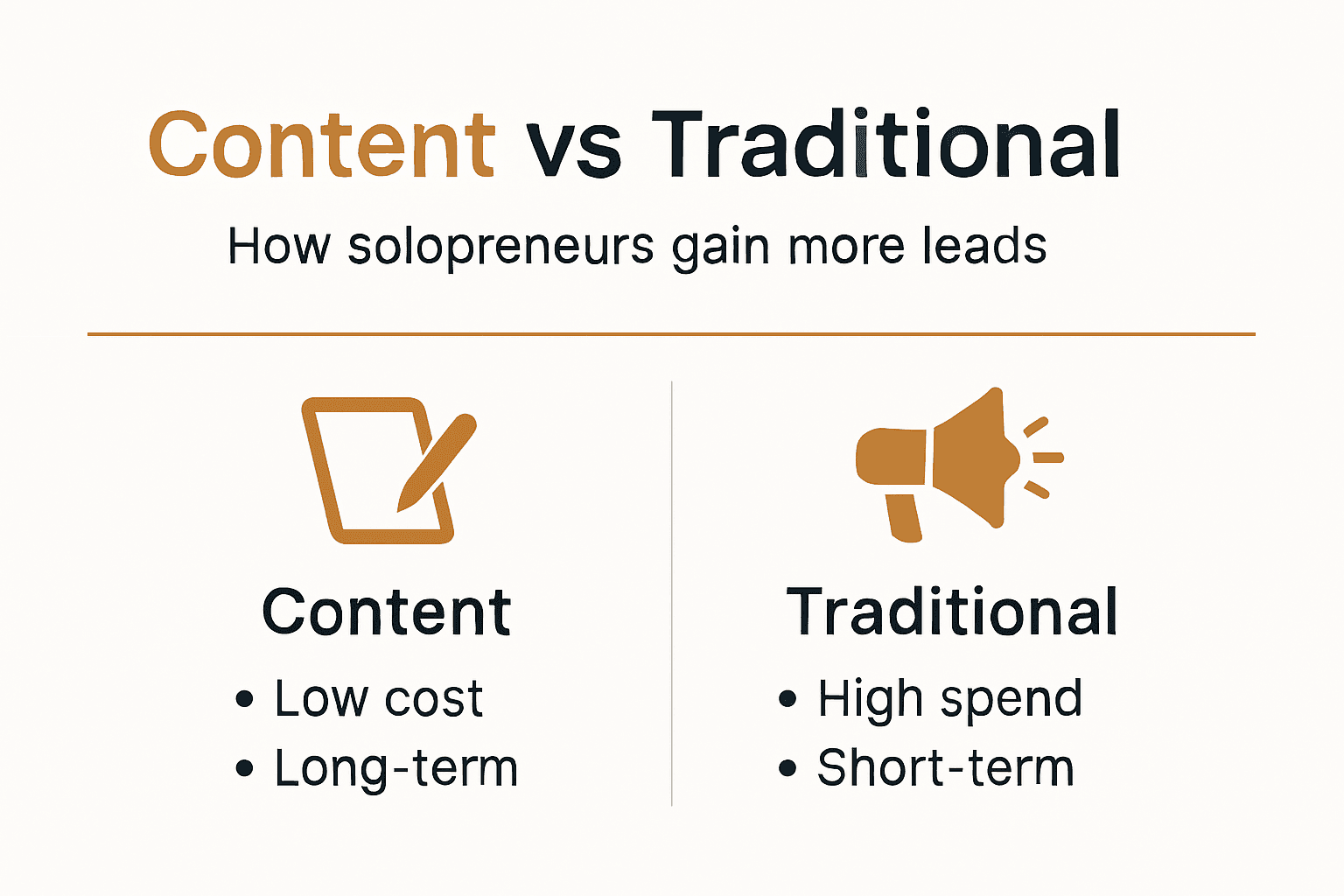
The upfront investment in content creation is minimal compared to traditional channels. You need time, basic tools, and knowledge rather than thousands in ad spend. A laptop, free design tools, and your expertise create assets that work indefinitely without additional payment.
| Marketing approach | Initial cost | Monthly ongoing cost | ROI timeline | Asset ownership |
|---|---|---|---|---|
| Content marketing | $100-500 | $50-200 | 3-6 months | You own all assets |
| Paid social ads | $500-2000 | $1000-5000 | Immediate but temporary | No lasting assets |
| Traditional advertising | $2000-10000 | $2000-10000 | Variable | No control |
| Event marketing | $1000-5000 | $500-2000 | Immediate but limited | Minimal lasting value |
Organic reach builds audiences you own rather than rent. Every email subscriber, blog reader, or social follower belongs to you. Platforms can change algorithms or raise ad prices, but your owned audience remains accessible. This independence protects your marketing investment from external disruptions.
Solopreneurs can reinvest the savings into product development, skill improvement, or better service delivery. Money not spent on ads becomes money available for business growth in areas that create lasting competitive advantages.
Pro Tip: Focus on owned channels like your email list and blog first. Social media provides distribution, but owned platforms give you complete control and direct access to your audience without platform gatekeepers.
Comparing content marketing vs traditional marketing costs reveals why solo entrepreneurs achieve better results by prioritizing content over paid channels.
Overcoming common misconceptions that limit solopreneurs’ content marketing success
Misconceptions about content marketing stop solopreneurs from starting or cause them to quit prematurely. Understanding reality versus myth helps you set appropriate expectations and design sustainable strategies.
Myth: You must post daily to see results. Reality: Quality weekly or bi-weekly content consistently outperforms daily rushed posts. Audiences value substance over frequency. One well-researched article provides more value than seven thin updates.
Myth: Content marketing only attracts new leads. Reality: It nurtures existing prospects and retains current clients too. Your content reminds past clients of your value, educates prospects still in consideration phases, and keeps you relevant to everyone in your network.
Myth: Content marketing requires too much time for solopreneurs. Reality: Strategic frameworks and content reuse make it manageable. Batch creation, repurposing across formats, and focusing on core topics reduces time investment while maintaining impact.
Myth: You need professional production quality. Reality: Authenticity beats polish for solopreneurs. Audiences connect with real insights and genuine personality more than studio-quality videos or professionally designed graphics. Your phone and honest communication work fine.
Clearing these misconceptions:
- Prevents burnout from unrealistic daily posting goals
- Helps you focus effort on quality over quantity
- Enables sustainable long-term content strategies
- Reduces intimidation that stops solopreneurs from starting
- Improves results by aligning approach with proven best practices
Learning the truth about content marketing myths and facts helps you avoid common pitfalls and design strategies that actually work for solo businesses.
Content marketing frameworks and practical tips for solopreneurs
Frameworks eliminate guesswork and make content marketing systematic rather than overwhelming. The Attract-Engage-Convert-Retain model provides clear structure for planning content that moves prospects through your business journey.
Attract phase focuses on awareness-building content that reaches new audiences. Create educational resources answering common questions in your field. This content ranks in search engines and gets shared on social platforms, introducing you to potential clients who don’t know you yet.
Engage phase deepens relationships through interactive content and community building. Share insights that spark conversations, ask questions that encourage responses, and respond to comments to build connection. This phase transforms strangers into familiar contacts who recognize your name and value your perspective.
Convert phase uses proof-driven content that demonstrates results. Case studies, testimonials, and specific outcome examples show prospects what working with you achieves. This content answers the question every prospect asks: “Will this work for me?”
Retain phase keeps clients engaged post-purchase through continued value delivery. Exclusive insights, early access to new content, or advanced resources remind clients why they chose you and encourage repeat business or referrals.
Step-by-step implementation:
- Define your ideal client’s biggest challenges and questions
- Create cornerstone content addressing these topics thoroughly
- Develop a sustainable publishing schedule matching your capacity
- Engage consistently with your audience across chosen platforms
- Track which content generates leads and conversations
- Refine your approach based on performance data
Pro Tip: Create reusable content templates for common formats. A blog post becomes a LinkedIn article, which becomes social media posts, which become email newsletter content. One creation effort serves multiple distribution channels.
Adapting posting frequency to your capacity prevents burnout. Two quality pieces monthly outperform eight rushed pieces. Match your commitment to available time and energy rather than arbitrary standards that lead to inconsistency or quitting.
Exploring content marketing frameworks provides additional models for different business types and goals. Improving efficiency through content marketing productivity hacks helps you maintain consistency without sacrificing quality.
Choosing the right content channels and measuring success
Channel selection depends on where your ideal clients spend time and which formats match your strengths. Spreading effort across too many platforms dilutes impact. Focus on two or three channels you can maintain consistently.
Social media rewards engagement-focused content over promotional messages. Engagement-driven content gets 40% higher reach on major platforms because algorithms prioritize posts that spark conversations. Ask questions, share controversial opinions, and invite responses rather than just broadcasting information.
Email marketing integration boosts overall conversion rates significantly. Subscribers who receive regular email updates convert approximately 40% more than social-only followers. Email provides direct access without algorithmic interference and builds deeper relationships through consistent inbox presence.
Selecting channels strategically:
- LinkedIn for B2B solopreneurs targeting professionals and decision-makers
- Instagram or TikTok for visual businesses serving consumer audiences
- Email newsletters for all solopreneurs as owned audience foundation
- YouTube for those comfortable with video and teaching complex topics
- Podcasts for solopreneurs with strong speaking skills and interview opportunities
Key metrics track progress and prove ROI. Website traffic shows content discoverability. Engagement rates reveal whether content resonates. Email list growth indicates audience interest. Conversion rates measure business impact. Track these consistently to understand what’s working.
Basic measurement framework:
- Monthly website visitors and traffic sources
- Social engagement rates per post type
- Email open and click-through rates
- Lead generation from specific content pieces
- Revenue attributed to content marketing efforts
Understanding social media and content channels for solopreneurs helps you choose platforms aligned with your business model. Learning about social media engagement benefits shows why interaction matters more than follower counts.
Conclusion: applying content marketing to grow your solo business
Content marketing delivers what solopreneurs need most: cost-effective client attraction that builds over time without requiring resources you don’t have. It establishes you as a trusted authority, generates leads consistently, and costs a fraction of traditional marketing while delivering superior long-term returns.
Misconceptions about required frequency and complexity hold many solopreneurs back from realizing content marketing’s full potential. The reality is simpler: consistent quality beats sporadic volume, owned channels provide more value than rented attention, and strategic frameworks make execution manageable even with limited time.
Key success factors:
- Commit to consistent publishing on a schedule you can sustain
- Focus on genuine value delivery over promotional messages
- Track metrics that matter to your business goals
- Adapt your approach based on what your audience engages with most
- Build owned assets through email and your website first
Start small but start now. Choose one channel, commit to one piece of quality content weekly or bi-weekly, and maintain that consistency for six months. The compound effect will surprise you. Your content library grows, your authority strengthens, and your lead generation accelerates as momentum builds.
Explore tools and resources for solopreneurs to master content marketing
Ready to strengthen your content marketing and personal branding? We’ve built comprehensive guides specifically for solopreneurs looking to maximize their marketing impact without overwhelming their schedules.

Discover how to build your personal brand on LinkedIn with strategies that work for busy solo entrepreneurs. Learn the tactics that help you stand out, attract ideal clients, and establish authority in your niche.
Our guide to create effective social media content shows you exactly how to produce engaging posts that drive real business results without spending hours daily on platforms.
Explore proven marketing strategies for solopreneurs that fit your budget and schedule. These practical frameworks help you implement content marketing systematically for sustainable growth.
FAQ
What are the biggest content marketing mistakes solopreneurs make?
Trying to post daily without the capacity to maintain quality is the most common mistake. This leads to burnout and thin content that doesn’t provide value. Ignoring audience engagement and failing to track which content generates actual business results also limits success significantly.
How often should a solopreneur publish content to see results?
Weekly or bi-weekly quality content consistently outperforms daily rushed posts. Consistency and genuine value matter far more than sheer volume. Choose a publishing frequency you can maintain for months, not one that exhausts you in weeks.
Which content channels are best for solopreneurs starting out?
Start with email and one social platform where your ideal clients actively engage. LinkedIn works well for B2B solopreneurs, while Instagram or Facebook suit consumer-focused businesses. Build your owned email list as the foundation because you control that audience completely regardless of platform changes.
Can content marketing really replace paid advertising for solopreneurs?
Content marketing provides more sustainable long-term growth and costs significantly less than ongoing ad spend. While paid advertising delivers faster initial results, it stops working the moment you stop paying. Content marketing builds lasting assets and authority that compound over time, making it the smarter primary strategy for resource-constrained solopreneurs.





Leave a Reply