

TL;DR:
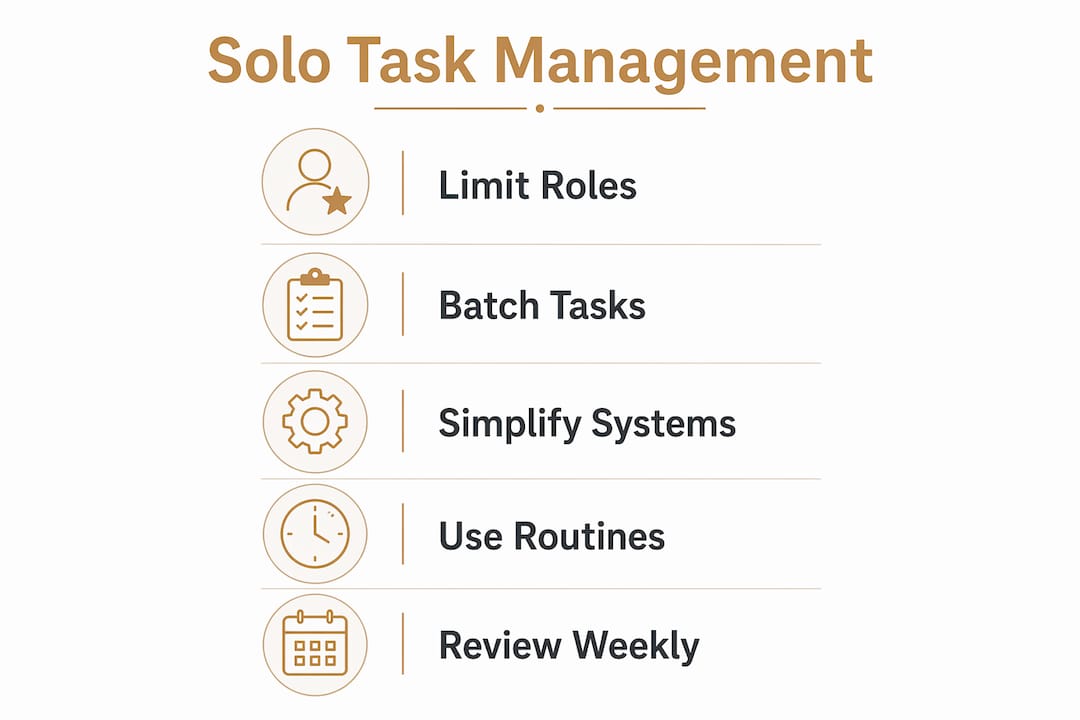
- Managing everything alone requires clear focus through limiting roles, batching tasks, and using a simple system. Developing routines and a weekly review helps preserve mental energy and maintain progress without burnout. The key is building a structured workflow that balances high-impact work with manageable daily routines and support.
Solo self-management is the practice of handling every personal and professional responsibility without a team, and it is entirely achievable with the right structure. Knowing how to manage everything alone comes down to three core disciplines: clear prioritization, a single trusted system, and protecting your cognitive energy. The good news is that highly productive solopreneurs already use proven methods to do exactly this. This guide gives you those methods, straight and practical.
How to manage everything alone: start by limiting your daily roles
The single biggest mistake solo operators make is trying to wear every hat every day. You are the marketer, the accountant, the creator, and the customer service rep. Switching between those roles constantly drains your focus and slows everything down.

The fix is the “two hats per day” rule. Productive solopreneurs limit themselves to two active roles per day and define a successful day by completing three main tasks. That constraint sounds limiting, but it actually frees you. When you know your two roles for the day, every decision about what to work on becomes easier.
Here is how to apply this in practice:
- Choose your two roles the night before. For example, Monday could be “creator + marketer.” Tuesday could be “operator + finance.” This prevents you from waking up and spinning your wheels deciding what to tackle.
- Write your Daily Big Three. These are the three tasks that, if completed, make the day a win. Not a list of 20 items. Three. Pick them before you open email or social media.
- Schedule your highest-leverage tasks first. Most people have only 4 to 6 hours of peak cognitive function per day. Use those hours for creative and strategic work, not admin.
- Block 2–3 hours for deep work. Protect this block like a meeting you cannot cancel. No notifications, no multitasking, no exceptions.
A sample Monday schedule might look like this: 8:00 AM to 10:30 AM is deep work for content creation. 10:30 AM to 11:00 AM is a short break and email check. 11:00 AM to 12:30 PM is marketing tasks. Afternoons handle lighter admin and planning.
Pro Tip: Write your Daily Big Three on a sticky note and put it on your monitor. Physical visibility beats any app for keeping you on track.
Does batching tasks really save time?
Yes. Batching content creation reduces time spent on it by roughly 40%. That number reflects what happens when you stop switching contexts and commit to doing similar work in one focused session. The same principle applies far beyond content.
Context switching is the silent productivity killer for solo operators. Every time you jump from writing a proposal to answering an email to updating a spreadsheet, your brain pays a switching cost. Batching eliminates that cost by grouping similar tasks into dedicated time blocks.
Tasks that batch well include:
- Email and messages: Check and respond twice a day, not continuously. A 9:00 AM and 4:00 PM window works well for most solo operators.
- Invoicing and financial admin: Do all billing, expense tracking, and bookkeeping in one weekly session, not scattered across the week.
- Content creation: Write all social posts, newsletters, or blog drafts in one sitting. Record all videos in one session.
- Client calls and meetings: Stack all calls on two or three days per week. Keep the remaining days meeting-free for deep work.
- Research and learning: Dedicate one block per week to reading, courses, or industry updates instead of grazing throughout the day.
Eliminating context switching through batching and turning off notifications during focus sessions improves output more than any single productivity app. That is a strong claim, and it holds up in practice.
Pro Tip: Group your digital notifications into a single daily digest using your phone’s scheduled summary feature. This supports batching without requiring willpower every hour.
What is the best system for managing tasks alone?
The best system is the simplest one you will actually use every day. Successful solo operators avoid “over-tooling” by relying on a single tool for task and project management rather than multiple disconnected apps. One source of truth beats five half-used apps every time.
App fragmentation is a real productivity drain. When your tasks live in one app, your notes in another, your projects in a third, and your calendar in a fourth, you spend mental energy just navigating the system. That energy should go toward actual work.
When choosing your single tool, look for these features:
| Feature category | Why it matters for solo operators |
|---|---|
| Fast capture | You need to log ideas and tasks in under 10 seconds or you will lose them |
| Simple prioritization | One-click tagging or flagging keeps your Daily Big Three visible |
| Low maintenance | A tool that requires constant upkeep will get abandoned within weeks |
| Calendar integration | Seeing tasks alongside time blocks prevents scheduling conflicts |
| Cross-device access | Your system must work on phone and desktop without friction |
A single, low-maintenance task manager is the optimal setup for solo operators. The goal is not to find the most powerful tool. The goal is to find the one you open every morning without thinking about it. Notion, Todoist, and Apple Reminders all fit this profile depending on your workflow. Pick one and commit.
The solopreneur productivity workflow that works in 2026 is built on simplicity, not complexity. Resist the urge to add more apps when things feel chaotic. Chaos is usually a sign you need fewer tools, not more.
How do routines reduce decision fatigue when you work alone?
Every decision you make costs mental energy, and that energy is finite. Ruthlessly reducing daily micro-decisions preserves cognitive bandwidth for the choices that actually move the needle. This is not a theory. It is a practical system used by solo operators who consistently outperform their own expectations.
Decision fatigue is the phenomenon where the quality of your decisions deteriorates after a long series of choices. It affects everyone, but solo operators feel it more acutely because there is no team to share the load. Every meal, every outfit, every workflow step is your call.
The solution is standardization. Here is what to lock in as non-decisions:
- Meals: Plan a weekly rotation of five or six meals. Grocery shopping becomes a 10-minute task. Lunch decisions disappear.
- Morning routine: Same wake time, same sequence of activities. Your brain starts the day already in motion, not deliberating.
- Work startup ritual: Open your task manager, review your Daily Big Three, start your deep work block. No variation.
- Weekly schedule template: Monday is content day, Wednesday is client day, Friday is admin and review day. Repeat every week.
Decision fatigue can be mitigated through standard routines and eliminating trivial daily choices. The energy you save on trivial choices flows directly into the high-stakes decisions your business depends on. Building daily habits that support focus is not about rigidity. It is about protecting your best thinking for your best work.
Pro Tip: Write a “default week” template in your calendar. Block every recurring task, routine, and role in advance. Treat it as your operating system, not a rigid schedule.
How do you stay motivated and on track when working alone?
Motivation without accountability is fragile. The most effective solo operators build review systems that replace the external accountability a team would normally provide. The 10-Minute Friday Review is the simplest and most effective version of this.
Here is how to run it:
- Ask what you completed this week. List every finished task, no matter how small. Seeing progress is fuel.
- Ask what slipped. Name the tasks that did not get done and decide: reschedule, delegate, or drop them entirely.
- Ask what needs attention next week. Set your top three priorities before Friday ends so Monday starts with clarity.
- Check your energy level. Rate your week from 1 to 10. If you score below 6 consistently, something in your system needs to change.
- Celebrate one win. Name one thing that went well. Solo work is relentless. Acknowledging progress keeps you going.
Visual systems like Kanban boards or simple checklists make progress visible and tangible. Seeing tasks move from “in progress” to “done” creates a small but real sense of momentum. The weekly review for solopreneurs is one of the highest-leverage habits you can build.
“The unacknowledged mental load of solo operation requires finding at least one reliable person to talk through plans and challenges. This is not a luxury. It is a survival essential.”
Finding a social or professional connection to discuss your work is not optional for long-term sustainability. A peer group, a mastermind, or even one trusted friend who understands your work gives you an external sounding board. That connection reduces the mental load that no productivity system can fully address.
Key Takeaways
Managing everything alone works when you build structure around your cognitive limits, not against them.
| Point | Details |
|---|---|
| Limit daily roles | Cap yourself at two active roles per day to protect focus and output quality. |
| Use the Daily Big Three | Define three must-complete tasks each morning to measure a successful day. |
| Batch similar tasks | Group emails, invoicing, and content creation into dedicated blocks to cut wasted time. |
| Use one system only | A single, low-maintenance task manager beats multiple disconnected apps every time. |
| Review every Friday | A 10-minute weekly review keeps projects alive and Monday starts with clear priorities. |
The real weight of running everything yourself
I want to be honest about something most productivity articles skip. The hardest part of managing everything alone is not the workload. It is the psychological weight of being the only person responsible for every outcome. There is no one to blame when things go wrong, and no one to celebrate with when things go right. That isolation is real, and pretending it is not does you a disservice.
What I have found, both personally and from watching other solo operators, is that the people who thrive long-term are not the ones with the most sophisticated systems. They are the ones who know when “good enough” is the right call. They do not chase perfection on low-impact tasks. They save their laser focus for the work that actually changes their trajectory.
Self-compassion is not soft advice. It is a performance strategy. When you miss a week of reviews or let a routine slip, the worst response is guilt. The best response is a quick reset. Burnout in solo builders often comes from misalignment between excitement and financial viability, not from working too hard. Screening new opportunities with a simple scoring system, asking “does this fit my capacity and my goals?” before saying yes, prevents the overcommitment that leads to collapse.
Build social outlets into your schedule the same way you build deep work blocks. They are not a reward for finishing work. They are part of the system that keeps you functional.
– Jay
What Yoursolobusiness built for solo operators like you
Running a one-person operation at full capacity requires more than good intentions. It requires the right tools, tested systems, and guidance from people who have actually done it.

Yoursolobusiness is built specifically for solopreneurs, freelancers, and independent consultants who want to run leaner without burning out. The productivity toolkit for solopreneurs covers seven proven strategies and ten tools that solo operators use to replace entire workflows. If you are ready to stop reacting and start running your day with intention, the 2026 solo setup guide walks you through building a complete one-person business system from scratch. Both resources are practical, specific, and built for people who do not have time to waste.
FAQ
What does “managing everything alone” actually mean?
Solo self-management means handling all personal and professional responsibilities without a team or external support structure. It requires clear prioritization, a single trusted system, and deliberate routines to protect cognitive energy.
How many tasks should I aim to complete each day when working solo?
Three main tasks per day is the proven standard for highly productive solo operators. Completing your Daily Big Three defines a successful day, regardless of how many smaller items you also handle.
How do I stop feeling overwhelmed when managing tasks alone?
Limit yourself to two active roles per day and batch similar tasks into dedicated time blocks. Reducing context switching and micro-decisions frees up the mental energy you need for high-impact work.
Is a weekly review really necessary for solo management?
Yes. A 10-minute Friday review keeps projects from falling through the cracks and ensures Monday starts with clear priorities rather than chaos.
Do I need multiple apps to manage everything alone effectively?
No. Successful solo operators rely on a single tool as their source of truth. Multiple disconnected apps create maintenance overhead that drains the time and energy you are trying to save.