
The fastest way to increase freelance income is not to work more hours. It’s to charge more for the hours you already work, cut the time you’re not getting paid for, and build income that doesn’t disappear between projects. The average US freelancer earns $47.71/hour, but top earners reach $132/hour by shifting from hourly billing to project and value-based pricing. That gap isn’t about talent. It’s about strategy.
Here’s what actually moves the needle:
- Set a specific income target broken down by quarter, month, and week, then track it weekly without fail
- Specialize in a niche so you can charge a premium instead of competing on price
- Raise your rates starting with new clients, then phase in increases for existing ones
- Automate administrative work to reclaim hours you’re currently giving away for free
- Build retainer relationships that create a revenue floor every single month
The sections below walk through each of these strategies in detail, with the exact steps, tools, and mindset shifts that make them work in practice.
1. How to set income goals that actually keep you on track
Vague goals produce vague results. “I want to earn more this year” gives you nothing to measure against. A specific target like “I want to hit $7,500/month by the end of Q3” tells you exactly how many projects you need, at what rate, with how many clients.
Start by looking at what you earned last year. Then set a goal that’s challenging but grounded: a 25%, 50%, or even 100% increase depending on how many hours you can realistically bill. Once you have that annual number, break it down.
- Divide the annual goal by four to get your quarterly targets
- Adjust each quarter based on what you know is coming (slower months, planned time off, ramp-up periods)
- Break each quarter into monthly and weekly targets
- Review your progress every Friday for five minutes
Tracking your effective hourly rate (your total income divided by all hours worked, including admin) is the single most clarifying number in freelance business. One freelance writer who started tracking this way discovered some clients were paying close to $200/hour while others were closer to $120/hour. That knowledge alone made prioritization obvious.
Pro Tip: Use Clockify (free) to track every hour you work, including emails, invoicing, and client calls. After 30 days, you’ll have real data on where your time actually goes, and you’ll probably be surprised.
2. Why specializing in a niche is your fastest path to higher rates
Generalists compete on price. Specialists compete on expertise. Specialized freelancers command 25–60% higher rates than generalists in the same field, according to 2025–2026 market analysis. That premium exists because a specialist solves a specific problem faster and with less risk to the client.

The goal is to define your niche clearly enough that a potential client immediately recognizes you as the right person for their exact situation. A useful test: can you describe what you do and who you serve in one sentence? Something like “I write email sequences for SaaS companies that want to reduce churn” is a niche. “I’m a writer who does content, emails, and social media” is not.
Here’s how to sharpen your positioning:
- Identify where you’ve delivered the best results. Your niche usually hides in your best past work.
- Research where demand is growing. AI development, cybersecurity, data analysis, and UX design are among the fastest-growing and highest-paying categories right now.
- Build a portfolio around outcomes, not deliverables. Instead of “wrote 10 blog posts,” say “increased organic traffic 40% over six months.”
- Collect specific testimonials. Ask clients to describe the outcome they got, not just whether they liked working with you. “My sales conversion improved 30%” is worth ten times more than “great work, very professional.”
Outcome-focused testimonials significantly increase client conversion and willingness to pay premium rates because they shift the client’s risk perception from “I hope this person is good” to “other people in my situation got real results.”
3. How to organize your workday so you stop leaving money on the table
Most freelancers lose several hours daily to low-value tasks such as checking email, switching between projects, and handling administrative work during focused periods. That’s not a discipline problem. It’s a structure problem.
The fix is to design your day around protected blocks of focused work, with admin batched into specific windows.
- Set a hard start and stop time. Your freelance day needs edges, or it bleeds into everything else.
- Batch similar tasks together. Answer all emails in one 30-minute window, not throughout the day.
- Use a timer for focused work blocks. Even 15–30 minute sprints with a visible countdown improve output quality and speed.
- Keep your work to-do list separate from your personal one. Mixing them creates mental clutter that slows you down.
For project management, tools like Asana or ClickUp help you see your full workload at a glance and avoid the “what am I supposed to be doing right now?” spiral. For automating repetitive workflows, Zapier connects your apps so things like client onboarding, follow-up reminders, and file organization happen without you touching them. You can find a full breakdown of how to set this up at Yoursolobusiness’s automation guide.
Pro Tip: Block two hours per week specifically for business development: sending pitches, following up with past clients, or updating your portfolio. Treat it like a client meeting you can’t cancel.

4. Raising your rates without losing the clients you want to keep
Most freelancers wait too long to raise rates, and when they finally do, they apologize for it. Neither of those things serves you. Freelancers who regularly adjust their rates earn more over time than those who set a rate early and leave it unchanged.
The cleanest approach: raise rates for new clients first, then phase in increases for existing clients at renewal points. Give existing clients at least 30 days’ notice, ideally more. A simple, direct email works better than a long explanation. Something like: “Starting [date], my rate for [service] moves to [$X]. Everything in progress stays at the current rate.”
A few tactics that make rate increases stick:
- Anchor with a tiered proposal. Offer three options (basic, recommended, premium) so the conversation shifts from “should I hire this person?” to “which level makes sense?” Behavioral economics calls this anchoring, and tiered proposals consistently shift client focus toward level of engagement rather than price alone.
- Tie increases to results. If you can point to a specific outcome you delivered, the rate increase has a justification that’s hard to argue with.
- Track your effective hourly rate on every project. If a $2,000 project took 28 total hours instead of 18 billable ones, your actual rate is much lower than your stated rate. That gap tells you where to tighten scope or raise prices.
- Expect some pushback. If every single prospect accepts your rate without hesitation, it’s probably too low. A healthy pricing level means roughly 20–30% of prospects decline on price.
5. How cutting admin time puts more money in your pocket immediately
Admin work doesn’t show up on your invoice, but it costs you real money. Every hour spent chasing a late payment, formatting a proposal, or scheduling a call is an hour you’re not billing. AI tools can reclaim 2–4 hours of non-billable time per client every month, which adds up fast across a full client roster.
The first place to look is invoicing. If you’re still sending invoices manually and following up by hand, you’re doing work a tool can do for free. Wave (genuinely free), FreshBooks, and HoneyBook all handle automatic invoice reminders: one reminder a few days before the due date, one on the due date, one a few days after. Most clients pay on the first automated reminder. They forgot, not maliciously.
Other admin areas worth automating:
- Scheduling: Calendly eliminates the back-and-forth of finding a meeting time
- Client onboarding: A standard welcome email sequence and intake form, set up once, handles every new client
- Proposal templates: A reusable proposal structure with fill-in-the-blank sections cuts proposal time from two hours to 20 minutes
- File organization: Zapier can automatically sort incoming files into the right folders based on client or project name
Pro Tip: Audit your last week and write down every task that took more than 20 minutes but didn’t directly produce a deliverable. That list is your automation roadmap. Pick one item and set up a system for it this week.
By reducing time spent on proposals, invoicing, and follow-ups by half, a freelancer frees up significant hours for billable work, translating into substantial recovered annual revenue depending on their hourly rate.
6. Building consistent income through retainers and diversified revenue
The feast-and-famine cycle is the most exhausting part of freelancing. One month you’re turning down work; the next you’re refreshing your inbox hoping for a new inquiry. Retainer agreements are the most direct fix because they create a revenue floor that covers your fixed expenses before you close a single new project.
Retainer clients typically pay 15–30% more than equivalent project fees because the ongoing commitment reduces their risk of losing access to a trusted specialist. From your side, one retainer client at $2,500/month generates $30,000 over a year from a single acquisition event. The same $30,000 from one-off projects requires twelve separate pitches, proposals, and onboardings.
Here’s how to build toward consistent income:
- Pitch retainers to satisfied clients right after a successful project. The timing matters. “I’d love to keep helping with [specific task]. I offer a monthly arrangement for [deliverable] at [rate]. Would that be useful?” is specific enough to get a yes or no, not a deferral.
- Upsell related services to existing clients. If you built a website, offer a monthly maintenance package. If you wrote a content series, offer ongoing SEO support. Existing clients already trust you.
- Add income streams in a risk-first sequence. Stabilize your core client base first, then add related services, then test a productized offer, then consider digital products or courses. Jumping straight to passive income before your client base is stable usually just creates distraction.
- Explore digital products when you’re ready. Templates, guides, and toolkits built around your expertise can generate income without active hours. The passive income guide at Yoursolobusiness covers exactly how to sequence this.
A target of 40–60% retainer revenue gives you a stable base while leaving room for higher-value project work on top.
7. How 2026 trends let you multiply your rate without working more hours
The freelancers pulling in $150K+ aren’t working twice as many hours as those earning $75K. They’ve changed the structure of how they earn, not the volume. Five specific factors multiply effective hourly income independently of time: niche, outcome pricing, AI, social proof, and retainers. We’ve covered each of these in the sections above, but in 2026 the AI piece deserves special attention because the productivity gains are now concrete and measurable.
AI tools like Claude, ChatGPT, and Gemini enable text-based freelancers to produce three to four times the output per hour compared to just a few years ago. For a content writer, that means researching, outlining, and drafting a 1,500-word article in 45–90 minutes instead of three to four hours. For a virtual assistant, it means email drafting, research summaries, and data entry take a fraction of the manual time. The key nuance: AI amplifies domain expertise. A practitioner with deep knowledge of a specific client type uses AI to apply that knowledge faster. Without the expertise, AI just produces generic output clients can generate themselves.
The practical moves for 2026:
- Adopt outcome-based pricing alongside AI. When AI cuts your production time in half, hourly billing means you earn less for the same result. Outcome pricing captures the full value regardless of how efficiently you produced it.
- Build visible social proof with specific outcome testimonials. After every successful project, ask: “Would you write two or three sentences describing the specific outcome you got?” A testimonial that says “my lead response time dropped from 24 hours to 5 minutes” converts far better than “great to work with.”
- Use AI for workflow automation across your whole business, not just client deliverables. Research, drafting, scheduling, invoicing, and client communication all have AI-assisted options that free up your highest-value hours.
The compounding effect is real. Niche specialization raises your base rate. Outcome pricing removes the hourly ceiling. AI cuts production time. Social proof reduces price resistance. Retainers stabilize the whole structure. Each lever works alone; together, they can double income without adding a single billable hour.
8. Investing in skills and certifications that clients will actually pay for
Upskilling pays off when you invest in what the market is actively buying, not just what interests you. Global workforce research consistently shows rapid growth in AI integration, automation systems, cybersecurity, and data-driven decision support. Certifications in these areas signal credibility to clients who don’t know you yet and justify rate increases to clients who do.
The most effective approach is to upskill based on where your existing niche is heading. If you’re a marketing freelancer, learning how to build and manage AI-assisted content systems is more valuable than a generic copywriting course. If you’re a developer, a cloud security certification opens doors to higher-paying enterprise clients.
A few principles worth keeping in mind:
- Certifications from recognized platforms carry weight. Google, HubSpot, Coursera, and LinkedIn Learning all offer credentials that clients recognize.
- Practical skills beat theoretical ones. A client paying $150/hour wants to know you can do the work, not just that you studied it.
- Adapt to what clients are actually requesting. If you notice clients asking for something you don’t currently offer, that’s a signal worth acting on. One freelance writer who started incorporating expert source interviews into her work found it opened doors to higher-paying assignments that other writers weren’t comfortable taking on.
Staying current also means staying hireable when the market shifts. Industries change fast, and the freelancers who adapt consistently outperform those who stick with what worked two years ago.
9. Negotiation tactics that protect your rates and your time
Most freelancers leave money on the table not because they lack skill, but because they accept the first number offered without pushback. Research in organizational psychology shows that professionals who negotiate earn significantly more over their careers than those who don’t. The good news: negotiation is a learnable skill, not a personality trait.
A few tactics that work consistently:
Anchor high. Start with a number above your target. Clients expect some negotiation, and anchoring high gives you room to move without ending up below your floor.
Justify with results, not time. “I increased a client’s email open rate from 18% to 34% on a similar project” is a stronger justification for your rate than “this will take me about 20 hours.” Clients care about outcomes.
Use silence. After you state your rate, stop talking. The discomfort of silence often leads to the client filling the gap with acceptance or a counteroffer you can work with.
Offer options, not discounts. If a client pushes back on price, offer a reduced scope at the lower price rather than the same scope for less money. This protects your rate while giving the client a path forward. A professional client portal that shows your process and past results can also reduce price resistance before the negotiation even starts.
When a client says your rate is too high, that’s often not a hard no. It’s an invitation to reframe the value. Ask what their budget is, then figure out what you can deliver within it at a scope that still makes sense for you.
10. How to manage taxes and finances so you keep more of what you earn
Freelance income feels great until tax season arrives and you realize you owe a large chunk of it to the IRS. The fix is treating your finances like a business owner from day one, not scrambling at the end of the year.
The most important habit: set aside a percentage of every payment for taxes as soon as it hits your account. A separate savings account labeled “taxes” makes this automatic and keeps you from accidentally spending money that was never really yours. The exact percentage depends on your income level and deductions, but many US freelancers set aside 25–30% as a starting point and adjust after their first year.
A few financial practices that make a real difference:
- Pay quarterly estimated taxes. The IRS expects self-employed individuals to pay taxes four times per year. Missing these payments triggers penalties. The due dates are typically in april, june, september, and january.
- Track every business expense. Home office, software subscriptions, professional development, equipment, and even a portion of your phone bill can be deductible. Tools like Wave or QuickBooks Self-Employed make this tracking nearly automatic.
- Open a separate business checking account. Mixing personal and business finances makes bookkeeping painful and increases the chance you’ll miss deductions.
- Work with a CPA who specializes in self-employment. The cost of a good accountant usually pays for itself in deductions you wouldn’t have found on your own.
Irregular cash flow is one of the most common stressors for freelancers, and most of it comes from slow-paying clients rather than a lack of work. Automated invoice reminders (covered in section 5) solve the payment side. Building a cash reserve equal to two to three months of expenses solves the anxiety side.
11. Effective marketing and networking to find better-paying clients
The best clients rarely come from job boards. They come from relationships, referrals, and a visible presence that makes the right people think of you when a need arises. Most freelancers underinvest in marketing when they’re busy and panic-market when they’re not. Neither works well.
The goal is a steady, low-effort marketing presence that keeps you visible even when you’re heads-down on client work.
LinkedIn is the highest-leverage platform for most B2B freelancers. One specific post about a result you delivered (not tips, not opinions, a specific outcome with numbers) does more for your positioning than ten generic “here’s what I learned” posts. Publishing a short case study from your last project, sharing a client win with their permission, or writing about a problem you solved in your niche all build the kind of authority that attracts inbound inquiries.
Networking works best when it’s genuinely relational. Reach out to past clients with a “what else?” email. Ask a satisfied client for a referral. Comment on a LinkedIn post about a project that fits your niche. These small actions compound over time, and strategies for higher freelance rates almost always trace back to a relationship that started with a low-stakes interaction.
Don’t overlook collaboration, either. Partnering with complementary freelancers (a designer who refers writing work to you, a developer who refers UX work) creates a referral network that costs nothing and generates warm leads. A professional client-facing presence, including a client portal that showcases your work, makes those referrals convert at a higher rate.
12. Putting it all together: your 30-day income growth plan
You don’t need to implement all twelve strategies at once. That’s a fast track to spinning your wheels without making progress on any of them. The most effective approach is to sequence your moves based on what produces the fastest return with the least risk.
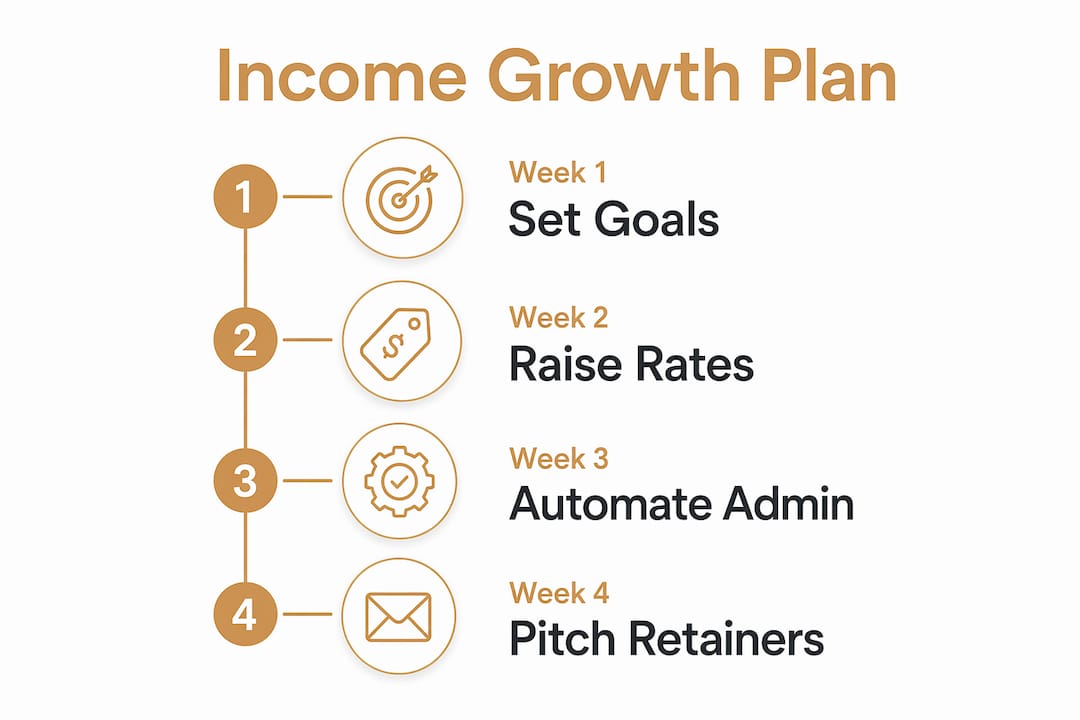
Week 1: Set your income target, break it into quarterly and monthly numbers, and start tracking your time in Clockify. Calculate your effective hourly rate on your last three projects.
Week 2: Draft a rate increase email for one client or set a higher rate for your next new client inquiry. Identify your niche and rewrite your bio or LinkedIn headline to reflect it.
Week 3: Set up automated invoice reminders in Wave or FreshBooks. Batch your admin tasks into two fixed windows per day and protect the rest for billable work.
Week 4: Reach out to one past client with a specific retainer proposal. Ask one current client for an outcome-specific testimonial. Add one AI tool to your workflow for a task you currently do manually.
The compounding effect of these moves is what makes the difference over a full year. One freelance writer who implemented structured goal tracking, time tracking, and a single rate increase went from $39,200 to $70,500 in one year, a 79% increase, while working part-time hours and maintaining a full personal life. That’s not a unicorn story. It’s what happens when you stop guessing and start treating your freelance work like the business it actually is.
Ready to work smarter with AI on your side?

If you’re serious about growing your freelance income without burning out or hiring a team, the right AI tools can do the heavy lifting on the tasks that eat your time. Yoursolobusiness has put together a practical AI toolkit for freelancers that covers exactly which tools to use, how to set them up, and how to integrate them into your workflow so you’re billing more and grinding less.
Key Takeaways
The most effective way to increase freelance income is to raise your rates, specialize in a niche, automate administrative work, and build retainer relationships that create predictable monthly revenue.
| Point | Details |
|---|---|
| Specialize to earn more | Specialized freelancers command 25–60% higher rates than generalists in the same field. |
| Track your effective hourly rate | Divide total income by all hours worked, including admin, to find your real profitability. |
| Retainers pay a premium | Retainer clients pay 15–30% more than equivalent project fees and reduce feast-and-famine cycles. |
| AI reclaims billable time | AI tools can recover 2–4 hours of non-billable time per client every month. |
| Raise rates starting with new clients | Phase in increases for existing clients at renewal points after raising rates for new ones first. |