
TL;DR:
- Small businesses can save 10–15 hours weekly by using ChatGPT for content creation, customer service, and workflows. The ChatGPT Plus plan at $20 per month provides better message limits, file analysis, and customization options, making it suitable for daily use. Integrating AI agents enables automation of repetitive tasks, freeing time and scaling operations without additional staff.
ChatGPT for small business is defined as using OpenAI’s large language model to handle writing, customer communication, research, and workflow automation without adding headcount. Small businesses and solopreneurs using AI tools this way can save 10–15 hours per week on tasks like email drafting, content creation, and customer responses. That kind of time recovery is the difference between spinning your wheels and actually growing. The right approach turns ChatGPT from a novelty into a core part of how you run your business every single day.
What are the most effective ChatGPT use cases for small businesses?
ChatGPT applications cover nearly every repetitive task a small business owner faces. The key is knowing where to start so you get fast wins without overcomplicating things.

Content creation is the most immediate win. A typical 1,000-word blog draft takes about 15 minutes with ChatGPT versus 2–3 hours manually. That math alone justifies the tool for any solopreneur doing content marketing.
Here are the highest-impact use cases to tackle first:
- Marketing content: Blog posts, product descriptions, ad copy, and landing page text all respond well to ChatGPT. Give it your audience, tone, and goal, and it produces a solid first draft fast.
- Email drafting: Pitch emails, follow-ups, client proposals, and newsletter copy. ChatGPT matches tone and length to whatever you specify.
- Customer service responses: Reply to reviews, handle common support questions, and write FAQ answers. ChatGPT for customer service cuts response time dramatically.
- Social media captions: Generate a week of posts in one session. Batch the work, then schedule it.
- Standard Operating Procedures: This is the underrated one. Creating SOPs with ChatGPT turns chaotic, reactive tasks into documented, repeatable workflows. That is how you build a business that does not depend entirely on you showing up every hour.
- Training materials: Onboarding docs, process guides, and internal knowledge bases. If you ever bring on a contractor or VA, these materials save you hours of hand-holding.
ChatGPT for marketing is especially powerful when you treat it as a content engine. Feed it your brand voice, your audience pain points, and your offer. It handles the heavy lifting while you focus on strategy and relationships.
Pro Tip: Write a “brand brief” prompt that includes your business name, target customer, tone of voice, and top three differentiators. Paste it at the start of every ChatGPT session to get on-brand output from the first message.
Which ChatGPT plan makes sense for small businesses in 2026?
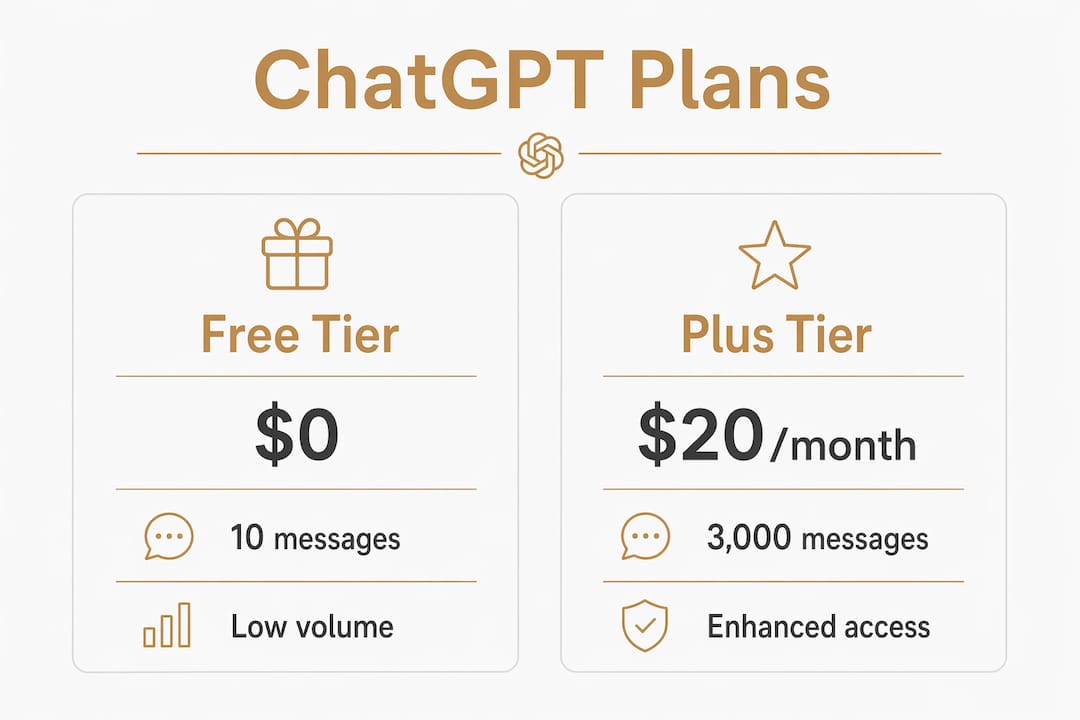
The free tier of ChatGPT limits you to roughly 10 messages every 5 hours. That cap kills productivity the moment you try to use it seriously for business. You hit the wall right when you are on a roll.
The ChatGPT Plus plan at $20 per month removes that friction. It gives you up to 3,000 messages per week, access to GPT-5.2, file analysis, and Custom GPTs. For most solopreneurs, the time saved in the first week alone covers the monthly cost.
| Plan | Monthly Cost | Best For |
|---|---|---|
| Free | $0 | Occasional, low-volume tasks |
| Plus | $20 | Solopreneurs and small business daily use |
| Business/Enterprise | $30+ per user | Teams of 3 or more needing admin controls |
The Business or Enterprise tier makes sense when you have multiple people accessing shared workflows and need admin controls or data privacy guarantees. For a one-person operation, Plus is the right call.
Pro Tip: Use the file analysis feature in Plus to upload a spreadsheet of customer data or sales figures. Ask ChatGPT to summarize trends and flag anomalies. You get analyst-level insight in minutes, not hours.
Setting ChatGPT up for business use takes about 30 minutes. Write your Custom Instructions with your business context, preferred tone, and output format. Then build a Project folder for each major workflow, like marketing, client communication, and operations. This structure means you are not re-explaining your business every single session.
How can small businesses integrate ChatGPT with AI agents and automation tools?
The 2026 shift in how to use ChatGPT in business is moving from text generation to autonomous action. AI agents do not just write things. They run end-to-end workflows in plain English without requiring any code. That changes what a solo operator can realistically accomplish alone.
Think of an AI agent as a virtual employee who never sleeps and never forgets a step. You define the workflow once, and the agent executes it repeatedly.
Here are the workflows small businesses are automating right now with AI agents:
- Lead qualification: An agent reviews incoming inquiries, scores them against your criteria, and routes hot leads to your calendar.
- CRM updates: After a sales call, an agent logs notes, updates the contact record, and sends a follow-up email automatically.
- Scheduling and reminders: Agents handle booking confirmations, reschedule requests, and reminder sequences without you touching a single message.
- Report generation: Weekly performance summaries, social media analytics, and revenue snapshots get compiled and delivered on schedule.
- Multi-app workflows: Agents connect your form submissions, email platform, project management tool, and CRM into one automated sequence.
Small teams using AI agents typically recover 10–20 hours per week per person, absorbing repetitive tasks like lead qualification and ticket triage at machine speed without additional salaries. For a solopreneur, that is the equivalent of hiring a part-time assistant without the payroll.
No-code platforms let you build these agents by describing the workflow in plain English. You do not need a developer. You need clarity about what the process looks like, step by step. That is where business automation for freelancers becomes a real competitive edge. The solopreneurs who figure this out first are the ones who scale without burning out.
What best practices help small businesses get the most from ChatGPT?
Getting great output from ChatGPT is a skill, and it is learnable. The quality of your prompt directly determines the quality of the output. Vague prompts produce vague results. Specific prompts produce usable first drafts.
Follow these five practices to build a repeatable, high-quality system:
- Write specific prompts. Include your audience, the desired tone, the format, the word count, and the goal. “Write a 300-word Instagram caption for a freelance graphic designer targeting e-commerce brands, using a confident and friendly tone” beats “write a social media post” every time.
- Use Custom Instructions or Projects. Store your business context, brand voice, and preferred output formats so ChatGPT applies them automatically. This cuts setup time per session to zero.
- Treat output as a first draft. AI tools for small business work best when a human reviews and refines the output. Blend prompt specificity with human oversight to protect your brand voice and accuracy.
- Start with one task, then expand. Pick the task that costs you the most time right now. Master ChatGPT for that one job before adding more. Measure the hours saved, then use that proof to justify expanding.
- Build SOPs for every workflow you automate. Document the prompt, the process, and the editing checklist. This makes the system repeatable and trainable, whether you bring on a contractor or hand it off to an agent later.
Pro Tip: Create a “prompt library” document where you save your best-performing prompts. Organize them by task type. This becomes one of the most valuable assets in your business over time.
AI-powered market intelligence adds another layer. Small businesses gain access to local market trends and competitor data that used to require a full marketing team to gather. ChatGPT can analyze that data and turn it into a clear summary you can act on. That is the fractional C-suite advantage that solo operators now have access to.
Key Takeaways
ChatGPT for small business delivers its highest return when you combine specific prompting, human review, and documented workflows into a repeatable system.
| Point | Details |
|---|---|
| Start with content and email | Blog drafts and email copy are the fastest wins with the highest time savings. |
| Choose ChatGPT Plus | The $20/month plan removes message caps and unlocks file analysis and Custom GPTs. |
| Build SOPs with ChatGPT | Documented workflows turn one-time tasks into repeatable, scalable processes. |
| Use AI agents for automation | No-code agents handle lead qualification, CRM updates, and reporting without staff. |
| Prompt specificity drives quality | Detailed prompts with audience, tone, and format produce usable first drafts every time. |
Why I think most small businesses are still using ChatGPT wrong
Most small business owners I talk to use ChatGPT like a search engine. They type a vague question, get a mediocre answer, and conclude the tool is overhyped. That is not a ChatGPT problem. That is a prompt problem.
The real power shows up when you treat ChatGPT as a system, not a session. I spent the first few months using it reactively, one-off task by one-off task. The shift happened when I started building prompt templates, storing context in Projects, and connecting outputs to actual workflows. Suddenly I was not just saving time on individual tasks. I was removing entire categories of work from my plate.
The other mistake I see constantly is trying to automate everything at once. Pick one workflow. Get it working well. Measure the time you recover. Then move to the next one. The 2026 trends in solopreneurship point clearly toward AI agents doing multi-step work, but you need clean, documented processes before an agent can run them reliably.
My honest advice: do not skip the SOP step. It feels like extra work upfront. It is actually the thing that makes everything else compound. A well-documented process is something you can hand to an AI agent, a contractor, or your future self six months from now. That is how a one-person business starts operating like a team.
– Jay
Tools and resources to run your solo business with AI
If ChatGPT has you thinking about what else you could automate or systematize, you are asking exactly the right question.
Yoursolobusiness is built for solopreneurs who want to run at team-level output without building a team. The productivity toolkit for solopreneurs covers the full AI stack, including the tools Jay uses daily to replace entire workflows. You will find prompt libraries, implementation checklists, and honest reviews of the tools that actually move the needle. If you are ready to build a one-person business system that runs without you being in every task, that is the place to start.
FAQ
What is ChatGPT and how does it help small businesses?
ChatGPT is an AI language model developed by OpenAI that generates human-like text for tasks like writing, customer communication, and data analysis. Small businesses use it to cut hours of manual work each week without hiring additional staff.
How much does ChatGPT cost for business use?
The ChatGPT Plus plan costs $20 per month and is the recommended option for professional business use, offering up to 3,000 messages per week and access to GPT-5.2 and file analysis.
Can ChatGPT replace a customer service team?
ChatGPT handles common customer questions, review responses, and FAQ content reliably, but human review of customer-facing output is still the best practice for accuracy and brand consistency.
What is the fastest way to get results with ChatGPT for marketing?
Start with blog post drafts and email copy, using specific prompts that include your audience, tone, and goal. A 1,000-word draft takes about 15 minutes, compared to 2–3 hours written manually.
What are AI agents and should small businesses use them?
AI agents are automated workflows that perform multi-step tasks like lead qualification, CRM updates, and report generation without human input. No-code platforms let small businesses build these agents in plain English, with no programming required.