
A productized service is a repeatable, fixed-scope service sold like a product. It turns variable client work into predictable, scalable revenue with a set price, a documented process, and clear deliverables. For freelancers and solopreneurs stuck trading hours for dollars, this is the single biggest lever for growing income without growing headcount.
TL;DR:
- Focusing on narrow, repeatable work such as audits or content rewrites enables better pricing, faster sales, and predictable capacity management.
- Using fixed scope, clear exclusions, and self-serve purchasing creates client trust and scales solo businesses more effectively than custom, hourly projects.
- Validating the offer through pre-sells with targeted buyers minimizes risk, while tracking actual delivery hours refines pricing and ensures margin preservation.
- Automating intake, billing, and basic delivery tasks with simple tools like client portals and AI drafts reduces admin friction and supports growth.
- Concentrating on one reliable package before expanding allows solo founders to develop expertise, boost credibility, and identify operational bottlenecks early.
What Productized Services Actually Are
Strip away the buzz and a productized service comes down to four things: a fixed deliverable, a documented process, clear exclusions, and a hard capacity limit. You know exactly what the client gets, how long it takes, and what falls outside the scope before a single email gets sent. That’s the whole model. Productized services package expertise into fixed-price, repeatable offerings with clear deliverables and standardized workflows, which is a very different proposition than “custom consulting, billed hourly.”
Compare that to typical freelance work, where every project starts from a blank page: new scope, new quote, new negotiation, new anxiety about whether you priced it right. A productized offer replaces all of that improvisation with a menu. The client picks a package, not a conversation.
The purchase path matters just as much as the deliverable. The strongest productized offers use self-serve or low-friction buying: a landing page, a checkout button, maybe a short intake form. No sales call required for the base tier. A strong productized offer relies on clear packages, repeatable SOPs, fixed pricing, and self-serve purchasing to create predictable revenue, and that self-serve layer is what actually lets a one-person business scale past the limits of their own calendar.
Here’s the part most people miss: the constraints aren’t a compromise, they’re the pitch. A narrow scope with explicit exclusions signals competence, not limitation. When you say “we only do five-interview insight sprints, delivered in seven business days, no ongoing strategy calls,” you sound like someone who has done this a hundred times. Vague scope reads as inexperience dressed up as flexibility. Tight scope reads as expertise.
Why Productize: The Measurable Upside
The case for productizing isn’t emotional, it’s arithmetic. Fixed-price, repeatable delivery makes revenue forecasting possible in a way that hourly billing never does. When you know exactly what a package costs to deliver and exactly what it sells for, you can predict next quarter’s income instead of guessing at it.
The benefits stack up in a few concrete ways:
- Predictable monthly revenue. A subscription or retainer-style package smooths out the feast-or-famine cycle that kills most solo businesses.
- Better margins per hour. Once your delivery process is documented, the fifth client costs you far less time than the first.
- Faster sales cycles. Buyers choosing from a menu decide faster than buyers waiting on a custom proposal.
- Less scope creep. A fixed deliverable with named exclusions gives you something to point to when a client asks for “just one more thing.”
Statistic Callout: The rise of accessible client-portal tools, AI agents, and modern billing systems has made productized services meaningfully easier to deliver and scale than they were a decade ago, which is exactly why solo founders are the ones benefiting most from this shift right now.
Productizing isn’t universal medicine, though. If your work is genuinely bespoke every time, forcing it into a fixed package can hurt quality and client trust. Skip productizing for one-off custom integrations, anything where legal liability shifts wildly project to project, or work where the client relationship itself, not the deliverable, is the product.
Is Your Service a Good Fit to Productize?
Some work copies well into a package. Some doesn’t. The difference usually comes down to how repeatable the underlying process is, not how skilled you are.
Good candidates tend to be things you’ve already done a dozen times with minor variation: content audits, client onboarding builds, copy editing, conversion rate reviews, landing page rewrites. If you can describe the steps from memory without opening a template, that’s a signal.
- Content production and editing (recurring, teachable, easy to time-box)
- Audits and diagnostics (fixed inputs, fixed report format)
- Onboarding and setup work (same checklist, different client)
- Conversion or performance “clinics” (narrow scope, clear before/after)
Deep, narrow expertise supports premium pricing inside a package, but shallow familiarity doesn’t. Shallow expertise can’t justify premium productized offers; the pricing has to be backed by genuine repeated experience, not a template you copied last week.
Poor fits: one-off system integrations, anything driven by compliance or heavy legal review, and work where every client’s situation genuinely changes the entire approach.
A practical framework to productize any service
You don’t need a business plan to start. You need seven decisions made in the right order.
-
Audit your past work for patterns. Pull your last 10 to 20 client projects and look for the task you repeated almost identically each time. That repetition is your raw material. Practitioners consistently recommend starting narrow: find the most repeatable, high-value slice of past work and productize that first, not your whole service line.
-
Pick a narrow buyer and a trigger event. Don’t sell to “small businesses.” Sell to “SaaS founders who just closed a funding round and need investor-ready messaging.” A specific trigger event (a launch, a hire, a rebrand) tells you exactly when to market.
-
Define inputs, outputs, turnaround, and exclusions. Write down precisely what the client sends you, what they get back, how many days it takes, and what is explicitly not included. This document becomes your sales page later.
-
Document the SOP and set capacity rules. Turn your process into a checklist a contractor could follow. Then decide a hard cap, something like four active clients per delivery slot, so quality never slides as demand grows.
-
Price from capacity and cost, then pilot with real clients. Calculate what it actually costs you in hours, add margin, and test that price on five real buyers before publishing it publicly.
-
Build the minimum tech stack. An order page, an intake form, a billing tool, and a simple client portal are enough to launch. Nothing more.
-
Pilot, measure actual hours, then iterate. Your first guess at pricing and turnaround will be wrong somewhere. Track real hours spent per client and adjust before you scale marketing.
Pro Tip: Run your pilot with clients you already have a relationship with. You’ll get honest feedback on scope and pricing without risking your reputation on strangers.
Solo founders launching offers like this should build in capacity safeguards and test priced assumptions through piloting rather than committing to a price before real delivery data exists.
Pricing and Packaging Rules That Protect Your Margin
Price from what delivery actually costs, not from what feels fair. Track hours across your pilot clients, add your margin target, then factor in reserved capacity, the time you’re deliberately not filling so quality doesn’t slip when volume increases.
Subscriptions make sense when the work recurs naturally, like ongoing content or fractional editing. One-off pricing fits work with a clear finish line, like an audit or an onboarding build. If you’re unsure which one, ask whether the client needs you again in 30 days. If yes, build a subscription tier around that need instead of re-selling the same one-off repeatedly.
Tier patterns that consistently work:
- Speed tiers (standard delivery vs. rush delivery at a premium)
- Volume tiers (one deliverable vs. a monthly bundle of five)
- Seniority tiers (standard operator vs. senior review pass)
- Add-ons priced separately from the core package (extra revisions, expedited turnaround, a strategy call)
Statistic Callout: Successful productized offers routinely enforce operational capacity caps, something as specific as a fixed number of clients per delivery slot, because that cap is what makes the quality promise behind the price credible in the first place.
Explicit exclusions do double duty: they protect your margin from scope creep and they clarify the offer for buyers who were on the fence. “This package doesn’t include ongoing strategy calls” isn’t a weakness to hide, it’s a line that closes sales faster.
Operations and Tech: What to Automate First
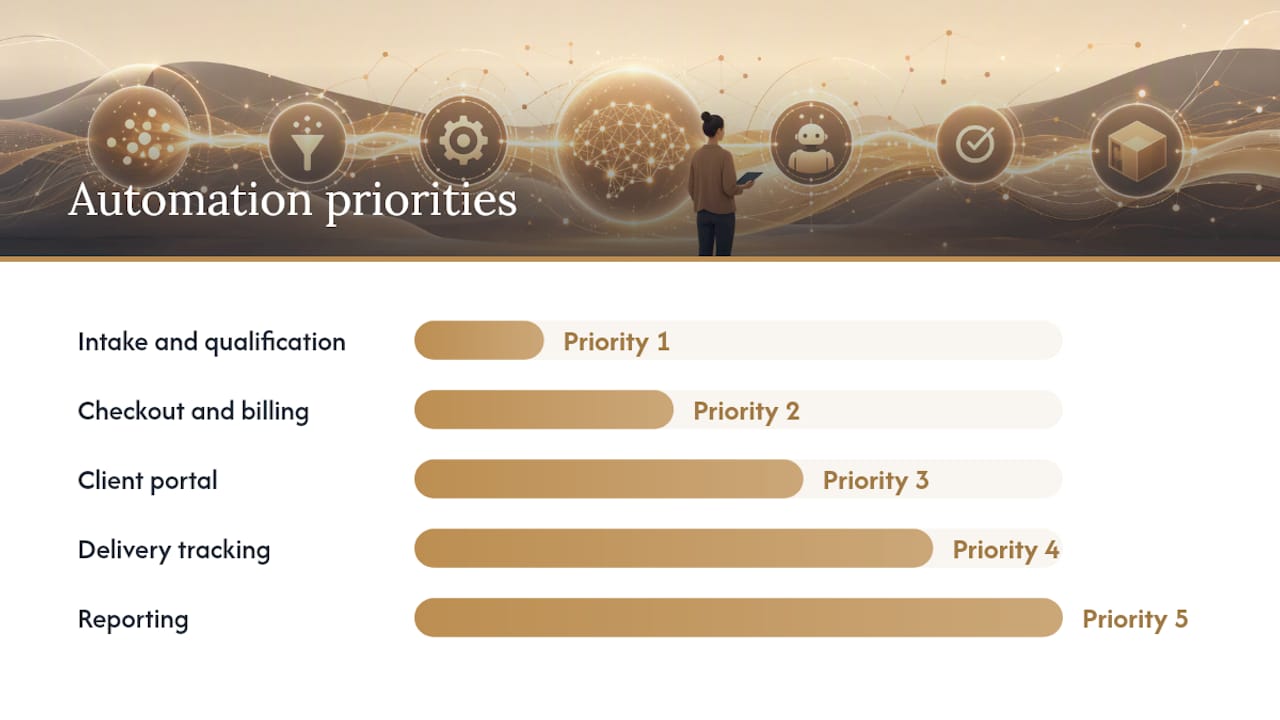
You don’t need a full stack on day one. You need five systems working, roughly in this order of priority.
- Intake and qualification — a short form that filters out bad-fit buyers before they book anything.
- Checkout and billing — a way to charge automatically without emailing an invoice every time.
- Client portal — a single place for files, status updates, and deliverables, instead of scattered email threads.
- Delivery tracking — even a simple board that shows where each client sits in your pipeline.
- Reporting — a lightweight view of what’s earning, what’s costing time, and what’s overdue.
Client portal and subscription billing platforms genuinely reduce the admin friction that kills solo operators, and tools like RealClients are built specifically for that intake-to-delivery workflow.
Ship intake and billing before anything else. They’re the difference between a real business and a hobby with invoices. Once those two are running, layer AI into the delivery side: draft generation for the first pass of a deliverable, automated quality checks against your SOP, scheduling for client calls, and templated responses for the repetitive parts of client communication. A client onboarding checklist built early saves you from rebuilding your intake process every time you add a new package.
Copy These Package Templates and Adjust
These six templates are starting points, not finished products. Swap the specifics for your niche and you have a sellable offer within a week.
- Five-interview insight sprint. Inputs: access to five customers. Deliverable: a synthesis report. Turnaround: seven business days. Best for founders who need voice-of-customer data fast.
- One-page offer rewrite. Inputs: current landing page copy. Deliverable: rewritten hero section and CTA. Turnaround: three days. Best for early-stage SaaS founders.
- Weekly content bundle. Inputs: brand voice guide. Deliverable: four posts a week. Priced as a monthly subscription. Best for solo consultants building an audience.
- Speed optimization sprint. Inputs: site access. Deliverable: a prioritized fix list plus implementation of the top three items. Turnaround: five days.
- Fractional editor subscription. Inputs: draft documents. Deliverable: edited copy, capped at a set word count monthly. Best for founders who write but don’t love editing.
- Onboarding automation setup. Inputs: current intake process. Deliverable: a built automated workflow. Turnaround: 10 days. Best for agencies scaling past their founder’s calendar.
Adapting any of these starts with your own audit from Step 1 above: find where your niche’s version of this pattern already exists in your past client work.
Why Productized Offers Fail (and the Exact Fix)
Most failures trace back to one of four causes, and each has a specific operational fix, not a vague “be more disciplined.”
- Scope creep. Fix: strict intake gating and a written exclusions document clients sign off on before you start.
- Founder dependency. Fix: test whether a contractor or senior hire can deliver the package using only your SOP, no shadow supervision from you.
- Underpricing. Fix: run the pilot, track real hours, and set the final price from measured capacity, not your first guess.
- Poor positioning. Fix: narrow the buyer and attach a specific trigger event instead of marketing to “anyone who needs this.”
Many productization attempts fail because founders package the offer before nailing the positioning; the buyer and the problem have to come first, everything else gets built around that.
Pro Tip: Write your exclusions list before you write your sales page. If you can’t name what’s excluded, your scope isn’t actually fixed yet.
Launching and Landing Your First Paying Customers
Skip the perfect website. Validate the offer first, then build around what actually sells.
- Pre-sell to five target buyers before building anything beyond a description of the deliverable. Their willingness to pay validates price and scope faster than any amount of planning.
- Add qualifying intake questions to your form so unqualified leads self-select out before you waste a call on them.
- Build a short landing page with the deliverable, turnaround, and price stated plainly, plus a working checkout button.
- Convert pilot results into proof. A single detailed before-and-after from your pilot clients does more selling than a generic testimonial ever will.
A tool like LeadPilot can help fill the top of that funnel once your offer is validated and you’re ready to push volume through outbound.
Running It Solo: The AI Stack That Replaces a Team
AI handles the repeatable middle of delivery reliably: first-pass drafts, formatting checks against your SOP, scheduling, and templated client updates. It doesn’t replace judgment on edge cases, a client whose situation doesn’t fit the standard intake, or a deliverable that needs a real quality call before it ships.
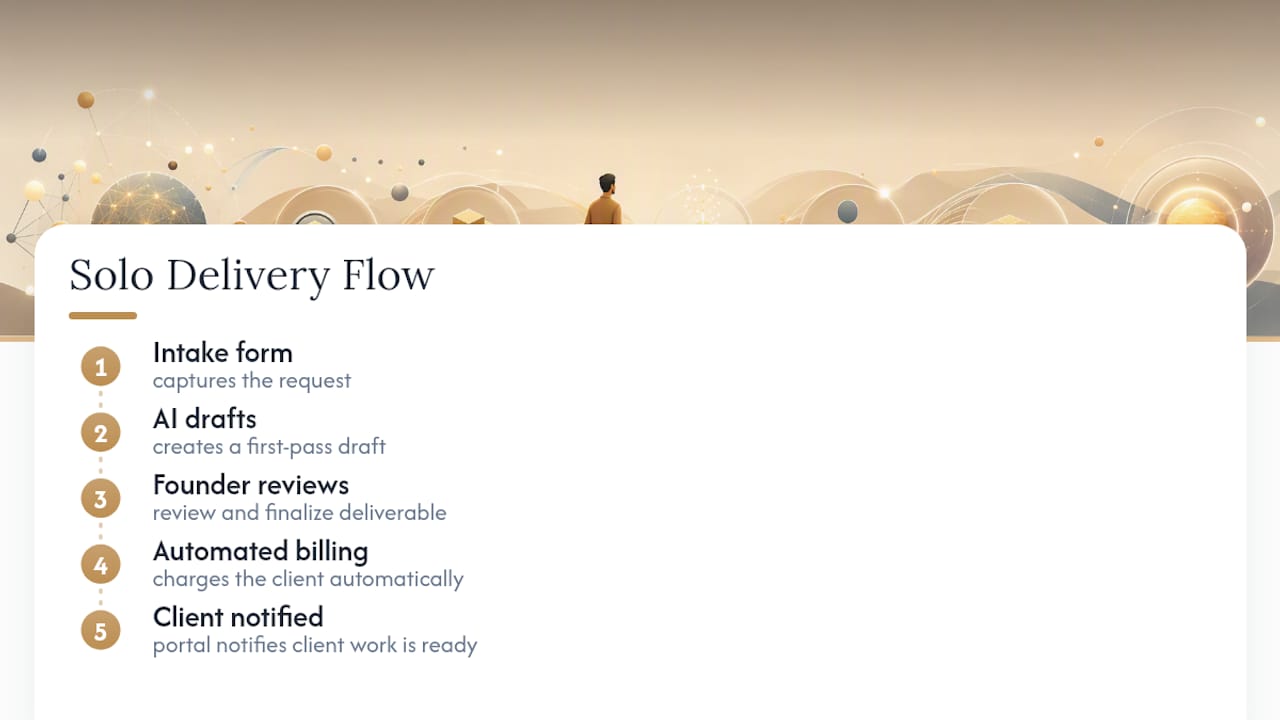
A workable solo flow looks like this: intake form captures the request, an AI tool drafts the first version, you review and finalize, billing charges automatically, and the client portal notifies them it’s ready. A curated AI stack plus strict intake forms can substitute for a team in early scale, though human review on anything unusual stays non-negotiable.
Automate drafting and scheduling immediately. Hold off automating client communication tone until after your first five paying customers, so you know what actually needs saying.
Start Narrow, Get It Right, Then Scale
Conventional wisdom says diversify early so you’re not dependent on one offer. I think that’s backwards for a solo founder. One narrow package, built well, teaches you more about pricing, delivery time, and buyer objections than three vague ones ever will.
The constraint is the credibility. “We only do this one thing, and we do it in seven days” beats “we can help with basically anything” every time a skeptical buyer is deciding whether to trust a stranger with their money. Pilots that stay narrow tend to surface their real problems (a pricing gap, a bottleneck task) within the first two or three clients, which is exactly when you want to find them.
Get the narrow version profitable before you touch a second offer. Everything compounds from there.
— Jay
Get the Templates and Checklists to Build This Faster
Reading the framework is one thing. Building the intake form, drafting the SOP, and picking the right AI tools for delivery is where most solo founders stall out. That’s exactly the gap the AI Toolkit is built to close: a checklist-driven resource with prompt libraries and a curated tool list for the operations and delivery work covered in this guide.

It’s built around the same sequencing this article recommends: intake and billing first, delivery automation second. If you’re ready to build the onboarding side of your productized offer specifically, the client onboarding automation guide walks through a 30-day build you can run alongside your first pilot. Start with a toolkit, pick the two or three tools that match your first package, and get your intake form live.
Sources
For more on structuring packages and pricing, the Copyblogger breakdown of productized services and Investopedia’s definition of productization both cover the fundamentals well. For solo-specific examples and capacity planning, see 100Tasks’s guide for solo founders.
- What Are Productized Services? Strategy and Examples — Copyblogger
- Productized services — Assembly blog
- Productized Services Examples: What to Copy, What to Ignore — Haus Advisors
- 10 Productized Service Examples for Solo Founders (2026) — 100Tasks





Leave a Reply