Content analytics with AI uses natural language processing, computer vision, and machine learning to tie specific content attributes, like a headline’s tone or an image’s color palette, to outcomes like clicks and conversions. That means you stop guessing which creative “feels right” and start knowing which one actually moves your numbers.
Here’s what that looks like in practice:
- A blog post’s structure and sentiment get scored against which paragraphs keep readers scrolling.
- A video’s first three seconds get flagged as a common point where many viewers bail.
- A product photo’s color scheme gets linked to a lift in add-to-cart rate.
You get faster decisions, fewer wasted assets, and a real answer to “why did this work?”
Key Takeaways
Content analytics with AI works because it ties specific, measurable content attributes to business outcomes, replacing guesswork with a repeatable test-and-learn loop.
| Point | Details |
|---|---|
| Define the question first | Skip vague exploration; start with one specific, measurable question before choosing a tool. |
| Match technique to modality | Use text-based NLP for copy questions and cross-modal analysis only once you trust the basics. |
| Build in human validation | Set a confidence threshold and route uncertain classifications to a human reviewer. |
| Watch for bias and drift | Audit your sample regularly and retrain models tied to real KPI shifts, not a fixed calendar. |
| Close the decision gap | Analytics only shape about 53% of marketing decisions; build a review cadence that forces action. |
What Does Content Analytics With AI Actually Measure?
AI content analytics can look at almost any format you publish. Text, images, video, audio, and increasingly the relationships between them, all fall inside its reach now. That cross-modal piece matters: instead of scoring your blog copy and your thumbnail image separately, modern tools can connect the two and show how they perform as a single unit.
Here’s what gets measured, roughly in order of how often marketing teams actually track it:
- Engagement — time on page, scroll depth, watch time, replay rate.
- Attention — where eyes go first, and where they drop off entirely.
- Sentiment — the emotional register of comments, reviews, and social replies.
- Conversions — clicks, sign-ups, purchases tied back to a specific content attribute.
- Attribute lift — the measurable difference one variable makes, isolated from the noise.
That last one is where things get interesting. Say two nearly identical product images get tested, one warm-toned, one cool-toned. If the warm version consistently outperforms on conversion rate across several audiences, you’ve isolated mood and color as a real driver, not a coincidence. Adobe Content Analytics builds its entire product around this kind of attribute-to-outcome mapping, flagging anomalies before a human analyst would even notice the pattern.
Which AI Techniques Power Content Analysis?
You don’t need a data science degree to use these tools, but knowing what’s under the hood helps you ask better questions and spot bad outputs. Five techniques do most of the heavy lifting.
- NLP primitives — tokenization, named entity recognition, sentiment scoring, and semantic embeddings turn raw text into structured, comparable data.
- Topic modeling and clustering — groups your content by theme automatically, surfacing gaps in your library you didn’t know existed.
- Supervised classification — models trained to sort content into buckets like “likely to convert” versus “likely to bounce,” based on patterns from your own historical data.
- Computer vision — tags visual attributes (color, composition, faces, product placement) and tracks where attention concentrates in an image or video frame.
- Cross-modal fusion — links what’s visual with what’s textual and behavioral, so a headline’s tone and a thumbnail’s mood get evaluated together instead of in silos.
ATLAS.ti’s guidance on AI content analysis describes how these techniques now automate transcription, coding, and pattern discovery at a scale that used to require a research team working for weeks. Text-based analysis tends to be the most mature and affordable entry point; cross-modal analysis is catching up fast but usually costs more and takes longer to configure well.
Pro Tip: Don’t start with cross-modal analysis if you’ve never run a content analytics project before. Nail text-based sentiment and topic clustering first, then layer in visual and video analysis once your team trusts the outputs.
Where Does AI Content Analytics Actually Move the Needle?
Five use cases account for most of the real value marketing teams report.
- Creative attribute testing — isolate a single variable (image style, CTA wording, video length) and run a holdout test to confirm the AI’s prediction before you scale the winning version.
- Social listening — spot a trend forming in real time and turn it into content before your competitors notice, rather than reacting three days late with help from an AI Brand Mentions tool for marketers.
- SEO and topic discovery — automated topic maps reveal content gaps your competitors haven’t filled yet, not just keywords you’re already ranking for.
- Video attention analysis — pinpoint the exact second viewers drop off, then move your call-to-action earlier instead of burying it at the end.
- Content audits — score your entire back catalog at once, flagging which pages deserve a rewrite and which ones should just be retired.
That last one alone can reshape a quarter’s content calendar. Instead of guessing which blog posts are underperforming, a scored audit tells you which ones deserve attention first, and it completes the process in a fraction of the time manual audits would take.
How Do You Actually Implement This?
Here’s the workflow, adapted from Dovetail’s seven-step process for AI content analysis, that keeps a project from turning into a science experiment with no business payoff.
- Define your question first. “Which video intros drive the highest completion rate?” beats “let’s see what the AI finds.”
- Assemble a representative sample. Pull content across every channel and format the question touches, not just your best-performing pieces.
- Match the technique to the question. Text-only sentiment analysis is overkill if your real question is about video pacing.
- Plan for human validation. Set a confidence threshold (say, 85%) below which a person reviews the AI’s tag or classification before it feeds a decision.
- Build a review cadence. Weekly or biweekly, turn insights into a quick A/B test or a creative refresh, not just a slide in a deck nobody opens again.
- Automate what repeats. A lightweight prompt library or scheduled report does more for a one-person content team than a full enterprise dashboard.
Pro Tip: If you’re running content analytics solo, resist the urge to measure everything at once. Pick one KPI, one content type, and one tool. Prove the loop works before you scale it.
Small teams win here because they can move fast on what the data says. A solo operator who spots a pattern on Tuesday can publish the fix by Thursday, no committee required.

What Are the Risks and Governance Gaps to Watch?
AI models reflect whatever data trained them, and that includes their blind spots. A sentiment model trained mostly on formal business writing will misread sarcasm or regional slang in your comment section, and it won’t tell you it’s confused.
A few failure modes show up again and again:
- Sampling bias — analyzing only your top-performing content skews every conclusion toward what already works.
- Privacy exposure — user-generated content, video recordings, and voice data all carry consent and retention obligations you can’t skip.
- Model drift — a model trained on last year’s audience behavior slowly becomes less accurate as trends shift underneath it.
- Missing explainability — if you can’t say why the model flagged something, you can’t defend the decision it drove.
There’s a bigger structural problem, too. A Gartner survey found that marketing analytics only influence about 53% of actual decisions, meaning nearly half the time, teams build the dashboard and then ignore it anyway. A simple governance checklist closes that gap: track data provenance, set retention limits, and schedule quarterly human audits tied to your KPI results, not just a calendar reminder.
How Do Leading Tools Handle Content Analytics Differently?
Vendors tend to cluster into a few capability buckets, and knowing which bucket you need saves you from buying features you’ll never touch.
- Attribute intelligence platforms connect visual and textual content attributes directly to conversion data. Adobe Content Analytics is built around this, with anomaly detection that flags underperforming assets automatically.
- Social AI and listening tools track live conversations and surface emerging trends. Hootsuite’s Wisdom and Yeti Agent analyze sentiment across social channels and generate content suggestions in response.
- Content discovery frameworks built into CMS platforms, like Contentful’s approach to content discovery, help teams find and reuse high-performing assets across a growing library.
- Qualitative research platforms like Dovetail and ATLAS.ti specialize in coding interviews, open-ended survey responses, and unstructured feedback at scale, turning weeks of manual tagging into hours.
Shortlist by matching your actual need: integration with your existing stack, which content modalities you need covered, and how directly the tool activates insights into a next step, whether that’s a test, a rewrite, or a campaign brief.
Why Most Teams Get This Backward
Most advice on this topic treats AI content analytics like a dashboard you install and walk away from. That’s backward. The tools I’ve described here are only as good as the question you feed them, and most teams skip straight to “let’s see what the AI finds” instead of defining what decision they’re actually trying to make.
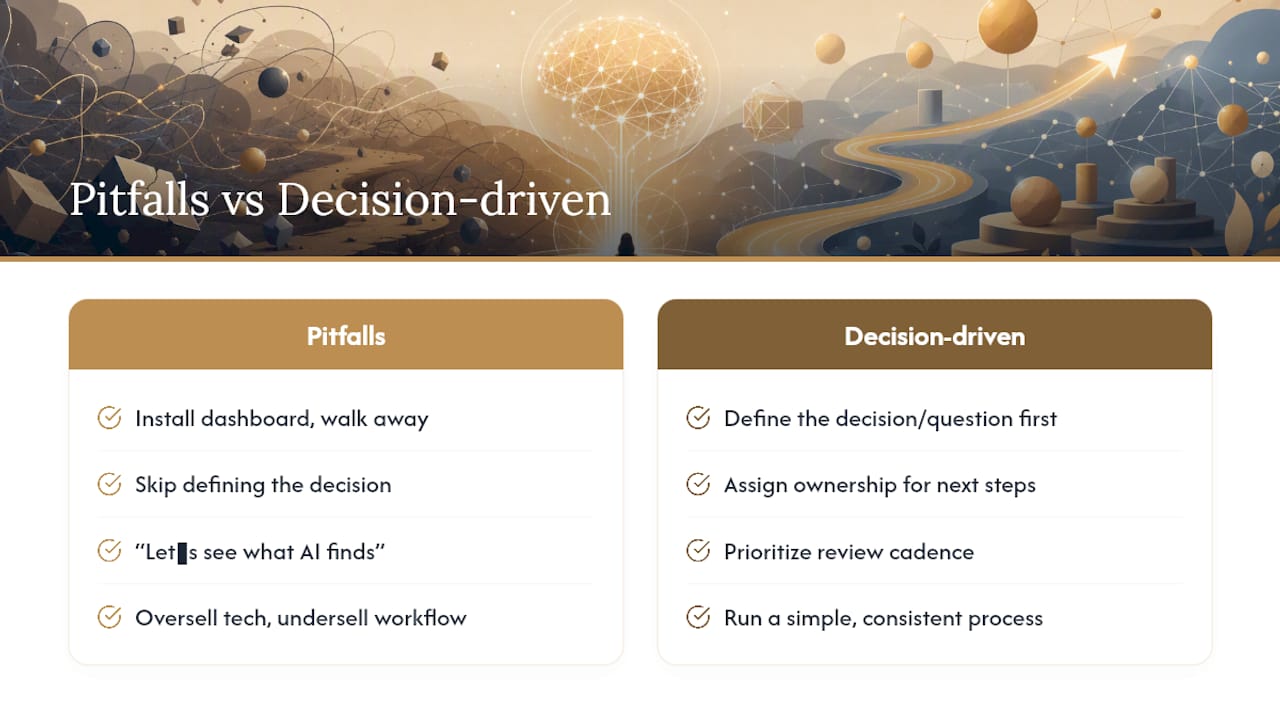
The conventional wisdom oversells the technology and undersells the workflow around it. A model that flags your best-performing thumbnail style is useless if nobody owns the follow-up test. That’s exactly why the Gartner finding on analytics only shaping about half of marketing decisions matters so much: the bottleneck was never the AI, it’s what happens after the insight lands on someone’s desk.
If you’re a solo operator or a lean content team, prioritize the review cadence over the tool. Pick something simple, run it consistently, and let the pattern of small wins compound. That habit beats any single platform’s feature list, and it’s the same principle behind automating other parts of a one-person business: the system matters more than the tool inside it.
— Jay
Ready to stop guessing which content actually earns its keep? The Your Solo Business AI toolkit rounds up the AI tools worth testing first, so you can build your content analytics workflow without wading through a hundred options that don’t fit a one-person operation.
Sources
- ATLAS.ti — AI Content Analysis guide
- Dovetail — How to do AI content analysis
- Hootsuite platform AI features (Yeti Agent, Wisdom)