
AI search visibility is how often ChatGPT, Perplexity, and Google AI Overviews mention or cite your brand when someone asks a relevant question. It matters more than classic rankings because these answers often close the loop before a click ever happens, and the traffic that does arrive converts at a notably higher rate. Your first move takes fifteen minutes: run ten priority prompts across ChatGPT, Perplexity, and Google AI Overviews, and note whether your brand shows up at all.
TL;DR:
- AI search citations are binary; your brand is either mentioned or not, with no ranking decay like traditional SEO.
- Tracking mentions, citations, citation share, visibility score, share of voice, and prompt coverage provides a comprehensive picture of your AI visibility.
- Improving citation rates involves technical site checks, structuring content for easy extraction, and earning third-party mentions or PR placements.
- Manual testing is viable for small teams, but paid tools are necessary for large prompt sets, provided their methodology can be verified.
- Focus on your most impactful platform first, run repeated prompt tests, and update top pages within 30 to 90 days for measurable progress.
What Is AI Search Visibility, and How Does It Differ From SEO?
AI search visibility measures whether a generative engine mentions, cites, or links to your brand when it answers a question. In the industry, you’ll also hear it called Generative Engine Optimization (GEO) or, less commonly, Answer Engine Optimization (AEO). All three terms point at the same goal: getting quoted by a machine instead of just ranked by one.
Traditional SEO chases position. You optimize for slot one on a results page, and every rank below it gets fewer clicks in a predictable curve. AI citation doesn’t work that way. There is no positional gradient, no “page two.” Either the model cites you in its answer, or it doesn’t. A page ranking eleventh on Google can still get quoted by an AI engine, while your number-one result gets ignored entirely. Ahrefs’ analysis of AI visibility confirms this: AI citations often pull from pages that never crack Google’s top ten, because ranking and citation are correlated but distinct signals.
Part of the reason is how these systems actually work. Large language models operate on two tracks: parametric memory, which is what the model “knows” from training data baked into its weights, and live retrieval, which is what it pulls fresh from the web when it answers a query. Your content strategy needs to serve both. You can’t edit parametric memory directly, but you can make sure fresh retrieval consistently finds your best material and can lift the exact sentence it needs without extra digging.
That’s the part good SEO doesn’t automatically solve. Strong technical SEO, solid backlinks, and clean site structure help AI crawlers find and trust your content, but none of that guarantees a citation. Google’s own guidance is direct about this: foundational SEO, meaning content quality, site structure, and demonstrated expertise, remains the base layer for AI-powered features. Platform-specific tactics build on top of that foundation. They don’t replace it.
Three things separate visibility for AI engines from visibility on a search results page:
- No positional decay. You’re either cited or invisible; there’s no meaningful difference between being the second citation and the fifth.
- Extraction matters more than authority alone. A well-ranked page written in dense paragraphs can lose to a weaker page with a clean, quotable answer block.
- Freshness gets weighted differently per engine. Some platforms favor recently updated pages far more aggressively than Google’s classic algorithm does.
Which Metrics Actually Tell You If You’re Visible?
Six numbers matter, and most marketers are tracking zero of them right now.
Mentions count every time an AI engine names your brand, product, or site in a response, cited or not. Citation frequency narrows that to instances where the engine links directly to your content as a source. Citation share compares your citation count against competitors answering the same prompt set, which tells you whether you’re winning the category or losing it quietly. Visibility score is a composite, usually a weighted blend of mention rate and citation rate across your prompt basket. Share of voice extends citation share across a broader set of topics rather than one query. Prompt coverage tracks what percentage of your target prompts return any brand presence at all, cited or not, and it’s often the most sobering number teams calculate first.
Pro Tip: Track sentiment alongside citation count. Getting cited in a negative or inaccurate context is worse than not being cited at all, and it happens more often than most marketers assume.
Here’s a manual measurement method you can run without buying anything:
- Build a prompt basket of 20 to 50 real questions your buyers ask, weighted toward commercial intent rather than generic research queries.
- Run each prompt across ChatGPT, Perplexity, and Google AI Overviews, logging results in a simple spreadsheet with columns for engine, date, cited or not, and exact quoted text.
- Repeat the same prompts weekly rather than once. AI answers are non-deterministic, meaning the same question can return different sources on different days, so a single test tells you almost nothing.
- Calculate citation share by dividing your citations by total citations across the top three competitors answering the same prompts.
- Watch GA4 referrer logs for traffic tagged from chat.openai.com, perplexity.ai, or similar AI referrers, since this is currently the cleanest signal that a citation actually drove a visit.
Paid tools automate this sampling at scale and add historical trend dashboards, but they’re running the same basic method you just read. Understanding the mechanics first means you’ll spot a lazy vendor methodology before you pay for it.
Manual Checks or Paid Tools: Which Approach Fits Your Team?
Solo marketers and small teams have a real decision to make here, and the honest answer is: it depends on how many prompts you need to track and how often.
Manual checks work well below a certain scale. If you’re tracking a single brand across ten to twenty core prompts, a spreadsheet and a weekly hour of testing gets you real data without a subscription. The tradeoff is coverage. You’ll likely check two or three engines, not five, and you won’t catch mid-week fluctuations unless you’re logging daily, which most solo operators simply won’t sustain.
Paid tools earn their cost once your prompt basket grows past what one person can reasonably sample by hand. Here’s what a legitimate tool should deliver:
- Multi-engine coverage spanning ChatGPT, Perplexity, Google AI Overviews, and ideally Claude, not just one.
- Historical sampling that shows trend lines over weeks and months, not a single snapshot.
- Transparent methodology that discloses how often prompts run and how results are sourced, not a black-box “visibility score” with no explanation.
- Reproducible results you could manually verify on a handful of prompts to confirm the tool isn’t inflating numbers.
Before trusting any vendor’s dashboard, run their top three flagged prompts yourself. If your manual result doesn’t roughly match their reported citation, that’s a methodology red flag worth investigating before you build a strategy on their numbers. Tools built for research and prompt testing, covered in this roundup for solopreneurs, can also double as a lightweight way to validate a vendor’s claims without a full subscription commitment.
How Do ChatGPT, Perplexity, and Google AI Overviews Differ?
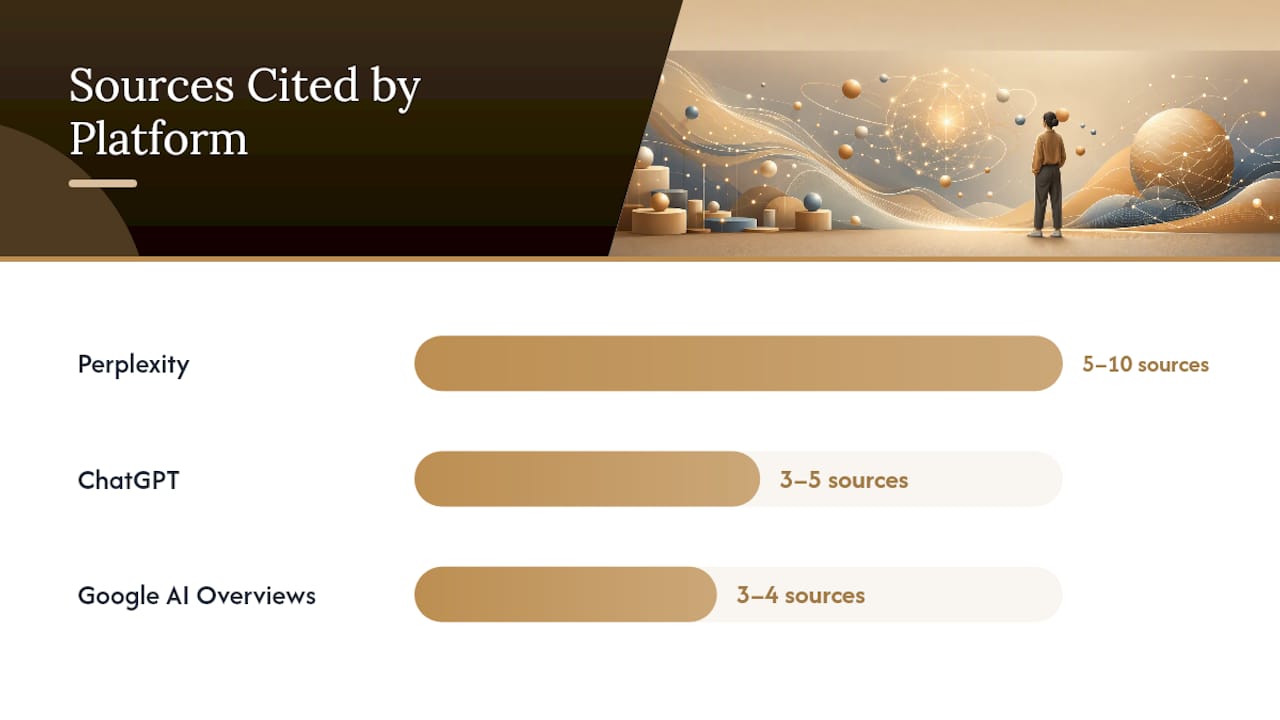
Platform behavior varies enough that a one-size strategy wastes effort. Perplexity tends to cite more sources per answer, commonly five to ten, which means there’s more room to earn a spot even without dominant authority. ChatGPT usually cites fewer sources, often three to five, making competition for each slot tighter. Google AI Overviews typically surfaces three to four sources and leans heavily on pages that already rank well organically, so your existing SEO investment carries more weight there than it does on Perplexity.
This changes how you prioritize:
- For awareness goals, Perplexity’s wider citation net rewards volume: publish more extractable content across more topics, since the bar per piece is lower.
- For purchase-intent queries, ChatGPT’s tighter citation limit means your comparison pages, pricing breakdowns, and specific-use-case content need to be the sharpest, most quotable version available, because only a handful of sources make the cut.
- For research-heavy queries, Google AI Overviews rewards content that already ranks, so classic SEO fundamentals and a Perplexity-style extractable structure both apply.
Pro Tip: Test the same prompt with a slight phrasing change on each platform before you conclude you’re invisible. A query answered with a citation on Perplexity might return zero brand mentions on ChatGPT for reasons that have nothing to do with your content quality.
Recency signals also carry different weight per platform. Some AI engines visibly favor content updated in the last few months over older, more authoritative pages, which rewards a republishing cadence that classic SEO doesn’t always demand.
What Are the Highest-Impact Tactics to Increase Citation Rates?
Fixing visibility comes down to three layers: technical access, content structure, and off-site authority. Skip any one, and the other two do less work than they should.
Technical fixes come first
None of your content optimization matters if AI crawlers can’t reach your pages. Start here:
- Verify crawler access for GPTBot, Google-Extended, ClaudeBot, and PerplexityBot in your robots.txt file. A single blanket disallow rule written years ago for a different reason can quietly block every AI engine at once.
- Check canonical tags to confirm you’re not accidentally telling crawlers to ignore your best pages in favor of a duplicate or outdated version.
- Audit nosnippet directives, since a page marked to block snippets in search results can also suppress the extractable text AI engines want to quote.
- Add an llms.txt file at your root domain. It’s a simple, emerging standard that tells AI crawlers which sections of your site are most relevant, similar in spirit to a sitemap but written for language models rather than search bots.
If any of this sounds unfamiliar, a compact site review like the six-step AI content audit built for solo teams walks through exactly these checks in a few days, not a few weeks.
Content structure decides who gets quoted
Extraction is the whole game. AI engines pull the passage that answers a question most directly, so your job is writing that passage on purpose.
- Open key sections with a direct, quotable answer in the first sentence, then support it below.
- Add specific statistics with inline sourcing rather than vague claims, since Semrush’s GEO guidance specifically recommends citable numbers as a core extraction driver.
- Write short, self-contained definitions for key terms your audience searches.
- Structure comparison and how-to content in clearly labeled steps or short Q&A blocks, since FAQPage-style structured content improves extraction rates even where Google no longer shows visible FAQ rich results.
Authority still has to be earned off-site
AI engines weigh corroboration. A claim repeated across a handful of independent, credible sources reads as more trustworthy than the same claim appearing only on your own domain. This means PR, guest contributions, and data-led research pieces that get picked up elsewhere directly feed your citation odds, not just your backlink profile.
Add structured data, specifically Article, Person, and FAQ schema, so machines can parse authorship and content type without guessing. Google’s AI optimization guidance treats this kind of markup as a supporting signal on top of the content quality baseline, not a replacement for it.
| Action | Layer | Effort | Typical payoff window |
|---|---|---|---|
| Fix crawler access and robots.txt | Technical | Low | Days |
| Add llms.txt file | Technical | Low | Days to weeks |
| Rewrite key sections into extractable answer blocks | Content | Medium | 2 to 4 weeks |
| Add sourced statistics and inline citations | Content | Medium | 2 to 4 weeks |
| Add Article/Person/FAQ schema | Technical | Low to medium | Weeks |
| Earn third-party mentions and PR coverage | Off-site | High | Months |
Once these changes go live, re-run your original prompt basket. Citation share is the metric to track, and it should move faster on the technical and content layers than on off-site authority, which compounds slowly.
What Should You Fix First: A 30/90-Day Plan?
Limited time means limited moves, so sequence matters more than ambition here.
Do this today (under an hour):
- Check robots.txt for GPTBot, ClaudeBot, and PerplexityBot access.
- Confirm an llms.txt file exists, or draft a basic one.
- Pick your five highest-value pages and check whether their key answer sits in the first two sentences of a section.
30-day sprint:
- Rewrite those five pages so each core question gets a direct, quotable answer up top.
- Add at least one sourced statistic per page with a visible inline citation.
- Build your 20 to 50 prompt basket and run the first full sampling pass across ChatGPT, Perplexity, and Google AI Overviews.
- Pitch two or three small PR or guest-post placements tied to your most citable data point.
90-day horizon:
- Roll out Article, Person, and FAQ schema across your top twenty pages.
- Establish a repeatable cadence, weekly or biweekly, for re-running your prompt basket and logging citation share.
- Track whether third-party mentions from your PR push are showing up as corroborating sources in AI answers.
- Revisit and refresh your most cited pages first, since these are your proven winners and the ones most likely to lose ground to a competitor’s fresher update.
Treat this as a rolling cycle, not a one-time project. The content analytics practices you already use for organic traffic apply almost directly here, just pointed at a new set of referrer sources.
What Does the Research Actually Show About Citation Drivers?
The most useful research on this topic comes from GEO benchmark work rather than marketing blog speculation, and the findings are more specific than most SEO advice.
Composite tactics, meaning statistics paired with expert quotes and clear citations, compound rather than work in isolation. Adding one lever moves the needle. Stacking several moves it further.
That framing comes from GEO benchmark research summarized in industry playbooks, and it matters because it contradicts the instinct to pick one tactic and run with it. A page with a strong statistic but no clear source citation underperforms a page with both. A page with both but no extractable structure underperforms a page with all three.
Google’s own position reinforces the foundation-first argument. Its AI optimization guidance states plainly that content quality, site structure, and demonstrated expertise remain the base layer AI features build on, with platform-specific tactics layered on top rather than substituting for them. Marketers looking for a shortcut around solid content fundamentals won’t find one here. The research says the shortcut is stacking proven tactics faster, not skipping them.
Off-site corroboration compounds this effect in a way that’s easy to underestimate. When your statistic or claim shows up on your own site and gets independently repeated by a third party, the AI engine has two matching signals instead of one. Semrush’s data on AI-driven traffic backs the business case for chasing this: visitors arriving via AI citations convert at multiple times the rate of standard organic search visitors, largely because they arrive already primed with a specific, trusted answer rather than a list of options to compare.
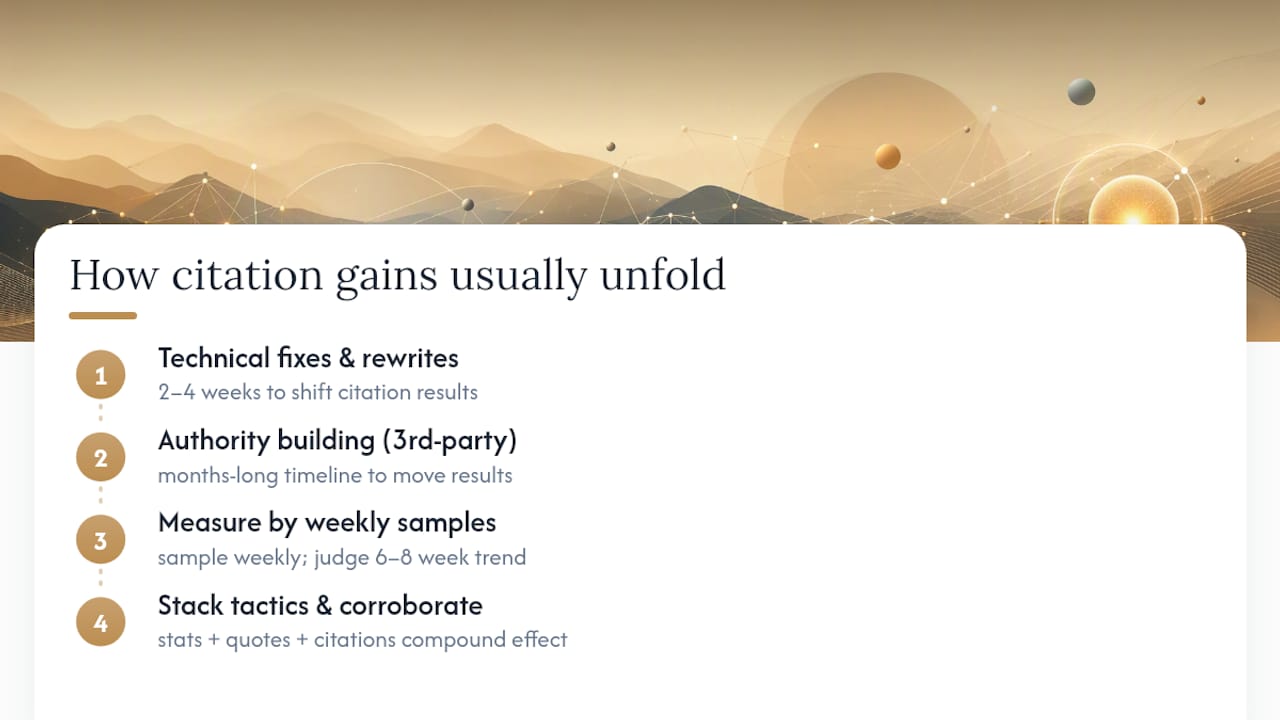
On timelines, be realistic. Technical fixes and content rewrites can shift citation results within two to four weeks, but authority-building through third-party mentions moves on a months-long timescale, not a sprint. Expect noise in your measurements too. Because AI answers are non-deterministic, the same prompt run twice in the same week can return different sources, which is exactly why a single test tells you almost nothing and a repeated weekly sample tells you quite a lot. Judge progress by the trend line in your citation share over six to eight weeks, not by any single day’s result.
A Solopreneur’s Real Workflow for Chasing AI Citations
Running this as a one-person operation looks nothing like a big agency’s process, and honestly, it shouldn’t. You don’t have a team to build a fifty-prompt tracking dashboard, and you don’t need one to see real movement.
Here’s the sequence that actually works when it’s just you: pick fifteen prompts tied to the exact questions your ideal client types into ChatGPT before they ever find your site. Run them once, screenshot the results, and don’t touch anything yet. That baseline matters more than the fix. Then pull your three most-visited pages and rewrite the opening two sentences of each core section into a direct, quotable answer, adding one specific statistic with a visible source per page. Wait two weeks. Run the same fifteen prompts again.
That’s the entire loop, and it’s genuinely doable in a single afternoon each cycle, not a quarterly project. The spreadsheet you’re already using for content tracking works fine for this. You don’t need a new tool to start; you need a repeatable habit, which is a different problem entirely, and one worth solving with a productivity system built for solo operators if consistency is your actual bottleneck.
One more thing worth saying plainly: don’t chase every platform equally out of the gate; instead, use an AI productivity assistant for life and work balance to focus your efforts efficiently. Pick the one engine most likely to influence your actual buyers, run your loop there first, and expand once you’ve seen a real citation shift. Spreading thin across five platforms before you’ve proven the method on one is the fastest way to abandon the whole effort by week three.
— Jay
Get Your AI Visibility Fixes Done Without Hiring an Agency
Everything in the 30/90-day plan above is doable solo, but doing it without a system means rebuilding your prompt basket, your audit checklist, and your schema templates from scratch every time. The AI Toolkit from Yoursolobusiness hands you that structure already built: prompt libraries for AI visibility testing, implementation checklists that mirror the technical and content fixes covered here, and templates you can drop straight into your own workflow instead of engineering one from a blank spreadsheet.
It’s built specifically for the reader running this alone, not a marketing department with five people to split the work across. If you’ve already mapped which pages need extractable rewrites and which prompts belong in your basket, the toolkit is the fastest way to turn that plan into a running process this week. Check out the AI Toolkit and see which checklists match the fixes you just read.
Where This Article’s Claims Come From
The core citation mechanics and platform behavior referenced here draw on Ahrefs’ research into AI visibility, which documents how AI citation and classic ranking overlap imperfectly. Tactical guidance on schema, crawler access, and extractable content comes from Semrush’s AI search optimization research, including its conversion-rate data on AI-driven visitors. The foundation-first framing throughout the article follows Google’s own AI optimization guidance, and the compounding-tactics research cited in the evidence section comes from GEO benchmark work summarized by GeoAura. Each source is worth reading directly if you want the full methodology behind the numbers.
Sources
- AI optimization guide — Google Search Central
- AI search optimization — Semrush blog
- AI visibility — Ahrefs blog
- AI search optimization — GeoAura (2026 guide)



Leave a Reply