
Building a business around your expertise can feel liberating, but it also means every decision carries your name. Today, solopreneurship is a major force shaping professional independence and flexibility across the globe, as highlighted by experts. With millions running solo ventures in fields from digital creation to consulting, understanding the core concepts of solopreneurship in 2026 is essential for anyone serious about growth, reputation, and avoiding burnout in an ever-changing tech environment.
Key Takeaways
| Point | Details |
|---|---|
| Solopreneurship Growth | Solopreneurs are becoming a significant economic force, focusing on personal branding and unique skills. |
| Technology Utilization | Advanced tools, especially AI, are essential for enhancing efficiency and optimizing workflows in solopreneur businesses. |
| Burnout Prevention | Developing coping strategies and setting digital boundaries are crucial for maintaining mental well-being and productivity. |
| Diverse Monetization Strategies | Successful solopreneurs leverage multiple income streams through innovative and scalable business models. |
Solopreneurship in 2026: Core Concepts
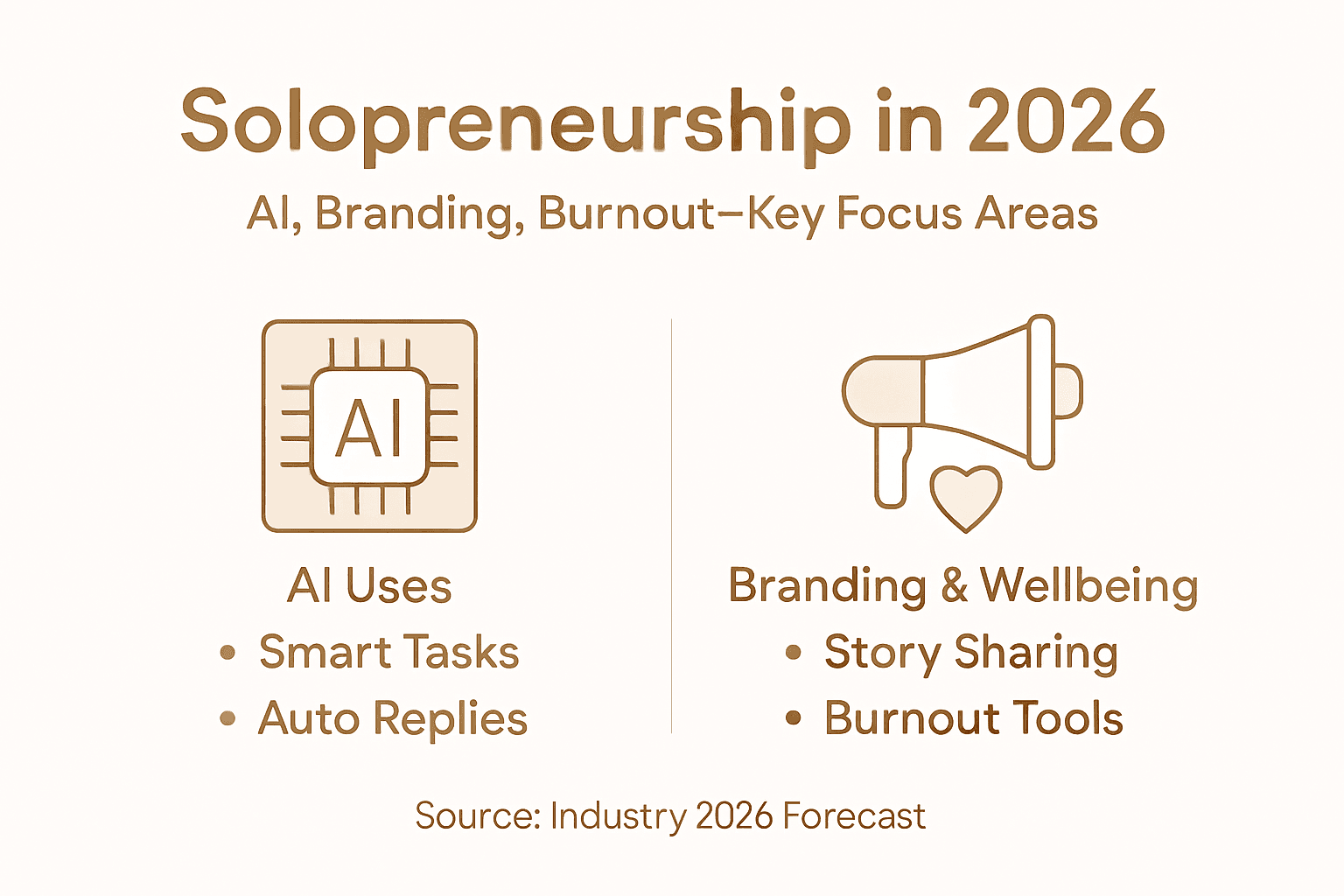
Solopreneurship has emerged as a powerful professional model where independent professionals build businesses around their unique skills and expertise. Distinct entrepreneurial strategies are transforming how individuals approach work, emphasizing personal autonomy and flexible career paths.
In 2026, solopreneurs represent a significant economic force, with millions of professionals operating businesses without traditional employment structures. These individuals span diverse domains:
- Consultants leveraging specialized knowledge
- Digital creators producing online content
- Freelance professionals offering targeted services
- Technology specialists developing niche solutions
- Independent researchers and analysts
The core characteristics of modern solopreneurship include deep personal investment, technological adaptability, and a focus on building reputation through exceptional work. Unlike traditional entrepreneurship, solopreneurship centers on individual identity and direct value creation.
Personal Branding becomes the primary differentiator for solopreneurs, with professionals strategically positioning themselves as unique problem solvers. Their business isn’t just about services – it’s about crafting a distinctive professional narrative that attracts ideal clients.
Technology Integration plays a critical role, with solopreneurs utilizing advanced tools for:
- Project management
- Client communication
- Financial tracking
- Marketing automation
- Skill development
Solopreneurship in 2026 is less about having a job and more about creating a personalized professional ecosystem.
Pro tip: Invest consistently in developing your unique professional brand by documenting your journey, sharing insights, and demonstrating expertise through multiple digital channels.
AI and Automation Reshaping Solo Businesses
Artificial Intelligence is fundamentally transforming how solopreneurs operate, offering unprecedented opportunities for efficiency and strategic growth. AI integration in professional services has become a critical strategy for solo entrepreneurs seeking competitive advantages in an increasingly complex business landscape.
The technological revolution brings multiple dimensions of automation that are reshaping solo business models:
- Intelligent task management systems
- Automated customer communication platforms
- Predictive analytics for business forecasting
- AI-driven content generation tools
- Smart financial tracking and reporting
Workflow Optimization emerges as a primary benefit, with solopreneurs leveraging technologies that dramatically reduce administrative overhead. Automation technologies enable professionals to redesign complex processes, eliminating repetitive tasks and allowing more focus on high-value creative work.
Generative AI tools are particularly transformative, providing solopreneurs with capabilities that were previously accessible only to larger organizations. These technologies enable:
- Rapid content creation
- Sophisticated market research
- Personalized client communication
- Intelligent project management
- Advanced data analysis
AI isn’t replacing solopreneurs – it’s empowering them to work smarter, not harder.
Successful solopreneurs in 2026 will distinguish themselves by their ability to strategically integrate AI tools, viewing them as collaborative partners rather than mere productivity instruments. The most effective professionals will develop a nuanced understanding of these technologies, learning to guide and customize AI outputs to match their unique business vision.
Here’s a look at how technology transforms solo businesses in 2026:
| Area | AI/Automation Examples | Resulting Advantage |
|---|---|---|
| Project Work | Intelligent task management | Reduced administrative workload |
| Marketing | AI content generation and automation | Quicker, more targeted outreach |
| Customer Service | Automated chat and communication | Faster, consistent responses |
| Financials | Smart tracking and reporting | Streamlined bookkeeping accuracy |
| Research | Generative AI and analytics | Deeper market and trend insights |
Pro tip: Dedicate at least two hours weekly to exploring and testing new AI tools that could streamline your specific business workflows.
New Personal Branding Strategies for Solopreneurs
Personal branding has evolved from a simple marketing concept to a critical survival strategy for solopreneurs in 2026. Personal branding tips have transformed from generic advice to sophisticated, technology-driven approaches that differentiate professionals in an increasingly competitive marketplace.
The modern solopreneur’s personal brand now encompasses multiple strategic dimensions:
- Authentic digital storytelling
- Specialized expertise positioning
- Cross-platform content coherence
- Data-driven personal narrative development
- Strategic online reputation management
Digital Presence requires a holistic approach that goes beyond traditional social media tactics. Successful solopreneurs are now creating integrated personal brands that seamlessly blend professional expertise, unique personality, and strategic positioning across multiple digital platforms.
Key strategies for building a powerful personal brand in 2026 include:
- Developing a consistent visual and verbal identity
- Creating high-value, niche-specific content
- Leveraging AI for personalized audience engagement
- Building genuine community connections
- Demonstrating thought leadership through original insights
Your personal brand is no longer just what you say about yourself – it’s the entire ecosystem of experiences you create for your audience.
The most effective personal branding now requires sophisticated storytelling that goes beyond traditional self-promotion. Solopreneurs must craft narratives that demonstrate genuine value, showcase their unique problem-solving capabilities, and build trust through transparent, authentic communication.

Pro tip: Invest 30 minutes weekly in systematically documenting and refining your unique professional narrative across your primary communication channels.
Tackling Burnout in a Hyper-Connected World
Burnout has become an epidemic for solopreneurs navigating the complex landscape of independent work. Burnout research reveals unique challenges that go far beyond traditional workplace stress, highlighting the critical need for proactive mental health strategies.
The most significant burnout risks for solopreneurs in 2026 include:
- Constant digital connectivity
- Blurred work-life boundaries
- Intense self-pressure and perfectionism
- Financial instability anxiety
- Lack of structured support systems
Psychological Resilience requires a multifaceted approach that addresses both external stressors and internal coping mechanisms. Solo professionals must develop robust strategies that protect their mental and physical well-being while maintaining professional momentum.
Key intervention strategies for preventing burnout include:
- Establishing strict digital boundaries
- Creating consistent self-care routines
- Implementing structured work-rest cycles
- Developing diverse income streams
- Building professional support networks
Burnout is not a sign of weakness – it’s a signal that your current system is unsustainable.
Solopreneurs must recognize that managing stress is not a luxury but a critical business survival skill. This involves developing sophisticated self-monitoring techniques, understanding personal stress triggers, and creating adaptive work environments that prioritize long-term sustainability over short-term productivity.
Compare top strategies for preventing solopreneur burnout:
| Strategy | Immediate Effect | Long-Term Benefit |
|---|---|---|
| Strict digital boundaries | Minimizes distractions | Maintains work-life separation |
| Structured work-rest cycles | Sustains daily focus | Reduces risk of chronic fatigue |
| Professional support networks | Provides emotional support | Fosters ongoing resilience |
| Diverse income streams | Eases financial anxiety | Builds career sustainability |
| Systematic self-review | Identifies stress patterns | Enables proactive workflow changes |
Pro tip: Schedule a monthly personal performance review to reassess your work patterns, energy levels, and overall well-being, making strategic adjustments before exhaustion sets in.
Monetization Models and Growth Opportunities
Solopreneurs in 2026 are redefining traditional income streams through innovative solopreneur revenue strategies that leverage digital technologies and flexible business models. The landscape of independent entrepreneurship has transformed, offering unprecedented opportunities for diversified and scalable income generation.
Key monetization models for solo professionals include:
- Digital product creation
- Subscription-based service offerings
- Membership communities
- Online coaching and consulting
- Productized service packages
- Content monetization platforms
- Affiliate and commission-based income
Revenue Diversification becomes crucial for sustainable solo business growth. Successful solopreneurs are no longer relying on single income channels but strategically developing multiple revenue streams that provide financial stability and reduce risk.
Emerging monetization strategies leverage advanced technologies:
- AI-powered content repurposing
- Automated sales funnel systems
- Personalized digital product development
- Scalable online course creation
- Integrated marketing automation
Modern solopreneurship is about creating an ecosystem of value, not just selling services.
Technology enables solopreneurs to create sophisticated income models that were previously accessible only to larger organizations. Artificial intelligence, automation tools, and integrated platforms allow solo professionals to efficiently manage complex revenue generation strategies without significant overhead.
Pro tip: Develop at least three complementary income streams that align with your core expertise, ensuring each represents a different level of effort and potential revenue.
Risks, Compliance, and Tech Adoption Pitfalls
Solopreneurs face increasingly complex technological landscapes that demand sophisticated risk management strategies. Technology adoption challenges extend far beyond technical implementation, requiring nuanced understanding of cultural and operational dynamics.
Key technological risk areas for solo professionals include:
- Cybersecurity vulnerabilities
- Data privacy compliance
- Regulatory technology gaps
- Integration complexity
- Technological skill gaps
- Emerging legal frameworks
- Algorithmic bias risks
Risk Management demands proactive strategies that anticipate potential technological disruptions. Solo entrepreneurs must develop robust frameworks that balance innovation with strategic governance and comprehensive security protocols.
Critical steps for effective tech risk mitigation include:
- Conducting regular security audits
- Implementing multi-layer authentication
- Developing comprehensive data protection policies
- Staying updated on regulatory changes
- Investing in continuous technological education
Technology risks are not obstacles – they are opportunities for strategic differentiation.
The most successful solopreneurs will view technological challenges as opportunities for competitive advantage, developing adaptive strategies that transform potential risks into innovative business approaches. Understanding the intricate relationship between technological capabilities and potential vulnerabilities becomes a critical competitive skill.
Pro tip: Allocate at least 5% of your annual budget toward technology risk assessment and continuous learning to stay ahead of emerging compliance challenges.
Navigate 2026 Solopreneur Trends with Confidence
Facing the challenges of AI integration, personal branding evolution, and burnout prevention calls for clear strategies and reliable resources. This article highlights how solopreneurs must balance advanced technology adoption with authentic storytelling while protecting their well-being. If you want to build a resilient solo business that stands out in a crowded market and avoid the pitfalls of overwork, acting now is essential.
Explore actionable guidance and practical steps in Plan Your Business – Your Solo Business and discover inspiring options in Solo Business Ideas – Your Solo Business. Our comprehensive Business & Strategy – Your Solo Business resources connect you with proven methods to integrate AI thoughtfully and develop a powerful personal brand.

Start transforming your approach today by visiting Your Solo Business where expert insights and a supportive community await. Don’t wait until burnout or uncertainty slows you down take control of your solo venture now and build a sustainable future with confidence.
Frequently Asked Questions
What are the core characteristics of solopreneurship in 2026?
The core characteristics of modern solopreneurship include deep personal investment, technological adaptability, and a focus on building reputation through exceptional work. Solopreneurs emphasize individual identity and create direct value for clients.
How is AI transforming solopreneur businesses?
AI is transforming solopreneur businesses by offering tools for intelligent task management, automated customer communication, predictive analytics, and content generation. These technologies help solopreneurs enhance efficiency and strategic growth while focusing on high-value tasks rather than administrative overhead.
What are effective personal branding strategies for solopreneurs?
Effective personal branding strategies for solopreneurs include developing a consistent visual and verbal identity, creating valuable niche-specific content, leveraging AI for personalized engagement, and building genuine community connections to showcase thought leadership and expertise.
How can solopreneurs prevent burnout in a hyper-connected world?
To prevent burnout, solopreneurs should establish digital boundaries, create consistent self-care routines, implement structured work-rest cycles, develop diverse income streams, and build professional support networks. These strategies help maintain resilience and balance in their work-life dynamics.
Recommended
- Don’t Be a Burnout Boss: 7 Simple Ways to Avoid Burnout For Solopreneurs – Your Solo Business
- 10 Personal Branding Tips That Work to Build Your Solo Business Successfully – Your Solo Business
- The 5 Phases of Solopreneurship: From Hustle to Thriving – Your Solo Business
- The Ultimate Productivity Toolkit for Solopreneurs [7 Strategies + 10 Tools] – Your Solo Business