

Turning expertise into income often feels challenging when you are working alone. Many creative and knowledge-driven solopreneurs discover that pinpointing both their unique strengths and the right audience unlocks real business growth. By focusing on your distinct skills, specialized knowledge, and personal experiences, you can attract clients who truly value your work while building an authentic personal brand that stands out. This guide walks you through practical steps to help you start monetizing your talent with intention and clarity.
Quick Summary
| Key Insight | Explanation |
|---|---|
| 1. Identify Your Unique Expertise | Conduct a self-assessment to pinpoint what distinguishes you professionally and who your target audience is. |
| 2. Build Online Authority | Establish a strong online presence through a professional portfolio and engaging content that showcases your expertise. |
| 3. Develop Monetizable Offerings | Create products and services tailored to meet the needs of your audience while generating sustainable income. |
| 4. Launch with a Strategic Plan | Use a multi-channel marketing approach to promote your offerings, focusing on solving specific problems for your audience. |
| 5. Test and Optimize Revenue Streams | Continuously analyze your income sources and adjust strategies to enhance financial performance and resilience. |
Step 1: Identify your unique expertise and target audience
Successfully monetizing your expertise begins with pinpointing your distinctive professional strengths and understanding precisely who will benefit most from your skills. This critical first step transforms your knowledge into a strategic business asset that attracts the right clients.
Start by conducting a comprehensive self-assessment of your professional capabilities. Reflect on your accumulated skills, specialized knowledge, and unique experiences that differentiate you from others in your field. Ask yourself probing questions:
- What professional challenges have I consistently solved?
- Which tasks do I complete more effectively than most?
- What unique perspectives or methodologies do I bring?
To refine your target audience, analyze demographic and behavioral insights that reveal who most needs your expertise. Look beyond basic demographics to understand deeper motivations and pain points. This means examining:
- Professional backgrounds of potential clients
- Specific industry challenges they face
- Their primary goals and aspirations
- Current solutions they find inadequate
Understanding your audience means going beyond surface-level characteristics to uncover their genuine needs and desires.
Cross-reference your unique expertise with market demand by researching industry trends, consulting professional networks, and analyzing competitor landscapes. This helps validate that your skills solve real-world problems for a specific audience.
Pro tip: Create a detailed client persona document that captures not just demographic data, but the emotional and professional motivations of your ideal client.
Step 2: Build authority and showcase your knowledge online
Establishing your professional authority online is crucial for attracting potential clients and positioning yourself as a trusted expert in your field. This step focuses on strategically demonstrating your expertise through targeted digital channels and high-quality content.
Start by creating a comprehensive digital portfolio that highlights your unique skills and professional achievements. Build authority through consistent, credible communication that showcases your depth of knowledge. Your online presence should include:
- A professional website with detailed service offerings
- Regularly updated blog or portfolio showcasing project successes
- Thoughtful social media content demonstrating industry insights
- Professional profiles on platforms like LinkedIn
Engage with your professional community by producing high-quality content that provides genuine value. This means:
- Writing in-depth articles about your area of expertise
- Sharing research-backed insights
- Participating in online discussions and forums
- Creating video or podcast content that educates your audience
Authentic expertise is built through consistent, well-researched communication that genuinely helps your target audience.
Utilize digital platforms strategically to amplify your professional narrative. Scholarly research and evidence-based content can significantly enhance your credibility, positioning you as a thought leader in your specific domain.
Pro tip: Develop a content strategy that balances personal insights with authoritative research, creating a unique voice that stands out in your professional landscape.
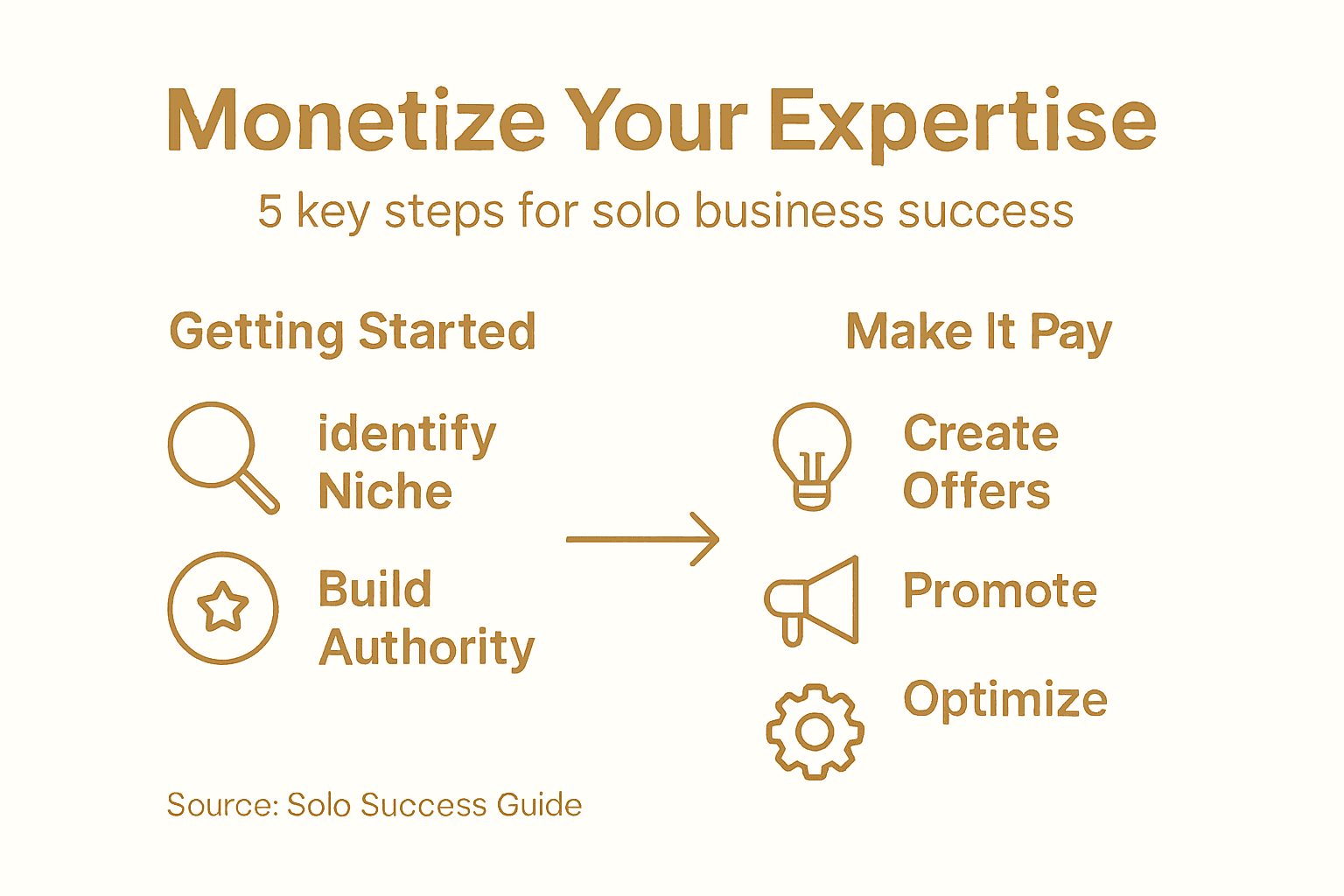
Here’s a quick comparison of popular online authority-building tactics and their business impact:
| Tactic | Platform Example | Business Impact |
|---|---|---|
| Blogging | Personal website | Boosts visibility and SEO |
| LinkedIn Profile | Grows credibility and reach | |
| Industry Podcasts | Spotify/Apple | Highlights expertise |
| Online Courses | Teachable/Udemy | Generates revenue streams |
Step 3: Develop monetizable products or services
Transforming your expertise into profitable offerings requires strategic planning and a deep understanding of your target market’s needs. This step focuses on creating products and services that not only showcase your unique skills but also generate sustainable revenue streams.
Identify potential revenue models that align with your expertise. Understand user behavior for effective monetization by analyzing how your audience engages with free and paid content. Consider developing offerings such as:
- Online courses and workshops
- Digital downloads (ebooks, templates, guides)
- Consulting packages
- Membership sites
- One-on-one coaching sessions
Design your monetization strategy by breaking down your approach into specific steps:
- Analyze market demand for your specific expertise
- Price your offerings competitively
- Create scalable content that provides genuine value
- Develop multiple pricing tiers
- Test and iterate your product offerings
Your most valuable product is the unique solution you provide to your audience’s specific challenges.
Transform information into economic assets by developing intellectual property that solves real problems. This means creating products that go beyond generic advice and offer actionable, specialized insights tailored to your target market’s precise needs.

Pro tip: Create a minimum viable product first, gather feedback quickly, and continuously refine your offerings based on actual customer insights.
Step 4: Launch and promote your offerings effectively
Successfully launching your solo business offerings requires a strategic approach that combines targeted marketing, clear communication, and genuine audience connection. This step will help you transform your carefully developed products into revenue-generating opportunities.
Develop a multi-channel marketing strategy that reaches your target audience where they naturally congregate. Promote your offerings through diverse communication channels to maximize visibility. Your promotional toolkit should include:
- Social media platforms
- Professional networking sites
- Email marketing campaigns
- Content marketing (blogs, podcasts, videos)
- Targeted online advertising
Craft your launch plan with these critical steps:
- Define your unique value proposition
- Create compelling marketing materials
- Build anticipation before the official launch
- Develop a pricing and distribution strategy
- Implement tracking and feedback mechanisms
Your launch is not just about selling a product, but about solving a specific problem for your audience.
Systematically approach your product launch by understanding customer needs and articulating clear benefits. This means going beyond surface-level descriptions and connecting deeply with your potential clients’ underlying challenges.
Pro tip: Create a soft launch with a select group of early adopters who can provide honest feedback and help refine your offering before a full-scale release.
Step 5: Test and optimize your revenue streams
Successfully monetizing your expertise requires continuous refinement and strategic analysis of your income sources. This step focuses on developing a dynamic approach to evaluating and improving your revenue generation strategies.
Implement systematic revenue tracking to understand your financial performance. Use quantitative models for revenue forecasting that help predict and optimize your income potential. Your revenue optimization process should include:
- Detailed financial performance metrics
- Regular income stream analysis
- Pricing strategy experiments
- Customer conversion rate tracking
- Profitability assessment for each offering
Develop a comprehensive revenue optimization strategy through these critical steps:
- Establish baseline revenue performance
- Identify high-performing and underperforming income streams
- Experiment with pricing and packaging
- Collect and analyze customer feedback
- Continuously adapt your approach
Successful revenue optimization is about finding the perfect balance between value delivery and financial sustainability.
Balance income stream diversification and flexibility by creating multiple revenue channels that complement each other. This approach ensures financial resilience and provides multiple opportunities for growth.
Pro tip: Allocate at least 10% of your time monthly to analyze and adjust your revenue strategies, treating your financial performance as a continuous improvement project.
Use this summary to compare key revenue optimization methods for solo entrepreneurs:
| Method | Purpose | Benefit |
|---|---|---|
| Diversified Offerings | Multiple products | Reduces financial risk |
| Pricing Experiments | Adjust price points | Maximizes profit potential |
| Feedback Analysis | Gather client input | Refines offerings |
| Performance Tracking | Monitor income trends | Informs strategy decisions |
Turn Your Expertise Into a Thriving Solo Business Today
Monetizing your unique skills and knowledge can feel overwhelming when you are trying to pinpoint your true value and reach the right clients. This article highlights how identifying your distinct expertise and target audience is crucial to building a successful solo venture. If you struggle with transforming your insights into steady income or crafting effective monetizable products, you are not alone. Many solopreneurs face these challenges while trying to establish authority and generate sustainable revenue streams tailored to their niche.
Dive deeper into strategies that help you convert your expertise into profitable offerings by exploring our dedicated resource hub on Monetize Your Expertise – Your Solo Business.
Take control of your solo business journey with proven tactics for business growth, branding, and strategic planning. Start refining your approach today by visiting https://yoursolobusiness.com and gain access to a wealth of articles, tips, and community support tailored for independent entrepreneurs. Your next step to success begins with actionable insights and a clear path forward. Don’t wait – explore Business & Strategy – Your Solo Business to unlock powerful resources designed to help you build and thrive in your solo business.
Frequently Asked Questions
How can I identify my unique expertise for monetization?
To identify your unique expertise, conduct a comprehensive self-assessment of your skills, knowledge, and experiences. Reflect on the challenges you solve and the perspectives you bring. Then, create a list of these attributes to help clarify your niche.
What steps should I take to build my authority online?
Start by creating a comprehensive digital portfolio that showcases your skills and achievements. Regularly publish high-quality content, such as blog posts and industry insights, to engage with your target audience and establish credibility.
How do I develop monetizable products or services from my expertise?
Begin by identifying potential revenue models that align with your skills, such as online courses or consulting packages. Analyze market demand and customer feedback to refine your offerings and create products that solve specific problems.
What marketing strategies can I use to promote my offerings effectively?
Develop a multi-channel marketing strategy that includes social media, email campaigns, and content marketing. Define your unique value proposition and create compelling materials to build anticipation before launching your products.
How can I test and optimize my revenue streams?
Implement systematic revenue tracking to evaluate your financial performance. Regularly analyze customer feedback and pricing strategies to identify opportunities for improvement and increase your profit potential.